KHNS - Haines

KHNS is our partner station in Haines. KTOO collaborates with partners across the state to cover important news and to share stories with our audiences.

Erosion destroys one campsite and threatens more on Dyea flats near Skagway

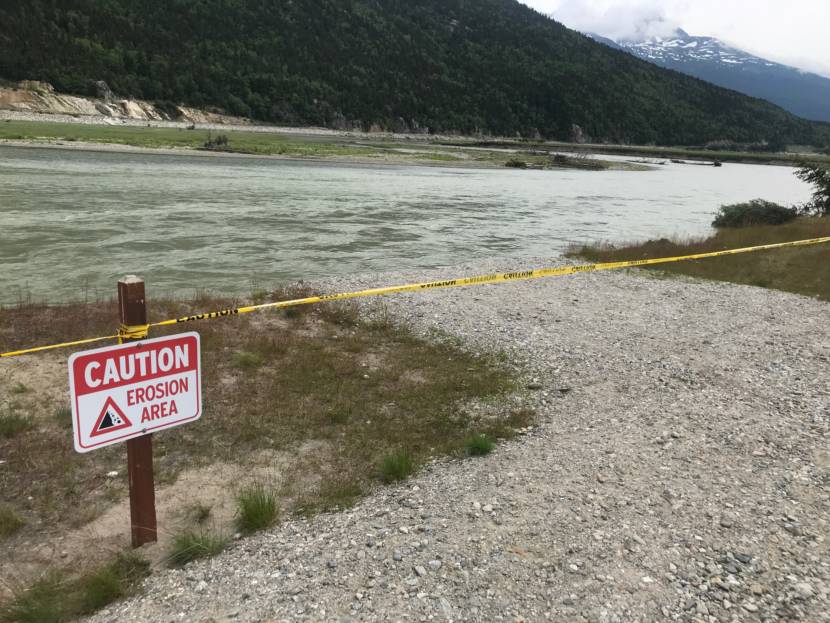
Former location of campsite 22 at Dyea Flats Municipal Campground. (Mike Swasey/KHNS)

A campsite at the Dyea Flats Municipal Campground, about 10 miles outside of Skagway, has been consumed by the Taiya River. The area saw record snowfalls this winter and with the spring melt and shifting tides in the brackish waters, the river is rapidly eroding its bank.

About three weeks ago, I sat at campsite 22 at the Dyea Flats Campground, enjoying the sounds of songbirds and the flow of the Taiya River. As of Wednesday, there was nothing left of that campsite. Erosion is threatening several other riverside campsites, while also threatening to erode parts of the National Park Service’s old townsite.

Borough Manager Brad Ryan said there’s not much that can be done.

“You don’t, if you can help it, try to work to control an alluvial fan. They move, and you put a lot of money into working in those areas, only to have the river move again,” Ryan said.

According to Ryan, a couple of years ago, PND Engineers from Anchorage was in town working on a different project while the Taiya was eroding land close to the campground. The engineers made their assessment.

“Their take was that you’re going to put a lot of money into trying to hold this sand in place, essentially. And the river is going to move or could move. And it just isn’t good money to do that,” Ryan said.
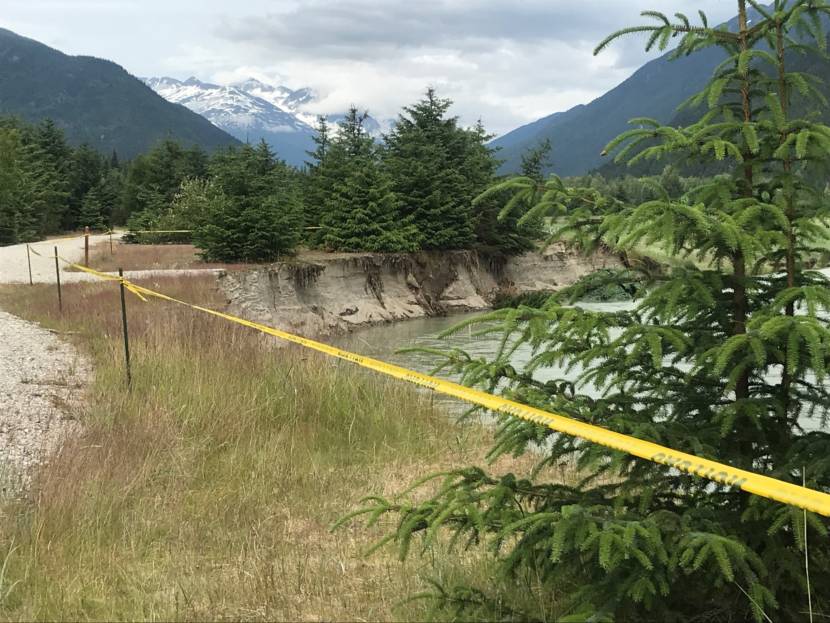
Erosion threatens more campsites on the Dyea Flats. (Mike Swasey/KHNS)

Some options the municipality has considered include a rip rap wall. But that could shift problems to other parts of the river, or the river could change course completely, leaving a large pile of rocks behind. Another option is planting trees to develop root wads and stall erosion, but, Ryan said, that probably wouldn’t be practical.

“You’re talking about sand. It’d be different if there was soil and mud and clay to grab ahold of, but instead, you have the sandbank,” Ryan said. “And so putting a lot of effort in there is just a whole bunch of money to try to control something that you’re probably not going to control.”

So for now the municipality plans on letting the river run its course. Public Works will put up wooden barricades to prevent vehicles and people from approaching the erosion area. And if the river continues to encroach upon the campground, they are prepared to move all of the picnic tables and outhouses to other areas.

Meanwhile, the new campground host has arrived and, as of July 1, is collecting fees. The fee structure is set at $10 per night or $50 for a season pass. Though the campground had been free to use prior to this year, the municipality’s 2010 plan allows the Skagway Assembly to impose the registration fees if they deem it necessary, and they did.

The 21 remaining campsites not damaged by erosion are being rented on a first-come, first-served basis.
Skagway, White Pass & Yukon Route Railroad at impasse over harbor cleanup

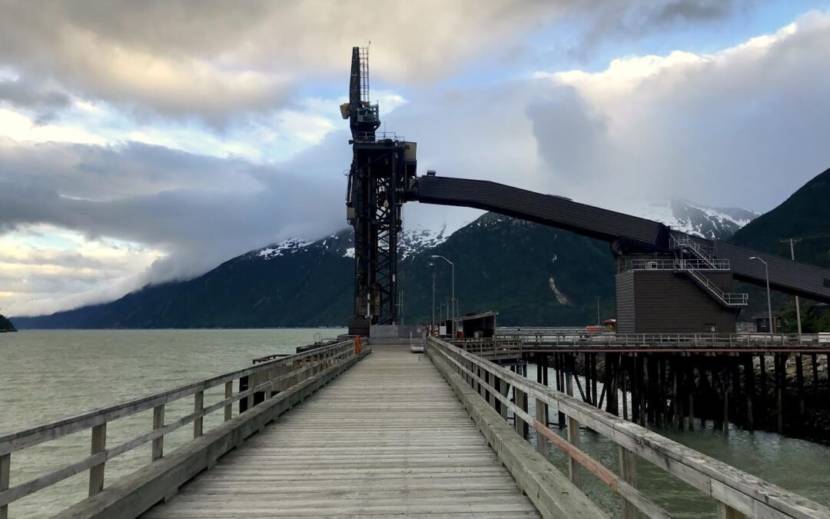
Skagway’s ore terminal (Mike Swasey/KHNS)

Environmental regulators have made themselves clear: Skagway’s harbor is contaminated with lead and zinc near the ore dock.

Over 30 years ago, White Pass and Yukon Route Railroad, which leases the dock, was told by those regulators to clean it up. The railroad says they finally have a plan, but they’re waiting for local officials to approve it. But Skagway officials say that’s already happened.

Cruise ships are usually tied up at Skagway’s ore dock during the summer cruise season. But the dock’s history is rooted in mining.

In 1985, after the South Klondike Highway opened, trucks came through Skagway every 30 minutes, 24 hours a day, hauling lead and zinc ore concentrate. Those trucks would dump their ore at the ore building on the south end of town, and ships would arrive every two weeks to transport it to overseas smelters. The ore was loaded onto the ships using an open conveyor system.

It wasn’t until 1991 that the system was enclosed.

In the 1980s, residents reported seeing lead and zinc dust blowing around the dock and landing on sidewalks and windowsills on the south end of town. It was reported that workers would sweep the remaining sediment off the dock into the harbor as part of their cleanup routine.

Finally, in 1988, blood tests were drawn from Skagway residents including the children. According to the standards at the time, none were above a level of concern. But if held up to today’s standards, most of those children would have been in the top 2.5% of children tested for lead levels in blood nationally.

A state memo referenced by The Associated Press in 1988 said that the “bottom sediments in the Skagway Harbor have been found to be among the most toxic in the world.”

In 1988, White Pass was tasked with cleaning up the contamination on the roadways, and state Department of Environmental Conservation said in 1990 that the cleanup was successful. But it also noted that the contamination in the harbor needed to be dealt with.

There’s been little progress since.

Last week Skagway’s borough assembly passed an ordinance setting sediment standards in an effort to define what a clean harbor would look like. The municipality plans to take possession of the ore dock in 2023 when the long-term lease with the railroad expires.

Skagway Mayor Andrew Cremata said setting local sediment standards was necessary because there are no statewide standards for guidance. He also said the new standards can be amended if necessary.

“These are standards that we’re going to accept here in Skagway,” Cremata said, “They can be modified, they can be changed at the table to something that everybody’s comfortable with.”

DEC officials admitted there’s no one-size-fits-all approach to sediment standards in Alaskan waters.

“For soil, for example, we have some tables in our regulation that has contaminants and a numerical cleanup level. We don’t have the equivalent for sediment. We do evaluate plans for sediment cleanup, based on the risk to human health and the environment. And it’s up to the responsible parties to evaluate risk and propose cleanup levels,” said Kara Kusche, with DEC’s contaminated sites program.

She says White Pass has submitted plans to use clamshell dredging that would clean up roughly 85% of the contaminants in the ore basin next to the dock. But that plan doesn’t address possible pollution under the dock or the ore loader.

White Pass spokesperson Jaime Bricker declined to be interviewed but responded to questions via email. She said plans are in the works for dredging and disposing of contaminated sediments in an approved landfill. And that it would be difficult to test for contamination under the dock.

She also said there are multiple potentially responsible parties at the site, which include White Pass and the Municipality of Skagway.

Cremata takes issue with the company’s argument that testing under the dock would be difficult.

“If you want to take a sample underneath the ore dock, it’s a wooden dock, you can just drill right through the dock. And multiple engineering entities have told us that,” Cremata said.

DEC officials said that White Pass has not submitted plans for testing under the dock. They also said that after cleanup, the agency would require further testing and potentially further remediation efforts before the project is considered complete.

The Alaska Industrial Development and Export Authority owns the ore facility and the ore loader but leases the land and part of the dock they sit on. White Pass states that they cannot clean up the area underneath the ore loader until the equipment is removed.

AIDEA did not respond to questions about when or if they plan to remove the ore loader, which has been in operation since the 1960s. Their lease is also up in 2023.

As for a timeline of when the dredging will begin, no one seems to know. White Pass claims they are waiting for written approval of their plan from the municipality. Municipal officials claim they have given the permission verbally and via press release.

DEC officials say White Pass still needs to submit a construction work plan and an environmental protection plan for approval before any work can begin.

Groundbreaking ceremony held for new Tlingit longhouse in Haines

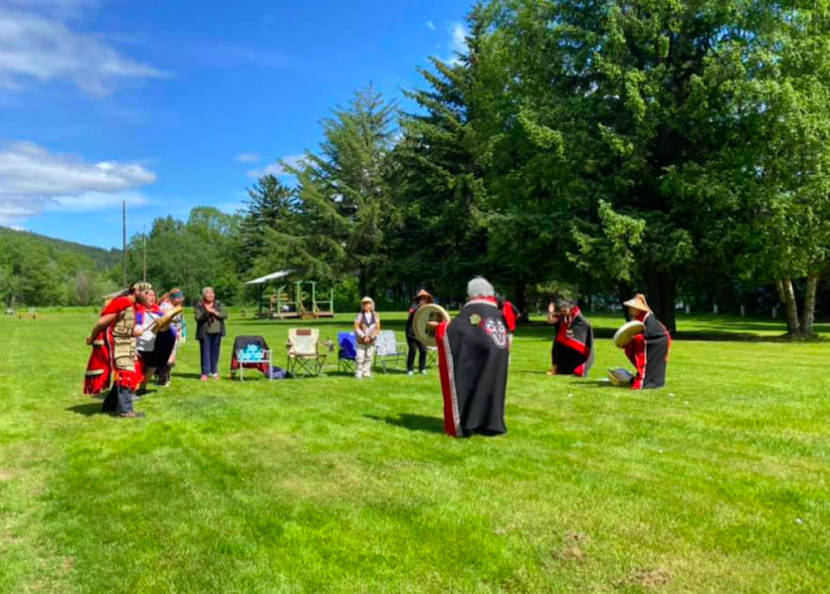
A groundbreaking ceremony and blessing was held for the new Tlingit Park longhouse on Sunday June 13, 2021 (Photo courtesy of Karen Taug)

A groundbreaking ceremony was held last week in Tlingit Park in Haines to celebrate the start of construction on a new traditional Tlingit longhouse pavilion.

A small group gathered in Tlingit Park near the Haines waterfront recently for a groundbreaking ceremony on a new Tlingit longhouse. Jan Hill, former mayor of Haines, was part of the group that blessed the site, and part of the committee directing the project.

“We wanted to make Tlingit Park more Tlingit,” Hill said. “It’s been on our hearts and minds for many, many years that we need to have a traditional gathering place and a longhouse.”

The borough project is funded by a $350,000 grant from the National Parks Service. It will include the longhouse pavilion and new trails connecting Tlingit Park to Front Street and the waterfront.

“Many of our long ago elders are buried there, in the little cemetery, and that’s a special place for all of us, I think,” Hill said.

Haines Borough Director of Public Facilities Ed Coffland says the borough applied for the grant several years ago. Once it was approved, his office took it on and formed the steering committee with assembly member Gabe Thomas and members of the Chilkoot Indian Association. He says it’ll also be an opportunity for tourists to learn more about Tlingit culture.

“It’ll be something where people can see the culture of the Tlingit tribe,” Coffland said. “And then longer term, the purpose of this building is also to house Tlingit art. So it’s one more step in putting together a solid trail system and something that will be appealing to tourists as well as those who live here in Haines.”

Chilkat Custom Contractors and Northwind Architects LLC are designing and constructing the longhouse according to traditional standards.

The longhouse will be located at the south end of Tlingit Park, facing the water according to custom. Sections of the exterior walls will be removable to allow for an open gathering place in good weather.

It’ll serve as a community gathering space and for performance and arts. Jan Hill is also a member of the Chilkat Dancers, which could perform here in the near future.

“Our dance group will use it for traditional performances and probably for practices,” Hill said. “I think you might see other groups using the stage area. You might hear music concerts. I think the door is wide open. But the bottom line is it’s another part of our Tlingit culture that needs to be represented, and there’s no better place than where we’re putting it.”

Hill says they hope to find more grant funding for additional Tlingit artwork and painting. She says that will be ongoing, and the real celebration will be the grand opening, expected early this fall.

“We will do traditional blessings of all four corners of the building, and we will incorporate more of our elders into the process and into the blessing part of this celebration, and you’ll be hearing singing and drumming all over the Chilkat Valley when that happens.”

Tlingit Park is still open to the public this summer, just the south end is closed while the longhouse is under construction.

Last year was a record year for problem bears in Haines; local experts hope this year will be different

A bear cub in Haines in 2010. (Creative Commons photo by Ray Morris/Flickr)

After a late snowmelt, Chilkat Valley brown bears are out of hibernation and looking for food. Last year there was a record number of bears killed, which launched several community initiatives to address bear attractants. Those prevention efforts should serve Haines well this year, say biologists and public safety officials.

Almost every day, sometimes twice a day, Haines residents are receiving alerts from the Haines Police Department that there is a bear in the area. This week there was an alert during the afternoon that a brown bear was seen on Main Street, and headed towards the school.

Alaska Department of Fish and Game wildlife biologist Carl Koch says with the late snowmelt, there’s been less vegetation and bears are scavenging for food.

“They have an excellent sense of smell,” he said. “Some say as good or better than a bloodhound.”

Koch says beginning in 2019, salmon runs and berry yields were poor, leading to intense scavenging activity for bears. Last year, Koch says he got daily phone calls.

“They’re coming out of the den hungry,” Koch said. “The landfill was a little bit more secure, but there was an awful lot of freezers and things like that that bears had been getting into, including dumpsters and things like that.”

Koch says the key is prevention. So make sure to secure any garbage or food sources that would attract bears to the area.

“You’re always going to have bears. We’re not going to bring it down to zero,” he said. “But you can reduce the complaints you know, by quite a lot if stuff is really battened down.”

Last year there were a record number of bears in and around Haines, and even breaking into homes and cars – meaning they were food conditioned. In total, there were 452 calls to Haines police, and an unprecedented 46 bears killed.

Haines Police Chief Heath Scott says at this time last year, there were 52 bear related calls; this year there have been 35 calls so far.

“So that’s tracking pretty closely,” Scott said. “I think we’re going to have an as involved year as we did last year. So we’re just gonna help keep everyone informed about what’s going on, and try coordinating with the Alaska Department of Fish and Game from an education standpoint and us from an enforcement standpoint, and hope that we prevent some of these interactions.”

Wildlife Biologist Carl Koch says Haines has already put several prevention measures into place, which should serve the community well this year. There’s more fencing at the Haines dump, a new Bear Task Force, an alert system for sightings and a bear ordinance. Residents are required to secure trash cans, and any other attractants like chicken coops, pet food or anything outside or in cars.

“There’s certainly no judgment here,” said Koch. “We live around bears so people are going to have bears come in their yard, we just know if things are really secured well, the number of calls will be more manageable, and it’ll be better for everyone in the community.”

Koch says Fish and Game is there to help people with any support or advice needed. They are also lending electric fences for securing property.

Haines residents can report a bear sighting by contacting Carl Koch directly at (907) 465-4329.

As Yukon’s COVID-19 outbreak intensifies, Skagway looks to avoid a similar fate

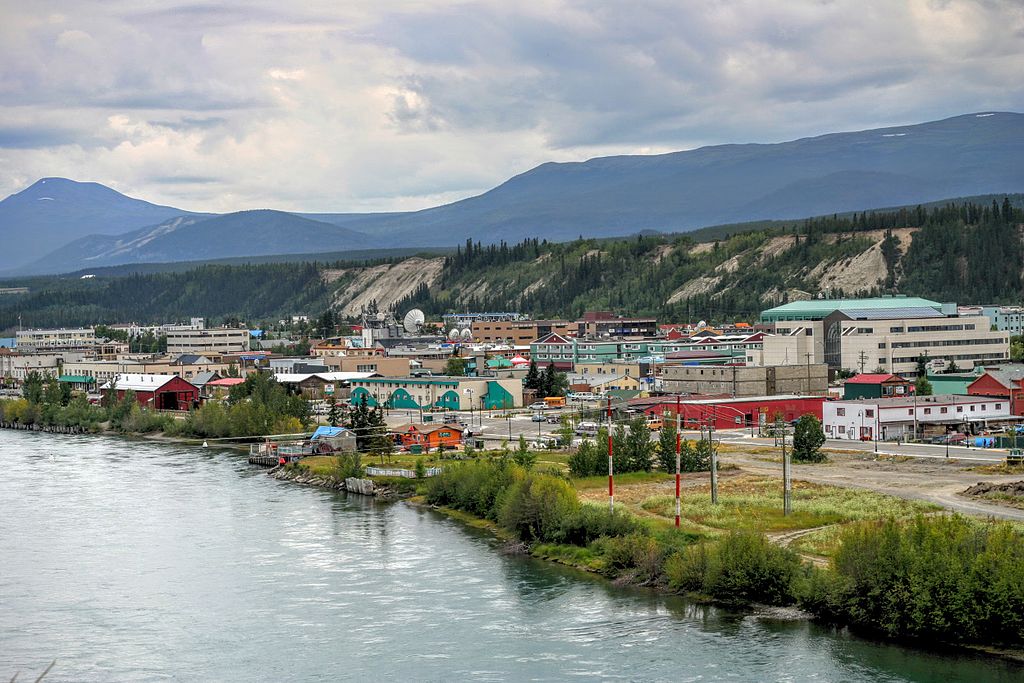
The Yukon River at Whitehorse. (Creative Commons photo by Gareth Sloan)

Canada’s Yukon Territory is in the middle of its largest COVID-19 outbreak to date with 54 active cases and one confirmed coronavirus-related death.

As of Wednesday morning, case numbers had more than doubled in just two days. Skagway officials are preparing for nearly 100,000 cruise ship passengers to visit this summer, and are taking steps to make sure the same sort of outbreak doesn’t happen on their side of the border.

Yukon’s Chief Medical Officer of Health Dr. Brendan Hanley spoke to reporters on Wednesday from Whitehorse.

“A couple of weeks ago we had no active cases in Yukon while we watched our neighbors to the south and east struggle with increasing case counts and illness,” he said. “You can say, in a way, that it’s now our turn. Just at the point we thought there was an end in sight and we were ready for further relaxations, this hit us.”

Border restrictions remain in place to prevent all but essential travel between Lynn Canal communities and Canada. But, the possibility of outbreaks in the region looms large as Skagway prepares to receive its first large cruise ships since 2019 next month.

The Royal Caribbean cruise ship Odyssey of the Seas this week has postponed its next sailing out of Florida due to COVID-19 cases. Two passengers and eight crew members tested positive on their last voyage.

Cruise line representatives say the crew had received both courses of the vaccine but hadn’t waited the full two weeks before sailing, which left them susceptible to the virus. They say the postponement was made out of an abundance of caution. The sailing was postponed for four weeks, but other cruises will continue as planned. Centers for Disease Control and Prevention guidelines state that cruise companies can sail with 95% of passengers and crew being fully vaccinated.

Skagway’s Borough Manager, Brad Ryan, said the port agreements between Skagway and the cruise ship companies have contingencies if active cases show up on board.

“If a cruise ship has COVID on it, they are going to have those people isolated on that ship, and they’re not going to get off,” he said.

Ryan said if there is a patient in need of urgent care, such as a need for a ventilator, they will be removed from the ship and medevaced out. They will not be sent to Skagway’s Dahl Memorial Clinic.

Ryan also said there isn’t a specific number of active cases on board a ship that would trigger a cancelation of a port call in Skagway.

“We’ve talked a lot about the fact that we should be getting a lot of notice, they shouldn’t be putting people in town that have COVID. If we did get somebody, say that tripped and fell and went to the clinic, and we tested them, and they tested positive for COVID, the ship would take control of that for us,” Ryan said.

Ryan went on to say that if an outbreak did occur that affected the unvaccinated population, contact tracing and other mitigation factors would be easier because of the town’s high vaccination rate.

The exact number of people in Skagway that aren’t vaccinated is difficult to pinpoint. The Dahl Memorial Clinic has stated that about 700 people in town have received full vaccinations. But seasonal employees continue arriving in town to work for the summer season. Ryan estimates that the number of people living in Skagway could currently be as high as 1,500.

He also said employers are pushing their incoming employees to get vaccinated, but it’s impossible to know how many have done so.

Yukon officials said at least two of the recent 54 cases identified in the territory were fully vaccinated. These are known as breakthrough cases. The rest were either too young for the vaccine or unvaccinated adults. The outbreak stems from high school graduation ceremonies and other related community events.

COVID-19 outbreak in Yukon Territory linked to high school students, unvaccinated adults

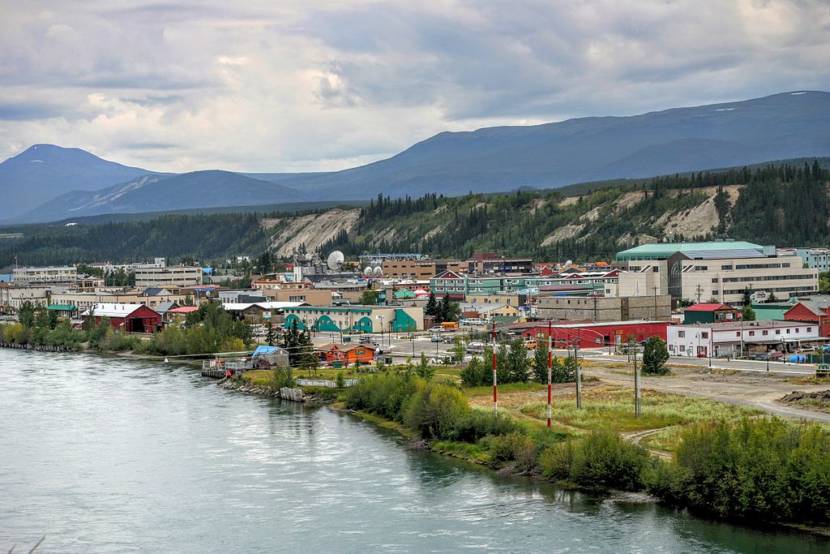
The Yukon River at Whitehorse. (Creative Commons photo by Gareth Sloan)

The Yukon Territory’s COVID-19 outbreak climbed from 18 to 21 active cases on Monday. That’s despite nearly three-quarters of the territory’s adult population being fully vaccinated. And even though life in Skagway seems to be getting back to normal for most, the rising case count is upending daily life on the other side of the border.

Whitehorse, Yukon’s largest city, sits about 110 miles north of Skagway. With the international border between Canada and the United States remaining closed to all but essential traffic, many people in the small border town of Skagway dream of visits to its closest neighbor accessible by road for groceries, hot springs and more.

However, this weekend Yukon’s COVID-19 cases surged. New cases were reported in Whitehorse as well as smaller communities like Burwash Landing and Carcross.

Yukon Deputy Chief Medical Officer of Health Dr. Catherine Elliott briefed reporters on Monday about a new, more infectious strain of the coronavirus.

“This is an outbreak of the gamma variant of COVID-19, which is a variant of concern that was first recognized in Japan, among people traveling from Brazil,” Elliott said.

Though most of the cases in Yukon involve high school students and unvaccinated adults, at least one fully vaccinated individual in Whitehorse was reported as infected. But Elliott said that’s rare.

“The times we see those unusual rare breakthrough cases is prolonged close contact of the type you have in a household or with a sweetie or with your, you know, best friends,” Elliott said.

Additionally, Elliott confirmed that symptoms are less severe in fully vaccinated people, plus the risk of hospitalization and death is far lower.

That is sure to be reassuring news for Skagway residents who worry that welcoming visitors from the Lower 48 could be exposing them to COVID-19. The first cruise ship to land in Skagway in 21 months, The American Constellation arrived last Friday and brought about 80 new faces to town for an overnight stay.

The latest report from the Dahl Memorial Clinic in Skagway shows 701 people have been fully vaccinated, but with a constantly shifting population, it’s difficult to know exactly what percentage that is.

Skagway’s tour season starts to ramp up significantly in late July, with ships bringing thousands of people to town on the schedule. There is no word yet on when the border between Canada and the U.S. will be opened, though Canadian Prime Minister Justin Trudeau has signaled there may be some relaxation on travel restrictions as early as next week.

Site notifications
Update notification options
Subscribe to notifications