KHNS - Haines

KHNS is our partner station in Haines. KTOO collaborates with partners across the state to cover important news and to share stories with our audiences.
Chilkat Indian Village and conservation groups sue BLM over mine exploration permitting near Haines

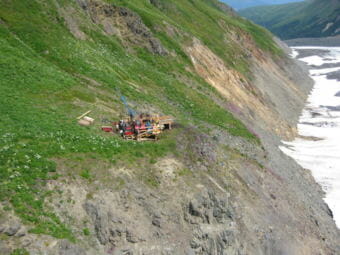
The Chilkat River as seen from Mount Ripinsky in summer of 2017. (Photo by Emily Files/KHNS)

A mining exploration project near Haines is at the center of a lawsuit against the United States Bureau of Land Management.

The Chilkat Indian Village of Klukwan, Southeast Alaska Conservation Council, Lynn Canal Conservation and Rivers Without Borders filed suit against BLM.

They’re represented by the Alaska office of Earthjustice, a nonprofit environmental law firm.

The Canadian company Constantine Metal Resources is exploring a potential mine about 35 miles north of Haines.

The plaintiffs allege BLM failed to consider future impacts of mine development before approving an exploration plan for the Palmer Project.

In 2016, BLM approved Constantine’s plan to expand operations after an assessment found potential environmental impacts to be insignificant.

The complaint claims the department violated the National Environmental Policy Act and the Administrative Procedure Act when it gave the plan the go-ahead.

It asks for BLM’s approvals to be invalidated.

Skagway Assembly overturns mayor’s veto of action on White Pass memorandum

A Disney cruise ship is tied up at Skagway’s ore dock. (Photo by Emily Files/KHNS)

memorandum of understanding between the Municipality of Skagway and White Pass and Yukon Route Railroad is moving forward.

The Assembly advanced the document at a special meeting Thursday, just over a week after a mayoral veto put on the brakes.

Last month, the assembly spent several meetings reviewing a draft memorandum of understanding with the railroad. The document would make way for a new, 15-year, tidelands lease with the private company and port improvements needed to accommodate larger cruise ships in coming years.

It also lays out conditions for the White Pass cleanup and remediation of the ore basin.

The group unanimously voted Nov. 21 to approve the draft memorandum, advancing it to a negotiating committee.

But the next day, Mayor Monica Carlson vetoed that action.

At a special meeting Nov. 30, Carlson said her veto it came down to two things.

First, information she recently received about the future of the Alaska Industrial Development Export Authority’s involvement on the waterfront.

AIDEA purchased the Skagway Ore Terminal nearly three decades ago. It subleases property from the city, through White Pass. Carlson said she recently met with AIDEA representatives, and learned the company isn’t planning to extend its lease past 2023.

“When I brought it up at the last meeting the only response that I heard was that’s between the lessee and their sub-lessee and they have an agreement,” Carlson said. “Not a word otherwise. But the reaction of the table it was of no concern. (If) the citizens of Skagway approve the lease, we would assume the AIDEA lease, its terminal and ship loader.”

Her concern was whether the municipality could assume responsibility for ore terminal cleanup if AIDEA leaves.

A description of the Skagway Ore Terminal project on AIDEA’s website says the lease expires in 2023 and it will not be renewed.

A representative from AIDEA recently said the future of the lease is unclear, and things could change in the future.

“I had no idea the negotiation committee had scheduled a Monday meeting with White Pass,” said Carlson, about her second reason for veto. “I was taken aback that I was not notified or told of the scheduled meeting. Had I known, I would have gone forward and scheduled an executive session and we would not be here tonight.”

Some Assembly members pushed back on this reasoning.

Orion Hanson, who is on the negotiating committee, said he thought he was clear about scheduling the meeting Carlson is referring to.

“I think this is a delay tactic,” Hanson said. “And I don’t know why. Because I really think, in the spirit of what we’re trying to do, you essentially just stalled negotiations.”

Steve Burnham Jr. said the Assembly is familiar with the situation around AIDEA’s lease, and doesn’t feel it has been ignored.

“I don’t feel like we didn’t care or didn’t know or were uninformed, I feel like we were,” Burnham said. “And had every possibility and chance to be.”

Dan Henry pointed out that the memorandum is not legally binding.

“You have absolutely nothing but conversation until the Assembly approves a legal crafted lease from the city attorney, which is then a final product,” Henry said. “And then, that has to go to the voters. To at any time deter any discussions on this matter, I think is a misstep.”

“I would like to be optimistic about this memorandum of understanding going forward,” said Tim Cochran, who also is on the negotiating committee with White Pass. “We are light-years beyond the 2015 MOU and lease. We’ve got a lot of protective language in there. Way over and beyond what we had before. I’d like to see White Pass agree to that stuff and go forward.”

Dave Brena and Jay Burnham were more understanding of the mayor’s veto.

Brena said focusing attention on the AIDEA sublease was a good idea.

“There were valid reasons to veto the progress of the MOU at least in a way that it would focus attention on an issue that seemed to be kind of skipped over to some degree,” said Brena. “And that is what exactly does happen to AIDEA in 2023.”

Jay Burnham said he didn’t have an opinion on whether the action was right or wrong.

“I do think that you had concerns about whether we fully understood the ramifications of the AIDEA lease,” said Burnham. “Aside from taking each one of us aside and talking to us, I can totally see why you’d want to get us all on the same page and have an executive session.”

The assembly met in executive session with the borough’s attorney to address potential legal issues related to the White Pass lease and subleases, before voting unanimously to overturn the mayor’s veto, moving the MOU forward.

Skagway mayor vetoes Assembly action on White Pass memorandum

A cruise ship moored at Skagway’s ore dock. (Photo by Emily Files/KHNS)

The Skagway Assembly took a step forward at a meeting Tuesday in waterfront negotiations with White Pass and Yukon Route Railroad.

The group unanimously approved a draft memorandum of understanding with the private company.

But, the next day, the mayor put on the brakes.

“I’d like to make a motion that we accept the MOU as has been amended this evening, to present to White Pass for their consideration,” Assemblyman Dan Henry said.

The motion passed unanimously, moving forward a draft of an agreement the municipality and railroad have been working on for several months.

The memorandum of understanding would make way for important port improvements and a new, 15-year, tidelands lease with White Pass.

Mayor Monica Carlson vetoed that motion in an email to the borough clerk the next morning.

Carlson did not respond to a request for comment by the time this story was reported, but in her email, she said this:

“The new information regarding the AIDEA Lease has not been addressed in the MOU.  This information has financial and potential immediate impacts to the Citizens of Skagway.  It is OUR responsibility that due diligence be complete.  It is not prudent to proceed into further negotiations without additional legal counsel.”

By AIDEA, Carlson is referring to the Alaska Industrial Development and Export Authority.

AIDEA purchased the Skagway Ore Terminal nearly three decades ago. They sublease property from the city, through White Pass. There is uncertainty around the future of AIDEA’s involvement on the waterfront.

Cleanup of the ore basin is an important part of lease negotiations.

At the Assembly meeting, Carlson said she’d met with AIDEA representatives recently.

She said the company isn’t planning to extend its lease past 2023. Carlson said the uncertainty is concerning.

“I don’t know if it belongs in this MOU or if it should be something different, but who will be responsible for the ore terminal and the cleanup,” Carlson said. “And are we ready to assume this responsibility or should we include language that the ore terminal and grounds be remediated, torn down, or what are discussions going to be about that.”

From AIDEA’s perspective, the future of its lease is unclear.

But Jim Hemsath, with AIDEA, said part of that comes from the organization feeling the city has pushed it away by not acting on a draft lease it presented a few years ago.

A description of the Skagway Ore Terminal project on AIDEA’s website says the lease expires in 2023 and it will not be renewed.

Hemsath said things could change in the future.

Carlson’s concerns about AIDEA, and what it could mean for the city if it didn’t renew its lease, led to the veto. At the assembly meeting, Steve Burnham Jr. pointed out the non-binding nature of the MOU.

“The lease also needs to be passed by the assembly,” Burnham said. “An MOU is not a binding agreement.”

“Right, but it’s in the MOU, so we might have to remove that section out of the MOU before it goes to a lease, as well,” said Carlson. “Because that is something that is something that is in the MOU that we will take over that lease, the way I’m looking at it.”

For right now, the memorandum with White Pass is on hold.

Assemblyman Tim Cochran, who has been on the negotiating team with the railroad, said he was “a little shocked” by Carlson’s veto, given the unanimous vote of the Assembly.

He’s hopeful the process will keep moving forward.

White Pass official Tyler Rose said he’s “a bit disheartened” by the mayor’s action.

He was hopeful the document would be moved forward at the beginning of the Assembly meeting.

David Brena voted in favor of moving the MOU forward despite his belief that it’s not the right move for the municipality. He believes the city should control the waterfront. The veto “is prudent and a necessary step prior to finalizing the MOU,” he said in an email to KHNS,

Based on Skagway municipal code, the veto could be overridden by a two-thirds vote of the Assembly.

What will happen next is unclear.

Haines Assembly to university: timber sale would go against local code

The Chilkat Peninsula is home to many residential properties. Right now, residents walk or boat across the bay to access the properties. (Photo by Abbey Collins/KHNS)

The Haines Assembly is pushing back on a proposed timber sale on the Chilkat Peninsula.

The University of Alaska is offering up 400 acres of land for harvest.

But at a meeting Monday, the local government said it will explore its legal options if a contract is awarded.

The proposed sale is located in Haines’ Mud Bay zoning district, a rural residential zone. The Assembly argues borough code for that area does not allow for the sale the university is proposing.

Assembly member Stephanie Scott made a motion that says if University of Alaska awards a timber contract in the Mud Bay Rural Residential Zone, the borough will evaluate its legal options.

Scott said the sale violates existing provisions for commercial use there. She said the offering goes against the purpose and intent of the code.

Brenda Josephson was the only Assembly member to vote against the motion.

“I don’t believe that the law supports. I think we need to do what’s in the best interest of the public in a whole,” Josephson said. “I’m hearing unison of voices from the people that they want this. They don’t want the university to be stopped with borough funds. They don’t want their tax dollars to be spent this way.”

Josephson cited parts of code and the borough’s comprehensive plan that she believes allow for and support this type of sale.

“The university actively manages its land for revenue generation. We acknowledge their active management of their land for revenue generation in our comprehensive plan,” Josephson said. “Our code states any development which existed prior to the implementation of the land use ordinance is a use-by-right.”

Assembly members disagreed on the interpretation of that part of code.

Tresham Gregg asked the university to halt the sale.

“We simply ask that the university withdraw its timber sale and behave as an institution of higher learning, practicing what it preaches by working with our community to develop a beneficial approach to all concerned,” Gregg said. “But especially to those who live here.”

Heather Lende said while the proposed deal shouldn’t be permitted, she does want to work with the university to develop its land in other ways – like a residential subdivision.

“I think it’s best for our citizens that they know that we uphold our oath. And that we will honor the code,” Lende said. “That land owners and property owners know what they can do with their property. I think it would be no more correct to allow lobbying in a rural residential neighborhood then it would be to allow a bed and breakfast in a heavy industrial zone.”

Tom Morphet also spoke out against the university proposal.

“Large scale commercial logging is not the highest and best use of logging on the peninsula, where there are adjoining homes and development in excess of several millions of dollars,” Morphet said. “My concern is that millions of dollars have been spent building the homes in this zone on the understanding – right or wrong, correct or incorrect, that commercial logging would not be allowed in those areas.”

Morphet argued that the sale as offered would have a one-time value for the university. He said it would take away long-term worth from property owners in the area.

University of Alaska Regional Resource Manager Patrick Kelly declined to comment on the assembly’s action.

David Griffin, with the Alaska Mental Health Trust Land Office, voiced that department’s support for the timber sale.

The Mental Health Trust also owns land in the area.

The timing of the university’s offering was motivated by a conversation at the Haines Planning Commission about, as it turns out, borough code. That group has been discussing whether to limit resource extraction in Mud Bay, but no action has been taken. Right now, the activity isn’t outwardly addressed in that zone.

At a meeting in Haines earlier this month, Kelly said the sale probably wouldn’t have been brought forward right now, had it not been for this discussion.

The deadline for bids and comments on the sale is 5 p.m. today (Nov. 22).

Control board moves forward with regulations that could prohibit cocktail sales at Alaska distilleries

Amalga Distillery employees in Juneau serve up a cocktail in their tasting room in May 2017.
Amalga Distillery employees in Juneau serve up a cocktail in their tasting room in May 2017. (Photo by Rhyan Nydam)

The debate over whether Alaska’s distilleries can serve cocktails continues.

The Alcohol Beverage Control Board reviewed at their meeting Monday  new regulations which would ban mixed drinks — unless you mix them yourself.

Alaska’s 10 distilleries just got some bad news.

The Alcohol Control Board decided proceed with regulations that stop distilleries from selling cocktails.

For Haines’ Heather Shade, that was a blow.

“It’s almost like the regulatory process is just failing an entire industry,” Shade said.

Shade and her husband have been winning awards for craft spirits since opening the Port Chilkoot Distillery in 2013.

Their businesses plan included getting legislation passed to allow distillery tasting rooms, so people could sample their spirits on-site.

That law passed in 2014.

Port Chilkoot has served cocktails and samples year-round in Haines ever since – until August.

The state’s Alcohol and Marijuana Control Office issued an advisory notice that took Alaska’s spirit makers by surprise.

AMCO received a complaint that a distillery was serving cocktails, which was a violation of the law.

“That was astonishing. It’s not a public safety issue,” Shade said. “Tasting-rooms have been operating in this manner for years.”  

The three-year-old law says distilleries “may sell not more than three ounces a day of the distillery’s product.” Mixers — from tonic, or juice to vermouth for a martini — didn’t count as the “distillery’s product.” The control office warned distillers to cease selling drinks with ingredients they didn’t produce.

Port Chilkoot changed their menu to comply with the new guidelines and keep serving cocktails.

“We had to adjust by producing all of our own mixers from scratch on site, so they would qualify as our distilleries product,” Shade said. “But now we’ve heard from the AMCO director that that’s not what she meant, and what they want is for us not to make cocktails at all, unfortunately.”  

The Alcohol and Marijuana Control Office director sent a message in September to the Alcohol Control Board.

Alaska’s Department of Law had looked into it and their interpretation was that distilleries shouldn’t serve cocktails at all, period.

“This is essentially a manufacturing statute,” said Assistant Attorney General Harriet Milks. “It provides a license to produce distilled alcoholic products — gin, vodka, things like that. It does not permit, on its face, distilleries to serve cocktails.”

The Control Board agreed to get new regulations written to make that explicit. But with a tied vote, they also allowed distilleries to keep serving homemade cocktails until those regulations are finalized.

In the meantime, both regulators and distillers are frustrated.

Milks said cocktails haven’t come up as an issue before because regulators monitor over 2,500 alcohol, and now marijuana, licenses statewide. There are only 10 licensed distilleries, half of which have been operating less than four years.

“Did any of these distilleries come to the board and say hey, we’re selling cocktails, is that OK? No, they never did that,” Milks said. “Unless you communicate with the regulators. . . they don’t just have ESP!”

Shade feels regulators did know distilleries were serving cocktails – or should have.

Alaska distilleries advertise their cocktails in printradiosocial media, on their websites.

The director of the Alcohol Beverage Control Board owns Anchorage Distilling, which serves cocktails in its tasting room.

“Every form of common sense is saying this is a good thing and a legal thing and we just get these arbitrary rulings,” Shade said.

No matter who knew what when, now that the Department of Law has weighed in, Milks said , the board’s hands are tied by that interpretation of the statute.

Legislators are weighing in, too. Eight lawmakers sent a letter to the board, saying they intended for distilleries to serve cocktails when they passed the law.

But that ship has sailed.

“When we provide a legal interpretation of a statute, we do not have free range to read in every possibility that might exist under the sun just because that was not precluded,” Milks said. “If that’s what the intent was, legislator’s can go back and fix that easily clear all this up.”

But the legislature doesn’t reconvene until January.

During their November meeting, the Alcohol Control Board reviewed new draft regulations.

They ban distilleries from serving mixed drinks — or at least from having staff mix them.

Because they can’t regulate non-alcoholic beverages, they can’t ban serving ingredients separately. So, even though you couldn’t order a gin & tonic, you could order both gin — and tonic.

The board voted to move forward with the regulations, and opened them up for public comment.

Christy Tengs, who owns the Pioneer Bar in Haines, feels torn about the board’s decision. Her bar operates under a beverage dispensary license – which in Alaska can cost $250,000, Milks said.

Distilleries don’t have to buy those licenses, and their annual fees are less than half what bars pay.

“Beverage dispensary permits cost a lot of money, and they’re limited in a community,” Tengs said. “It has felt like unfair competition from my view.”

Tengs recently put her bar up for sale. Business is hard enough in Haines, she says, for everyone.

The Alcohol Control Board will review public comments on the draft regulations, before they take a final vote at their January 23 meeting.

You can send a message to the Board at AMCO.regs@alaska.gov.

Eagle numbers soar near Haines, while visitors to annual festival decline

Photographers take pictures of eagles feeding on salmon in the Chilkat River. (Photo by Emily Files/KHNS)

Eagles flocked to the Chilkat River near Haines and Klukwan in great numbers this year.

But the number of human visitors coming to see them was way down.

According to American Bald Eagle Foundation Executive Director Cheryl McRoberts, 99 people registered for the weeklong event this year.  She says typically the festival sees more than 300 guests.

McRoberts attributes some of the decline in visitors to the limited restaurant options in Haines this time of year.

The early November gathering happens just after the summer tourism season winds down, and several restaurants have closed for the winter.

The festival centers around eagle viewing and photography on the Chilkat River, and also features events like natural history talks, a banquet and auction, and the release of rehabilitated eagles.

Despite low numbers, McRoberts said the foundation still made a profit, grossing more than $19,000. She said she’s grateful for the businesses that remained open during the event.

Site notifications
Update notification options
Subscribe to notifications