KHNS - Haines

KHNS is our partner station in Haines. KTOO collaborates with partners across the state to cover important news and to share stories with our audiences.

Talking Trash: The garbage that doesn’t make it to the dump

At an informal, and illegal, dump 25 miles out the Haines Highway, residents have tossed everything from old washing machines to broken chest freezers. (Photo by Abbey Collins/KHNS)

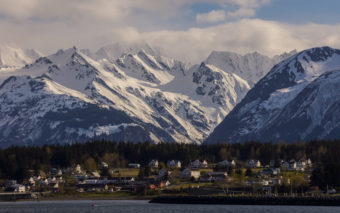
Haines is a scenic town, surrounded by the ocean and towering mountains. But there’s one big eyesore that’s taken over parts of the area: garbage.

Like some other cities, illegal dumping is a problem the community can’t seem to get a handle on.

But, there’s hope that could change with a different system for waste disposal.

About 25 miles out the Haines Highway, there’s a pullout.

From the road, a large sand pile obstructs trails leading to the Chilkat River. In the summer they provide a short route down to the water. In the winter, a popular cross-country ski track.

Over the years, the area has also become an informal and illegal dump.

Takshanuk Watershed Council interim director Derek Poinsette lives out the highway and drives by the 25-mile eyesore regularly.  He said illegal dumping here has been an issue for as long as he can remember.

The watershed council runs community cleanups, and Poinsette says this particular trash pile gets removed every couple years.

Poinsette said it’s not just an eyesore, illegal dumping causes environmental concerns as well.

So, why would people bring garbage here instead of the sanctioned landfill? Poinsette points to money.

“I think it’s just expensive,” Poinsette said. “Anything that has any weight to it is expensive to get rid of.”

That’s been a driving factor in the conversation a local working group started last year. The question before them: is there a better way for Haines to deal with solid waste?

Right now, Haines has one option for garbage disposal, privately owned Community Waste Solutions. Many residents load their garbage in their car or truck, drive it to the landfill, and pay by weight.  Mixed waste costs $0.27 per pound.

There’s one other option for some items, the non-profit Haines Friends of Recycling also will take things such as refrigerators and washing machines for a fee.

For people who don’t generate a lot of trash, or get rid of waste by burning it or recycling, the garbage company’s pay-by-the-pound is a pretty cheap system. But that’s not true for everyone.

“It’s expensive to get rid of your trash here,” said Darsie Culbeck, who chairs Haines’ solid waste working group. He said illegal dumping isn’t the main motivation for the conversation they’re having.

But it’s a symptom of the bigger problem.

“I’ve been here 30 years, as a wilderness guide and a person that’s out in the bushes quite a bit,” Culbeck said. “It’s a big problem. There’s lots of trash out in the – if you do the community cleanups in the spring and walk the ditches there’s garbage all over the place, it’s disgusting.”

That’s the weird thing, right? This has been a problem for a long time. It’s common knowledge that there are trashed appliances sitting out at 25 mile, and garbage in pullouts along the highway.

So, why is it still happening?

“Usually things are deposited in the dead of night by people who don’t leave their names behind,” Haines Borough Manager Debra Schnabel said. “It’s impossible to identify who was the previous owner. And that’s the nature of it.”

Schnabel grew up in Haines and she does remember a time when this wasn’t such a big issue.

She points to what she sees as the turning point: when the borough ended mandatory trash pickup.

Reinstating mandatory pickup isn’t necessarily the answer here, Schnabel said. But she does think accountability should be introduced back into the system.

“You can have an account with the borough but you can manage it yourself,” Schnabel said. “You can choose to take it to the dump. You can choose to recycle 100 percent or 90 percent. As long as we know what you’re doing with your garbage. I’m not telling you what you have to do but it has to be done in a safe manner.”

Illegal dumping is a problem that persists throughout Southeast.

In the last year, Tongass National Forest law enforcement officers responded to nearly 30 cases.

Public Affairs Officer Paul Robbins said it’s a consistent problem. There are particularly problematic areas, such as Sitka’s Harbor Mountain Road and Ketchikan’s Brown Mountain Road.

In Haines, the solid waste working group has struggled to find the right answer.

“Remember we’ve been talking about this for a year,” said Culbeck at a September meeting. “Or, some people 25 years or however long. And it’s political. This is going to be hard to move through and we need to keep it as simple as we possibly can.”

The issue is political for a couple reasons that mostly come down to cost.

Residents who don’t generate a lot of trash worry about paying more for disposal – through taxes or a utility fee.

In Haines, the waste group has a recommendation for the assembly that includes setting up a transfer station in a central location, funded through a sales tax hike. That would reduce the cost per-pound to just $0.02 to $0.08.

Illegal dumping brings penalties.

Fines for littering range from $50 to $100. But, because it’s so hard to figure out who’s doing it, they don’t serve as much of a deterrent. Whether a new strategy for waste disposal is the light at the end of the trash-filled tunnel remains to be seen.

Chilkoot Indian Association works to purchase vacant dock

The Portage Cove dock the Chilkoot Indian Association is working to purchase from the Klukwan Inc. trust. (Photo by Berett Wilber/KHNS)

A Haines tribe is in the final stages of buying a local dock that has gone unused for years.

The Chilkoot Indian Association sees the Portage Cove dock as an economic development opportunity and a chance to keep a piece of land in tribal hands.

The dock is about a quarter-mile down the road from Haines’ only cruise ship dock.

A distinctive red-and-gray building near the entrance sits empty and the float where a tour boat used to tie up has been removed.

The Native corporation that owned it, Klukwan Inc., declared bankruptcy five years ago and the facility has been vacant ever since.

“It’s been bugging me for years seeing that dock empty,” said Harriet Brouillette, the Chilkoot Indian Association tribal administrator.

She used to work for Klukwan Inc., which was once highly profitable.

The corporation and the Chilkat Indian Village of Klukwan used the dock for a tour excursion catamaran called the Chilkat Express.

Brouillette said it was important for her to keep the dock in tribal hands.

“This was, at one time, all tribal land, and you can see that tribally held land has shrunk and shrunk and shrunk,” Brouillette said. “We just need to put the brakes on that. If we lose one more piece of property, we’re just shrinking our sovereignty.”

At the same time Brouillette watched the dock fall into neglect, she and other Chilkoot employees were looking for ways to use a specific pool of federal funding. The money comes from the Federal Highway Administration and is specifically for transportation projects.

“We were just still trying to figure out what could we do besides building trails and filling potholes on Third Avenue,” Brouillette said.

In spring 2016, the association thought of the dock.

But it was a challenge to convince the federal government that the money, which is traditionally used for things like tribal road projects, should go toward marine transportation.

“Our people are seafaring people and it only made sense to use some of our federal transportation dollars for marine transportation,” Brouillette said.

Eventually, the tribe got approval to pursue a purchase of the dock.

Brouillette said it should be final by the end of October.

Since the sale isn’t yet complete, she didn’t disclose the price tag. The most recent assessment valued the property at about $700,000, which Brouillette confirmed is in the ballpark of what the tribe is offering to pay.

Rod Worl, the president of the Klukawn Inc. trust, which owns the dock, said he could not comment until the sale is complete.

Once it does go through, the first step will be repairing the facility. The Chilkoot tribe commissioned an engineer assessment of the dock.

“There are some pieces that (the engineer) uses the phrase ‘nearing end of life,’ which is a polite way to say not good,” said Ryan Barber, the tribe’s assistant transportation coordinator. “But a lot of it is still very functional, like Harriet said, it needs some love. And some anodes.”

In total, the repairs could cost more than a million dollars.

“We’re not scared away by the cost of the repairs because I think that in the long run, keeping that piece of property locally owned is very important,” Brouillette said.

The tribe plans to draw from the close to million dollars a year it receives from the federal transportation program for dock repairs.

The tribe hopes to have the dock ready for use by the spring. Transportation coordinator Nick Kokotovich says the association plans to offer mooring space for yachts and possibly small cruise ships.

“It’s a unique opportunity for us and Haines because Haines doesn’t have a docking facility for private yachts that come up,” Kokotovich said. “There’s a big need there.”

Brouillette said the association have other ideas as well, like using the building as a carving shed and offering canoe rides.

“There are some options,” Brouillette said. “We are going to take our time in developing those. We’ll probably just start out with offering larger private boat mooring. And from there, figure out what works best for us.”

She said the association is open to ideas from the community.

The long-term goal is to create local jobs and give Chilkoot tribal members control over a slice of the waterfront.

New winter tours, heliski map ordinance on Haines Assembly agenda

A helicopter in Alaska. (Creative Commons photo by <a href="https://www.flickr.com/photos/odoublesnap/7786466878/in/photolist-cS4FjW-WM5WKH-dNURT-7SunVp-cS4CMY-fEMsmb-cKpVzY-26fb8-53w5wv-26fdY-4Y84kQ-WHVKr7-haybq-jBreFi-nsV7Kf-d76NHh-Vz5h8H-8CMZJd-in4bgi-jP1Ue6-EdX3Bo-7zf65y-B8XWw-7SvS6G-4gNLQx-bcvxF4-nKL5F2-7H4mAJ-nufwbU-6sAxne-949nxo-cobXmw-fyRGcW-dLauC-ffqrKU-4NrgXD-Etvbr-nsV9Mw-eKR2RV-hxUtc1-4wgmqv-8qUNgn-8nzrXh-qcoKTW-nufvYj-cX1ucW-hUgXMq-hHsijZ-a9pkFQ-8Snkfc">Kevin Duffy/Flickr Creative Commons</a>)
A helicopter in Alaska. (Creative Commons photo by Kevin Duffy/Flickr Creative Commons)

Haines’ newly elected officials will take their seats Tuesday night.

The election results are set for certification at the beginning of the assembly meeting. It won’t mean much change in the makeup of the body.

Incumbent Mayor Jan Hill was re-elected, and two appointed Assembly members, Stephanie Scott and Sean Maidy, were voted in.

Brenda Josephson is the only brand new member. She will take the seat currently occupied by Ron Jackson, who did not run for re-election.

The Assembly will consider whether to permit new winter backcountry tours.

Alaska Mountain Guides wants to offer snowmachining tours, along with four-wheeler and backcountry skiing day trips.

The tours would take place in the 26 mile area, around Jarvis Glacier, Flower Mountain and Devil’s Elbow.

At least two residents have written letters in opposition to the tours.

An ordinance establishing a new process for heliski map amendments is on Tuesday’s agenda.

The borough’s last heliski map committee was plagued by conflict of interest and wildlife concerns. It resulted in a $10,000 borough attorney bill and no recommendations to the Assembly.

The ordinance would revise the heliski map amendment process. Instead of a special committee, two established groups would review map requests: the parks and recreation advisory committee and the tourism advisory board.

The two groups would consider input from federal and state agencies like the Department of Fish and Game. Then, they would send recommendations to the assembly, which makes the final decision.

Under the new process, people who submit heliski map requests would not be able to deliberate on the changes. That was an issue for the last map committee.

One major question is how new wildlife studies from Fish and Game will be incorporated into map decisions.

Biologists spent years tracking critical mountain goat and brown bear denning habitat in the Chilkat Valley.

The meeting is at 6:30 p.m. Tuesday in Assembly chambers.

University extends bid, comment deadline for proposed Chilkat Peninsula timber sale

The deadline for bids and public comment on a proposed Haines-area timber sale has been extended.

The University of Alaska’s timber sale area on the Chilkat Peninsula. (Photo courtesy University of Alaska)

The University of Alaska is offering up 400 acres of old growth Sitka spruce and western hemlock on the Chilkat Peninsula.

The extension follows the Haines Assembly’s request that the University of Alaska delay the sale until the two parties can meet.

The peninsula is southeast of the Haines townsite, and is home to many residential properties.

Many area residents have spoken out against a large scale timber sale in their neighborhood.

The university originally set the bid and comment deadline for Oct. 23. But regional resource manager Patrick Kelly said it was extended for a couple reasons.

“The first reason was we received requests from potential bidders to extend the RFP (request for proposals),” Kelly said. “Secondly, we received a request from the borough manager to extend the public comment period.”

Kelly declined to comment further about the potential bidders, but said there has been interest in the sale.

The deadline for bids and comments was pushed off about a month, to 5 p.m. Nov. 22.

Kelly said the university is also working to schedule a meeting with the Haines Borough and the Alaska Mental Health Trust. A date has not yet been set for that meeting.

The university put the land up for sale partly in response to a discussion taking place with the Haines Planning Commission.

The commission is considering restrictions on resource extraction in the Mud Bay Rural Residential Zone.

Potential restrictions would affect the university and Mental Health Trust, which own large parcels of land in that area.

Comments on the proposed sale can be sent to ua-land@alaska.edu.

New Haines museum exhibit explores how a Tlingit stronghold gave way to non-Native settlement

This headdress was carved by the artist Kadjisdu.áxch, who is known for carving the intricate Whale House Collection. It is on display in this exhibit as an example of the art that is part of the Tlingit culture. (Photo by Emily Files/KHNS)

The Haines area used to be a Tlingit stronghold, ruled by an alliance between the prosperous Chilkat and Chilkoot people.  A new Haines Sheldon Museum exhibit explores how the Native territory gradually gave way to white settlement in the late 1800s. The exhibit will anchor the museum’s upstairs space for at least two years.

The exhibit is called “Everything From Afar Drifts Ashore.” It is the meaning for the Tlingit name “Yandeistakye.”

Yandeistakye was a Tlingit village located near the current Haines airport. It was the site of some of the 19th century’s most influential contact between Natives and white visitors in this area.

Haines author Dan Henry recounts this time in his recently-published book “Across the Shaman’s River.” The museum exhibit is partially based on the book.

Henry says, for much of the 1800s, the Chilkat and Chilkoot Tlingits staved off white settlement.

“The Northern Tlingits were very effective at defending the area,” Henry said. “They pretty much would escort people out. So there was never a military attack or opportunity to gain a foothold.”

That’s where the museum exhibit begins. It starts with a map of the Jilkaat Aani – the territory of the Chilkat and Chilkoot people.

“We start in 1850,” said museum director Helen Alten. “When the Russians and Europeans and Americans have all been trading in this area, but none of them have been in Jilkaat Aani to stay.”

But Henry says that changed after the arrival of naturalist John Muir.

Russia sold it Alaska territory to the U.S. in 1867. Twelve years later, Muir travelled to the Chilkat Valley to study glaciers. He accompanied a Christian missionary named S. Hall Young.

When they arrived, they met with Tlingits in Yandeistakye.

“[Muir] gave a short speech that was essentially a Unitarian speech, all he talked about was brotherhood,” Henry said. “He said ‘we’re brothers.’ So he talked about it from a horizontal status rather than vertical, top-down. Muir said, ‘you and I are the same.’ And that’s exactly what the Tlingits wanted to hear and they said ‘OK, we’re with you.’”

Zack James is Tlingit and grew up in the Chilkat Valley. His great-grandmother lived in Yandeistakye.

“There are very few writings in that time period about what the Tlingit people actually thought,” James said. “Everything is second-hand.”

James is a student at the Institute of American Indian Arts in Santa Fe. He helped with research for this exhibit. He says the Tlingits were feeling pressure to make a compromise with the Americans.

“Some of the leaders in the Tlingit community noted just how many American ships were coming up to Alaska,” James said. “And I think they got the impression that Americans were a hugely powerful force and that hostility wasn’t going to benefit them in the long-run.”

Tlingit leaders selected land known as Deishu for a Christian mission and school. Deishu later became Haines.

“[In] 1879, they sealed the deal on Deishu,” Alten said. “Then, because of that, the word went out that it was opened up.”

Entrepreneurs, missionaries, teachers, miners and the military started to arrive. The exhibit tells the stories of some of the first non-Natives to make a home in Haines.

James says Tlingits valued education and knowledge. But many of the schools during this time period repressed the Native culture. His grandparents went to boarding schools where they weren’t allowed to speak their language.

“The goal, I suppose, was to try to sever that cycle of knowledge from being passed down from grandparent to grandchild and parent to child,” James said.

The last section of the exhibit asks who Haines is now. It displays modern Tlingit artwork from Wayne Price and Lani Hotch. But it also points out that in this former Tlingit stronghold, Haines’ population is now just 11 percent Alaska Native. The village of Klukwan, which used to be home to 2,000 people, now has a population of about 100.

Alten says the loss of land came up during meetings with Native elders leading up to this exhibit.

“It’s something that we want people to figure out on their own,” Alten said. “We’re not going to interpret it for people, we’re just trying to give them what it is.”

As for John Muir, the white naturalist who connected with Tlingit leaders…

“He left and never came back,” Henry said.

The author says this chapter in Haines history is full of irony.

“Muir went on a speaking tour down south and said, ‘The last hostile heathens are now mollified, the hills are now open for gold prospectors,’” Henry said. “So this book ends by saying John Muir, the founder of American environmentalism, started the Klondike Gold Rush. Which some in Yukon have called the largest environmental disaster in the Yukon.”

The checkered history of the non-Native impact on Jilkaat Aani and surrounding lands will be on display at the Haines Sheldon Museum for at least two years.

The opening Friday included a 7 p.m. talk from Henry. He will also be in Skagway to talk about “Across the Shaman’s River” Sunday at 2 p.m.

For third time in 2 years, state officials cite Skagway Assemblyman for financial disclosure violations

Dan Henry won the race for the second assembly seat by just five votes. (Photo by Emily Files/KHNS)
Dan Henry won the race for the Skagway Assembly by just five votes. (Photo by Emily Files/KHNS)

A Skagway resident narrowly elected to a seat on the borough assembly violated state disclosure laws three times, according to Alaska Public Offices Commission staff. They determined Dan Henry has failed to disclose his incomedebt, and now, gifts from a private company.

Henry did not disclose gifts he received during trips to negotiate a major waterfront lease on behalf the Skagway Borough.

In 2013 and 2014, Skagway was in talks with the parent company of White Pass and Yukon Route Railroad. The tourist railroad has leased a significant share of Skagway’s tidelands since the 1960s. The city entered negotiations on a new lease because it wanted to renovate the port, on property White Pass controls.

Henry was on a municipal negotiating team. The team traveled to Florida multiple times for talks with TWC Enterprises. The Canadian corporation operates the White Pass railroad.

The trips included stays at a Florida golf resort owned by TWC. City records show that TWC covered accommodation and meals for the Skagway negotiating team. Henry told APOC that TWC also provided golfing free of charge, but he did not recall on how many occasions.

This investigation was sparked by a citizen complaint from Skagway resident Roger Griffin. Griffin estimated the “gifts” from TWC to Henry to be worth between $4,000 and $8,000.

APOC staff said Griffin was correct that Henry should have disclosed the lodging and entertainment provided by TWC. But they could only confirm about $500 worth of expenses. That’s based on three hotel stays in February, October and December of 2013.

Still, $500 in gifts is enough to warrant reporting on the disclosure forms required of candidates and public officials. On Henry’s 2014 disclosure form, he did not report any gifts over $250. APOC staff say that is a violation. The staff were not able to find enough documentation to determine whether Henry’s 2015 form should have included gift disclosures.

The maximum fine for the 2014 violation is more than $12,000 — $10 a day. But APOC staff recommend a 90 percent reduction of the penalty, to $1,276. That’s based on the fact that the amount of gifts Henry received was under $1,000, according to the APOC investigation.

APOC staff also recommend Henry correct his disclosure form and attend a financial disclosure statement training within one year.

In determining a penalty, staff reference Henry’s previous violations. Less than a month ago, APOC fined Henry $220 because he did not report substantial debt on his most recent disclosure form. In 2016, Henry was ordered to pay a much more hefty fine of $22,000. He hadn’t reported his income on multiple disclosure statements. Henry appealed that decision. He said not disclosing his income was a misunderstanding and not disclosing debt was an oversight.

All three of the APOC investigations into Henry resulted from citizen complaints.

Henry’s checkered candidate disclosure record was discovered when he pleaded guilty to federal tax crimes in early 2016. Henry hadn’t paid income tax for a number of years. He was sentenced to a year in prison and ordered to pay $600,000 in restitution to the IRS.

Henry finished his prison sentence and returned to Skagway in time to run public office. He previously served in Skagway government for 19 years. It was a close election. Henry won an assembly seat by just five votes. He was neck-and-neck with a write-in candidate.

The Alaska Public Offices Commission still has to make its official decision on this latest complaint against Henry. The commission could agree with the staff recommendation to fine Henry about $1,300. Or it could make a different decision. The commission’s next regular meeting in February.

The years of negotiating with White Pass railroad owner TWC resulted in a proposed 35-year lease. But Skagway voters resoundingly rejected the agreement in 2015. Now, the assembly has another lease proposal on the table. This one would prolong White Pass’ hold on key tidelands for 15 years.

Site notifications
Update notification options
Subscribe to notifications