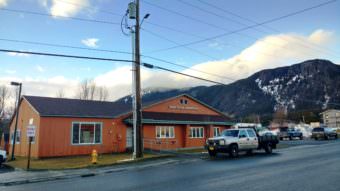
KHNS is our partner station in Haines. KTOO collaborates with partners across the state to cover important news and to share stories with our audiences.
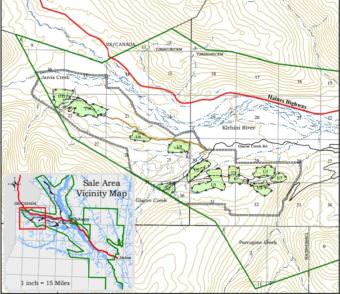
The University of Alaska’s timber sale area on the Chilkat Peninsula. (Photo courtesy University of Alaska)
The Haines Assembly is holding a special meeting this week to discuss what the borough manager has called a “politically motivated” proposed timber sale.
The University of Alaska is offering 400 acres of Haines-area land for timber harvest. The land is located on the Chilkat Peninsula and abuts many residential properties.
The university is advertising the sale at this time because of the threat of new local restrictions.
In the spring, the Haines Planning Commission realized the Mud Bay Rural Residential Zone does not explicitly allow or forbid resource extraction. The commission has been brainstorming potential restrictions over the last few months.
That worries university land managers, who want to capitalize on the property. Money from a timber sale would go to the university’s trust programs, which fund student scholarships.
At its last meeting, the Haines Assembly voted unanimously to explore potential land swaps in the Mud Bay area.
Member Heather Lende floated the idea of a temporary moratorium on resource extraction in Mud Bay, considering the planning commission’s work.
“Until we make a ruling on how resource extraction is gonna go on the peninsula, mainly in light of the Mud Bay land use area historic residential values and the situation out there,” Lende said.
Lende and fellow Assembly members Ron Jackson and Tresham Gregg requested a special meeting this week to talk about the proposed timber sale. The assembly members requested the planning commission and borough attorney participate.
The meeting is set for Thursday at 6 p.m. in Assembly chambers. Part of the discussion may be held in executive session.
Comments and bids on the Chilkat Peninsula timber sale are due by Oct. 23.
Costanza Marabini, left, went to school in Haines for about a month while visiting a family friend. Marabini sits next to fourth-grader Audrey Bader. (Photo by Emily Files/KHNS)
Earlier this school year, Haines fourth-graders learned about another part of the world from someone their own age.
An Italian student visiting a family friend in Haines spent a month in the local school.
Costanza Marabini, 9, is known as “Costy” to Haines resident Nelle Jurgeleit-Greene.
Jurgeleit-Greene met Costy’s family five years ago through a program called GeoVisions.
She stayed with the Marabinis in Potenza Picena, helping them learn English and teaching English in the local school.
“I suggested that any of the kids could come and stay with me,” Jurgeleit-Greene said. “Costy was the only one who said ‘I want to do it!’ So here she is, and we’ve had a great time.”
Costy said she never got homesick while in Haines.
She enjoys walking Jurgeleit-Greene’s dogs, learning new games and eating dinner a few hours earlier.
“There is more games, like Captain Robert, tag … and like dinner we do much late, like at 8:30 maybe, but here we do dinner at 5 or 6,” Marabini said.
In addition to different meal times, she had to adjust to different food.
“Like in in Italy, on Saturday and Sunday, two times a week, we’d eat pizza,” Marabini. “But here, no.”
“If you eat pizza there, it’s very thin,” said Haines fourth-grader Jackson Cowart, one of the American students who learned about Italy from Costy.
“It was awesome having Costy in our class because she teached (sic) us a lot – taught us a lot — about Italy,” said Bear Scott.
What have they learned?
“Both Costy and us live by the ocean,” Arik Koverdan said.
“Their art on paintings is a lot different,” Loyal Tormey said.
“I actually didn’t know that Rome was in Italy,” Jonas Bell-Turley said. “I didn’t know they had much different architecture.”
Fourth-grade teacher Tracy Wirak said the class took a Google Earth tour of Costy’s hometown.
“We zoomed in and we actually got to see Costy’s house. She took us on a little tour to her school, the route that she takes,” Wirak said. “We’ve also tried to incorporate some Italian words on some items around the classroom. Luckily, Costy helped correct me on some words I had totally wrong.”
In turn, Costy has been learning English.
“I’ve seen her English improve dramatically,” Jurgeleit-Greene said.
Even though Costy had never been outside Italy before her visit to Haines, she has some things in common with American students.
Her favorite parts of school are recess and lunch (and snack time.)
Costy spent about a month at the Haines School.
In mid-September, she and Jurgeleit-Greene traveled back to Potenza Picena.
Heather Parker with Gov. Walker’s office, DOC Commissioner Dean Williams, Pretrial Director Geri Fox, Haines Mayor Jan Hill, Haines Borough Manager Debra Schnabel and Haines Police Chief Heath Scott pose in a Haines jail cell with a revised community jails contract. (Photo by Emily Files/KHNS)
Gov. Bill Walker is calling on the legislature to make changes to the crime reform bill known as SB 91.
As part of that program, the state wants to shift its relationship with 15 communities that operate rural jails.
It will mean more money for local police departments, but also more work on the prevention side of things.
Haines is the first community to sign the new contract.
Last week, Department of Corrections Commissioner Dean Williams crowded into one of Haines’ three jail cells for a photo-op with the borough mayor, manager and police chief.
The local leaders had just signed on to a new contract that pays the borough an extra $30,000 to provide what are call “pretrial” services.
“The biggest growth in our prison population in the state have been this pretrial population,” Williams said.
He explains that the goal of Alaska’s new pretrial program is to keep people who aren’t much of a threat out of prison as they await trial or another resolution to their case.
“Imagine there’s two people charged with the same crime, they both get a $1,000 bond put on them because that’s what the traditional system has been,” Williams said. “If you have $1,000 you pay it and get out. If you don’t, you stay in prison until your court date. That is a bad system.”
Williams said this exposes low-level offenders to more serious criminals and it could cause them to lose a job or be away from their family.
“We’re really trying to make decisions based on what risk a person represents, not their ability to pay a monetary bond,” Williams said. “It’s been disproportionate, quite frankly, if you’re a poor person, you’re less likely to get out of prison.”
The first step of the new pretrial program is a risk assessment.
Department of Corrections’ new pretrial director Geri Fox said the risk analysis will be based on a series of objective questions.
“How many felony arrests has this person had in the last five years?” Fox gives an example. “How many misdemeanor arrests has the person had in the past three years?”
Who conducts the risk assessment and monitors the defendant if they are not behind bars? That is going to depend on the location.
Williams said DOC will hire about 60 pretrial service officers for bigger cities in Alaska. But in small towns like Haines, he sees that role falling to local police departments.
That’s where the community jails contracts come in.
DOC pays 15 communities, from Haines to Kotzebue to Cordova, to operate rural jails.
Williams wants to add on to the contracts, so that police departments participate in monitoring and supervision of defendants outside the jail cell.
“With the increased monies that DOC is giving us and the increased responsibility, I think at the end of the day we’re better serving our community,” Haines’ police chief Heath Scott said. “We’re in touch with people we need to be in touch with keep them on the straight and narrow, so to speak.”
The Haines department consists of a chief, soon to be four officers, and five dispatchers.
The dispatchers also act as corrections officers, operating the jail. Scott said the new pretrial responsibilities may require either another part-time dispatcher or more overtime hours.
But he thinks the $30,000 DOC is adding to the contract will cover that work.
“We don’t know exactly what it looks like right now,” Scott said. “We’ve done no supervision, we’ve done no monitoring right now. But we don’t think it’s going to be a heavy lift.”
Scott hopes the revised contract means DOC funding is more secure in the future.
The police department still is heavily reliant on the community jails funding.
Williams hopes the roll-out of the $10 million statewide pretrial program will make Alaska’s justice system more equitable.
“It just makes sense, you don’t want low-risk people who’ve had a bad day in prison,” Williams said. “Have them be responsible and pay a consequence otherwise. But if you’re a risky person and you’ve been able to pay your way out of prison, those days are done.”
As the Legislature prepares to debate changes to SB 91, Williams and his department are preparing the pretrial program, which includes meeting with smaller communities like Haines to see if they’re willing to partner in this new focus on prevention.
Dan Henry’s troubles with Alaska’s campaign finance watchdog started last year, when he was on the assembly.
His candidate financial disclosures, also called POFDs, were used as evidence in a federal investigation. In that case, Henry pleaded guilty to not paying his federal income taxes over a number a years.
He was sentenced to more than a year in prison and fined about $600,000 in restitution to the IRS.
The Alaska Public Offices Commission launched its own investigation after a citizen complaint. APOC found that Henry did not report his income on multiple campaign finance disclosures. For those violations, he was fined $22,000 – a decision which he is appealing.
Henry served his prison sentence and returned to Skagway at the end of the summer, in time to file as an assembly candidate. As required, he filled out a new financial disclosure form.
And Skagway resident Lynne Cameron noticed that it didn’t provide a complete picture.
“I wanted to see someone who wanted to run for office (who) would volunteer their financial information fairly,” Cameron said. “I could make a judgment about whether they would be an appropriate candidate.
Cameron filed a complaint with APOC, saying Henry did not disclose the debt he owed the IRS and APOC. And the commission said Cameron was right, Henry violated state regulations with his incomplete disclosures.
Henry says it was an innocent mistake.
“It was an oversight on my part,” Henry said. “I don’t think there’s any gross negligence there … due to (KHNS) reporting, the Skagway newspaper, KTOO. I think everybody is pretty much fully aware. I don’t think it’s anybody being kept in the dark in any way shape or form.”
When asked why, after the 2016 APOC case, he wasn’t more diligent in filling out his POFD, Henry said, “I guess I should’ve sent the POFD to my attorney and my accountant just to make sure.”
“Because of the 2016 situation, no that didn’t turn me into a perfect person,” he said. “It was an oversight.”
Henry says said will pay the $220 fine and turn in a new, complete financial disclosure form.
Cameron, who filed the complaint, asked APOC for a harsher penalty.
She said Henry should not be able to run for office in the upcoming election.
But the commission did not address that request in its final order.
Cameron said she’s not disappointed and respects APOC’s process. But she plans to vote for write-ins on Election Day. Henry’s only challengers for assembly are write-in candidates.
“If someone says they represent me, then I want to make sure that’s true, and I want to make sure they’re representing the values that I believe should be held up by any candidate,” Cameron said. “That is my job as a voter.”
Griffin makes the same allegation as Cameron, and an additional one. Griffin says Henry didn’t report gifts in financial disclosures from previous years.
Henry calls that accusation ‘dead wrong.’ APOC will decide within the next few months.
The timing of the university’s decision was motivated by a conversation happening at the local level.
The Haines Planning Commission is considering whether to restrict resource extraction in the Mud Bay area.
At a Sept. 14 University Board of Regents meetings, Land Management director Christine Klein said the university’s ability to monetize its Chilkat Peninsula land was under threat.
“The reason we’re bringing this to you now is that there have been increasing efforts to put restrictions on the property and the area in Haines that this land is located at,” Klein said.
The conversation Klein is referring to started back in May, when the Haines Planning Commission noticed an apparent oversight in the code governing the Mud Bay Rural Residential Zone. There is nothing there to restrict resource extraction in the generally quiet residential neighborhoods.
Since then, the commission has brainstormed what kind of rules to put in place for that area. The university and the Alaska Mental Health Trust, both major landowners on the peninsula, spoke out in opposition to any limitations.
University President James Johnson wrote in a letter to Haines officials that revenue from land holdings is critical to UA’s trust programs, which fund student scholarships. University funding has plummeted by $61 million since 2014 in the wake of the state fiscal crisis.
At a meeting in June, planning commission chair Rob Goldberg said there was no rush to answer the Mud Bay resource extraction question.
“We’ve had this code in place for about 25 years and there hasn’t been any major resource extraction during that time,” Goldberg said. “And I haven’t seen a big rush for people to do it.”
Now there does seem to be a rush.
“If we don’t move forward with this, we may be in the situation of losing the ability to harvest the timber,” Klein said at the Sept. 14 regents meeting. “And in doing so, we would also lose our ability to check and verify if there is any mineral potential.”
Haines Forester Greg Palmieri says this is the largest potential timber sale on the Chilkat Peninsula in decades.
“I’m not aware of any timber sales on the peninsula in the last 10 to 20 years that weren’t on private property or very small,” Palmieri said. “This doesn’t compare to anything in the last 10 to 20 years.”
The 400 acres make up a significant swath of the peninsula south of the Haines’ townsite. Dozens of residential properties neighbor the sale area, including Eric Holle’s home.
“It’s not something I’m gonna lose sleep over at the moment,” Holle said.
Holle has lived across Mud Bay for 29 years. He’s also the president of a local conservation group. But he’s not too worried about the timber sale because he doesn’t think the university will be able to make money from it.
“Once they go through and do a timber cruise on this, I think they will be quite surprised on the lack of valuable timber in this area,” Holle said.
Planning commission chair Goldberg lives out Mud Bay, and he also questions the profitability of the timber harvest. He says creating residential subdivisions would be a much more valuable use of the land.
As for how this development will factor into the commission’s conversation around Mud Bay resource extraction, Goldberg says he’s not sure.
“If we were playing a game, it would be like the university has just wiped all the pieces off the board and said ‘game over,’” Goldberg said.
The university will find out if there are interested buyers for this timber sale by the bid deadline on Oct. 23. That’s also the deadline for comments on the plan, which can be sent to ua-land@alaska.edu.
Haines’ Port Chilkoot Distillery spirits on display when the tasting room opened in 2014. (Photo by Emily Files/KHNS)
Craft distilleries in Alaska are reeling after a decision that could change the part of their businesses most accessible to the public: tasting rooms.
Distilleries have been operating tasting rooms since 2014 legislation allowing that practice.
But now, state officials say distilleries aren’t allowed to serve mixed drinks.
The tasting room at the Port Chilkoot Distillery in Haines opened almost three years ago, serving cocktails like ‘High Bush Cranberry Gimlets,’ ‘Spruced Up Gin,’ and ‘Moscow Moose.’
Craft distilling is a growing industry in Alaska, with nine currently in the state.
Port Chilkoot part-owner Heather Shade says the tasting room has been a crucial part of their growth.
“The tasting rooms allow a small business to start up, they allow us to succeed in a challenging economic environment in the state,” Shade said. “And it allows up to grow our staff, infrastructure and distribution by having cash flow into our businesses to do that.”
Shade is trying to figure out how this part of her business will be affected by a recent decision from the State’s Alcoholic Beverage Control Board.
A complaint against Juneau’s new distillery brought attention to a potential gray-area in Alaska statute.
The legislation that allows distilleries to open tasting rooms says they can sell their own product.
ABC Board Director Erika McConnell points out that doesn’t include the other beverages that distilleries use to make cocktails, like the vermouth in a martini.
In a memo to the board McConnell writes, “There is nothing in the statutory language itself to suggest that a bloody Mary, a martini, or a margarita qualifies as ‘the distillery’s product.’”
Shade said there’s a reason for not serving spirits straight up.
“The purpose of mixing our products with ingredients and ice and serving them in this way is that so people know how it’s going to taste in their cocktail,” Shade said. “They know how they might want to make it at home.”
But the board sided with McConnell and voted to uphold an advisory that prohibits the sale of mixed drinks made with outside products, starting immediately.
Port Chilkoot does make a lot of its own mixers on-site, including ginger beer, Shade said.
“We’re going to continue operating the way we’ve been,” she said. “We produce our ice on site. We produce our juices and syrups and almost everything.”
She said they will stop using alcoholic mixers produced off-site.
At the recently-opened Amalga Distillery in Juneau, Brandon Howard said the same – they’re not going to stop serving cocktails.
Amalga makes its own ginger beer and tonic water that it uses is most of its drinks, Howard said.
“Until we have clarity from the board and until we know that these regulations that they’re considering are completely legal, yes, we are going to continue doing what we’re doing,” Howard said.
Both Shade and Howard said not only would serving exclusively straight spirits take away from the experience of the drink, they don’t think it’s responsible.
“I think it’s irresponsible to serve an individual basically three ounce shots of gin and then just send them out,” Howard said. “The mixed drink part of our business is not an insignificant part, but the way in which it leads to bottle sales for us is massive.”
According to ABC Board’s McConnell, it is okay for the businesses to continue mixing drinks with products they make themselves.
Dale Fox is the president and CEO of Alaska CHARR – that’s Cabaret, Hotel, Restaurant and Retailers Association. Fox said CHARR helped get the original legislation passed, and now they agree with the ABC Board’s decision to limit tasting rooms.
“It’s morphed into bringing in other spirits that are not the product of that distillery,” Fox said. “Mixing drinks, entertainment and a whole series of other things that were not allowed in that provision.”
Fox said if you want to mix drinks, get a bar license. That’s why he said even if state lawmakers clarify the rules and allow for the sale of cocktails at distilleries, CHARR probably won’t support it.
State Rep. Chris Tuck said new legislation is on the way.
“We will be introducing something to rectify the situation.”
Tuck was the primary sponsor on the tasting room legislation back in 2014. He and several other legislators wrote to the ABC Board to say they never meant to prohibit distilleries from serving mixed drinks.
“When we had our grand opening of the bill signing, even then at that ceremony we had mixed tastings for people to try,” Tuck said.
McConnell said the board will be looking closer at regulations around distilleries.
Shade and Howard are challenging the state’s interpretation. They say for now they will continue with business as usual. That includes cocktails.
Close
Update notification options
Subscribe to notifications
Subscribe
Get notifications about news related to the topics you care about. You can unsubscribe anytime.