KHNS is our partner station in Haines. KTOO collaborates with partners across the state to cover important news and to share stories with our audiences.

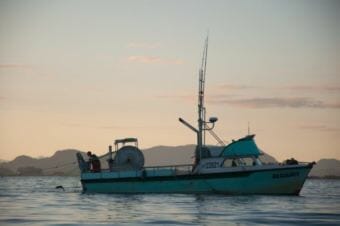
Three Alaska Power and Telephone workers were rescued Tuesday after their boat ran aground 6 miles south of Skagway, according to a report from the Alaska State Troopers.
Lance Caldwell, Cory Nelson and Jordan Frost were returning from winter shut-off work on the Kasidaya hydropower plant about 3:30 p.m when their boat ended up on the rocks.
Darren Belisle, AP&T’s Power operations manager for Upper Lynn Canal, said it wasn’t their fault.
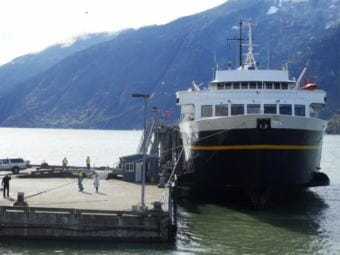
“Our boat captain headed down there to pick ‘em up, and the state ferry was going by at the same time and had a weird wave hit ’em and turn ‘em sideways and got stuck on the beach,” Belisle said.
No one was hurt, but the workers couldn’t free themselves.
“The boat’s big enough that with the outgoing tide, couldn’t keep up and get it,” he said. “We just called search and rescue to yank us off the beach.”
Six rescue volunteers did just that. They got the 26-foot skiff off the rocks, and Nelson, Caldwell, and Frost drove it back to Skagway without incident.
Alaska Marine Highway records show the M/V Columbia was the likely culprit.
The Baby Brown sale area. (Map courtesy state of Alaska Division of Forestry Haines Office)
The largest potential timber sale in the Haines State Forest in decades was put on hold this summer.
The decision from the Department of Natural Resources was made in response to a successful appeal of the forest land use plan for the 855-acre sale.
Now, the Division of Forestry has put forward a new plan.
The Baby Brown Timber Sale, about 35 miles northwest of Haines, offers up 20 million board feet of old-growth spruce and hemlock.
Astoria Forest Products offered $270,000 for the timber last year. They were the only bidder.
But the sale hasn’t gone forward.
DNR Commissioner Andrew Mack canceled the deal as it was being offered, because Lynn Canal Conservation successfully appealed the state’s forest land use plan. The original plan was only for a portion of the sale.
Lynn Canal Conservation said it shouldn’t have gone out to bid until plans were complete for the entire area.
Haines Forester Greg Palmieri said that’s the main difference between the new document and the old one.
“This plan takes into account the entire sale offering, which is 11 harvest units,” Palmieri said. “The first forest land use plan only offered a harvest plan that applied to the first two units that were going to be for the sale.”
Palmieri explains why only a portion of the potential sale was addressed the first time around.
“I was directed to make the most effective use of the timber sale offering as I possibly could initially, by creating a forest land use plan for two units to start with that could be prepared for that operational season, which would have been this past summer, had that gone through,” Palmieri said.
After the successful appeal, Palmieri went back and wrote up a plan for the entire sale.
“So I’m hoping that’s going to lead to a successful discussion and moving forward with the sale,” Palmieri said.
But Lynn Canal Conservation president Eric Holle said the overarching environmental concerns haven’t been alleviated.
“We’re not really any happier with the land use plan,” Holle said. “It dotted a few I’s and crossed some T’s. But the real issues remain the same.”
Holle sees a fundamental flaw with the sale.
“The big issue is that clear-cutting old growth forest in these large industrial-scale cuts is really from the dark ages of forestry,” Holle said. “Most places around the world that still have old growth do not do that.”
He points to some positive aspects of the plan.
“I should say, it’s encouraging to see some mention of the hydrologic impacts, and the impacts to cavity nesting birds, for example,” Holle said. “But the use of partial cuts and shelterwood cuts, and so forth, is not convincing. The same old problems are going to remain.”
Though he can’t say for sure, Holle doesn’t think Lynn Canal Conservation will appeal the sale again. But he remains concerned about potential environmental impacts.
“Really, they’re going to be removing 855 acres of old growth trees near the Klehini River, which is a prime salmon stream. And there’s not a whole lot we can do about that,” Holle said.
Forestry is accepting public comments on the current forest land use plan until Dec. 11. You can link to the full document here.
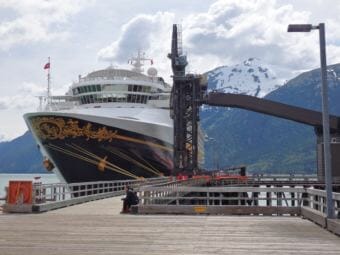
A cruise ship moored at Skagway’s ore dock. (Photo by Emily Files/KHNS)
The Skagway Assembly met for the second time this week to review a document that could provide a way forward on port improvements.
The group made some notable edits to a memorandum of understanding with White Pass and Yukon Route Railroad.
The agreement would make way for important waterfront improvements and a new 15-year tidelands lease with the private company.
Assemblyman Orion Hanson is one of the Assembly members who’s been negotiating with the railroad since discussions re-started earlier this year.
He suggested amending the memorandum to make White Pass responsible for the full cost of a new floating dock, instead of splitting it with the municipality.
“I’m looking for a solution to where we’re pushing forth the issue,” Hanson said. “Also this greatly speeds up the ability to get this dock done. Because White Pass can build this cheaper than we can. And they can probably get it permitted if not faster, than at least as fast without the red tape that we incur as a city.”
Hanson suggested the municipality contribute the $7.5 million that would have been spent on the floating dock to the roll-on, roll-off portion of the structure or other improvements to the ore dock basin.
The floating dock is needed to accommodate larger cruise ships in coming years.
The Assembly approved the amendment in a 5-1 vote.
White Pass official Tyler Rose said this is an option the company is entertaining right now.
But he said there needs to be more discussion.
Rose said White Pass is planning separate improvements for the railroad dock, to make room for bigger vessels in 2019.
He’s hopeful the Assembly will adopt the MOU and send it to the negotiating committee.
The Assembly accepted several changes recommended by the borough’s attorney that provide incentives for the railroad to complete cleanup and remediation of the ore basin.
The Assembly adopted a change that says a new lease will not happen if that cleanup doesn’t conclude by the end of the current agreement in 2023.
In the current draft of the MOU, the ore basin has to be removed from the Alaska Department of Environmental Conservation’s list of contaminated sites.
The changes to the MOU would also make way for liquidated damages if the cleanup isn’t completed, or in the event of future contamination.
Assemblyman Jay Burnham moved to make another amendment, looking ahead to the future of the other side of the port – the railroad dock.
“Seeing as how we’re kind of moving toward purchasing all – or acquiring – the tidelands, that’s a prime chunk of tidelands that we should look at acquiring in one way or another,” Burnham said.
Burnham suggested adding a section to the MOU that would give the municipality the right of first refusal to either purchase or acquire the railroad dock and tidelands under it, if White Pass is sold.
Hanson pushed back.
“I think that becomes a real imposition to the spirit of this MOU at that point because we are forcing them to sell something to us in the event that they make a business decision as part of an asset that then breaks up what they’ve been doing for over 120 years.”
The addition passed after Mayor Monica Carlson broke a tie vote in favor of the action.
Carlson favors the municipalitycontrolling the port. Reading a statement at the start of the meeting, Carlson told the assembly there are other ways forward besides a new lease.
“White Pass is not our only option going forward,” Carlson said. “Going forward, we don’t know who will own White Pass and who we are negotiating with tonight. We can continue tonight or we can stop it now, tell White Pass we will work in partnership with them until 2023, at which time we will have control of our future. The port is the golden key that unlocks the future for Skagway.”
The Assembly voted to send the amended draft MOU back to the borough attorney to review. They’ll take it up again at the next regular Assembly meeting.
The Haines Borough Administration building. (Photo by Emily Files/KHNS))
The use of drones, or unmanned aircraft systems, by the Haines Borough has raised concerns about privacy and local government overreach.
Residents and representatives pushed back at an Assembly meeting Tuesday on the use of the technology as a routine tool for government.
“Some of us moved up here to get away from government encroachment in our lives,” Haines resident Judy Rogers said. “We just want to live our lives in peace and be left alone. We don’t want to have to worry about a government with a drone looking over our shoulders, listening to what we have to say.”
Rogers wasn’t alone in her opposition to the local government’s use of drones.
Ryan Cook also spoke out at the meeting.
“I think we’re going to be treading on really thin water here if we start messing with this stuff,” Cook said. “It’s a huge invasion of privacy.”
Borough Manager Debra Schnabel recently employed the use of a drone to help enforce a land use issue.
A lot of people weren’t happy about that.
Schnabel wanted to address the issue with an administrative policy.
“As a manager I felt it was a responsibility to address that by getting in front of the issue and just saying — oh we should have a policy for how we would pursue – to guide the administration if we ever had a need or desire to employ drones in the future,” Schnabel said.
Schnabel wanted to be clear – she doesn’t want to change borough code or establish a drone use program at the borough.
The policy wouldn’t dictate how Haines residents can use the crafts, but guide the borough administration’s use of the technology.
Schnabel sees drones as a tool that could be used for a variety of reasons.
The policy includes search-and-rescue and gathering evidence and documentation after crimes and accidents.
Schnabel’s draft policy also points to possible drone use for helping people like engineers, land surveyors and land use planners gain aerial perspective.
It also names assisting incident command staff and first responders as a potential use.
Mike Denker, a commercial pilot who owns and has operated drones, thinks the policy could get the borough into legal trouble.
“I believe the potential legal exposure for a misadventure into this frontier would far exceed any public benefit the policy offers at this time,” Denker said. “I would urge you to slow down, put this policy to committee and let it be fully vetted.”
The Assembly didn’t have a whole lot of love for it either, questioning whether a policy is necessary, and whether the borough should be using drones as a tool at all.
Assembly member Tom Morphet suggested sending the document to committee.
Brenda Josephson said it should just be taken off the table.
“I think it would be better to just shelve the drone policy,” Josephson said. “The policy is we don’t use drones.”
Sean Maidy said they shouldn’t discount the use of the technology. But, he said it should only be used with the permission of landowners.
“I would move that we pass an ordinance to only use drones with the express written permission and presence of the landowner, who also gets copies of any pictures taken,” Maidy said.
Morphet said he could see drones being useful for search and rescue and public safety emergencies.
But he questioned whether a borough administrative policy is necessary for these uses.
“I think in extreme situations we might want to use a drone when other remedies have failed,” said Morphet. “I’m not convinced that there’s never a situation where a drone would be advisable. I think it obviously should be a very last resort remedy.”
Eagle photographers along the Chilkat River. (Photo courtesy John Hagen)
Raptors and bird enthusiasts alike flock to Haines for the Alaska Bald Eagle Festival, when the world’s highest concentration of eagles gathers on the Chilkat River.
Last year, the bird count spiked — and numbers are even higher this year.
It’s eagle season in Haines.
“This time of year is particularly special,” said Sidney Campbell, the Education and Outreach Coordinator at Haines’ American Bald Eagle Foundation. “The hydro-geology of the Chilkat is really unique. This river freezes a lot later than the other ones, so we have a really late run of salmon — and that’s what the eagles come for.”
The foundation capitalizes on the birds in its backyard: as the salmon attract eagles, the foundation welcomes visitors for the Annual Bald Eagle Festival.
Visiting photographers, birders and scientists gives Haines’ economy a bump between cruise and ski seasons.
But the event isn’t just aimed at outsiders, Campbell said.
“I think the biggest thing this year is that we really want this to be a community event,” Campbell said. “Almost every event during the festival is going to be free to Haines locals. And we’d really really like them to come in and meet with us and talk with us and see what we do.”
Opportunities include hearing scientist Rachel Wheat share her Ph.D. research on Chilkat Valley eagles, a film screening with the Takshanuk Watershed Council, Alaska Native dance and storytelling — and plain old-fashioned eagle watching, which could be particularly good this year.
Pam Randles spent a decade doing scientific eagle counts, and passed the torch to Chloe Goodson two years ago.
After years of decline, the women say birds counted on the Chilkat seem to be rising.
“For the previous four years, we were getting counts in the 700 to 900 level,” Randles said. “For (Chloe) to be getting over a thousand — 1,300, almost 1,400 — that’s a difference.”
That’s good news for visiting eagle observers.
Randles thinks it’s good for residents, too.
“The eagles directly reflect the salmon run,” Randles said. “Salmon, as you probably know, in this area, is crucial to the economy.”
Randles said eagle counts can also illustrate environmental changes.
The Tsirku Delta on the Chilkat River attracts eagles because other rivers — other food sources — freeze over sooner.
Fewer eagles at the Tsirku could indicate less ice throughout the Chilkat Valley.
“If there is more open water and more access to food for the eagles, they’re going to take advantage of that instead of being crowded into the Tsirku fan area,” Randles said. “I think it’s an indicator of climate change.”
While two years of elevated eagle numbers don’t prove a lasting trend, Randles and Goodson will keep counting.
Their data reaches back to the late ’80s, and soon they hope to synthesize what three decades of eagle populations can illustrate about changes in the Chilkat Valley.
For Campbell and the foundation, that link between the birds and the environment motivates the Festival.
“Hands down, this is one of the most rich and valuable ecosystems left in North America,” Campbell said. “Our big action item is teaching people how to respect it and what we can do to make sure it stays as pristine as it currently is.”
This year, the festival will run Nov. 6-11. A schedule of events can be found here.
The Skagway Assembly will begin Thursday’s meeting by honoring a former resident killed while serving the U.S. Army in Afghanistan.
U.S. Army Chief Warrant Officer 2 Jacob M. Sims, 36, died in a helicopter crash in Afghanistan on Friday, Oct. 27, 2017. (Photo courtesy U.S. Department of Defense)
In a news release Sunday, the Department of Defense confirmed Chief Warrant Officer 2 Jacob Sims died from injuries sustained in a helicopter crash.
According to a proclamation from the mayor and Assembly, Sims grew up in Skagway and graduated from Skagway High School.
Earlier this week, Gov. Bill Walker ordered United States and Alaska flags be lowered to half-staff in honor of Sims.
The Assembly will also continue to discuss a Memorandum of Understanding with White Pass and Yukon Route Railroad.
The municipality and White Pass are trying to negotiate a new waterfront lease. Negotiations are motivated by the need to renovate Skagway’s port to accommodate larger cruise ships by 2019.
At the last Assembly meeting, newly elected Mayor Monica Carlson proposed halting negotiations. She had support from David Brena, who was recently elected to the Assembly.
Met with opposition from other assembly members, Carlson decided to continue the conversation outside Assembly chambers. She’s working to schedule a retreat to discuss the lease.
White Pass President John Finlayson sent a letter to Carlson and the assembly earlier this month, requesting an executive session to help complete negotiations.
Also on the agenda is a request from the Skagway Local Emergency Planning Committee. The group recommends the municipality apply for a grant from the State Homeland Security Program for emergency equipment. The committee wants to purchase a community siren, backup generator, and a utility trailer.
Close
Update notification options
Subscribe to notifications
Subscribe
Get notifications about news related to the topics you care about. You can unsubscribe anytime.