KNOM - Nome

KNOM is our partner station in Nome. KTOO collaborates with partners across the state to cover important news and to share stories with our audiences.
Searchers find missing Bering Air plane, but no survivors

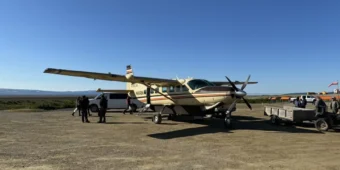
The Cessna Caravan is a mainstay in Bering Air’s fleets. Caravans were parked at the Nome Airport on Friday, Feb. 7, 2025, as a massive search was ongoing for the plane that went missing the day before on its way from Unalakleet. (Ben Townsend/KNOM)

Update, Friday:

No survivors were found on board the Bering Air plane that went missing in the Nome area Thursday when searchers discovered it Friday afternoon, according to the U.S. Coast Guard.

In a post on X, the Coast Guard said three people were found dead inside of the plane. The agency did not mention the other seven on board.
The plane was found about 34 miles southeast of Nome, the Coast Guard said.

The wreck of a Bering Air plane found about 34 miles southeast of Nome on Friday, Feb. 7, 2025. Three of the 10 people aboard were found dead. (U.S. Coast Guard)

Original story:

City officials plan to hold a press conference at 5 p.m. to provide further details. KNOM will livestream the conference on its FacebookYouTube and radio signals.

A massive search is ongoing Friday for a Bering Air plane with 10 on board that departed Unalakleet Thursday and failed to arrive in Nome, officials said.

Flight records indicate that Bering Air flight 455, a Cessna 208B Grand Caravan, was flying at around 3,400 feet when it stopped transmitting its location at 3:18 p.m. It was scheduled to arrive in Nome about 10 minutes later. Nine passengers and one pilot were on board the regularly-scheduled flight, officials say.

During a Friday news conference, Coast Guard Lt. Benjamin McIntyre-Coble said an “item of interest” had been discovered and was being checked out by search aircraft. Crucial information about the missing plane’s last moments airborne came from Civil Air Patrol radar data.

“Part of that radar analysis showed that at around 3:18 p.m. yesterday afternoon, this aircraft experienced some kind of event which caused them to experience a rapid loss in elevation and a rapid loss in speed,” he said.

Officials said they did not have information yet about what led to the plane’s sudden drop. Nome’s fire chief, Jim West Jr., had said in an interview Thursday night that the pilot planned to stay in a holding pattern over Cape Nome until the runway cleared. Then the plane disappeared.

At the time of the plane’s disappearance, the National Weather Service reported visibility of just one mile in Nome, with light snow falling. McIntyre-Cole described weather conditions in the area as “pretty challenging” Thursday, noting that they forced an Alaska Air National Guard helicopter to turn back that evening. Although weather had improved Friday, conditions remained cold.

“The air temperature in the vicinity of the last known position is about 3 degrees,” he said. “The sea temperature, depending on the status of the ice, is about 29 degrees..”

Coast Guardsmen and troopers declined to identify those aboard the plane, but said all of them were adults. Their families have been notified, according to the Nome Volunteer Fire Department. “Please keep families in your thoughts at this time,” said the department’s online update.

Clint Johnson, the National Transportation Safety Board’s Alaska chief, said numerous NTSB personnel were headed to Nome Friday.

“We have a pretty large response coming from Washington, D.C., from various locations in the air, in the neighborhood of nine people,” Johnson said.

No signs of the aircraft overnight

The U.S. Coast Guard is leading search efforts Friday morning, with support from troopers, the Alaska National Guard, the FBI and local volunteers. The Coast Guard reported that the plane was 12 miles offshore when its position was lost.The search by air Thursday night was mostly focused over the water and infrared imagery returned no strong indicators of the plane’s location. The plane has not sent any alerts via its emergency locator transmitter, according to the Nome Volunteer Fire Department.

The department said Friday morning that weather for the next 24 hours looked stable for continuing the search by air, and local rescue groups would continue searching by snowmachine. A base with supplies and fuel has been established 16 miles east of town.

West said that overnight aerial surveys found no signs of the aircraft. As of Friday morning, two Bering Air King Airs, a Black Hawk helicopter and a MH-60 Jayhawk helicopter were among the aircraft involved in the search. The Coast Guard was also planning to drop a buoy to track ice movement in the area, firefighters said.

All commercial Bering Air flights for Friday have been grounded.

A Black Hawk helicopter launched from Nome Friday, Feb. 7, 2025, as part of the search for a plane that went missing in the area with 10 aboard the day before. (Ben Townsend/KNOM)

Clint Johnson, the National Transportation Safety Board’s Alaska chief, said an investigator traveled to Nome on Friday morning, with a full team en route. The FBI’s Anchorage office said it also sent a team to provide “cellular analysis,” which firefighters said might help locate the flight through signals from the cellphones on board.

All families of passengers on the missing flight have been notified, the local fire department said. “Please keep families in your thoughts at this time,” said the department’s online update. Norton Sound Health Corporation announced Thursday evening it had set up a space for family members in its third floor conference room.

A representative from Bering Air confirmed the flight number, departure time and the time of the plane’s disappearance, but declined to say more. Bering Air, based in Nome, is a major regional air carrier serving 32 communities along Alaska’s northwest coast.

 Weather hampers early air search

National Weather Service meteorologist Jonathan Chriest said that the Nome area saw snowy conditions and visibility between 1 and 3 miles for most of Thursday. Conditions cleared slightly between 2 and 4 p.m, but after that, light freezing drizzle returned and transitioned back to snow later in the evening.

“There was a period of good visibility around 3 p.m., up to 10 miles,” Chriest said. “Then visibility later on in the afternoon diminished back down to near a mile, with a short period of visibility at half a mile.”

Overnight into Friday, volunteer crews from Nome and White Mountain searched by snowmachine for signs of the plane. Danielle Sem, a spokesperson for the Nome Volunteer Fire Department, said the initial effort was a ground-only search “because of the weather and icing.”

Paul Kosto of the Nome Police Department points toward the location of a HC-130J, operated by the U.S. Coast Guard, on a map. (Ben Townsend/KNOM)

West said a Bering Air helicopter tried to search for the plane Thursday but turned around near Cape Nome, citing high winds and low visibility.

West said the city had provided a grader to plow 16 miles of road to the east of Nome for a staging area. While finding the plane is the first priority, he said windy weather and deep snow would make the work difficult.

“The next goal is, how do we get out there to get to them? Right? That’s going to be the challenge,” West said on Thursday night.

The search area includes the land east of Nome, where an occasional grove of willows breaks up the treeless tundra, and the Bering Sea just off the coast. Satellite imagery confirmed the presence of sea ice extending a half-mile from the shore.

‘It hits home for everyone’

Norton Sound Health Corporation announced Thursday evening it had set up a space for family members in its third floor conference room.

Gov. Mike Dunleavy and Alaska’s congressional delegation offered prayers for those aboard the missing plane via social media Friday.

“Rose and I are heartbroken by the disappearance of the Bering Air flight over Norton Sound,” Dunleavy said. “Our prayers are with the passengers, the pilot, and their loved ones during this difficult time.”

“Our prayers are with all those on the plane missing out of western Alaska, the Bering Air family, and the entire community of Nome,” said Sen. Lisa Murkowski.

Sen. Dan Sullivan said Friday morning that he had asked NTSB Chair Jennifer Homendy to visit Alaska – “and to her credit, she’s doing that this weekend.”

“My team and I stand ready to assist the community of Nome and (Gov. Dunleavy) in any way we can,” said Rep. Nick Begich.

Spotlights illuminate a Bering Air logo on one of the airline’s hangars in Nome. (Ben Townsend/KNOM)

The state Senate held a moment of silence in Juneau to mark word of the missing plane. State Rep. Neal Foster, D-Nome, posted links to news updates about the search on his Facebook page.

“Many thanks for keeping those on board and their families in your prayers,” Foster said.

Sem praised the response from local volunteers, who turned out in force Thursday to search for the plane at night, in 10-degree temperatures.

“When something happens here in small communities, in the small region that we live in, it hits home for everybody,” Sem said. “Because if you don’t know them, somebody else knows them.”

Correction: An earlier version of this story misstated the time the plane was scheduled to land in Nome and its altitude when it stopped transmitting its location.

This is a developing story. Check back for updates.

Alaska Desk reporter Alena Naiden contributed reporting from Anchorage.

State Sen. Donny Olson hospitalized in Anchorage

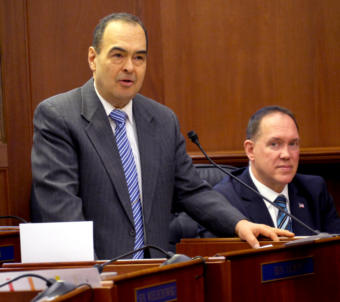
Sen. Donny Olson, D-Golovin, speaks during a Senate floor session in Juneau on March 13, 2019.
Sen. Donny Olson, D-Golovin, speaks during a Senate floor session in Juneau on March 13, 2019. (Photo by Skip Gray/360 North)

State Sen. Donny Olson, D-Golovin, was flown to Anchorage last week after suffering a medical emergency. The 71-year-old lawmaker took to Facebook on Monday to acknowledge the news.

“First I’d like to thank those who have lifted me up in prayer over the years,” Olson said. “I suffered a medical event in Juneau and I put my guardian angels to the test. I received quick care and am well on the road to recovery.”

Olson was in Juneau participating in the opening week of this legislative session. He wasn’t able to provide an exact time for his return.

“I will need some time to heal but rest assured I will be back at 100% soon,” Olson said. “God is good, all of the time.”

His wife, Willow Olson, responded to a tweet by The Alaska Landmine to thank the public for the well wishes.

“We are really grateful for everybody that helped with a quick intervention. He will need to take some time to recuperate, but you know him, he’ll be back to work before we expect it,” Willow Olson said. “Really appreciate that (Gov. Mike Dunleavy) called to check on him. We would appreciate privacy right now.”

Internet disruptions reported in western Alaska due to apparent subsea cable break

An apparent subsea fiber optic cable break is to blame for a widespread internet outage in Northwest Alaska, according to telecommunications company Quintillion.

Users first reported internet issues early Saturday morning. Quintillion subsequently confirmed the outage via Facebook at 10:02 a.m. In the post Quintillion said, “it appears there was a subsea fiber optic cable break near Oliktok Point, and the outage will be prolonged.”

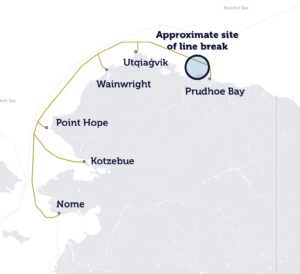
The approximate site of a line break in the Quintillion Subsea Cable Network. (Map from submarinecablemap.com with KNOM edits)

The apparent cable break is in a similar location to an outage in 2023 that left customers without internet for 14 weeks. Repairs were performed by a specialized vessel during the ice-free summer months.
No timeline was provided for resumed service, although Quintillion said it is “working with our partners and customers on alternative solutions.”

When reached by email, a spokesperson for Quintillion reiterated the message shared on Facebook and was not able to share any further details.

The Quintillion Subsea Cable Network runs from Prudhoe Bay to Nome. Service disruptions are expected at each of the line’s stops along the route, including in Utqiaġvik, Wainwright, Point Hope, and Kotzebue.

Plans to expand the network from Nome to Homer are underway although won’t be operational until 2027. The project seeks to limit internet disruptions due to line breaks by rerouting internet traffic north to Prudhoe Bay or south to Homer, away from the site of the break.

In an update on Sunday, Quintillion President Mac McHale said repairs would not be possible until late summer and the company is exploring alternative options to restore service in the region.

Quintillion fiber ring could quell Alaska’s Arctic internet outages

Workers aboard a barge transfer materials to a Quintillion-operated ship. (Courtesy Quintillion)

Just 100 feet under the surface of the Bering Sea, a thin 2-inch-wide cable silently pulses on the seafloor. A flurry of ones and zeroes flash through the cable at near-lightspeed, carrying with it social media posts, Zoom meetings and medical records.

This is Quintillion’s Arctic fiber network, which stretches north from Nome all the way to Prudhoe Bay. There, it meets up with a landline that runs down to Fairbanks and on to the Lower 48. But for coastal communities south of Nome, there’s nothing like it.

Quintillion’s director of operations, Art Paul, said the telecommunications company is taking steps toward changing that.

Map of Quintillion’s future fiber ring around Alaska. (Courtesy Quintillion)

“So Nome, Kotzebue, everywhere north of them gets to use that fiber pathway. We recognize there’s more customers to serve, of course, in the southwest,” Paul said.

For all the good subsea fiber brings – blazing fast speeds and low latency – it comes with its own challenges. The thin armored cables span hundreds of miles on the seafloor, where they’re susceptible to line breaks.

So what happens if a cable does break?

In June 2023, a cable scoured by sea ice 34 miles offshore of the North Slope took Quintillion’s entire Arctic fiber network down. Utqiaġvik, Wainwright, Kotzebue and Nome were all taken offline.

Paul said that this new project will complete a ring around Alaska, giving Quintillion the ability to simply send traffic the opposite direction should another line break occur.

“In the future if there’s an ice scour event or a boat anchor event, we can reroute traffic the other direction,” Paul said. “So never again will those communities be stuck while our ship mobilizes from the Lower 48 to replace that fiber break.”

The new route will stretch from Nome to Homer, where five subsea cables already convene. Paul said Homer’s established infrastructure and port makes it an ideal end point for the new, 950-mile-long cable.

“It’s an ice free port, so it’s a pretty easy place to to do business. But primarily it’s because the other cables land there, it’s kind of a hub for fiber in Alaska,” Paul said.

Quintillion plans to begin construction this summer with help from its new partner, Xtera Inc. The Texas-based company signed a $77 million agreement last November to provide procurement and expertise for the network.

Quintillion said it expects to invest $61 million of its own capital for the project and estimate the total cost to be around $150 million. Construction of the Nome to Homer Express is expected to wrap up by late 2026, with the network operational by early 2027.

Landslides to late freezes: New report makes sense of changes to Alaska’s environment

The updated “Alaska’s Changing Environment” report, which documents the effects of climate change statewide. (Ben Townsend/KNOM)

When Rick Thoman looked ahead to 2024, one big project was on his list. The veteran climate specialist set his sights on updating 2019’s widely-distributed “Alaska’s Changing Environment” report, posted online by the International Arctic Research Center.

“This report is now more than four years old; it’s still getting thousands of unique hits a month on the IARC website,” Thoman said. “And so that told us that this kind of report had enduring value to people in Alaska and beyond.”

IARC teamed up with the University of Alaska Fairbanks and Thoman’s employer, the Alaska Center for Climate Assessment and Policy.

More than 35 people were brought on to contribute to the project — double the number of the first version. Key contributors like IARC’s Brian Brettschneider returned to the project while several new names entered the mix.

The cover, an aerial shot of a 2023 landslide in Wrangell that killed six people, sets a poignant tone for the report. As the name suggests, Alaska’s environment is changing — and its creating new challenges for Alaskans. Thoman said the wording of the title was intentional.

“We specifically did not want ‘Alaska’s Changing Climate’, because the impacts of that changing climate are what people really feel,” Thoman said. “Those are the kinds of things that impact people, and they impact our land and our resources right down to what’s for dinner tonight.”

To help a wide audience understand those changes, sections like winter precipitation begin with the broad statement, “most of Alaska is seeing more mid-winter snow.” Typically, such statements are followed up with a very simple explanation like, “This increase is driven by warmer temperatures that enable air to hold more water vapor.”

Thoman said he worked in tandem with ACCAP’s science communications lead, Heather McFarland, to break things down to the simplest terms.

“Heather will go through and say, ‘That’s jargon, I don’t understand this,’ ‘Oh, that’s good,’” Thoman said. “Heather will do that with text from other experts as well, to get that into the style that you see there.”

a report
A page in Alaska’s Changing Environment 2.0 featuring observations made by Bobby Schaeffer in Kotzebue. (From IARC)

While not new, Indigenous voices are now sprinkled throughout the report. The insights provide anecdotal evidence of the changing environment, like a story shared by Seldovia’s Stephen Payton.

“Elders also say to wait to pick until after first frost, but now the berries are ripe before that point,” Payton shared at an Alaska Berry Futures listening session.

These changes are prompting questions about how Alaskans should respond, both at the local and legislative levels.

“We certainly hope and expect that this information will help to inform some of those discussions, because we’re providing this information in a non-technical way that anybody that’s interested can get to,” Thoman said.

Printed copies of “Alaska’s Changing Environment 2.0” are headed to the American Geophysical Union’s annual meeting in Washington D.C next week. Digital and web versions are available at IARC’s website.

Coast Guard secures new icebreaker from civilian service

The icebreaker Aiviq, seen sailing 116 miles southwest of Kodiak. (From U.S. Coast Guard)

The U.S. Coast Guard inked a deal last month to bring a third icebreaker, the civilian vessel Aiviq, into its fleet. The long-awaited move was announced at the Halifax International Security Forum held in Nova Scotia Nov. 22-24.

From July to September, the U.S. Coast Guard publicly documented at least five separate intercepts of Russian or Chinese vessels in the Bering and Chukchi seas. Press releases announcing the intercepts often noted that the Coast Guard “met presence with presence”.

But with the Coast Guard operating just two polar icebreakers, one each in the northern and southern hemispheres, what happens if one is not operational?

That happened this summer when the 28-year-old polar icebreaker Healy experienced an electrical fire while on patrol in the Chukchi Sea. Other Coast Guard vessels scrambled to fill the gap, although they lack the icebreaking capabilities the Healy and its sister icebreaker the Polar Star bring to the fleet.

Coast Guard Commandant Adm. Linda Fagan said at the forum that following months of negotiations, they’re getting closer to closing that gap.

“Just in the last three days, we have signed a contract to acquire a commercially available icebreaker,” Fagan said.

The Aiviq, which draws its name from the Inupiaq word for “walrus”, was launched in 2011 and has primarily served as a support vessel for oil exploration. Following some modifications, the 360-foot-long vessel will be designated a medium polar icebreaker, the same class as the Healy.

Seated next to Fagan was Canada’s minister of national defense, Bill Blair. He said as climate change transforms the Arctic, it is also remaking global trade routes.

“As the sea ice melts and the permafrost melts, we believe that the Arctic Ocean could very easily become the main point of transit between Europe and Asia, as a trade route, in the coming decades,” Blair said.

The Coast Guard has said it needs as many as nine icebreakers to protect the nation’s interests in the Arctic. According to Fagan, they can’t come soon enough.

“We are behind as a nation. This isn’t an Alaska issue, this is a United States sovereignty and defense issue as it pertains to the Arctic,” she said.

During a Nov. 14 hearing of the U.S. House Subcommittee on Coast Guard and Maritime Transportation, Coast Guard Vice Adm. Thomas Allan said efforts to get the new ship ready for operations are underway.

“We are making tremendous strides in that with the owner. They’ve already painted about a quarter of it Coast Guard icebreaker red,” Allan said.

He said the Aiviq is scheduled to sail to its new homeport of Juneau in the spring of 2026.

Site notifications
Update notification options
Subscribe to notifications