KNOM - Nome

KNOM is our partner station in Nome. KTOO collaborates with partners across the state to cover important news and to share stories with our audiences.
Alaska’s rural animal shelters are struggling to keep up: ‘Everywhere has no room’

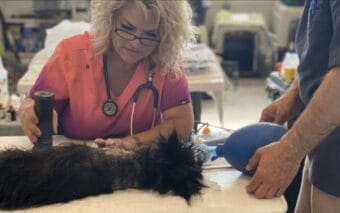
A volunteer shaves the area where the dog will be receiving surgery. (Courtesy of Emily Stotts)

Animal shelters around the state have seen a recent uptick of stray and surrendered animals, and it’s been an especially tough year for one organization who serves the Norton Sound region.

PAWS of Nome is a non-profit animal rescue and advocacy organization that provides no-cost animal related support to pet owners. The organization says it has saved thousands of animals since opening in 2013.

Emily Stotts is the president of PAWS of Nome. She said this year has been overwhelming, and the rescue has reached full capacity multiple times.

“Probably closing in on 700 to 750 animals that have been helped by us this year,” she said.

Animal Care and Control in Anchorage recently experienced several multi-week-long closures due to dogs testing positive for the highly contagious canine parvovirus. All services were furloughed until all animals were healthy, with the exception of pet adoptions.

During the closures, Stotts said rescues around the state received calls from desperate owners looking to re-home their pets. She said when PAWS of Nome reached maximum capacity, she had to deny surrender requests.

She said the number of dumped and stray animals has become too much for rescue organizations to handle on their own, especially in rural Alaska where there isn’t a strong animal control presence.

“It’s just me, and I’m out of space,” she said. “They’re in my own backyard, they’re in three facilities that I run, they’re at my friend’s houses as fosters.”

PAWS of Nome is run by volunteers and is funded through grants and donations.

Stotts said rural Alaska needs more support from government officials. Without government support, she said she worries the PAWS of Nome won’t continue. She cites North Slope Veterinary Clinic in Utqiagvik, which receives funding from corporations and provides animal control and limited veterinary services.

“If we stop what we’re doing here, that is going to devastate what’s going on in Anchorage and Fairbanks and everywhere else,” she said. “Everywhere has no room.”

PAWS of Nome encourages residents to call and write letters to local and state government officials requesting their support of animal rescues.

Northern Alaska cable break repaired after 14 weeks of internet outages

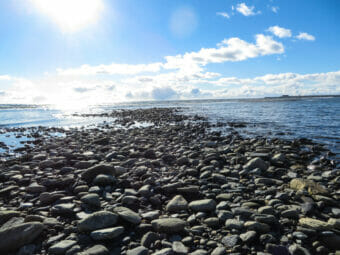
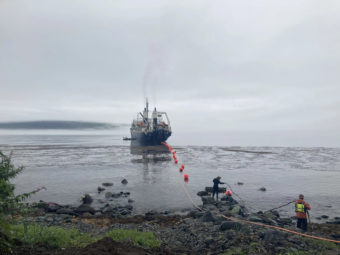
A rocky stretch of coastline near Nome (Laura Kraegel/KNOM)

Repairs are complete to a severed fiber optic cable affecting Internet and cellular services to much of Northern and Western Alaska.

GCI announced the repairs in an email to customers Monday, 14 weeks after the cable was cut in an ice scouring event in the Arctic Ocean west of Prudhoe Bay. Many people in the affected regions experienced spotty internet and cellular services, and at times, no internet connectivity at all.
The company that built and owns the cable, Quintillion, originally anticipated service would be restored in eight weeks, but that timeline slipped several times.

When the cable initially broke, GCI switched customers to the company’s satellite and TERRA networks which allowed for some connectivity. But GCI spokeswoman Heather Handyside said the company is beginning to transfer customers back to the faster fiber-optic service that connects to the Quintillion cable.

“That restoral effort has already begun,” Handyside said. “And I believe that consumer customers are already seeing better service as a result.”

Handyside said GCI will be monitoring the network throughout the week. She said once network levels improve, the company will discontinue the credits it’s been providing customers since the initial cable break in June.

“It’s going to take us a while, maybe you know throughout the rest of the week, to fine tune things to make sure that traffic levels are optimized, and that everyone is receiving the connectivity that they were receiving prior to the break,” she said.

Updates to the network are being made during midnight and 6 a.m. Internet services through Northern and Western Alaska are expected to improve throughout the week. Quintillion cable break outage updates can be found on the company website.

Nome’s urban musk oxen have residents worried about their safety

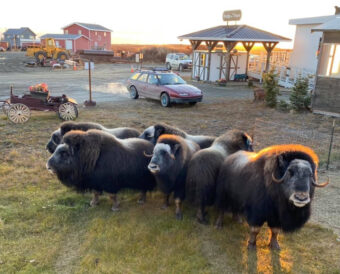
A group of musk oxen near Nome’s Dredge 7 Inn in 2021. (Courtesy Kim Knudsen)

Nome residents are worried about their safety as musk oxen hang around within city limits.

Musk oxen have been spotted in various places around town, including the elementary school and neighborhoods. Musk oxen have reportedly killed or antagonized animals, and they’re keeping people from visiting the cemetery.

And in December of 2022, a musk ox killed a state court services officer as he was trying to haze it off his property’s dog lot near Nome.

Musk oxen disappeared from Alaska by the beginning of the 1900s but were bred in the Bering Strait Region in the 1970s and transplanted to the mainland.

According to the Alaska Department of Fish and Game, the population has grown from 750 musk oxen in the 1970s to more than 4,000 today.

This year, the state is offering 30 musk ox hunting permits for the inner and outer Nome areas. Sarah Germain, a wildlife biologist with Fish and Game, said this should help control the musk ox population in town.

“Hopefully, now that there’s a cow season, folks may be encouraged to harvest a musk ox in the fall,” Germain said. “And we’ll have to assess and see if that does help the nuisance musk ox situation.”

Germain said musk oxen have been coming into town since 2007.

“Since that time, we’ve periodically gotten calls about dog and human conflicts with musk ox,” she said. “I don’t really know that I’d say that it’s increased over time.”

She said residents have used tactics to help deter the animals off personal property, and some are more effective than others.

“Fish and Game staff have learned a lot about getting musk ox enout of an area through time, but it seems like you could yell, you could try to use sirens, there’s water guns,” she said. “Folks have tried various things, but all those things are temporary compared to a fence.”

Sarah Swartz, a Nome resident since 2006, remembers driving down Beam Road to view musk oxen when she first moved to town. But a personal encounter six years later changed her perspective.

“Back in 2012, my dog, in that short time of folding my laundry, he did get gored,” Swartz said. “And that was very, very traumatizing because this big animal who had just attacked my dog was angry and he wouldn’t move. And I couldn’t find my dogs.”

The increasing presence of musk oxen in town prompted Swartz to adapt her daily routines around musk oxen, specifically around her home. She said she goes outside every morning to make sure there are no musk oxen hiding, so she can safely leave her house.

Fish and Game advises residents living in musk ox country to clear brush around their homes to improve visibility and reduce potential encounters with musk oxen. But Swartz said not all Nome residents have the financial means or tools to clear brush or build a fence.

“That takes a tremendous amount of time and money because of resources and stuff that I have to use,” she said. “I really don’t feel like we should be paying for it.”

Swartz said she can’t find a management plan for musk oxen in the Seward Peninsula, but has found plans for other Arctic regions, including Greenland. She said there’s enough land in the region for the musk oxen to be moved and recommends a musk ox farm.

“It’d be great for tourism, and it would be safer for the community and everybody else,” Swartz said. “We could actually get to a point where we could have a higher population and end up having some of those animals harvested for food and it can go to communities in need.”

Nome police didn’t immediately answer a request for comment Friday.

Germain said that Fish and Game will be performing a musk ox survey around the Seward Peninsula next spring that will assess the results of the new bag and cow limits. Limits will be reevaluated for the next hunting season based on those results.

As frustration grows, Quintillion extends timeline for restoring Western Alaska internet service

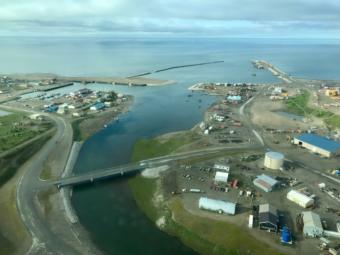
The Port of Nome at the mouth of the Snake River, June 2018. (Photo by Gabe Colombo/KNOM)

Repairs to a damaged fiber optic cable affecting internet and cellular services to much of Western Alaska will now take longer than initially anticipated, according to Alaska-based communications company Quintillion.

The original timeline of 6-8 weeks for restoring services is now 9-11 weeks. Quintillion says repairs to the cable can’t happen until sea ice opens up enough for a repair vessel to get through.
The company plans to begin repair operations Aug. 9-22, if the area is 90% free of ice. In a statement published July 14, Quintillion said a repair vessel would be in the North Slope community of Wainwright by the middle of August on standby for when the ice opened up.

Michael McHale is the President of Quintillion.

“The ice is really on the critical path. It looks like right now that the ice is cooperating with us, and moving as expected, in some cases, even faster than expected. As soon as we can access the area, we’ll go in and start to affect the repair,” he said.

McHale says ice forecasts are moving out quicker than expected and the vessel will be mobilized over the weekend and will then go north. He says ice will likely open the first and second weeks of August, with repairs expected to take up to a week.

In early June [June 13th] the company announced the sub-sea outage was a result of an ice scouring event, located just over 34 miles north of Oliktok Point. Quintillion initially estimated the break could result in a six to eight-week outage. It’s now been six weeks and repairs are still stalled by sea ice, leaving some customers questioning whether repairs will be made before freeze-up.

McHale says that the cable break in early June was the first outage since the subsea cable went live in December of 2017, and that the company is working to improve how the cable is buried.

“We’ll take some risk mitigation steps to make it even more durable than it was. We buried it below the seabed floor, we will do that, again, we may use concrete to cover the trails,” he said.

McHale says Quintillion is looking at securing a bypass route that would create a ring between Fairbanks and Homer to prevent another outage from happening in the future. In June, the company received a nearly $90M grant from the National Telecommunications and Information Administration toward expanding the subsea broadband project. McHale says they started communication right after the break to contact their customers directly. The company has been posting updates on several of their social media outlets, although many affected by the break are having trouble viewing the online updates.

“I don’t want to put a date out there that disappoints at this point, because again, the ice cover is really the gating item. If we had visibility at this point, we’d be in the area making the repair right now, but you know, it’s important to get the services back up and running,” he said.

Nome Mayor John Handeland says Quintillion has kept him informed, when there are updates.

“I’m not expecting a regular report from them. As to their process, I know things won’t happen till August. Should they have something new and exciting I know they’ll call me, or I can pick up the phone and call them,” he said.

Frustration is growing as businesses and individuals are approaching seven weeks without reliable internet services. Some residents have opted to order Starlink internet, a satellite internet provider, while others have adjusted to the changes.

Businesses in Nome have been reluctant to speak to KNOM about their experience with Quintillion, as many have turned to Starlink. Communication remains minimally affected for those with landlines.

Internet is out for much of Western Alaska, and repairs could take weeks

A ship leaving Unalaska dragging a heavy cable behind it
The C/S IT Intrepid begins deploying subsea fiber in Unalaska. (Photo by Laurelin Kruse/KUCB)

Repairs to a fiber optic data cable suppling nearly all of Western Alaska are underway, though a full restoration of internet and some cell service could take up to two months.

That’s the word from Quintillion President Mike McHale.

“This will be a long-term outage,” he said. “We’re talking about probably a six-to-eight-week turnaround time for the ship to mobilize and for the ice to clear out of the region, but that is the current situation.”

According to a statement Monday from Quintillion, service on the subsea fiber optic network was interrupted over the weekend after a fiber cut caused a system-wide outage.

Initial assessments indicate an offshore cut north of Oliktok Point, near Prudhoe Bay. McHale says heavy ice is the likely cause of the cut.

“We believe that the cut, and we’re confirming this, but it’s a high probability that the cut was a result of significant ice scouring event,” McHale said.

The broken line is 34 miles offshore, at a depth of about 90 feet.

According to McHale, two repair ships are being mobilized to go to the location of the break.

Nome brothers take home $500k for winning ‘Race to Survive: Alaska’

The first-season finale of “Race to Survive: Alaska” was broadcast Monday, June 5 at the Katirvik Cultural Center in Nome. (Ava White/KNOM)

Nome residents and brothers Oliver and Wilson Hoogendorn, competing as the AK Boys on USA Network’s “Race to Survive: Alaska” TV series, took home the championship on Monday during a watch party in front of a packed hometown audience.

The series finale was viewed by more than 100 attendees at the Katirvik Cultural Center.

After showcasing their win, which includes a $500,000 cash prize, in front of the standing-room-only crowd, they said this is what was most challenging.

“Probably starving for like 50 days,” the pair said. “One hundred percent.”

The first season of Race to Survive: Alaska aired starting in March of this year and showcased eight teams embarking on a competition to survive the Alaskan wilderness. The brothers competed over the summer across the 50-day survival course, becoming the first winners of the show.

The eight teams of two competed in six races over 100 miles of wilderness in rough and rural Alaska.

The brothers faced treacherous terrain and weather, but persevered and brought the win home to Nome. They said they needed each other more than anything else during the competition.

“I think with any other partner, wouldn’t have gone as well, so I’m glad we had each other,” Oliver said.

“If I didn’t have my brother as a partner, we probably wouldn’t have won,” Wilson said.

The teams were only allowed to use what they could carry on their backs and used their wildland skills to make it through each race.

With their winnings, the pair say they plan to give back to the Nome community, and they thanked numerous family members, friends and supporters after the airing of the episode.

Site notifications
Update notification options
Subscribe to notifications