A Russian Su-35 fighter jet crossing in front of an American F-16 during a Sept. 23, 2024 intercept in the Alaska Air Defense Identification Zone. (Screenshot from NORAD video)
After an Air Force pilot’s close encounter with a Russian fighter jet last week, U.S. Sen. Dan Sullivan is calling for the U.S. military to continue building its presence in Alaska to “meet force with force.”
In a video of the Sept. 23 encounter released by the North American Aerospace Defense Command, a Russian Tu-95 Bear bomber can be seen flying to the left of an American jet. Suddenly, a Su-35 jet passed the American F-16 fighter on its left as it rolled to the right.
The F-16 pilot reflexively banked right to avoid a collision as the Su-35 flew off into the distance.
The reckless and unprofessional maneuvers of Russian fighter aircraft—within just a few feet of our Alaska-based fighters—in Alaska’s ADIZ on September 23 put the lives of our brave Airmen at risk and underscore the escalating aggression we’re witnessing from dictators like… pic.twitter.com/uutqZYBaYn
In a press release, Sullivan said that such a maneuver is dangerous and puts lives at risk.
“The reckless and unprofessional maneuvers of Russian fighter pilots — within just a few feet of our Alaska-based fighters — in Alaska’s ADIZ on September 23 put the lives of our brave Airmen at risk and underscore the escalating aggression we’re witnessing from dictators like Vladimir Putin,” Sullivan said.
Sullivan also called for increased focus on military projects in Alaska, like the port expansion project in Nome. Once complete, the port expansion in Nome will be capable of hosting all U.S. Navy vessels except for the U.S.’s fleet of enormous 1,100-foot-long aircraft carriers.
“We need to answer force with force and continue building up America’s military presence in Alaska and the Arctic with more infrastructure, like the strategic Arctic port at Nome and reopening the Adak Naval Air Facility, and more military assets,” Sullivan said.
Sullivan’s call to reopen the Adak Naval Air Facility, which closed in 1997, comes as the U.S. military recently moved 130 troops to Shemya Island some 400 miles west of Adak Island.
A bald eagle is seen on Feb. 6, 2018, perched in a tree in the Kodiak National Wildlife Refuge. (Photo by Lisa Hupp/U.S. Fish and Wildlife Service)
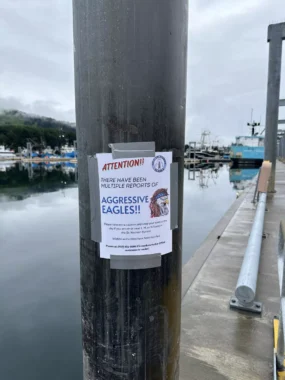
Dock users at Kodiak’s biggest boat harbor are being urged to keep an eye out for eagles in the area, as several attacks have been reported in the last week. U.S. Fish and Wildlife staff say this is a rare occurrence, but residents should still be wary when in the area of St. Herman Harbor.
Kodiak’s Harbormaster and Port Director Dave Johnson posted on social media the morning of July 11, warning everyone who is using St. Herman Harbor, also known as Dog Bay, of at least three eagle attacks in a specific area of the dock.
Kodiak Island Borough Assembly member James Turner confirmed the attacks at an assembly work session on July 11, and said a few people required sutures on their heads. Turner is also the local plant manager for OBI Seafoods.
“Be careful over in Dog Bay, walking on L and M floats. There have been multiple eagle attacks,” Turner said. “U.S. Fish and Wildlife is looking into this. But multiple people have been attacked and multiple people have needed stitches.”
Steve Lewis, a wildlife biologist at the U.S. Fish and Wildlife Service, with a focus on eagles and raptors, said this type of encounter is “strange” for the Kodiak area.
“I’ve dealt with eagles in lots of places and normally they just aren’t that defensive. Like I’ve done things like I’ve climbed nest trees. And most of the nest trees, in fact all of them, the birds [the eagles] don’t dive bomb you as you’re climbing, like when you get to the nest,” Lewis explained. “They are definitely aggravated. You can see them flying around and they are calling, but they aren’t diving at you or anything aggressive.”
Kodiak Ports and Harbor staff put flyers up near Floats L & M of St. Herman Harbor warning of bald eagle attacks in the area. (Davis Hovey/KNOM)
But in Kodiak, Lewis suspects this one aggressive eagle was not protecting a nest. Instead its behavior might be due to the abundance of dead fish and food scraps available around the docks. He adds that it could possibly be a pair protecting a nest, but he is not as convinced of that explanation. Bald eagle’s breeding season goes from March to the end of August, according to Lewis, with the young fledglings starting to fly out of the nest at this point in July or earlier.
“I think they are probably getting fed by people around the harbor,” Lewis stated. “And I think that in a similar way that it kind of changes how bears are, if they start getting food from people, they become more aggressive towards people. I think that might be similar to what’s going on with these birds.”
The bald eagle is the national bird of the United States and has certain protections, although permits can be obtained for special uses like for science or to make Alaska Native handicrafts under the Bald and Golden Eagle Protection Act, and Migratory Bird Treaty Act. The USF&WS just updated its permit program for bald and golden eagles earlier this year in April. As such, it is illegal to harm or kill a bald eagle.
Lewis recommends anyone walking in the area of St. Herman Harbor should hold something above their head to protect themselves, or continue to watch the birds so that they won’t swoop down and attack other people. Lewis said eagles tend to attack the highest point of a person that is visible to them, so holding a hat or umbrella above your head could help protect you from injury.
The remnants of Stebbins’ school, seen from a Bering Air flight. (Ben Townsend/KNOM)
STEBBINS — Gov. Mike Dunleavy has declared a state disaster in the Norton Sound community of Stebbins, where the local school and several outlying buildings were destroyed in a fire Wednesday.
Alaska State Troopers said no injuries or deaths have been reported from the fire.
On Thursday in Stebbins, the smell of burning rubber filled the air as residents pored over what was left of their only school. The pungent odor wafted out of piles of dirt on the north side of the ruins, where red rubber mulch once laid under the school’s playground. The melted remains of a metal jungle gym protruded from the pile as still-red-hot embers glowed in the background.
The school is a complete loss. Eight nearby buildings were also destroyed in a fire that started around 4 p.m. Wednesday. The fire began in a shop adjacent to the school where an old boiler was kept and then spread to a welding shop next door.
Fire begins to spread from Stebbins School to a nearby housing unit. (Courtesy George Dan)
Stebbins resident George Dan said he received a text from a friend around 5 p.m. Wednesday that simply read “the school is on fire.” Still in his flip-flops, Dan grabbed a thick Carhartt jacket and hopped on his four-wheeler. The Stebbins School graduate didn’t hesitate to join the effort to save the structure.
“I just wanted to be there to help, I’m just trying to do my best and be a part of whatever crew there was,” Dan said. “I literally grew up in that building, I have so many memories and it’s a tragedy that it’s lost. Everybody tried, the whole community, they were all doing the best we can.”
Dan desperately jammed his thumb into the end of a long hose to increase the reach of the low-pressure water line, he lifted his thick jacket to insulate his face from the extreme heat. At times, he doused himself with water so he could stand his ground just a little bit longer.
The blazing-hot temperatures caused the wood siding of the Stebbins School to combust. In a matter of an hour shifting winds spread the fire from the north side to the south side of the building. Residents formed a bucket brigade from the nearby Norton Sound and tossed water on the school.
As the local response unfolded, Nome Volunteer Fire Department firefighters 116 miles north scrambled to fly in help. They sent eight firefighters, hoses, water couplings and a water pump. The first team arrived around 8:45 p.m. Wednesday, with a second flight arriving around 9:15 p.m. The crews promptly got to work and installed a water pump in the ocean water.
Warped metal from the school’s boiler room. (Ben Townsend/KNOM)
As the fire continued to grow, local construction company Tapraq Rock used dozers and loaders to push two nearly brand-new portable classroom buildings into the blazing school. Dustin Scalisi, manager of Tapraq Rock, helped the community make what he called a “bold” decision.
“We were like, ‘Well, the school’s done’, now let’s save the portables,” Scalisi explained. “Then we were like ‘The portables are done, now let’s save the rest of everything else,’ so that’s when we took bold action and we started pushing everything in.”
Tapraq’s crew moved massive amounts of dirt to establish a perimeter. In coordination with the Nome firefighters, they successfully prevented any further spread. By 2 a.m. Thursday, the fire — and the school it incinerated — were reduced to a smoky pile of wood beams and sheets of metal.
As the people of Stebbins struggle with the fallout of the fire, leaders in the community met to light the path forward. Over 30 people crammed into the office of Tapraq Rock where its employees, as well as representatives for Stebbins and the Bering Straits School District, listened attentively as City Administrator Daisy Katcheak opened the meeting.
“Right now I’m looking at 102 homes that are disabled with no electricity, no heat. I’m worried about their freezers and children that are dependent on nebulizers and oxygen for the elders,” Katcheak said.
Representatives from regional nonprofit Kawerak and nearby village St. Michael joined the meeting by phone. Katcheak outlined her needs for the community and requested Kawerak’s assistance with fuel deliveries to keep generators running. The nonprofit provided guidance on the joint resolution Stebbins was drafting with the nearby village of St. Michael to request a disaster declaration from Dunleavy.
Part of the school’s roof rests on the ground. (Ben Townsend/KNOM)
The declaration makes the village eligible for reimbursement for a number of recovery projects. In the joint request, Stebbins officials sought funding for improvements to the road connecting Stebbins with St. Michael in case students need to travel there for school.
The school district’s director of maintenance, Gary Eckenweiler, traveled to Stebbins to assess the situation. He issued an estimate for how long it would take for students to return to a new school.
“Stebbins will get a new school built. That’ll be three years, minimum,” Eckenweiler said. “That’s really the only good thing about this whole thing.”
A meeting will be held on Friday between Stebbins officials and district administrators to discuss the path forward. According to Eckenweiler, no option will be left off the table.
“Tomorrow’s meeting we’re going to put any potential idea for how we can get school operating in August out there, and then we’ll start whittling those ideas down to the good ones,” Eckenweiler said.
Stebbins lacks a fire department, which prompted the response by air from Nome. Many in the meeting expressed frustration at the precious hours wasted trying to fight the fire with inadequate resources.
Stebbins City Administrator Daisy Katcheak looks out of a window. (Ben Townsend/KNOM)
Katcheak, the city administrator, said she paced around town through the night supporting her community. She said she didn’t sleep until 8 a.m. Thursday, and after less than two hours of rest she was right back at it.
Katcheak led the community through 2022’s Typhoon Merbok,the destruction of the village’s only grocery store in a fire just two months later, and now Wednesday’s fire. As she reflected on her turbulent tenure, she said she felt assured that her place as leader of this community is where she’s supposed to be.
“I had to go cry away from people,” Katcheak said as she recalled the night of the fire, fighting back tears. “I was asking God for something, and he kept coming to encourage me. And I said, ‘God is this — is this what I’m supposed to be doing?’”
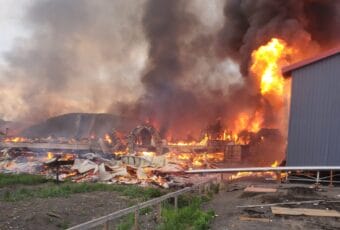
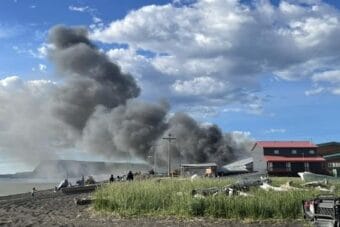
Smoke rises from a Wednesday, June 26, 2024 fire in Stebbins. (Courtesy Pamela Pete via Facebook)
A fire that started Wednesday evening in Stebbins has destroyed the local school and several other nearby buildings.
Stebbins is located on St. Michael Island about 120 miles southeast of Nome.
According to eyewitnesses in Stebbins, the fire started in a shop next to the Tukurngailnguq School at about 7 p.m. Wednesday. The school, shop, two new portable buildings and nearby housing are expected to be total losses.
Bystanders live-streamed the fire on Facebook as regional residents offered up words of support in the comments. The videos revealed a fire that had already engulfed much of the southern side of the school. Streams of water could be seen flowing up from the ground as firefighters attempted to slow the spread.
Witnesses reported the smell of burning rubber in the air as rubber mulch from the school’s playground caught fire.
Heavy equipment was used to dig a perimeter around the school. As of Thursday morning, it appears to have helped contained the fire.
The Nome Volunteer Fire Department began deploying to Stebbins at about 8 p.m. Wednesday, with a Bering Air Cessna Grand Caravan carrying one crew member and equipment.
Volunteer firefighters could be seen assembling gear at Nome Airport, waiting to catch the next flight to Stebbins. A King Air departed Nome Airport at 8:47 p.m. with additional equipment and crew.
NVFD Chief Jim West Jr. confirmed to KNOM that six firefighters are being sent to Stebbins. West has received reports that the fire started in a boiler room in a nearby shop building, although that is still to be confirmed. Witnesses reported hearing an explosion coming from the direction of the shop.
The school is located near the town’s water plant and teacher housing. In the late evening 10-mph northern winds shifted and began to flow from the south, creating new challenges for firefighters attempting to contain the blaze.
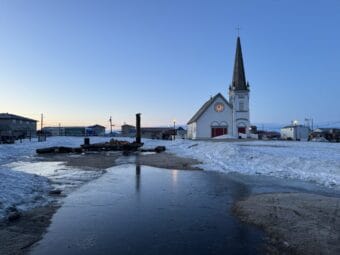
The Iditarod Trail’s famous Burled Arch rests in pieces scattered across the ground with Old St. Joe’s Church in the background. One of the pillars of the arch lies on the ground. (Ben Townsend/KNOM)
The iconic Burled Arch that marks the finish line of the Iditarod Trail Sled Dog Race collapsed on Saturday near Old St. Joe’s Church in Nome. Residents looked on in awe as they took part in a Ties and Tiaras event taking place just 100 feet away at the church.
The wooden arch fell as the City of Nome experienced its first 40-degree temperatures since Oct. 31. The high temperature observed at Nome Airport on Saturday was a balmy 44 degrees.
The right pillar of the Burled Arch remains mostly intact. One of the pillars of the arch lies on the ground. (Ben Townsend/KNOM)
The Burled Arch most recently underwent renovations in July 2013.
KNOM has reached out to the Iditarod Trail Committee for more details on what happens next.
Marjorie Kunaq Tahbone works on a replica of an earring needed for a scene in HBO’s “True Detective: Night Country.” (Courtesy of Marjorie Kunaq Tahbone)
The latest season of the HBO series “True Detective” — titled “Night Country” — features a fictional town in Alaska called Ennis. While most of the filming was done in Iceland, some scenes were shot around Nome. Producers have been in touch with locals to get insights and feedback for the show.
Marjorie Kunaq Tahbone was one of five people on a team called the Iñupiaq Advisory Council, which advised the show. She said the producer’s goal was to “make the show about a place like Nome.”
“They just wanted people who were from up here to help advise the writing, then the whole process,” Tahbone said.
Tahbone said the board reviewed the scripts for all six episodes featuring Ennis, and they shared their concerns with writers about scenes and lines that seemed inaccurate or questionable.
Marjorie Kunaq Tahbone stands with actress Jodie Foster at the premiere of “True Detective: Night Country.” (Courtesy of Marjorie Kunaq Tahbone)
One of those changes was featured in the first episode.
“There’s a scene where there’s caribou, but in the original script it was elk,” she said. “And we’re like, ‘we have no elk in Alaska, let alone up in the Arctic.’”
She said the council encouraged producers to include Iñupiaq words and learn about the meaning behind traditional Alaska Native stories. Tahbone said they even helped choose most of the Iñupiaq names for characters in the town.
The council also encouraged including trigger warnings for the show because some episodes involve missing and murdered Indigenous people.
“We advised about leaving traditional parts in and taking other elements of the story out just to maintain the integrity of the story and kind of keeping it true, but also kind of holding it close,” she said. “It’s kind of like not wanting to give away too much, because people who aren’t from our area who weren’t raised in our culture, can misunderstand or just not have any clue what’s being said.”
Tahbone is also a traditional Inuit tattoo artist and helped design some of the tattoos on screen.
She said the show is a “melting pot” of unique cultures and includes people from other Arctic communities like Greenland and Canada.
Close
Update notification options
Subscribe to notifications
Subscribe
Get notifications about news related to the topics you care about. You can unsubscribe anytime.