KNOM - Nome

KNOM is our partner station in Nome. KTOO collaborates with partners across the state to cover important news and to share stories with our audiences.
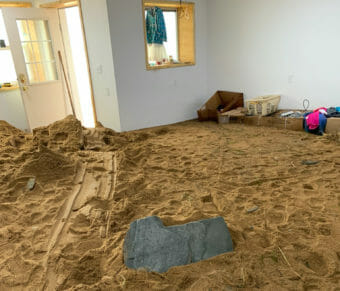
In Golovin, Alaskans shovel sand out of their homes after historic storm

“Inside my house is a sandbox,” Golovin resident Willow Olson posted on Twitter. “If I don’t smile about this I will cry.”

Golovin residents are in clean-up mode as their community works to restore power, phone service and clear debris. After the flood waters receded from the weekend’s historic fall storm, some locals are left with feet of sand in their homes.
“At my place we’ve got 3 feet of sand we’re still shoveling out with the crew here — trying to get the sand out of the living area so we can get the sheetrock to go ahead and dry off,” said Alaska Sen. Donny Olson of Golovin.

Other residents in his hometown are dealing with the same issues, according to Olson. But some of his neighbors were not as lucky and their homes were moved across town or floated away completely.

“Housing is still the major issue down here cause so many buildings have been shifted or knocked off their foundations. There are now debris including houses in the middle of the road, blocking the way, that need to be cleared before we can get the roads back open,” Olson said.

Golovin is about 70 miles east of Nome and home to roughly 180 people. The state says it’s one of the communities hardest hit by this weekend’s powerful storm, remnants of Typhoon Merbok. Once the storm hit the Friday night into the next morning, water levels rose rapidly to 9-10 feet above the normal high tide line. The National Weather Service forecast highest water levels for Saturday evening .

That same day, resident Dwight Amaktoolik posted on social media that half the community was under water and Golovin had lost power.

https://twitter.com/AlaskaWx/status/1571197657259057152

As of Monday afternoon, power was partially restored in the community but not at the Golovin school, Olson said. The priority is to maintain electricity for as many homes as possible so residents can save the subsistence food stored in their freezers, he said.

“Because we had a number of people who had to evacuate because there was no heat in their homes,” he said. “Now that we’ve got power back on we want to make sure it stays there. And then after that we make sure there’s some kind of food security situation, that we have something to eat as well as something to drink.”

Outside agencies and organizations have been sending relief to Golovin directly, whether through the World Central Kitchen delivering food, Northern Air Cargo and Ryan Air bringing in bottled water, or even via online donations.

A GoFundMe page was started for the community by a former teacher in Golovin. It had already raised over $5,000 in the first six hours of being posted.

“That was something to boost our… like we hadn’t been forgotten here in Golovin,” Olson said.

The Alaska National Guard has deployed to Western Alaska to assist with recovery efforts over the coming days.

Mid-storm fire on Front Street destroys restaurant, spares the Nome Nugget Inn

Firefighters pour water on the ruins of a building right next door to the Nome Nugget Inn
The Bering Sea Bar and Grill in Nome was demolished after catching fire in a storm on Sept. 17, 2022. (Photo courtesy of Danielle Slingsby)

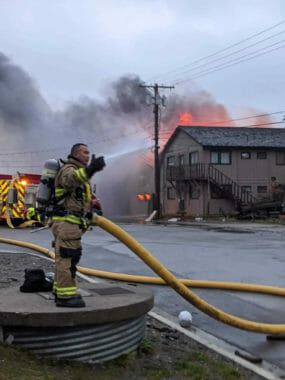
The Bering Sea Bar and Grill is gone after a fire started in the building on the evening of Sept. 17 as Nome was being buffeted by a powerful fall storm.

“Definitely was an active fire. We had three go to the hospital, get treated and released. There were no deaths involved,” Nome Volunteer Fire Department Chief Jim West Jr. said.

A man stands holding a firehose as a building burns across the street
The Nome Volunteer Fire Department fights a fire at the Bering Sea Bar and Grill on Sept. 17, 2022. (Photo courtesy of Garrick Fuller)

TJ Wright, a local Nome resident who witnessed the fire, told KNOM he heard an explosion after some propane tanks burst and the Bering Sea Bar and Grill was, “engulfed in flames, sending embers flying all over town.”

Firefighters demolished the building Saturday evening to keep the fire from spreading to other buildings.
“The bar itself, the restaurant was a total loss. We were able to save the hotel, which is three feet next to it,” West said.

Part of the backside of the adjoining Nome Nugget Inn suffered some damage, but the hotel structure is intact.

West said Sunday morning that there were still some hotspots at the building site, and the department was monitoring them.

Bering Strait communities plan to fly in drinking water after massive storm

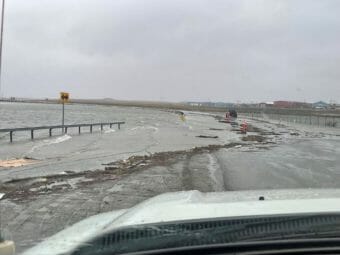
A photo taken from the driver's seat of a white truck showing a road partially flooded and littered with debris
High water washes over Nome’s Seppela Street on Saturday, Sept. 17, 2022. (From Alaska DOT&PF)

As water levels receded Sunday, residents in the Bering Strait region began taking stock of the damage done by the strongest fall storm to hit Western Alaska in 50 years. The storm destroyed sea berms, knocked homes off their foundations and left some communities with contaminated drinking water.
In Teller, the forecast from the National Weather Service had predicted that all 230-plus residents would have their homes completely flooded during the storm. But Mayor Blanche Okbaok-Garnie says the community was prepared and a little bit lucky.

“We lost parts of our seawall. We lost quite a bit of the rocks and gradians that hold up the seawall and then we lost some of the planks, treated planks,” Okbaok-Garnie said. “But for the most part…the homes were dry. Some of the water went up and around some of the homes and boats.”

Across Norton Sound, in Unalakleet, residents were evacuated Saturday afternoon to the local school until the notice was lifted Sunday morning. Despite having high water and debris on the airport ramp, the local airport was operational Sunday.

The city office also reported a complete water pressure loss during the storm, along with power outages, which has led to a boil water notice and conserving of water until the city can reach their pump house.

There could be some temporary relief coming to Unalakleet and several other communities in the Norton Sound that are without potable water.

Nome Mayor John Handeland said during Sunday’s city emergency operations meeting that Northern Air Cargo, other freight carriers and the Alaska National Guard would be delivering bottled water and supplies to communities without drinking water.

“NAC does have a couple freighters that are scheduled to come our way,” Handeland said. “Their first load, sounds like it’s going to be bottled water that needs to get out into communities around our area. The biggest concern that I mentioned to the governor and (Alaska National Guard Adjutant) General (Torrence) Saxe is probably the food supply and getting the bypass mail and cargo going.”

In spite of rising water levels threatening the Nome airstrip over the weekend, there was no standing water on the runway or significant damage, so flights resumed Sunday.

Throughout the Nome area, water levels rose to about nine feet above the normal high-tide line during the storm. That’s according to Rick Thoman, a climatologist with the University of Alaska Fairbanks’ Alaska Center for Climate Assessment and Policy.

“We can say for sure, this was the highest storm surge for Nome since the great November 1974 storm,” Thoman said. “This was about eight inches higher than the Bering Sea superstorm in 2011.”

A house in a river, hung up on a bridge
A house rests against Nome’s Snake River bridge on Saturday, Sept. 17, 2022. (From Alaska DOT&PF)

On Saturday, a house from Belmont Point was swept into the Snake River and trapped under the bridge. City officials enlisted help from gold miner Sean Pomrenke to remove the house in sections and haul away the debris Sunday.

The city is also assisting the seven local residents who are staying at the Nome Recreation Center, which was set up as the emergency shelter during the storm. That shelter is likely to be operational for the next few days.

Locally the cleanup process has already begun, with the State Department of Transportation coordinating to make Nome’s roads passable again. Calvin Schaeffer, DOT’s regional superintendent for the Western District, says the agency will be assessing the damage to Nome-Council Road which was significantly eroded in certain sections on the east end of town.

“We’re trying to get a grader out toward the Cape [Nome] and then beyond that, assess damages and maybe take an engineer with him,” Schaeffer said. “Then we’re going to go from there and basically see what we can do to open it back up, and do what we can before winter.”

The Nome City Council is scheduled to meet at noon Monday to make a formal disaster proclamation for the storm.

Western Alaska braces for coastal flooding and 90 mph gusts from potentially historic storm

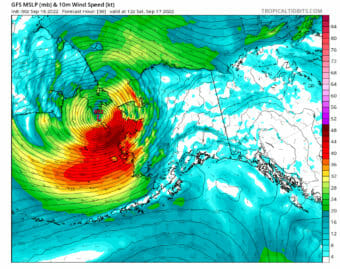
A storm tracking map showing an intense red area covering most of the Bering Sea
An aerial view of the incoming September storm on track to hit Western Alaska today and tomorrow. (Storm track from Rick Thoman with UAF ACCAP, Aug. 16, 2022)

As a significant fall storm approaches Western Alaska, the state Department of Homeland Security and Emergency Management is asking residents to prepare as best they can to protect life and property.

What’s left of Typhoon Merbok is on a textbook track into the Bering Strait, said Ed Plumb, a meteorologist with the National Weather Service Office in Fairbanks.

“The remnants of that [moved] up into the Bering Sea Thursday, and then move northeast and track towards the Bering Strait,” Plumb said, “And then into the Chukchi Sea through Saturday.”

Thursday night, seas were as high as 41 feet in the Western Aleutians, according to the National Weather Service in Anchorage.

Because the storm is estimated to bring high winds and coastal flooding later today, DHSEM is urging communities and residents to make last minute preparations now. Claude Denver, the response manager for the state emergency operations center, said people in Western Alaskan should secure large equipment or loose materials, stock up on drinking water and check on their neighbors in need.

“We expect that there may be up to 90 mph gusts. The same kind of weather conditions that would complicate flying, would complicate any kind of aerial delivery of materials or response. So that’s something to keep in mind. For most communities, while the storm is going on, folks have to employ your local emergency plans in preparation to kind of get through the first 48 to 72 hours of the event,” Denver said.

The strongest wind gusts are expected later tonight along with rapidly increasing storm surge throughout the night.

https://twitter.com/AlaskaWx/status/1570844633458155520?s=20&t=uek9G_8O2K4vbYnU8yS_JA

This applies to communities along the Yukon Delta Coast, the Norton Sound, and throughout the Bering Strait. The peak storm surge could rival the Bering Sea superstorm from November of 2011. But without any sea ice to buffer coastal communities this time around, Plumb says it could cause severe coastal flooding.

“The highest storm surge is going to be in the Northern Bering Sea. We’re looking at storm surge values from 8 to 12 feet over portions of the Southern Seward Peninsula and then down further south, towards the Yukon Delta, 5 to 8 feet,” Plumb said.

Based on historical climate records in Alaska, going back over the last hundred years, this could be the strongest September storm ever recorded in the Northern Bering Sea, according to NWS.

Denver emphasizes that for now, communities should activate their emergency response plans. But once the storm settles down, then the state will respond with the appropriate resources, Denver said.

“We’re really not quite sure what the impact is going to be,” Denver said. “So we really want to make sure that if something happens in a community, if they could reach out to us, the State Emergency Operations Center at (907)428-7100, and let us know what they find; if there’s flooding, if there’s damage, [high] winds, resource needs, if they’ve got people sheltering, if the power is out.”

For more detailed information on what local impacts this storm could have in your community, go online to NWS Fairbanks’ Facebook page.

Storm of the decade forecast for Bering Strait region

Front street in Nome, soaked and covered with debris
The aftermath of the infamous storm that ravaged Nome and environs in October 2004. Here is the east end of Nome’s Front Street just after the storm had passed, littered with driftwood and large rocks. KNOM provided live coverage and emergency advisories throughout the event. (Photo from KNOM file, 2004).

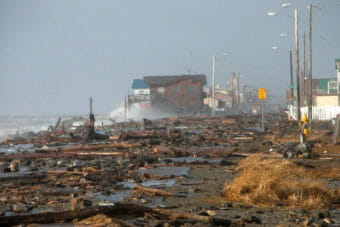
The National Weather Service is forecasting coastal flooding in Nome and across Western Alaska this weekend, with potential storm surge reaching up to 14 feet above normal levels. If this multi-day fall storm hits Western Alaska as predicted, storm surge would reach levels rarely seen over the last 50 years.

Based on the latest forecast from the Weather Service office in Fairbanks, significant storm surge and high wind will affect the coast of Western Alaska from Point Hope south to Hooper Bay starting tomorrow.

The Weather Service currently estimates water levels will rise between eight and 11 feet above normal high tides in the Nome area, with the likelihood of the Council Road being completely covered in water.

The forecast also calls for powerful winds along the Bering Sea coast, with gusts as high as 90 mph possible in some places.

The storm could be just as damaging as the November, 2011 Bering Sea superstorm and have similar coastal flood impacts, according to the Weather Service. The City of Nome announced on social media that the residents in Belmont Point area should be prepared to evacuate if necessary.

Climatologist Rick Thoman with the Alaska Center for Climate Assessment and Policy at the University of Alaska Fairbanks told KNOM via email that the latest information suggests Nome will see some of the highest ocean levels ever recorded since the local sea wall was constructed. Nome’s seawall was completed in June of 1951, according to the U.S. Army Corps of Engineers, but updated to something similar to its current form in the mid-1970s.

https://twitter.com/AlaskaWx/status/1570481928813551616


Thoman said that the timing of tides and the highest storm surges will determine where coastal flooding will be the most severe.

“Coastal flooding is certain this weekend, the only question is how bad,” he said.

Even the UAF research vessel Sikuliaq, which was docked in Nome the afternoon of Sept. 14, left town and headed north ahead of schedule to avoid the worst of the storm.

This post has been updated.

Gambell National Guard members to receive Alaska Heroism Medal for 1955 rescue

The broken-off tail of an old plane lying on the tundra
Part of the Lockheed P2V-5 Neptune wreckage still remains in Gambell. (Photo courtesy of Gay Sheffield/UAF Northwest Campus and Alaska SeaGrant)

The Alaska National Guard and the Alaska Office of Veterans Affairs plan to award the Alaska Heroism Medal to the families of 16 members of the Alaska National Guard in Gambell. The awards are being presented for the rescue of a downed Navy air crew almost 70 years after the event.

On June 22, 1955, a U.S. Navy patrol plane took off from Kodiak with a crew of 11.

The crew’s mission was to patrol U.S. airspace, check navigational aids and document sea ice, according to Verdie Bowen, director of the Alaska Office of Veterans Affairs.

About 200 miles west of Nome, the crew encountered two Soviet MiG-15 fighter jets, which fired on them. They attempted to hide in the cloud cover, but the MiGs managed to disable one of the patrol plane’s engines, and the crew crash-landed on St. Lawrence Island about 9 miles south of Gambell.

David Assard, the navigator, described the landing in an interview with Alaska Dispatch News in 2015.

“The landing was as beautiful as you could imagine, with the notable exception that, because we had no wheels and there were a lot of boulders and rocks on shore, they ruptured the center tank,” Assad said.

He said the fuel ignited, causing a fire inside the plane.

“As the plane decelerated, the fireball didn’t, and it rolled forward and burned everybody,” Assard said.


June Walunga, daughter of one of the National Guard members who responded to the crash, remembers being in Gambell and watching the plane come down.

“I was seven years old, and I remember the sound and the plane going over Gambell,” she said. “It was thundering to us. You know, we never heard that kind of sound back then. And it’s right there very close to your head. And shortly after that, I saw smoke.”

None of the crew died in the crash, but all of them sustained injuries, including burns, shrapnel and bullet wounds.

Staff Sgt. Clifford Iknokinok and three other members of the Gambell First Scout Battalion were seal hunting nearby and made their way to the crash site despite the Soviet fighters continuing to circle overhead. Upon realizing that they didn’t have the necessary equipment to help the air crew, Iknokinok set off for Gambell to gather additional assistance. Before he made it to Gambell, though, he ran into several of his fellow National Guard members, who were already on their way to help.

The National Guard members used umiaks to transport the injured air crew back to Gambell. June Walunga remembers them arriving in town.

“I remember I was holding my mother’s hand, and we were walking towards the beach where the boats were coming in, and they were carrying these people on stretchers going up the beach. Some had bandages wrapped on them and their arms; some of them were halfway up on their shoulders,” Walunga said.

After arriving in Gambell, the crew’s injuries were treated. A team from Elmendorf Air Force Base retrieved them two days later. Bowen says it was only due to the quick action of the Gambell First Scouts that all 11 members of the air crew survived.

But if this all happened in 1955, why is the National Guard awarding medals in 2022? There’s a simple reason, according to Bowen.

“In 1955, there (were) no peacetime medals in the active military or in the National Guard,” he explained.

Brigadier General John Noyes presented the members of the Gambell First Scout Battalion with letters of commendation for their actions.

“For that time, that was appropriate for 1955 and, in reality, that was the only thing that he really had in his awards branch to provide,” Bowen said.

In November of that year, the U.S. Navy also recognized the Gambell First Scouts by awarding Honorary Naval Aviator Designations to Master Sergeant Willis Walunga and Staff Sergeant Clifford Iknokinok, the senior members of the unit. The other members received letters of appreciation from the Navy.

After a review by Major General Torrence Saxe, the current adjutant general of the Alaska National Guard, the awards were upgraded to the Alaska Heroism Medal, currently the highest award for heroism in the Alaska National Guard. The medals will be presented to the families of the members of the Gambell First Scout Battalion and Cpl. Bruce Boolowon, the only surviving member.

The full list of recipients is as follows:

  • Master Sgt. Willis Walunga
  • Staff Sgt. Clifford Iknokinok
  • Sgt. Herbert Apassingok
  • Sgt. Ralph Apatiki Sr.
  • Cpl. Bruce Boolowon
  • Cpl. Victor Campbell
  • Cpl. Ned Koozaata
  • Cpl. Joseph Slwooko
  • Pfc. Holden Apatiki
  • Pfc. Lane Iyakitan
  • Pfc. Leroy Kulukhon
  • Pfc. Woodrow Malewotkuk
  • Pfc. Roger Slwooko
  • Pfc. Vernon Slwooko
  • Pfc. Donald Ungott
  • Pvt. Luke Kulukhon

The award ceremony was originally scheduled for July 9, but due to inclement weather, personnel from the Office of Veterans Affairs and the Alaska National Guard were unable to land in Gambell that day. The National Guard and the Office of Veterans Affairs say they will work with the community and family representatives to reschedule the event.

Click here to watch the full Strait Science presentation focusing on the Gambell National Guardsmen and their heroic rescue mission from 1955.

Site notifications
Update notification options
Subscribe to notifications