KNOM - Nome

KNOM is our partner station in Nome. KTOO collaborates with partners across the state to cover important news and to share stories with our audiences.
Western Alaska’s dwindling jackrabbit population is being surveyed for the first time

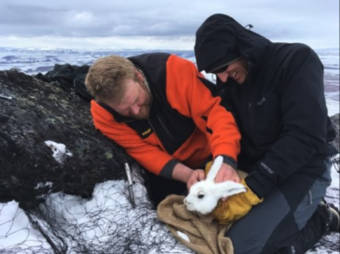
Two men holding a white hare by its neck in a treeless arctic landscape
Biologists releasing an Alaska hare. (Alaska Department of Fish and Game photo)

The Alaska Department of Fish and Game is studying western Alaska’s dwindling population of Alaska hares, more commonly known as jackrabbits. Researchers don’t yet know why the population has been decreasing, and they need more information about the species to find out.

In 2013, Fish and Game started planning their first official population surveys on Alaska jackrabbits. Wildlife biologist Chris Barger took the lead on this premier project. He shared his initial findings during a Strait Science presentation hosted by University of Alaska Fairbanks’ Northwest Campus in Nome earlier this month.

“This is an understudied species that we know very little about,” Barger stated. “And historical accounts from local residents, department staff, and field experiences from across western Alaska suggest that the Alaska hare population is substantially below these historical records. However, we have never had any surveys of the species and it’s never been done until this project began.”

Barger wants to know how many jackrabbits are left in western Alaska, what they eat and where they go. But in order to answer those questions, he had to count and catch some.

“For hares and rabbits there are many different approaches, and we tried and failed at many of them. One of those methods was to try and find them, and count them with spotlights. Another idea was to try aerial surveys with a helicopter. Also we tried just track surveys and pellet counts,” Barger listed.

For counting methods, Fish and Game had the most success by using DNA analysis on the rabbits’ fecal pellets to identify individual animals in the areas they surveyed. That involved following hundreds of miles of tracks with snowmachines and transects..

Barger and his team went to seven different locations within the jackrabbits range, spanning from Bristol Bay to just north of Kotzebue. They have so far identified fewer than 100 hares in the Nome area, fewer than 20 in Ekuk near Bristol Bay, and about ten in the Kotzebue area. Alaska hares are distinct from snowshoe hares mainly because of their size. Jackrabbits are two to three times bigger than the snowshoe, according to Barger.

A screenshot taken during a Zoom presentation given by Chris Barger of ADF&G on jackrabbits. This graphic shows the jackrabbits’ range compared to a snowshoe hare’s. (Screenshot by Davis Hovey/KNOM)

The research team then went from counting to trapping the rabbits.

With an almost Looney Tunes approach, Barger and his colleagues tried using bow nets with a pull string, night vision googles, camouflaged blinds and all sorts of different methods to capture the elusive jackrabbits.

But what was eventually successful was a modified pen trap with a transmitter attached to notify Barger when something was caught in the trap. He explains how the team used bait in the middle of the box trap, which is set up within a bigger pen trap and includes a trip wire made of monofilament fishing line.

“Now it starts to get a little complicated,” Barger said. “A string is attached to the doors, and that string is held up by a nail that’s wrapped with some wire. The nail is then connected by a string down to the bottom of a rat trap and then a thin monofilament fishing line goes from the trigger of the rat trap and runs all the way across the bait pile at the bottom of the net.”

That method led to the capture of about ten animals, who are now being tracked with satellite collars that will last for about a year.

Those jackrabbits were tagged so Fish and Game could find out more about the animals’ movements, Barger said.

“Using this preliminary data, we have found they can have a home range upwards of 5,000 acres and they can easily move three to four linear straight line miles in a matter of hours. So these things can really book it across the tundra when they want to,” Barger said.

In western Alaska, jackrabbits tend to spend most of their time in a core area of 430 acres within the larger home range. Barger tends to see jackrabbits living in willow thickets.

Since this is the department’s first official survey of jackrabbits, preliminary data is sparse. But the team will do their final field surveys this spring in Nome, according to Barger. Then they can analyze the diets of jackrabbits and maybe begin studying what is causing Alaska hares in western Alaska to decline.

Scientists use drones to count Chukchi Sea walruses without disturbing them

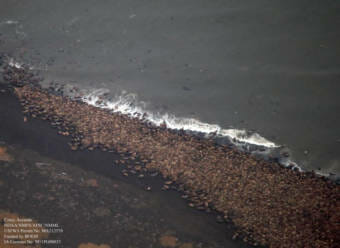
An aerial photo of many walruses hauled out on a beach
Thousands of Pacific walrus gather on shore near Point Lay in this aerial image captured during a NOAA survey of the Chukchi Sea. The arctic surveys serve to document the distribution and relative abundance of bowhead, gray, right, and fin whales, belugas, and other marine mammals in areas of potential oil and natural gas exploration, development, and production activities in the Alaskan Beaufort and northeastern Chukchi Seas. (Photo by Corey Accardo/NOAA)

Scientists from both the U.S. and Russia are using less invasive technology to get a more complete survey of the walrus population in the Bering Strait region. Their updated methods of surveying could lead to better management and protection of the subsistence marine mammal.
Tony Fischbach is a wildlife biologist with the U.S. Geological Survey Alaska Science Center. He’s been collaborating with scientists from the Russian side of the Bering Strait to test newer methods of surveying walrus on both sides of the Strait.

“With the help of Anatoly Kochnev and a team of biologists working there (in Chukotka), they were able to monitor five different sites using drones, and they also did controlled experiments in places where there weren’t too many walruses to determine what altitude the walruses will tolerate,” Fishbach stated.

The partnership helped scientists determine that if they flew a drone less than 50 meters above the head of a walrus, the walrus would be disturbed and flee, Fischbach said during a Strait Science presentation hosted by the University of Alaska Fairbanks Northwest Campus in Nome. But if the drone was flown higher than that height, then they would be able to safely conduct their surveys.

Fishbach says his team now flies drones about 100 meters above walruses, to be doubly sure they don’t disturb them. Overall, he thinks relying on drones rather than aerial surveys in small planes flown by private pilots is the better option.

“It’s much, much safer, not only for humans, but much safer for walruses. The best thing for us, is you can get more data. Whenever the weather breaks, the rain stops, and lays down, we can get out of our tents, launch this thing, get the survey done, and do it safely,” Fischbach said. “And the data is better too.”

Fischbach’s research team was able to fly 26 drone surveys in a span of two years to count walruses. That’s compared to the old method of flying planes for aerial surveys a few times a year, which was limited by costs, weather, and seasonal challenges.

Thanks to drone surveys, they were able to release “defensible numbers” from their annual walrus count at a previous Point Lay haul out, Fischbach said. The team estimated almost 60,000 walruses were on the beach during surveys taken at Point Lay in the fall of 2018 and 2019.

Once Fischbach and his team combine the survey data with information gathered from radio telemetry tags they placed on a number of walruses, then he says they will have a fuller picture of the regional population.

“And now that we have this methodology worked out, we can collaborate with partners in Northern Chukotka,” Fischbach said. “If they are interested, we can build a team, and we can do an estimate for the entire Chukchi Sea during that open water period.”

Anatoly Kochnev is one of the scientists who has been doing similar drone surveys on the Chukotka side of the Strait since 2017 and studying walruses for decades. Kochnev has also conducted aerial surveys of walrus, as well as focused on the local polar bear population in Chukotka for 30 to 35 years.

“The Pacific walrus is our shared resource, and Russia and the US need to work together to effectively manage and conserve the population,” Kochnev told KNOM via email. “Therefore, I really hope for continued cooperation. I think we need to focus on developing a simple and reliable method for regularly estimating population size – for example, using satellites is exactly what Tony [Fischbach] is doing right now. I would also like to continue monitoring the land walrus haulouts. In addition, we need to focus on tracking changes in the population associated with climate change.”

Kochnev’s and other Russian scientists’ involvement hinges on the 1994 re-negotiation of the U.S.-Russia Environmental Agreement to cooperate on environmental issues of mutual interest and concern.

As scientists from both sides of the Strait gather better survey data of walruses, this data could be used to inform management practices for U.S. and Russian agencies and to protect the animals from increasing vessel traffic.

Fischbach pointed to numerous ships transiting up and down the Chukotka side of the Bering Strait, mostly going in and out of the Sea of Okhotsk.

“The main thing is that we’re able to provide near-real-time management information and let people know ‘oh, take that different approach,’ so don’t fly over them [the walrus] for the aviators. And the same thing for mariners. That can be provided to authorities and they can give advice to people. It can also be used to support haul-out based estimates we were working on before,” Fischbach explained.

One of the next goals for Fischbach and his research team is to do future population estimates of walrus using satellite imagery counting the animals directly from space.

The U.S. Fish and Wildlife Service does not yet know when they will do an updated survey of the Chukchi Sea walrus population, according to Fischbach.

Impacts of warming temperatures dominate discussion of Arctic Report Card

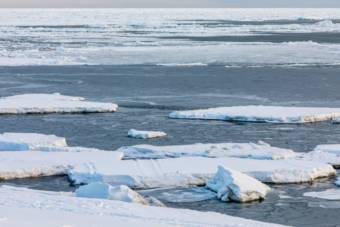
Scattered sea ice near Nome, Alaska, March 15, 2019. (Photo courtesy David Dodman via KNOM)

Warm temperatures, melting sea ice, ocean debris and permafrost degradation dominated discussion of the 2021 Arctic Report Card by the National Oceanic and Atmospheric Administration.

NOAA Administrator Rick Spinrad summed up the overall feeling of disquiet.

“The trends are consistent, alarming and undeniable. Rapid and pronounced warming continues to drive the evolution of the Arctic environment. From this year’s report card, we learn that the October to December 2020 period was the warmest Arctic autumn on record dating back to 1900. The average surface air temperature over the Arctic this past year was the seventh warmest on record,” Spinrad said.

Deputy Lead Scientist Twila Moon of the National Snow and Ice Data Center addressed the issue of the Arctic’s rising temperatures specifically, saying the Arctic is warming at more than twice the rate than the rest of the globe.

This means that the flora, fauna and peoples of the Arctic continue to experience rapid and often dramatic changes,” Moon said.

Moon stressed, however, that it is important not to oversimplify the Arctic ecosystem as one continually warming event. She pointed out that data can vary from location to location, and from season to season, painting a far more complex picture of the Arctic.

Lawrence Mudryk, who is a scientist from Environment & Climate Change Canada, had a presentation that touched on melting sea ice. Ice coverage of the Arctic seas has declined greatly over the past few years, according to the report card findings. Notwithstanding a few ups and downs in sea ice extent in the past few years, Mudryk noted that scientists have observed the fifteen lowest extents of sea ice all within the last fifteen years.

Mudryk pointed out that diminishing sea ice contributes to warming Arctic temperatures, not to mention negatively impacts Indigenous peoples who have depended on sea ice for their way of life for centuries.

“Sea ice’s high reflectivity plays an important role in regulating the amount of sunlight that enters the Arctic region and thereby helps to regulate its temperature. As sea ice disappears, the underlying ocean surface is exposed, and this much darker ocean surface will absorb sunlight and thereby allow a lot more heat to enter the Arctic system,” Mudryk said.

Gabriel Wolken, a research professor at the University of Alaska Fairbanks, presented on the state of the Arctic’s permafrost.  He dwelt on the degradation of some of the Arctic’s once stable permafrost and the implications these changes have for the plants, animals, peoples and structures housed in a permafrost environment. A greater familiarity with the conditions and locations of permafrost degradation will help scientists identify trends, Wolken said. A sounder understanding translates to a stronger ability to help affected communities navigate the hazards of warming permafrost.

The last presenter, Kaare Sikuaq Erickson of Unalakleet with Ikaagun Engagement, ended on a positive statement. Alluding to how he witnessed his people come together and call upon their traditional values of sharing and cooperation during the ongoing hardships of the pandemic — when access to outside food was limited. He called for cooperation in the Arctic.

“I think people need to put their differences aside and work together on things. The polarization of our society is not helping anything. In the Arctic, we really do have to put things aside and focus on practical solutions. Otherwise, we won’t survive. I think the rest of the world is going to have to face that as well,” Erickson said.

He pointed out that cooperation has been one of the great strengths of Alaska Natives.

“We really did fall back on that kind of communal sharing, relations with others in our villages … because these are lifelong dependencies on our neighbors,” Erickson said.

The 2022 Arctic Report Card will be released at the end of the year.

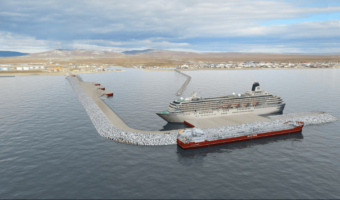
Alaska’s only Arctic deep draft port will get hundreds of millions of dollars from infrastructure bill

A model rendering for the design of a potential Arctic Deep Draft Port in Nome. (Courtesy PND Engineers)

Alaska’s congressional delegation announced on Jan. 19 that the Port of Nome will receive a quarter of a billion dollars for future construction. The significant financial boost for Alaska’s only Arctic deep draft port comes from the Infrastructure Act passed in 2021. There is a deep draft port in Dutch Harbor, but that is not located in Arctic waters.
This $250 million has been a long time coming, Senator Lisa Murkowski said.

“What it now means is that with money that is coming, now the real work begins,” Murkowski said. “This news about the port expansion is incredibly great, but we also know we’re going to have other projects coming our way, whether it’s the build out of broadband capacity, water and wastewater … So we’re going to be busy in Alaska.”

In the final infrastructure package signed into law in November, $250 million was earmarked for Alaska ports, specifically “remote and subsistence harbor construction.” Although this is the full amount the Port of Nome was awarded, it won’t necessarily take away money from other port projects in the state, Murkowski said.

“Because again if you look at that broader Infrastructure Bill, we did right by the port infrastructure. So it doesn’t necessarily mean it’s coming to remote and subsistence,” explained Murkowski. “And again as we look into more details, we’ll get some better definition there.”

For example, Senator Dan Sullivan mentioned in a similar announcement on Jan. 19 that the subsistence harbor project in Elim will receive $3,335,000 from the same funding source. That money will go towards planning engineering and the design for Elim’s harbor.

Alaska will receive a total of $925 million from recent appropriations announced by the U.S. Army Corps of Engineers, according to Sullivan.

More details on the timeline for the funding and next steps for the Port of Nome’s Deep Draft Port are forthcoming.

Unalakleet endures water shortage after nasty freeze-up

A large, yellow cylindrical water tank in the snow
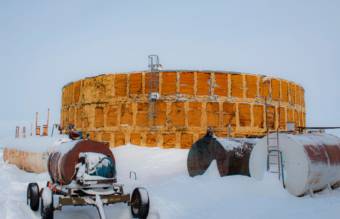
An example of a water storage tank in Western Alaska. This is St. Michael’s water tank in February of 2020. (JoJo Phillips/KNOM)

Unalakleet’s supply of water was running on empty following a nasty freeze-up at the end of December. As the community pulls together to conserve water, there is hope that recent funding from the federal government will help Unalakleet avoid future water shortages.

“We did have some effects from the Dec. 26 storm that interrupted our water supply out at our source, Powers Creek,” City Manager Moe Zamarron said.

Freezing rain led to a frozen pool of standing water, which shifted the community’s pump house before the New Year, reducing the flow of water into the water tank, Zamarron said. Levels were down to two feet early last week.

Zamarron said the tank didn’t reach empty this time, but it was down to about 7% of its total capacity.

“It took a lot of effort from the local community to conserve,” Zamarron said. “It was a community effort for everybody to pull together and see to it that we could turn this corner and begin the increased flow again and start building our reserves back up.”

As of Jan. 6, the community had started to put more water back into the storage tank, Zamarron said. But the repairs and resolution to the current water issues are ongoing.

The Department of Housing and Urban Development recently awarded the Native Village of Unalakleet over $650,000 to develop a water haul system. The funds came from a 2021 round of Indian Community Block Grants through the American Rescue Plan.

Unalakleet has struggled with its water system in the past, with almost annually recurring shortages, contamination issues or freezing pipes at the water tank.

According to HUD, the new system will provide the community more access to treated, potable water without having to rely solely on the water tank and Powers Creek.

In the meantime, Zamarron says the residents of Unalakleet came together to conserve water, share their subsistence foods and support each other to avoid a larger disaster.

Research cruise gets rare chance to study Bering and Chukchi seas

The Sikuliaq travels north in the Chukchi Sea in November 2021. (Photo courtesy of Seth Danielson)

The final research cruise of 2021 in the Bering and Chukchi seas came through the region in November. Scientists on board observed a variety of marine mammals, saw sea ice growth in real-time and found evidence of a healthy ecosystem despite warmer water temperatures from the summer.

Seth Danielson, a professor with the University of Alaska Fairbanks College of Fisheries and Ocean Science, led as chief scientist. The first time measurements were recorded from the Bering Strait in November was in 1960, according to Danielson.

“After 1960 there weren’t any other cruises that I’m aware of, in the month of November, until 2011. And that was a cruise that Karen Ashton led. Since Karen’s cruise in 2011, there have been a couple more that have gone north in November,” Danielson said. “A couple of them did manage to sample some stations on the shelf (of the Chukchi Sea), the way we did. They did that in pretty warm years.”

This cruise saw a much colder November in much of the Bering Strait and better sea ice conditions than in recent years.

Danielson presented his initial findings during a Strait Science presentation on Dec. 2 hosted by UAF’s Northwest campus. He was joined on board the Sikuliaq by many other researchers, including Catherine Berchok of the Alaska Fisheries Science Center Marine Mammal Lab.

“I was surprised by how few bowheads and how many gray whales and humpbacks there were out there,” Berchok said.

Alaska Sea Grant’s Gay Sheffield remarked that local observations from across the region supported Berchok’s assessment too.

Berchok was observing marine mammals from the bridge of the ship on a regular basis throughout the nine-day voyage. The research team headed north from Seward on Nov. 7 and stopped through Nome on their return around Nov. 16.

Various measurements from the Sikuliaq organized in color-coded graphs by Seth Danielson and research team from their November research cruise. (Screenshot from Strait Science presentation/YouTube)

They witnessed roughly a 20% or more increase in sea ice extent while in the Chukchi Sea during their trip, according to Danielson.

“Why we ever got a situation like this where it’s near freezing at the surface and warm near the bottom (of the sea). And the only thing I can think of is that it was the advection, the currents carrying ice over this region. And so ice did not form in place, but it must have been carried in,” Danielson said.

Other scientists on board the Sikuliaq were taking measurements from the Bering and Chukchi Seas to study water temperature, salinity and oxygen levels.

Southwest of St. Lawrence Island, there was a healthy amount of productivity for this late in the season happening in the Bering Sea ecosystem, according to Jackie Grebmeier, a researcher with the University of Maryland Center for Environmental Sciences.

“So there is still Chlorophyll,” Grebmeier said. “This is viable Chlorophyll on the bottom (of the seafloor) that can provide both food for consumption as well for microbial and carbon cycling. So it’s still going on into November although the values are about 50% less than what we have during the real productive times in July.”

Four DBO mooring sites were monitored by the research team on board the Sikuliaq during their November 2021 cruise. (Screenshot from Strait Science presentation/YouTube)

Grebmeier, Danielson and other scientists from the Sikuliaq are still compiling their final observations. The research team will publish more formal findings sometime in the next couple of years.

Site notifications
Update notification options
Subscribe to notifications