KNOM - Nome

KNOM is our partner station in Nome. KTOO collaborates with partners across the state to cover important news and to share stories with our audiences.
Pandemic relief will help build new homes in overcrowded Bering Straits communities

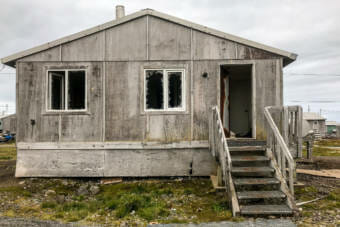
Several older homes in Savoonga have been run down by frequent winter storms and many years without maintenance. (Photo by Emily Hofstaedter/KNOM)

The COVID-19 pandemic has made it difficult to build homes in Western Alaska. But it’s also provided opportunities for more funding to alleviate some housing issues that exist in the region.

More than a third of residents in the Bering Strait region are living in overcrowded conditions according to the Alaska Housing Finance Corporation.

The former CEO of Bering Straits Regional Housing Authority, Chris Kolerok, gave public testimony on housing conditions in the region three years ago. Kolerok spoke during an Indian Affairs Senate Hearing held in Savoonga, the first of its kind hosted in Western Alaska.

“In the Bering Straits outside of Nome, the overcrowding rate is 37% — 19% of that are homes being classified as severely overcrowded,” he said in 2018. “And during community meetings, we have been confronted with the heartbreaking stories of 21 people sharing a small three-bedroom home.”

That same year, Savoonga received six new houses. Since then, there have been no new homes built in the community. Prior to the completion of those six new homes, Savoonga hadn’t seen new houses built locally in over 10 years.

Those rates are based on the Alaska Housing Finance Corporation’s latest housing assessment from 2018.

Jolene Lyon inherited these challenges as she took over as president and CEO of Bering Straits Regional housing authority in 2020. Although the housing authority has traditionally served tribal members of the Bering Strait by building houses, during the pandemic they were able to offer other assistance.

“Some communities chose to buy side-by-sides or ATVs,” Lyon said. “Others chose to get washers and dryers, some wanted more PPE, some wanted freezers because at the same time there was a concern that there would be meat shortages.”

Each community gets a certain amount of funding from the U.S. Department of Housing and Urban Development based on the population of the tribe. The housing authority then pools all the allocated money together which comes to between $1.4 million to $1.8 million each year for the entire Bering Strait region.

Staffing turnover, logistical issues and the wrench thrown into the plan by COVID-19 all delayed the construction of new homes that were slated for this year. Lyon says the upside of waiting though, is that the housing authority received additional funds from COVID-related grants and can afford to build more homes in 2022.
She had money left over from the regular allotment from the federal government and decided to stretch that with approval from the housing authority’s board of directors.

“I presented a revised Indian Housing plan to take that remaining funding and apply it towards new construction for Shaktoolik. So now we have two homes we can build. Thus comes along, we get the American Rescue Plan [funding], and I can take another $1.5 million from that and now I’m building four homes in Shaktoolik instead of the one we were actually going to do,” she said.

Shaktoolik, Diomede and Wales are all set to receive new homes in 2022. On top of that, King Island tribal members received two new modular homes constructed in Nome last year.

But a couple of single-family homes every 10 years or so is not enough to tackle the issue of overcrowding which is at 14% in Nome, and 37% in the Bering Strait region, according to the latest numbers from AHFC.

Sophia Katchatag, tribal coordinator for the Native Village of Shaktoolik,  says four new homes next year will only make a small dent in a sizable issue for her community.

“It’s a blessing to know we are getting four new homes this coming summer, but there’s still a need out there. There’s still multiple families living in homes,” she said.

According to Katchatag, the last time Shaktoolik had new homes built in the community was from 2005 to 2006.

Going forward into 2022, Lyon says the housing authority will focus on building more homes across the region, with some extra funding courtesy of the American Rescue Plan Act.

“We can build stick-build [houses]. We can build sit-paneled homes, with those big, large panels. We can do modular or if they’re small, we can do tiny homes, we can have those shipped in,” she said.

Each option comes with its own set of pros and cons. Some cost more to ship than others but some are more suitable for the Arctic conditions that exist in Western Alaska.

According to Lyon, the housing authority could build up to a total of 10 new homes next year for three different communities instead of the usual three new homes.

And in early December, the federal housing and urban development department announced an additional $52 million in Indian Community Block Grants. Some of those funds will pay for a temporary shelter in Solomon, five tiny homes in Aniak and water holding tanks for Wales.

Correction: An earlier version of this story misspelled Jolene Lyon’s last name. It is Lyon, not Lyons.

Bering Sea survey finds Yukon River chinook populations are low and staying closer to shore

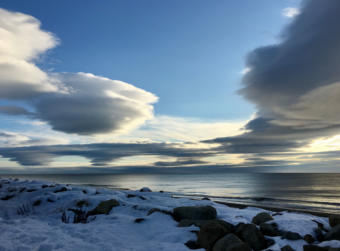
Bering Sea coastline near Nome, October 2017.
The Bering Sea coastline near Nome in October 2017. (Zoe Grueskin/KNOM)

Salmon abundance is down and population distributions have changed, according to NOAA’s 2021 surface trawl survey. Besides focusing on salmon, the survey also examined aspects of Bering Sea life such as zooplankton, sediment, sharks, marine birds, pacific herring, capelin and saffron cod.

Like the bottom trawl presentation on Zoom earlier in November, the top trawl presentation examined decreasing fish populations occurring in several Bering Strait species.

According to the survey’s preliminary estimates, young Yukon River chinook salmon populations continue to be low.

“Juvenile abundance was below average in 2021 and has been below average since 2017,” research biologist Jim Murphy said.

Besides lower populations, Murphy also noted the distribution of chinook salmon observed this year was unusual. While one typically finds chinook salmon distributed throughout the Bering Sea area, the area which NOAA typically surveys, most chinook salmon were found near Alaska’s shores.

Graphs on juvenile chinook salmon. (Courtesy of NOAA)

Like chinook salmon, Murphy’s team observed chum salmon almost exclusively near Alaska’s shores.
“And this is even more atypical for chum salmon as they tend to be much more broadly distributed than chinook salmon,” Murphy said.

Juvenile chum salmon populations have actually been above average since 2018, according to Murphy. 2021’s population is estimated to be one of the largest juvenile populations seen since then. A large juvenile fish population usually correlates with a large returning adult population.

But past observations, the correlation between adult and juvenile chum salmon tends to be more variable than the relationship between juvenile and adults in other fish species, Murphy said.

To illustrate, he pointed out that there was a large population of juvenile chum salmon in 2016 but a significantly low adult population. Murphy and his team postulated that this is because chum salmon are dying at greater rates later in their lifecycle. That would explain the great decline of chum salmon in the Yukon River, despite the high juvenile populations observed in the survey, Murphy said.

Pink salmon saw the same kind of low numbers and near-shore distribution during 2021. Murphy noted that his team combined pink salmon from Norton Sound and the Yukon River into the same graph because of their genetic similarity.

“With this model we are expecting to see low numbers of pink salmon returning to the region in 2022,” Murphy said.

In contrast, NOAA’s preliminary biomass index of coho salmon was close to the highest in the history of the survey. Hopefully, this means a strong run of coho in North Bering Sea salmon next year, Murphy said.

Besides salmon, multiple fish populations surveyed were found to be lower than average. These species include capelin, saffron cod, young pollock and cod and pacific herring.

In general, forage fish populations are low.

NOAA conducts both its bottom and surface trawl surveys annually to study the status of marine life in the Bering Sea.

November sea ice extent in the northern Bering is the best since 2012

An aerial view of Unalakleet, with open water along the coast in 2019. (Zachariah Hughes, Alaska Public Media)

Through the weekend of Nov. 13, sea ice extent in the Chukchi Sea was well above the average from the last thirty years.

“So far, Chukchi Sea ice is developing much quicker this year than it has in all recent years,” climatologist Rick Thoman explained.

Thoman, with the Alaska Center for Climate Assessment and Policy, or ACCAP, has Chukchi Sea ice data going back to 1979. Current sea ice extent in Northern Alaska waters is the highest it’s been since November 2001, according to the National Snow and Ice Data Center’s sea ice index.

https://twitter.com/AlaskaWx/status/1459928137077182466

As of Nov. 13, the main ice pack had already reached the northern coast of the Seward Peninsula, Thoman said.

“What we have right now is fairly typical in the sense that ice tends to start to grow out from the Alaska and the Chukotka coast. This year it’s actually kind of met down towards the Bering Strait, so there’s really no open water now just north of the Bering Strait, between Chukotka and the Alaska side,” Thoman said.

Thoman suspects the rest of open water in the Chukchi Sea could be ice covered by the end of November.

As of Nov. 17, sea ice in the Bering Sea has covered much of the Eastern Norton Sound along the coastline of the Seward Peninsula except for an area in front of Nome. Sea ice had also started forming on the southern edge of St. Lawrence Island.

This is much more favorable for Western Alaska compared to the sea ice conditions the region experienced last year. The last couple winters in the Bering and Chukchi Seas have featured record low sea ice extents.

Thoman says all the pieces for sea ice growth, like colder surface temperatures and sustained northern winds, came together this year in the Bering Strait region.

“Really since early October, we’ve been in a persistently cold pattern,” he said. “Not quite every day was below normal, but most days below normal (temperatures). And so we didn’t have our thumbs on the scales with very warm waters that had to be extracted out, and we’ve had a weather pattern that has been conducive for ice formation.”

Based on current forecast models, the entire Norton Sound could be covered in ice by the end of November. There’s also a good chance of sea ice extending all the way south to the Pribilof Islands this winter, which hasn’t happened in recent years, according to Thoman.
Major COVID outbreak puts Savoonga into lockdown

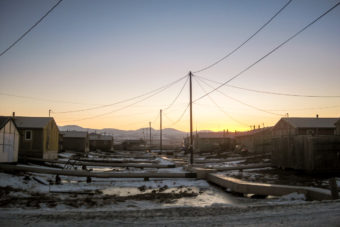
Savoonga
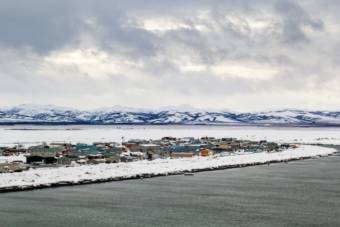
Savoonga in December 2013. (Photo by Anna Rose MacArthur/KNOM)

Roughly 15% of residents in the remote community of Savoonga have COVID-19, the Norton Sound Health Corporation said this week.
Savoonga is on St. Lawrence Island, out in the Bering Sea. The health corporation on Monday reported 115 COVID-19 cases in the community of less than 800 people. The most recent 55 cases are considered community spread.

The community is under lockdown and movements are limited, said Delbert Pungowiyi, a tribal member of the Native Village of Savoonga.

“Eighty-plus percent of our adults are fully vaccinated, and I think that is making a positive impact on the effects of COVID,” said Pungowiyi. “So Savoonga has done a complete lockdown right now. We can venture out to the post office and check our boxes — a few people at a time that can go in there. Everyone has to wear their masks.”

The local store is only accepting orders by phone, said Pungowiyi.

Last week, Nome’s City Manager Glenn Steckman said the health corporation had recently done significant testing for COVID-19 in Savoonga. That may factor into why so many cases were identified so quickly.

The outbreak of COVID-19 began with six cases in Savoonga on Oct. 26. Two weeks later, the local case count reached the highest on record for the community since the pandemic hit Western Alaska.

Pungowiyi worries about elders in the community.

“But I do believe they’ve been fully vaccinated. So far there have been no serious medevacs or hospitalizations that I have heard of,” Pungowiyi said.

Pungowiyi noted that Savoonga ran out of isolated quarantine locations for residents who test positive, as the community is experiencing a housing crisis. Many multi-generational families share a two-bedroom home, fitting eight to 10 people in a space meant for four.

Due to the massive spike in COVID-19 cases, the Bering Strait School District has issued “high risk” status for the Hogarth-Kingeekuk Sr. Memorial School in Savoonga. There are at least 20 positive cases among students, according to the district.

Supplies and aid are being sent to Savoonga from relatives and donors across the state.

A beluga from the Beaufort Sea has traveled unusually far south, to Washington State

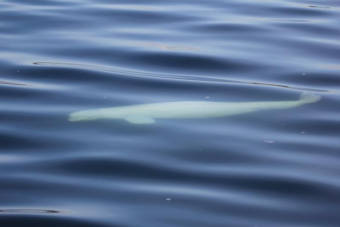
A beluga whale from the Beaufort Sea photographed in Puget Sound earlier in October, 2021. (Photo from NOAA Fisheries, World Vets under MMHSRP 18786-05)

A beluga whale found unusually far south in Puget Sound earlier this month is believed to have come from a pod in the Beaufort Sea. NOAA Fisheries made the announcement this week based on genetic material they were able to analyze from the beluga.

In the first week of October, the Seattle Times reported a single beluga whale had been sighted in multiple places across Puget Sound — something that hasn’t been seen in the area since the 1940s.

NOAA Fisheries says the whale appears to have swum thousands of miles south from Arctic waters in the Beaufort Sea. Scientists do not believe the beluga came from the smaller Cook Inlet population.

NOAA Fisheries did not say what might have caused the beluga to wander so far south on its own. However, beluga whales are known to sometimes roam beyond their normal area in Arctic waters.

Dr. Kim Parsons, a research scientist with NOAA Fisheries, said they used genetic analysis of DNA taken from a water sample in the Puget Sound near where the beluga was located. This material is referred to as environmental DNA.

“The information that we can obtain from eDNA is more limited than what we can generate from a tissue sample, but can provide insight about where the whale is likely from,” Parsons said.

Scientists determined that the DNA sequence from the beluga matches other beluga whales found in the Beaufort Sea and Arctic waters. This population usually migrates between Alaska, Canada and Russia.

The far-flung beluga was last sighted on Oct. 20 near Tacoma, Washington, according to NOAA Fisheries. The West Coast Marine Mammal Stranding Network will respond if this whale is identified as stranded.

Scientists have documented an increase in harmful algal blooms in northern waters

A bloom of algae discolors a swath of Gastineau Channel just north of the Douglas Bridge on Monday, July 30, 2018.
A bloom of algae discolors a swath of Gastineau Channel just north of the Douglas Bridge in Juneau on Monday, July 30, 2018. Scientists have documented an increase in harmful algal blooms in the northern Bering and Chukchi Seas. (Jeremy Hsieh/KTOO)

Scientists have documented an increase in harmful algal blooms in the northern Bering and Chukchi Seas. The blooms carry toxins, but scientists aren’t sure what effect they will have on marine mammals.

“We don’t know yet if toxin levels in Arctic food webs are reaching high enough concentrations to cause health impacts in marine mammals in that (the Arctic) region,” Don Anderson said.

Anderson, a senior scientist with Woods Hole Oceanographic Institute, or WHOI, has been studying algal cysts in the Bering and Chukchi Seas for several years. He presented his data and the work of other researchers in the region during a Strait Science virtual event hosted by the University of Alaska Fairbanks Northwest Campus on Oct. 14.

Map of harmful algal blooms in the Northern Bering and Chukchi Seas. (courtesy of Don Anderson/WHOI)

Not all types of algal blooms are harmful, Anderson pointed out. In fact, there are thousands of them spread across the world’s oceans. But in the Northern Bering and Chukchi Seas, there is a growing presence of Alexandrium cysts, an algal bloom that creates harmful saxitoxin.

The previously accepted explanation for how they got this far north is called the “trail of death” hypothesis, Anderson said.

“That (says) it’s being carried from the south in these relatively warm surface waters, and that it would form cysts in the Chukchi region that fall to bottom sediments where the temperatures would be too cold to support significant germination,” Anderson said. “I call that cyst seed bed a sleeping giant.”

Since bottom water temperatures have been warming drastically across the Northern Bering and Chukchi Seas over the last few years, cysts are now growing locally in Arctic waters. In other words, the sleeping giant has awoken.

“So what you’ve got then is a dramatic increase in the potential for what we would say is local initiation of blooms. In other words, not just transport, but blooms that are starting, inoculated from that region, from those two Ledyard Bay and Barrow cysts’ seed beds,” Anderson stated.

Ocean currents shown on a map in the Northern Bering and Chukchi Seas. (courtesy of Don Anderson/WHOI)

Recently, the United States Geological Survey concluded that the recurring seabird die-offs seen in the Bering Strait region are not related to harmful algal blooms. USGS scientists did however find low levels of toxins in many species of birds they sampled.

Since 2016, low levels of biotoxins have been documented in all different types of marine mammals, seabirds and various fish species in the Bering Sea, Anderson pointed out.

Even so, Anderson said eating various forage fish or salmon in the region still poses low risk to human health.

“Based on current understanding of these toxins in many other parts of the world, we think that muscle and blubber are not likely to accumulate saxitoxin in levels that pose a human health hazard. These tissues haven’t been fully tested, but there are reasons to believe they’re not going to accumulate toxin,” Anderson said.

This baseline is based on the only metric that exists from the FDA regarding safe food consumption of shellfish. It determines the level at which clams or other shellfish become too toxic to eat and then could cause paralytic shellfish poisoning. However it is not the best way to gauge how high algal toxins can be in marine mammals before causing harm to humans who eat them, Anderson said.

Alaska Marine mammals map showing toxin levels found in various species, from Kathi Lefebvre’s 2016 report on algal toxins in Alaskan waters, used with permission. (courtesy of Kathi Lefebvre)

While Anderson believes the health risk for Bering Strait subsistence users is quite low, he still emphasized using caution and safe practices as usual when eating shellfish or marine mammals. He also highlighted the fact that other parts of the world are living with the same conditions.

“Many regions of the world face similar risks and yet are able to maintain healthy communities and ecosystems. But it’s done through good management, good communication, and through understanding what the threats are,” Anderson said.

Overall, as cysts spread and cause more harmful algal blooms, there is an increasing potential for them to impact human health and ecosystem health in Northern Alaskan waters.

One observation from Edgar Ningeulook cited in 2013 pointed to an algal bloom near a historical place called Ipnauraq.

“This was the location of a red tide that at one time caused many deaths. And it doesn’t say how, what were they eating? I note that this is a place where there is a lot of fishing going on, especially for herring, one of those forage fish that I was talking about. So was it herring that was eaten, was it clams, who knows. But notice its location, it’s in that pathway of the transported blooms from the south. So long ago there was that threat and it got to the point where many people died,” Anderson said.

Research in the Chukchi Sea is ongoing. Anderson’s team will be partnering with scientists on the Russian side of the Strait in 2022 to get the full scope of what other changes are happening in the Bering Sea ecosystem.

Site notifications
Update notification options
Subscribe to notifications