Viola Waghiyi of Savoonga is one of the 26 members chosen for a new White House advisory council on environmental justice. The council will give advice and recommendations on how to address current and historic environmental injustices across the United States.
“It is an honor, not only as a Sivuqaq Yupik grandmother and Native Village of Savoonga tribal citizen, but as an Arctic Indigenous person who has been working on environmental health and justice issues going on 19 years,” Waghiyi said.
As the environmental health and justice program director at Alaska Community Action on Toxics, Waghiyi has advocated for environmental health on her native St. Lawrence Island. Since the end of the Cold War, her tribal community has been trying to hold the U.S. military accountable for toxic contamination from two Cold War bases.
Waghiyi says the council will be one way she’ll exercise her voice.
“[To] make sure that the priorities – including military toxic contamination and the persistent organic pollutants – are at the forefront with this administration. These have resulted in health disparities never before seen in our people,” she said.
Persistent organic pollutants, or POPs, have contaminated the food supply for subsistence diets. St. Lawrence Islanders are experiencing a range of related health issues – including cancer – due to POP contamination.
“Even though we don’t have manufacturers or chemical plants, we are finding them [POPs] in our backyards, in our lands and waters, in our bodies, and in our most sacred traditional foods that have sustained our people for millennia,” Waghiyi said.
According to Waghiyi, the Yupik people still feel the benefits of maintaining their traditional diet outweigh the risks.
Her appointment shows the federal government’s growing geopolitical interest in the Arctic. While different branches of the military have announced plans for operating, once again, in Alaska and the Arctic, Waghiyi says that a seat at the table in Washington is timely and important.
“It is so important because a lot of times we are never at the table when decisions are being made for us miles and miles away,” she said. “This will ensure that we have a voice at the White House.”
The council was established to confront long-standing environmental injustices and to ensure that historically marginalized and polluted communities have greater input on federal policies and decisions.
Council members will serve in a voluntary capacity, offering recommendations in a number of areas including climate change resilience, pollution and tribal and Indigenous issues.
This satellite shot is from March 25th after a winter storm. The most prominent leads can be seen near St. Lawrence Island and in parts of the Norton Sound. (courtesy Alaska Center for Climate Assessment and Policy)
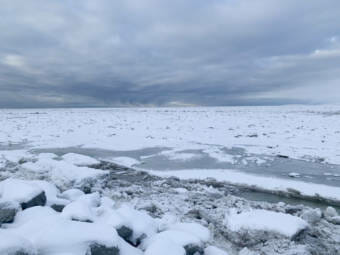
Blizzards and winter storms battered the Seward Peninsula and surrounding region throughout the month of March, but the sea ice has proved more resilient than in recent years.
Rick Thoman is a climatologist with the Alaska Center for Climate Assessment and Policy. He said these March storms have been known for tearing the ice apart.
“We have not seen the dramatic collapse of sea ice like we saw in several previous years, including last year, when the ice extended significantly farther south than it does this year,” Thoman said. “During the stormy spell last March, the ice retreated quite a bit. We have seen some decrease this season, but it’s been much less.”
Thoman thinks the sea ice held better this year because the most southern part of the ice edge down near St. Matthew Island has been much thicker and more stationary than in recent years. That ice can hold up better against the recent batch of storms.
The most recent sea ice model from the National Weather Service. Image from the NWS, 2021.
Some of the worst ice retreat was off Savoonga, but that’s unsurprising for Delbert Pungowiyi, a lifelong resident of Savoonga and former tribal president. He said that for about ten years now, the island has only had sikuliaq — that’s the word in St. Lawrence Island Yup’ik for young and brittle shorefast ice.
“Before the storms hit us you see on a satellite [that] it looks like a good winter,” Pungowiyi said. The north side of our island is all locked up [with ice] and the south side of our island. [But] any given storm from the east or south, it just breaks it up and opens it up.”
Recent storms have continued to push the ice off the northern parts of St. Lawrence Island.
Even when the sikuliaq is there, it is difficult to use for hunting. Pungowiyi recounted that recently a group of hunters fell through the young ice attempting to get to walrus. The hunters were fine, but the hunt was unsuccessful and Pungowiyi estimates that Native food from the ocean makes up as much as 90% of the community’s food security.
Wind speeds in the Nome-census area averaged around 43 mph with easterly winds on Sunday, based off data recorded from regional airports collected by mesowest.edu, with wind in Golovin reaching as high as 56 mph.
Thoman says that historically, these storms haven’t been typical for March.
“Typically this time of year, we’re not seeing storms track through the northwestern Bering Sea, across Chukotka and into the Chukchi Sea. That’s very common in the fall. But this time of year, quite unusual. But it’s been an unusual run of marches,” he said.
Weather patterns suggest that rather than having a storm season, the climate is just becoming stormier and less predictable. Thoman said that 2021 is also the seventh year in a row that the maximum ice extent is less than the 1981-2010 average.
“When we get these storms with less ice cover, that means, of course, that there’s more water exposed south of the ice edge, which means that water is available to evaporate and be incorporated into these storms,” Thoman said. “So when these storms come along, they have the potential to hold more moisture than they would have if say the ice extended all the way to St. Paul. And that certainly is directly attributable to the low sea ice, which is part and parcel with our changing environment.”
Graphic courtesy of the Alaska Center for Climate Assessment and Policy
And that likely means more snow and rain for Western Alaska.
At this point, Thoman predicts that melt-out for most of the Western Bering Sea and Gulf of Anadyr will likely occur in early to mid-May for parts of the Norton Sound. But these abnormally late winter storms may not be over yet. The National Weather Service is predicting heavy snowfall for Friday evening and the weekend in many parts of Western Alaska, including 5-10 inches for areas near Unalakleet and across the Eastern Norton Sound.
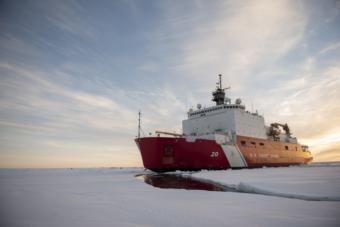
The U.S. Coast Guard Cutter Healy in the ice Wednesday, Oct. 3, 2018, about 715 miles north of Utqiaġvik, Alaska, in the Arctic. (Public domain photo by NyxoLyno Cangemi/U.S. Coast Guard)
Last year, the United States’ largest icebreaker needed repairs after an engine fire. This summer, the U.S. Coast Guard Cutter Healy will take a trip through the Northwest Passage, in conjunction with Canada.
Experts said the Coast Guard cutter Healy’s trip through the Northwest Passage signifies a willingness to cooperate between Canada and the U.S. The announcement came from Coast Guard Commandant Adm. Karl Schultz during his State of the Coast Guard Address on March 11.
Professor Troy Bouffard studies Arctic security at the University of Alaska Fairbanks. He said the two countries disagree about the status of the Northwest Passage. The United States said it’s an international strait that ships should be able to transit without Canada’s consent, but Canada said those are internal waters that fall within its sovereignty and they should be notified of any transit.
“I think it sends a clear message or agreement to disagree. The official status of the Northwest Passage is somewhat less important than being able to collaborate and operate with expectations and confidence with our partners,” Bouffard said.
The countries have a treaty, signed in 1988, basically agreeing that the United States will get Canada’s consent to sail icebreakers through waters Canada claims. That treaty came about after controversy in 1985 when the U.S. icebreaker Polar Sea transited the passage without telling Canada.
The upcoming 2021 trip honors that treaty. But in recent years, the U.S. has considered moves that would have violated that.
In response to a 2019 Russian announcement that the country would restrict traffic in the Northern Sea Route, the U.S. said it likely would conduct an exercise in the Northwest Passage. That exercise could have inflamed tensions with Russia and Canada, but it never happened.
Bouffard said that the Biden administration and Canada jointly planning this summer’s 2021 trip is a strategic move — and that it sends a message to Russia and U.S. adversaries.
“I tend to think that this was also a clear message to, as quick as possible, strengthen the friendship in partnership with Canada in light of recent years of tensions and mixed messages about freedom of navigation and get back to the way things normally were,” Bouffard said.
“The Arctic continues to be a region of growing geostrategic importance, where the maxim ‘presence equals influence’ rings true,” Schultz said in his address to the Coast Guard earlier in March.
Statements like that aren’t lost on Kawerak’s Marine Advocate Austin Ahmasuk. He pays close attention to those international tensions as he studies shipping traffic and activity in the region.
“I think what’s perhaps playing out, is a little bit of rhetoric between countries that are kind of escalating hot political topics, such as, security interests, national defense, that kind of thing. I don’t think that we in the Arctic want to be in the middle of an arms race or political stage playing that puts us in jeopardy. Of course, we have to work internationally, as much as possible to ensure that peace occurs in the Arctic,” Ahmasuk said.
Ahmasuk said the Coast Guard and U.S. military have been destructive toward Alaska Native people many times. As one example, he points to the military’s history of leaving toxic waste in the Arctic.
Even the Healy’s namesake, Capt. Michael Healy was partially responsible for the destruction of the Tlingit village of Angoon in 1882. While U.S. Naval Cmdr. Edgar C. Merriman is often cited as the primary officer who gave the order for the bombardment, historical documents do show that Healy, as captain of the Thomas Corwin, did participate in the bombardment.
But as temperatures rise, Ahmasuk recognizes the undeniable increase in traffic in the Arctic waterways. And he’s hopeful that trips like the Healy’s upcoming Northwest Passage journey could be a chance for communication between federal agencies and Indigenous people.
“I hope that the Coast Guard can learn from our communities, and compare how our communities contrast [and] how our communities might be involved in this new era — this relatively new era that we’re trying to figure out now,” he said.
Bouffard explained that this trip is meant to be primarily for research and learning.
“I hope this does become a pattern for research and for other means and collaborations and learning about the environment and working together because the U.S. Coast Guard and the Canadian Coast Guard have completely different statutory requirements,” he said. “For example, the U.S. Coast Guard has a law enforcement function, especially with regard to international law, whereas Canada doesn’t. There’s a lot to learn from each other in that way.”
And he said there is still much to be studied and surveyed in the Northwest Passage.
According to Coast Guard documents, the trip will be primarily observational. And pending approval from Canadian officials, it will allow for some onboard scientists to do some “passive research”.
The Coast Guard does plan to do some undefined operational exercises in Baffin Bay after embarking from Nuuk, Greenland.
Right now, Nome’s Harbormaster Lucas Stotts doesn’t have any official word on whether the U.S. Cutter Healy will dock in Nome.
But according to the Coast Guard, the voyage plans to begin in mid-August from Dutch Harbor and finish by mid-September in Nuuk. Plans have not yet been decided for the timing or route of the USCG Healy’s return voyage to its homeport in Seattle, Washington.
The Burled Arch and Finisher’s Chute are noticeably absent in Nome for the 49th Iditarod. (Emily Hofstaedter/KNOM)
Without the Iditarod Trail Sled Dog Race coming to town, the City of Nome and many commercial establishments expect to take a financial loss this year as one of Nome’s biggest tourist events falls casualty to the COVID-19 pandemic.
Because of all the festivity that normally takes place in Nome, the final week of the Iditarod Trail Sled Dog Race has been called the “Mardi Gras of the North.”
Eager visitors from Alaska and around the world spill out from restaurants, bars, hotels and shops to watch elite dog sledding teams finish the race beneath the Burled Arch, the famous landmark marking the end of the nearly 1,000-mile race.
But that didn’t happen this year.
Out of COVID-19 concerns, the Iditarod Trail Committee skipped the Bering Sea Coast, including Nome, and re-routed the race back to Willow.
“Well, it doesn’t feel good. That’s kind of a bad feeling. It got to be demoralizing for everyone,” said Ronald Locke who owns the local favorite, Breakers Bar, that stands yards away from the Iditarod’s traditional finish line in Nome. And in March, it’s always crowded.
“It’s a big month. You have a lot of people in here, you doubled and tripled the population. A lot of people go and stay in our camps for the time that Iditarod is going on so they rent their houses out. This place is full of people, they’re eating, the restaurants are all full. And it’s pretty much gone,” he said.
The past year has been hard for Locke and Breakers Bar. While they were able to be open most of the summer, the governor’s orders shut them down halfway through the 2020 Iditarod.
They also lost the holiday season when Nome saw its worst outbreak of COVID-19 and the city government shutdown indoor dining and drinking.
While it’s still a big moneymaker, Locke comes to rely on the Iditarod less and less.
“But yeah, this Iditarod’s gonna hurt. But they’ve slowed down the last three, four years. That’s another thing too,” he said.
He speculates that the loss of several big sponsors, like Alaska Airlines and the outdoor specialty retailer Cabela’s, discourages visitors.
Dips in bed and sales tax collections in 2018 and 2019 could be from slower Iditarod seasons, Nome’s city finance director speculates. Another seasonal event — the Lonnie O’Connor Iditarod Basketball Tournament — brings visitors from all over the Bering Strait region. The tournament is also canceled this year. City Manager Glenn Steckman said those March festivities bring in money that gets spread far around the city.
“That’s roughly 800 to a million dollars less of outside money coming into the community, fresh money. And that is going to have an impact,” Steckman said. “And Iditarod for many in the hospitality industry was something that could hold them over until the summer recreational and tourism season began.”
At a 5% sales tax, Steckman estimates that could be up to $50,000 in sales tax that the city budget won’t see this March.
It’s not surprising that bed tax is down after a visit to the Nome Nugget Inn. Jason Song bought the hotel and its two adjoining restaurants in 2019. During the weeks of Iditarod, those rooms are coveted as they overlook the mushers arriving on Front Street. But not this March. Song said with a shake of his head, “Right now, it’s almost empty.” He has used the Paycheck Protection Program and local government assistance to get his staff and business through the COVID-19 pandemic. Like many, he is hoping for more tourism this summer as the vaccination rate in Alaska continues to increase.
But Iditarod tourism expands to more than just the week that mushers are in Nome. The Iditarod is a part of Nome’s cultural identity, Steckman said, and its reputation brings people to Nome throughout the year.
“People who can’t visit maybe during the Iditarod period, come up on cruise ships and other ways to say, ‘Okay, hey, I want to go see where all of this that I’ve heard about happens, which is Nome, Alaska.’ And so there is a marketing aspect to this too,” Steckman said.
For some vendors, they said sharing the lifestyle and culture of a unique place like Nome is what they’ll miss the most this year.
Dr. Kamey Kapp-Worland owns The Dog Lot, LLC. The optometrist and dog musher partners with outside tour vendors to get tourists on her sled.
“If the random person comes in that maybe is a little skeptical about dog mushing and how we take care of them and what we do with them if we can change their mind and show them how loved these animals are, that realistically, they live on my couch half the time, you know, we’ve done a service,” Kapp-Worland said.
If tourism continues to slow down, Kapp-Worland said she’ll have to pay for their dog team out of pocket — and because mushing is part of her lifestyle — she will continue to do that. But she said her outside career affords her the opportunity when mushing off the road-system is becoming prohibitively expensive.
“I would say that any given year, my dogs earn their kibble in that two weeks that we do tours. And so we probably made a quarter last year of what we normally do,” Kapp-Worland said.
Back on Front Street, some workers feel cautiously optimistic — although they’ll miss the income an Iditarod normally brings in.
Vanessa Connors has served and bartended in Nome for over 10 years. This year, income has been tricky. She received a mix of assistance from state and local government relief programs — and periods where the bar has been open. But even without Iditarod, she’s starting to see the light.
“With everyone getting vaccinated. People are slowly more comfortable coming out. Just this past week alone has picked up a lot,” Connors said.
The Norton Sound Health Corporation reports that the city’s vaccination rate has reached 70% — one of the highest rates in the country. In Nome, many hope that life can return to normal, even if that means missing out on the 2021 Iditarod Trail Sled Dog Race.
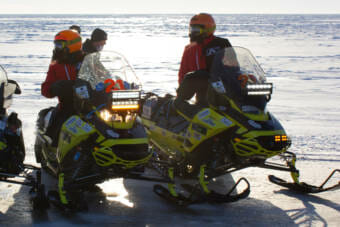
Joseph and Israel Hale arriving in Nome during the 2021 Iron Dog. (Kevin Fox/KNOM)
On Saturday, Joseph and Israel Hale became the first disabled team to ever finish the full 2,600-mile Iron Dog race. KNOM caught up with these rookies, now finishers, in the garage during their layover in Nome.
On Feb. 15, the brothers had been the first team into Nome as racers trickled in ahead of their restart.
“We were coming into Nome, and I hadn’t done a lot of praying that we could win or anything like that, but I was like, ‘Lord, keep these snow machines running; we’d really like to be first into Nome today.’ And he answered my prayer by 18 seconds, so you can’t beat that,” Joseph said.
Joseph is the elder brother. He rides with his younger brother Israel, who is a double amputee. The brothers participated in the Iron Dog last year, in the trail class.
“We pulled in here first in the trail class teams by about 7 hours, I think,” said Israel.
Joseph laughed.
“I don’t quite think it’s that much,” he said.
But what’s driving them to compete at the pro level? Israel fielded that question.
“Mostly to inspire people to push forward in life despite issues of disability,” he said. “And just do something that’s never been done. For both of us, it was just to do something that most people think is impossible or we kind of even thought might be impossible ourselves.”
Israel Hale was in his early twenties when he was hit by a car traveling at 50 mph while he was working on a collapsed trailer on the side of the road. He lost his legs.
While recovering and regaining his strength, he began taking snowmachining much more seriously, even with the challenges of navigating the sport as a double amputee.
On Saturday afternoon in Big Lake, the Hale brothers became the first ever disabled team to cross the pro-class Iron Dog finish line. Before concluding their interview at the garage with KNOM, Joseph asked to part with a message for anyone listening.
“Don’t give up spirit even when life is hard because life comes at us from all different angles. And some days it’s really hard,” he said. “Out on the race, the trail is really hard. People have no idea the challenge. If you put your mind and heart to it and it’s what you want to do, you can make yourself do it. It’s not always going to be easy, but easy isn’t always good. Not just the race, but anything in life whether it’s work or family or anything.”
A shearwater in flight. (Photo from National Oceanic and Atmospheric Administration)
Coastal seabirds have experienced die-offs in Western Alaska the past few years. But recent results from over a decade of research suggest that offshore birds are also feeling the impact of low ice and warming ocean temperatures in the Bering Sea.
Kathy Kuletz is the lead seabird biologist for Migratory Bird Management with U.S. Fish and Wildlife Service. In a Strait Science presentation on Feb. 11, she shared research findings on birds that spend a majority of their lives at sea.
“During this warm period, there was low abundance of birds, or they shifted their distribution,” Kuletz said. “Overall, there was little reproductive success for seabirds, particularly in the northern Bering Sea.”
From 2015 to 2019, Kuletz said that bird species that feed off the surface of the water fared a little better than birds that dive for their food. However, in the northern Bering Sea, groups of murres and other surface-feeding birds overall seemed to decrease, while more of the diving birds increased.
“With the fish-eating birds, the eastern murres, puffins, murres, guillemots, all combined, they show quite a dramatic shift towards lower abundance after 2014 and 2015,” she said. “On the other hand, the plankton-eaters, which are three species of auklets, in this case, have increased during that period, from 2015-2019 in the northern Bering Sea.”
There have also been numerous changes in distribution. Thick-billed murres, for instance, decreased in the northern Bering and southern Chukchi seas, yet increased in the central and northern Chukchi Sea. Meanwhile, auklets did the opposite — they decreased in the north and increased in the south.
Overall, Kuletz said that every bird species responded differently to warming waters and a lack of sea ice in recent years.
“So we have some species that have declined like the common murres, some that have shifted their distribution a little bit north like the thick-billed murres,” she said. “And then [some species], like the short-tailed shearwaters here, have gone dramatically further north and concentrated in the Chukchi during these warm years.”
More long-term research is needed to understand why these changes in distribution and abundance are happening in seabirds. One potential cause is food scarcity. Quoting research done by National Oceanic and Atmospheric Administration Dave Kimmel, Ph.D., Kuletz said that the zooplankton community in the northern Bering Sea was significantly lower in 2019 than in 2017 and that a majority of the community was small copepods. Seabirds like auklets rely on large copepods to feed their young.
Kuletz speculates that the lower abundance and quality of prey has to do with the diminishing cold pool in the Bering Sea.
“Without the ice in the Bering Sea, there was no cold pool, for the first time ever in 2018, no thermal barrier. And this resulted in a lot of very large, predatory fish coming up into the northern Bering Sea and even into the Chukchi,” she said. “This was potential competition for forage fish and zooplankton, we don’t know for sure. But there was definitely some impact.”
Looking to the near future for studying offshore birds and the permanence of these changes, Kuletz says that Fish and Wildlife has partnered with United States Geological Survey for a new risk assessment. They plan on purchasing automatic identification system data from large vessels that traverse the Bering Sea.
With this data, researchers can overlay the ships’ track lines with seabird migration patterns and colonies, and ultimately understand species and areas of risk. This could also help shipping traffic in these lanes avoiding high-risk areas.
Close
Update notification options
Subscribe to notifications
Subscribe
Get notifications about news related to the topics you care about. You can unsubscribe anytime.