KNOM - Nome

KNOM is our partner station in Nome. KTOO collaborates with partners across the state to cover important news and to share stories with our audiences.
Biden reinstates northern Bering Sea climate plan

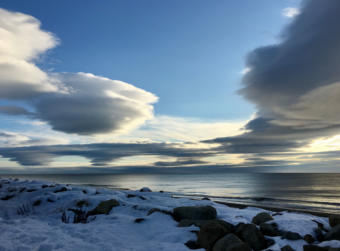
Bering Sea coastline near Nome, October 2017. (Photo by Zoe Grueskin/KNOM.)

President Joe Biden signed several climate-related executive orders on his first day in office. One of them reinstates the Northern Bering Sea Climate Resilience Area, an Obama-era executive order that includes protections from offshore oil and gas leasing in the Norton Sound as well as waters around St. Lawrence Island.

The original order was revoked during former President Donald Trump’s early months in office.

The reinstated order outlines policies on marine shipping, pollution, marine debris and oil spills, among other Arctic marine-related issues. The entire “resilience area” stretches over 112,300 square miles, from the Kuskokwim Bay to the southern border of the Chukchi Sea.

But for groups in Western Alaska, one of the most significant things about the order is that it acknowledges the importance of using local Indigenous knowledge. The federal task force responsible for the Northern Bering Sea Climate Resilience Area would include an intergovernmental tribal advisory council. The council has not yet been formed but would include between nine and eleven elected representatives from tribal governments.

Melissa Johnson, executive director of the Bering Sea Elders Group, called it a “milestone” for incorporating Indigenous people into federal conversations and policy on climate change.
“That council focuses on the matters that affect us as Indigenous people who live along the Bering Sea coast, who rely on the Bering Sea coast and who pass that knowledge on to future generations,” Johnson said.

Johnson and others emphasize that anything addressing climate change and activities in the Bering Sea should include local tribes. In 2016, the Elders group and 39 Tribes reportedly petitioned the Obama administration for additional marine protections. One of their primary concerns was that increased Arctic shipping could impact marine mammal migrations and subsistence hunting.

In a joint press-release from several Tribal groups, the Bering Sea Elders Group said the order “elevates” tribal roles in Bering Sea management and “provides a pathway for our Tribes to exercise self-determination.”

The “resilience area” stretches over 112,300 square miles, from the Kuskokwim Bay to the southern border of the Chukchi Sea. (map from the executive order)

Kawerak, Inc. marine advocate Austin Ahmasuk welcomed the new order after years of Arctic policy that he said has not adequately included the people most affected.

“A lot of Arctic policy is being proposed, decided upon, even written, by people who are not from this region,” Ahmasuk said. “We’re glad that it’s prohibited oil and gas leasing in those planning basins. We are of course glad about the prohibition of bottom trawling into the northern Bering Sea. And then we look very much forward to how communities will be involved as advisors in Northern Bering Sea management.”

The original 2016 executive order drew sharp criticism from the Alaska congressional delegation. Senator Dan Sullivan called it a “unilateral plan to harm Alaskans.” The delegation has not yet issued a statement or responded to requests for comment on Biden’s decision to reinstate the 2016 executive order.

The Dunleavy administration would not comment specifically on the reinstatement of the Northern Bering Sea Climate Resilience Area.

In a statement from the Alaska Department of Law, Assistant Attorney General Maria Bahr wrote that Biden’s executive orders are still being reviewed for their impacts on state agencies.

“These are complicated and evolving issues and will take some time to fully analyze,” Bahr wrote in a statement.

US Congress authorizes deep draft port project in Nome

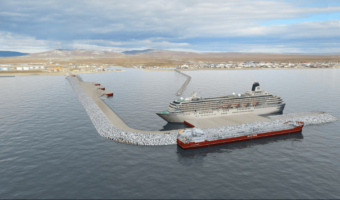
A model rendering for the design of a potential Arctic Deep Draft Port in Nome. (courtesy PND Engineers)

After years of waiting, the Arctic Deep Draft Port project in Nome was authorized by Congress on Dec. 21 and is ready to move forward.

Included in the 2020 Water Resources Development Act that was part of the Consolidated Appropriations Act of 2021, the project calls for an extended causeway and a new deepwater basin at Nome’s port.

Mayor John Handeland says that getting the Congressional authorization for the project passes a major hurdle.

“We were excited that the Deep Draft Port [project] at Nome was included in the Water Resource Development Act bill that Congress recently passed,” Handeland said. “This project has been on the planning table and been advanced by the city for a decade, I would say, and getting over this hump is monumental for our area.”

Now that the plan has been approved by Congress, Joy Baker, Nome’s port director, says the project now moves into the design phase and continues the quest for funding.

“Once the Alaska District is able to access their federal funds in the F21 Work Plan, we will move immediately into the design phase, that’s a two-year phase. We expect something between now and March. We’re hoping they will get their funds released and we’ll be able to start,” Baker said.

The price for the project has increased to $505,233,000, compared to $490 million when the Army Corps of Engineers initially signed off on the plan last year.

The Corps will pay $378,908,000, leaving the city of Nome responsible for $126,325,000.

But Baker emphasizes that the money is not immediately coming from taxpayers — a majority of the money will come from project partners, and now that the plan is authorized, the city can request grant money.

Some community members are concerned this project could have negative effects on the marine environment and local subsistence hunters.

Kawerak, Alaska’s Native regional tribal consortium, made no comment on the latest development but did release a statement about their concerns for the project last year. They recommended that more be done to enable subsistence hunters’ access to resources, limit negative effects on the environment and keep the cost of living down in Nome.

Gail Schubert, President and CEO of Bering Straits Native Corporation, says the corporation “whole-heartedly supports” the port project and trusts that the port will not greatly impact subsistence hunters and fishers.

“I think that the port location, or the location in and around Nome, has been used fairly regularly and substantially for the past several hundred years by people coming into Nome,” Schubert said. “I think that if there were going to be any sort of subsistence impact, it would have happened already, so I’m confident with the work that the Corps has done and that the port can be built out safely.”

Baker also believes that Nome’s new port project will bring a lot of economic benefits for the region.

“I think the region could definitely benefit from the economic injection and boost that this would bring to jobs in the region. I see ten years down the road, a very bustling busy military facility that’s also supporting industry and providing jobs that are desperately needed in our region,” Baker said.

The two-year design phase will begin in the spring of this year. After the design phase, the project will move on to the construction phase.

‘A really tough decision’: The 2021 Iditarod won’t end in Nome, but local leaders and mushers understand

Norwegian musher Thomas Waerner is the champion of the 2020 Iditarod Trail Sled Dog Race, the third Norwegian to ever win the race and the second in the past three years. (KJ McElwee/KNOM)

In a historic first, the Iditarod Trail Sled Dog Race will not be finishing in Nome this year. The race was rerouted because of COVID-19 concerns.

Iditarod musher Aaron Burmeister said he was distraught when he heard that he would not be racing to Nome this year.

“My whole dream, most of my adult life and since childhood, has been to bring a winning team from Nome back to Nome. And bring the victory home to Nome,” he said. “So that’s something I’ve worked very hard for, and it’s been a goal of mine.”

Burmeister is a Nome local who grew up in the city and trades his time between Nome and Nenana, where he trains his team. This will be his 20th Iditarod, and he’s been in the top five finishers three times.

But the COVID-19 pandemic caused the Iditarod race organizers to create an altered route, one that goes through mostly unpopulated checkpoints.
The 2021 race begins and ends in Willow and sticks to tradition by following the southern route it uses every odd year. Teams will go to the abandoned mining town of Flat before turning returning to Willow, making a run of 810 miles.

Most of the checkpoints are abandoned mining towns or have just one cabin. The largest community along the route is McGrath, with a population of 310.

So if Burmeister wins, it won’t be beneath Nome’s Burled Arch.

“The reason I love Iditarod is the communities we traveled through the people along the trail. I feel at home on the Yukon River when I hit the coast,” he said. “I think the Iditarod had a really tough decision. I think they made that decision in the best interest of the communities along the trail.”

Last year, the COVID-19 pandemic began to escalate while mushers were out racing the Iditarod Trail. It caused one community, Shaktoolik, to make the last minute decision to ban the race from entering their village.

Barely two-and-a-half months out from the ceremonial start of the 2021 Iditarod, some communities like Unalakleet hadn’t made a final decision about they felt safe enough to host the race. That’s according to Unalakleet Mayor Kira Apaachuaq Eckenweiler.

“It’s going to be difficult to not have them come here this year. And it’ll be strange. But we support their efforts to try to protect our community from COVID-19,” Eckenweiler said.

She says the community still puts their support behind the Iditarod and hopes to see it next year.

Unalakleet is one of the largest communities on the trail most years, with a population of about 700 people. It’s the first checkpoint on the Norton Sound coast and an often critical rest stop as teams prepare to traverse the ice of the sound.

And as Iditarod Board member and Nome Mayor John Handeland says, teams need lots of time to know how to prepare for the race.

“People have said, ‘Why didn’t you just wait till the beginning of March? You know, we’re getting a vaccine right now, and things could change.’ Well, that’s true, it’s just that things just seem to change every day with this,” he said.

Handeland says they were already cutting it close to make a decision. If a village forced the race to reroute at the last minute due to an outbreak, it would cause massive logistical challenges.

“Our mushers need to know right now, how to prepare,” Handeland said. “Where they’re going depends on what they put in their sled bags and the like, you know, if they’re not going to have checkpoint support along the way, that adds to their planning.”

Handeland found himself in a tricky position. As the mayor of Nome, he says the city was open to hosting the Iditarod. The Nome City Council passed a resolution of support for the race earlier in the year. But as a member of the Iditarod board, he understands the difficult decision race organizers found themselves in.

“Ultimately, the position that I took for the city was that we are disappointed that it’s happening, but we support the idea that the Iditarod’s needs to do this after they had consulted with many of the checkpoint villages in our area,” he said.

Handeland did vote in favor of changing the race route, a decision he says was made unanimously among the board.

Mushers will be following a safety plan which includes multiple rounds of COVID-19 testing and quarantining at the Lakefront Hotel in Anchorage before they can run the race. They’ll also take another rapid test in McGrath before they can finish the race.

It’s still unclear how social distancing will be enforced at the ceremonial start in Anchorage.

Nome musher Aaron Burmeister says he feels absolutely safe under the plans from Iditarod.

It’s become a common misconception that the Iditarod race commemorates the 1925 Serum Run when dog teams carried life-saving serum to Nome during a diphtheria outbreak. But according to the site’s website, the race was created to preserve the sport of dog mushing.

And during a time of global pandemic, staying safe and being with his dogs is what matters most for Burmeister.

“I would be racing regardless of the virus or not, regardless of knowing what the trail was going to be or not, because it’s not just an event,” Burmeister said. “It’s a lifestyle.”

Police continue search for missing Nome woman last seen in August

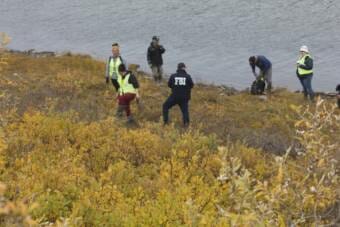
Agents from the FBI search for Florence Okpealuk alongside Nome volunteers by the Snake River in September. (Photo by Emily Hofstaedter / KNOM)

Florence Okpealuk went missing from Nome over two months ago. But the Nome Police Department isn’t ready to let the case go cold yet.

Scott Weaver is an investigator newly hired by NPD. He said they continue to receive analyzed cellphone data provided by the FBI field office in Anchorage. As that continues to come in, Weaver hopes the Nome police can better direct their investigation.

“So, we’re still actively investigating some evidence that hasn’t even come in yet, which will help us hopefully, with some directionals and understanding where people were and who was where that could stir up a new lead for us,” Weaver said.

A spokesperson from the FBI did confirm that the Anchorage office continues to aid the Nome Police with technical assistance in this missing person’s case.

Florence Okpealuk of Nome, who Nome Police are searching for. (Photo courtesy of Nome Police Department)

The 33-year-old, Alaska Native mother was last seen leaving a tent on Aug. 30 about a mile outside of Nome on West Beach. Okpealuk’s shoes and jacket were left behind.

Numerous search and rescue efforts, including large community searches and trained cadaver dogs, have yielded no major breakthroughs thus far. Community-organized search efforts have brought volunteers and funding from across the state, including from regional communities like Brevig Mission, Teller, Wales and Savoonga. That’s been the most impressive and most helpful aspect of the whole search for Weaver, who is used to working with large police departments in Florida.

“Look at our department, we have like six or seven people that are officers,” Weaver said. “And maybe one or two that could help on the case at that time, because we’re still handling all these calls for service. So without the help of search and rescue efforts, and all the volunteers in town and the family members, we would have been at a loss, you know, it was a big help.”

Since early September, the department has faced some criticism for what some community members perceive as a delayed search effort on NPD’s part. But the Nome police continually reaffirm they started their missing persons’ response and protocol as soon as Okpealuk was reported missing.

Kawerak Inc. President Melanie Bahnke said in September that she offered to put Nome in touch with FBI resources when she realized that Okpealuk was missing.

Part of a search team and MAT-SAR K-9s during an October search mission for Okpealuk. (Photo courtesy of Blair Okpealuk)

“Thankfully they were already in touch with the FBI themselves, so I was really pleased when I found out about that,” Bahnke said.

As November presses on and police continue their investigation into Okpealuk’s disappearance, Weaver is hoping that some technical analysis will reveal a lead sooner rather than later. But Weaver also realizes that winter is no longer on their side.

“I know it’s becoming more difficult with the snow hitting the ground now,” he said. “So search and rescue efforts are going to become more strained with the weather.”

It’s a challenge but her family maintains hope.

“We will not give up,” said Florence’s older sister Blair Okpealuk. “We want answers and closure.”

She continues to organize search efforts and stresses her gratitude for the outpouring of searchers and support for her sister. Some of that has included donations of $1,000 each from Kawerak Inc. and Norton Sound Economic Development Corporation.

Anyone with any information regarding the whereabouts of Florence Okpealuk can call the Nome police at 907-443-5262. Callers can remain anonymous.

Fall storms set back Bering and Chukchi sea ice formation in already delayed season

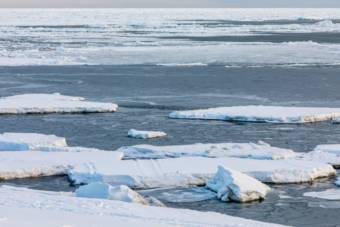
Scattered sea ice near Nome, Alaska, March 15, 2019. (Photo courtesy David Dodman via KNOM)

As of Nov. 3, sea ice in the Bering and Chukchi Seas is the lowest on record for the last five years, even with tiny bits of ice starting to form in Norton Bay and Kotzebue Sound. One climatologist forecasts that sea ice will form late, the extent will be below average, and it will be similar to last year’s.

The Bering Strait region is on track to have the lowest sea ice extent on record for early November, based on a 15-year dataset.

It started this summer, when May through September again featured some of the warmest ocean temperatures on record. Climate specialist Rick Thoman, with the Alaska Center for Climate Assessment and Policy (ACCAP), said the good news is that summer 2019 was still significantly warmer than this summer.

“In Eastern Norton Sound, in Kotzebue Sound, those are temperatures that are seven degrees Fahrenheit or more above average for that entire five months. And you can see the entire Chukchi Sea, almost all of the Bering Sea in 2019 was significantly warmer than normal. That’s not the case this year, well actually it kind of is, in that most of the Bering Sea for those five months, did end up warmer than normal,” Thoman said.

Thoman points out that in the northern Bering Sea, sea surface temperatures have gone from 42 degrees in the early 1900s up to about 45 degrees today.

“That doesn’t sound like much to most folks, but three-to-four degrees warming of a five-month average, in the ocean…is really just incredible,” he said.

As the average temperature in the Bering and Chukchi Seas continues to climb, and with the La Niña conditions this year, sea ice extent is expected to remain below the historical average. However, Thoman says sea ice in the Bering Strait region most likely won’t be as poor as last year. Nome didn’t see sea ice offshore until late November 2019, and even then the quality was poor.

“It’s still below the recent years’ average, but not as low as last year, but that is a bad comparison for our part of the world,” Thoman said. “Even though the Arctic-wide sea ice extent average for September was the second-lowest on record, the Beaufort Sea kept our area from being as low in sea ice as we saw in 2019.”

Thoman warns that from January to March, if there are strong swings of weather patterns across the Bering Sea, those will absolutely affect sea ice growth.

“This really seems like the kind of situation where we might get three weeks of really cold weather and then the pattern changes and boom — it’s storm after storm after storm. With water temperatures above normal, if ice extent is not much better than normal, then these storms could produce a lot of precipitation,” he said.

Today, according to the National Weather Service and Thoman, a “big Bering Sea storm and associated fronts” are expected to bring a mess of snow and rain along with winds up to 40 mph to the Bering Strait region.

This storm could also raise water levels in the Norton Sound, setting sea ice development back a week or more in the Bering and southern Chukchi seas.

Unalakleet woman wins on appeal against US Air Force for contaminating her land

Emily Nanouk’s property near Unalakleet that was allegedly contaminated by the Air Force. Photo taken by Melanie Sagoonick, (Photo courtesy of Sam Fortier).

Unalakleet resident Emily Nanouk is fighting the U.S. government in court for the health of her family and the sanctity of her land. Nanouk’s property was contaminated by toxic chemicals which she says had detrimental health effects on her family and home.

Since the 1960s Nanouk has not only used her land in Unalakleet to raise her family, but also for subsistence activities like hunting, fishing and berry picking.  In 2003, she noticed a strange smell and dead vegetation between her property and the abandoned North River Relay Station.

“It’s not gasoline, it’s not oil, it was a sweet smell.  I knew it wasn’t right, there was something wrong.  There was no green stuff around it, there was no green willows, no berries.  [It was] dead around that area.  I knew there was something wrong,” she said.

This relay station was built as part of the White Alice Communication System to allow for early warning of any potential Soviet air attack during the Cold War and was operated by the United States Air Force. By the 1970s new satellite technology rendered these systems useless. So, the Relay Station was closed in 1978 and the Air Force abandoned the site.

“Everybody just kind of packed up and left, I guess, like when you pull out of a war zone,” said Sam Fortier, an attorney representing Nanouk.

Their case points out that in 1981 the Air Force was criticized for doing nothing more than sending a ‘caretaker’ out to the site to inspect the property.  It was discovered that barrels containing highly toxic polychlorinated biphenyls — commonly referred to as PCBs — had been left, not properly disposed of and began contaminating the surrounding area.

Nanouk and her family used the only trail leading from the main road to her allotment, which passed through the contaminated relay station site.  The vehicles they drove picked up and carried the hazardous chemicals onto her property, spreading the contamination.

Fortier says Nanouk believes the exposure to PCBs affected her and her family’s medical conditions.

“Within her own family there have been significant illnesses, those illnesses are really connected to the PCBs. In this case, the PCB level was extremely high.”

According to Air Force technicians that examined the site in 2003, in some areas, they measured PCBs at 40,000 times the level that is considered safe for humans. In addition, Fortier notes a deeper element of emotional trauma associated with Nanouk’s experience.

“It’s also important to understand that in the early days after she [Nanouk] reported the discovery, people went in with basically moon suits to clean the property.  You can imagine realizing that her husband had died because of the cancer associated with the PCBs, that she herself has had health problems, and all of her family has had health problems; only magnified her terror and the loss of use of her allotment.”

Fortier and Nanouk are arguing that this was negligent of the Air Force.  The U.S. Department of Justice, assuming responsibility, declined to comment on this case. The Air Force stated that they could not make any comment in this case due to the ongoing litigation.

Nanouk’s lawsuit was originally halted on December 12, 2018 when United States District Judge Ralph R. Beistline dismissed the lawsuit. However, Nanouk’s most recent victory on appeal in the Ninth Circuit Court means she can keep fighting. This most recent decision was made on September 4, 2020 and the finding was published just after.

Nanouk says she would like to emphasize the importance of health to anyone hearing her story.

“And I would not want anybody to go through this, any family to go through this like my family and I did … [like we] still are going through.  Health is more important than money.”

The COVID-19 pandemic has slowed court proceedings across the state and country, but Nanouk and her attorney remain persistent in pursuing this lawsuit as soon as they possibly can. This case now goes back to the United States District Court of Alaska, but the timeline for a final decision is unclear.

Site notifications
Update notification options
Subscribe to notifications