KNOM - Nome

KNOM is our partner station in Nome. KTOO collaborates with partners across the state to cover important news and to share stories with our audiences.
Without running water, Stebbins improvises sanitation amid COVID-19 outbreak

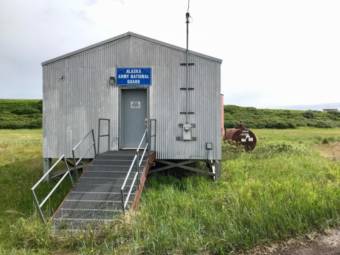
The Alaska Army National Guard armory in Stebbins is now used as isolation housing for COVID-19 patients. (Gabe Colombo/KNOM)

Stebbins is having one of the Norton Sound region’s worst outbreaks of COVID-19, with at least 24 cases being reported since Oct. 6.

It’s also a community that doesn’t have running water, which is forcing the community of 700 to get creative with their sanitation measures.

At 73-years-old, Virginia Tom of Stebbins has seen a lot — including outbreaks of pneumonia, tuberculosis, and other public health issues. But the novel coronavirus outbreak in the village scares her.

“It seems to spread really fast. Just fast! One minute I see a person walking by the window and then the next minute I hear, ‘he’s got it,’” she said.

Tom has never been so health conscious in her life. With COVID-19 active in the community, both she and her daughter have been doing the errands and caring for their household of nine people. That includes both children and elders.

When she is running errands, Tom says she wears a mask and is always washing her hands.

“I do more hand washing than ever,” she said. “Oh my gosh!”

But Stebbins does not have running water or a sewer system. It’s unserviced. Just like her neighbors, Virginia Tom hauls water from the local washateria for all household needs, including handwashing.

With water in short supply, many people will stretch their water by filling a washing basin with soap and water every morning. It should be replaced after every use, but in many cases, it ends up being used by the family throughout the day.

“That’s a potential place for spreading contamination if it isn’t changed out regularly,” said Sean Lee of the Norton Sound Health Corporation.

Lee is the sanitation, engineering and construction project manager for Norton Sound Health Corporation’s environmental health office. The department has been working to set up new hand-washing stations for homes in all of the region’s village communities, not just Stebbins.

“We worked on creating a basic handwashing station that utilizes two buckets, and it has a little copper faucet on it. And it uses a foot pump.”

The bottom bucket is filled with clean water, and the foot pump pushes the water up to the top bucket.

“One of the users would just basically step on the foot pump. And then a good two to three seconds stream of water comes out every time they step on the foot pump,” he said.

It’s more water-efficient than just running water through a tap, and Lee thinks in some ways it’s more hygienic, too.

“There’s no touching involved with the hands, so it helps prevent cross contamination. And it’s also a very portable unit that just needs fresh water in the bottom.”

The Alaska Army National Guard armory in Stebbins is now used as isolation housing for COVID-19 patients. (Gabe Colombo/KNOM)

Stebbins is the first regional community to receive those sinks. They’re currently being assembled and will eventually be distributed to every home in town.

It’s not a permanent solution by any means, but Lee does think the coronavirus pandemic has forced some innovative thinking and design for unserviced communities. But Lee says running water would be the gold standard.

“It [the pandemic] has really highlighted the need for water in unserved communities because the outbreaks in Gambell and the outbreaks in Stebbins are mostly related to not having adequate water for handwashing,” he said.

In the meantime, Virginia Tom is keeping things clean for the nine people living in her three-bedroom house.

“I wish we had running water, but I like those hand wipes. The disposable wipes that you pick up for cleaning, those are real good,” she said.

Those wipes are also sold out in the community of Stebbins right now, so NSHC is working with local water operators to get the community supplies and instructions to make their own bleaching solutions.

“The water treatment plant operator would be able to make a batch of household bleach chlorine solution from the chlorine that they have in their water treatment plant used for disinfecting purposes. And it would be the same 5% solution that you get from your household bleach, like Clorox,” said Lee.

Lee is hopeful that the temporary innovations borne out of necessity by COVID-19 can have some lasting benefits for regional communities. Even if either the sinks or bleach solutions get used long-term, he thinks they could help improve the state of sanitation in those villages.

But the lack of adequate sanitation is still frustrating for healthcare workers like physician’s assistant Mark Hayward, who is working to do COVID-19 testing in Stebbins.

“The fact that these are American citizens living in 21st century America without running water, and having to crap in a bucket, is inappropriate. And that’s a word that I’m toning way down for radio,” he said.

But there are layers of bureaucratic and funding issues that mean plumbing for Stebbins is a long way off. Hayward said most residents are doing everything they can to combat the virus, but they don’t have all the resources they need.

Virginia Tom says she is just trying to keep clean and make the best she can of a hard situation.

“In a way, we spend more time with our family in home. We are even closer to our family here,” she said.

Gambell residents hunker down amid COVID-19 outbreak

The local grocery store in Gambell, on St. Lawrence Island in 2017. (Davis Hovey, KNOM)

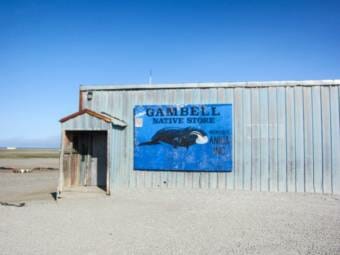
Melanie Campbell is finishing up work for the day at the Gambell IRA office. It’s nearly 5 p.m., and she hasn’t had a chance to call in her groceries to the Native store.

“I kind of feel like it’s too late for me to make an order!” she said with a laugh.

With 29 cases of the virus locally, and about half of the community tested, the local store is only taking phone orders. Residents are asked to form a line, stand six feet apart and wait for the store clerk to deliver their groceries.

There’s one grocery store for the community of 700 people, and the phone line is constantly busy. And the lockdown is exacerbating the already delicate grocery supply chain.

“We haven’t had any eggs and fresh produce in quite a while,” said Gambell City Clerk Charlotte Apatiki. She notes that several times this season the cargo plane failed to land and unload groceries.

Apatiki says Norton Sound Health Corporation is helping deliver groceries to families in isolation.

The Gambell school is closed and right now, and the Bering Strait School District is not doing meal deliveries. Many children in the community normally eat both breakfast and lunch at school.

While eggs would be nice to have for baking projects to keep her children entertained, Apatiki doesn’t think her household of six will go hungry.

“Most of us, if we were lucky to have gas during the spring harvest, are living on Native foods and fish,” she said.

Charlotte Apatiki, Gambell’s city clerk, in 2020. (JoJo Phillips/KNOM)

Earlier this year a broken fuel line caused Gambell to be on a fuel ration for most of the spring and summer subsistence season. That has since been repaired, and Apatiki says local fuel prices have gone down from $12 to about $7.40. But she thinks the fuel ration impacted a lot of residents’ ability to harvest the food they now need to get them through lockdown.

Some assistance did come from the federal government. The Native Village of Gambell decided to give every member of the community $600 through their tribal CARES Act funding to help ease the burden of those costs. According to grant administrator Melanie Campbell, that funding is for cleaning supplies, food, fuel or anything else a family would need.

The emotional costs are taking a toll as well. Gambell has three village police officers going around the community to enforce the lockdown. That’s hard for Apatiki’s kids, who are used to roaming the tightly-knit village.

“My five-year-old really wants to go play with his cousins and everything. The weather hasn’t been cooperating at all. It’s raining and pretty windy out there.”

Aside from being cooped up inside, online schooling isn’t an option either, and homework isn’t being sent out by the local school.

“Our [internet/mobile] data here is practically slow-to-nothing on some days,” Apatiki said. “Nothing is being done right now.”

The local hospital considers the situation in Gambell to be an outbreak. Local residents told KNOM they worry that the virus is spreading more easily because of the number of people living in overcrowded homes with their extended families.
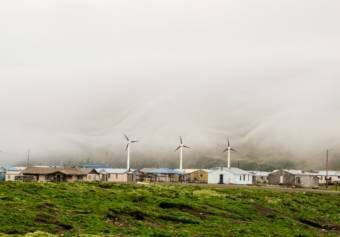
Norton Sound Health Corporation is reporting that at least one household of six individuals in Gambell all tested positive for COVID-19. Despite that, local Mayor Joel James feels prepared for the current hunker-down order.

“People that are in isolation have isolation housing and people that are in quarantine are in quarantine at home,” he said.

For privacy reasons, he wouldn’t confirm where the isolation units are, but James says there are enough units available in Gambell if more people become sick.

Local leaders like Mayor James stress the importance of following curfew and quarantine rules to slow down the community spread. The mayor is trying to do his part too

“I’m a very busy man,” he said. “I was delivering toilet paper to people in isolation.”


In Gambell, COVID-19 cases more than doubled last week

An overview of Gambell, Alaska, in 2015. (Kristin Leffler/KNOM)

There are now 17 active cases of COVID-19 in the St. Lawrence Island community of Gambell. Norton Sound Health Corporation announced four patients tested positive for the virus on Friday and three on Saturday — that’s on top of four other Gambell cases announced earlier in the week.

According to a press release from NSHC, the health corporation has been working with tribal leaders for more than a week to reduce any further spread of the coronavirus. The City of Gambell has instituted a hunker down mandate asking all residents to remain at home for two weeks and to only leave for necessary medical needs and groceries.

NSHC says the local village public safety officer is patrolling in the village to help limit contact between residents. There is also a community-wide curfew in place.

Roughly 400 people, or more than half of Gambell’s population, have been tested for COVID-19 since one household with six individuals contracted the virus earlier this month. NSHC says they will send a second response team to Gambell this week.

Separately, a resident of Savoonga tested positive for the virus on Friday. According to NSHC, the patient was identified through the community’s testing and quarantine requirements for travelers coming to Savoonga. The individual is safely isolating, and the community’s leaders have been notified.

The State Section of Epidemiology and Public Health Nursing are following up with any close contacts of the newly confirmed cases. There are now 78 cases of COVID-19 in the Norton Sound region. Twenty are active while 58 are considered recovered.

Local orgs donate $38,000 to speed up processing of Nome’s sexual assault kits

Sexual assault evidence kits. (public domain)

Local entities are stepping up financially to help survivors of sexual assault in Nome. Kawerak Inc., Norton Sound Economic Development Corporation and Norton Sound Health Corporation are all pitching in to pay for testing of Nome’s backlogged sexual assault kits. Their donations amount to $38,295.

Kawerak’s President and CEO Melanie Bahnke says the tribal consortium has made public safety a priority. In late July, Bahnke sat down with the Nome police chief and city manager to learn how Kawerak could help.

“One of the things they [Nome police and the city] shared is that they didn’t have adequate resources and also that the state lab is backlogged,” Bahnke said. “After they submitted all of the sexual assault kits, the anticipated wait time is a year. That’s just unacceptable.”

The Nome Police Department sends all of their sexual assault kits to the state crime lab for processing — and so does everyone else, including the Alaska State Troopers and other municipal police departments across the state. Right now, according to Nome police evidence custodian Paul Kosto, it’s taking kits about a year to be processed in the state lab. Kosto says the donated funding will allow Nome’s unprocessed sexual assault kits to get tested at a private laboratory.

“A big part is money,” Kosto said. “It costs a lot of money to get kits sent to the front of the queue and to pay an outside entity to perform the test.”

That means around a dozen kits will tested by BODE Laboratories in Virginia. Instead of taking a year for processing, Kosto says those kits will likely be done in 60 days or less.

“Then the investigators and the District Attorney’s office can determine where they’re going to go forward on those kits,” Kosto said.

More sexual assaults were reported to Nome police by mid-September this year than all of last year — 98 so far in 2020 compared to 88 reported in 2019.

Kawerak’s Melanie Bahnke says it’s unacceptable for any of those survivors to be waiting a year for their sexual assault kit. She wants to remain focused on building a partnership with the City of Nome and local law enforcement.

“We’ve got some bigger hurdles ahead of us, and Kawerak will keep advocating for justice for victims of all kinds of abuse,” Bahnke said.

Bahnke says that includes advocating for resources at the state level so there won’t be a backlog of sexual assault kits to begin with.

Friends and family wait for answers in disappearance of Nome woman

Florence Okpealuk of Nome. (Nome Police Department, used with permission)

Her name is Florence, but friends call her Flo. It’s hard for Lucille Weyapuk to pick just three words to describe her friend.

“Humorous, you know … sophisticated, encouraging, loving, friendly, gosh! You name it!“

Weyapuk and Okpealuk grew up in Wales as close friends, and they’re distant cousins. But Weyapuk gets a bit lost figuring out the family tree.

“We’re pretty close because she’s named after my mom. Ever since she was a little girl, she’s always baked goodies for my dad and for all of us siblings. She probably started doing that when she was five or six.”

Lucille Weyapuk lives in Anchorage now, where the two women last visited in March. When Okpealuk came through town for medical treatment, she would always give Weyapuk a call.

Flo’s older sister Madeleine Blaire Okpealuk, who goes by Blaire, has a different perspective.

“Growing up she was stubborn, but she was always organized and responsible.”

Flo is the second youngest of seven siblings. Blaire says they’ve had their share of tragedy as a family, too.

“We lost our Dad in 1998. It seems as though we were almost forced to grow up fast.”

Flo is the mother of a six-year-old girl. On social media, she posted dozens of pictures with her daughter. Flo wears square-rimmed glasses, and her face is framed by long black hair. The mother and daughter sport matching smiles and sometimes even t-shirts.

At the time she was last seen, Blaire believes Flo was living in an apartment with her boyfriend. She says Flo was struggling with alcoholism and had some recent criminal charges, her first serious legal trouble. Blaire says that was something that gave her sister anxiety.

Throughout those challenges, Flo kept her focus on her little girl, her sister says. And she continued to share childcare with her daughter’s father.

“She was pretty active with her daughter,” Blaire said. “She brought her daughter to community events or participated in activities for her daughter.”

It was a big red flag when Flo dropped out of sight. She always kept in touch with family. When Blaire got a call from Flo’s boyfriend, she immediately went looking.

“I started at all of the bars, in town, people.”

A dispatch from the Alaska State Troopers says Okpealuk was last seen Aug. 30 on Nome’s West Beach, about 1-2 miles out of town, leaving a tent. She reportedly left a jacket and shoes outside. Tents are a normal sight on Nome’s West Beach during the summer, as miners and other temporary residents set up short-term spaces.

Searchers go out every day to look for Okpealuk, and the community held a prayer vigil Sept. 12th at Old St. Joseph’s park. It offered some relief for Blaire.

“I think it was hopeful and it was reassuring,” she said.

Law enforcement has not said they have any leads in the investigation. Meanwhile, friends and family around the state wait for answers.

Anyone with any information about the disappearance or possible whereabouts of Florence Okpealuk can call Nome Police Department at 443-5262. Callers can remain anonymous.

Alaska Native women rally to search for missing Nome woman

Florence Okpealuk of Nome (courtesy of Nome Police Department, 2020).

Last week, law enforcement and local authorities began searching for a 33-year-old Nome woman they say was reported missing August 31. A community-wide organized search began Saturday, but Florence Okpealuk has still not been found.

Some women from Nome and nearby Teller don’t think that response was fast enough.

Florence Okpealuk was last seen on August 30, and Nome Police received a call the day after. Like many in the area, Billie Jean Miller of Nome was heartbroken to learn Okpealuk was missing. The women played basketball together as girls. Okpealuk, who is a few years older than Miller, became a trusted confidant off the court.

“I used to go to her for advice here and there, and she was always so kind and open with her space and her energy. Anytime something came up, she was always very positive. She was always a light and always a beacon every time we saw her,” said Miller.

Miller said a group of five women began messaging each other, brainstorming ways they could help. By Wednesday they were actively organizing their efforts.

“And that group message has grown. I can’t even count the number of women who have offered to help Flo and this is just a part of our sisterhood as Indigenous women.”

To cover more ground, the women’s group decided to search away from West Beach, where the Troopers, Coast Guard and Nome Search and Rescue looked. Dozens of women combed the beaches, the foot trails behind the grocery store, the suburb of Icy View and all the other nooks and crannies around town.

“We’ve had women checking abandoned cars around town and in and out of the junkyard. We’ve been searching abandoned houses. We’ve walked the tundra,” said Miller.

Miller says the search team isn’t limited to just foot searchers. It includes the women staying home to babysit and cook so others can search.

Carol Seppilu of Nome is also helping the search. She wonders if the community urgency would be different if it were a non-Native woman.“If it were a white woman who went missing, they would have already conducted a community-wide search,” said Seppilu.

Seppilu and Miller don’t think the search and investigation are happening fast enough. But Nome’s Deputy Police Chief Robert Pruckner insists police have been doing everything they can.

“The first searches that were done were on September 1. We began the process of investigating and starting the paperwork as soon as we were notified from the family that she was missing. NPD was part of the search process in coordinating with the search- and- rescue team,” said Puckner.

Some in the community have criticized Miller and Seppilu for downplaying the efforts of law enforcement and trained search-and-rescue teams. But Miller says local law enforcement’s efforts need to be shared more broadly with the community.

“The truth is we don’t know their efforts because we’re not being given information. We need for all of our women to feel safe and feel protected and know that if one of us goes missing we’re not going to wait until day six.”

Anyone with any information surrounding Okpealuk’s disappearance is encouraged to call the Nome Police at 443-5262.

Site notifications
Update notification options
Subscribe to notifications