KNOM - Nome

KNOM is our partner station in Nome. KTOO collaborates with partners across the state to cover important news and to share stories with our audiences.
Bowhead whales are changing migration patterns, researchers say

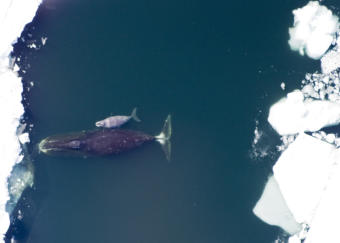
A bowhead whale and a calf in the Arctic on May 29, 2011.
A bowhead whale and a calf in the Arctic on May 29, 2011. (Photo by Corey Accardo/NOAA)

Bowhead whales are on their way to Canada for the summer months, and whaling communities in the Bering Strait region have reported a successful spring hunting season. Despite these annual events continuing as normal, researchers have recently found some bowheads deviating from their usual movements.

Bowhead whales are creatures of habit. They spend their summers in the Amundsen Gulf and the Tuktoyaktuk Shelf region of Canada and then migrate along the northern coast of Alaska past Utqiagvik, before going south to the Bering Sea, where they stay for the winter.

“Bowheads leave the Bering Sea in April, right before it becomes the most productive ocean in the world…,” said Lori Quakenbush of the Alaska Department of Fish and Game. She has been studying these specific whales, using satellite telemetry, for more than 14 years.

She says researchers believe that bowhead typically travel to places where their food, like zooplankton, is heavily concentrated.

“So in spring, in April and May, they follow northward closest to Alaska Coast and then when they get to Point Barrow, they actually go a little bit beyond Barrow before they turn right, and then they pretty much go straight shot to Canada from there, which is really interesting. They’re out over the deep water under Beaufort Sea ice, that’s probably at about the heaviest it is during the year, so they’re doing that in May.”

The annual migration of bowheads normally puts the massive marine mammals around Point Barrow in the spring and then again sometime between late August and October.

But suddenly, last fall, the community of Utqiagvik and Quakenbush experienced something that had never happened before.

“One of the big changes was last year in the fall whaling season in Utqiagvik basically didn’t happen and unfortunately we didn’t have any tags out to say exactly where those whales were. The aerial survey folks found some, really late for normal migration, still in the Beaufort Sea.”

Veteran whalers said last year the community of Utqiagvik had never gone that long without seeing a bowhead whale near Point Barrow during the fall hunting season. Alaska’s northernmost community did land one whale last November, however it paled in comparison to the almost 20 whales Utqiagvik harvested during the 2018 fall season.

As Gay Sheffield with Alaska Sea Grant puts it, communities in the Bering Strait region are greatly interested in where bowhead whales will be spotted next, following these unusual movements from the past fall season.

By that time in the bowhead’s migration, Quakenbush’s satellite tags had stopped transmitting information and funding for the project ran out. She says that was unfortunate timing for more than one reason. The project officially ended in 2018, but the final satellite tags on bowheads continued to transmit data into 2019. None were still active by the fall whaling season.

“And we’re also seeing this shift in the wintering area in the Bering Sea and we don’t have an opportunity to track that now. We did learn a lot and we learned a lot about (what) bowheads were doing with the ice conditions that were pretty stable at that time, and now that they’re changing we’re not sure what we know,” she said.

Quakenbush and other researchers are seeing ecosystem-wide changes, like the warming Bering Sea, but also, more specifically, bowheads starting to change where they spend their winters. During recent warm winters in the Bering Sea, bowheads spent more time in the southern Chukchi Sea than in their normal wintering area south of Bering Strait.

Other movements, unrelated to warming ocean temperatures, were also found. Quakenbush says some bowheads are traveling twice as far on their journey west from Canada and then back east from the Beaufort Sea.

“We have a fair number of whales that leave the Canadian Beaufort, go all the way over to the Chukchi and then back to the Canadian Beaufort, before they migrate back in the fall; which seems like a pretty long distance. But there’s some really interesting movements of leaving, either to look for another place to feed, or we don’t know… But they’re basically traversing the Beaufort Sea twice in the same season.”

Quakenbush and the research team, made up of local subsistence whalers, tagged more than 77 bowhead whales between 2006 and 2018. She said that this is a small sample size relative to a bowhead population which is estimated to be more than 16,000.

As the Alaska Eskimo Whaling Commission has told KNOM, subsistence hunting for bowheads and other marine mammals is a way of life that AEWC members will continue, regardless of external factors. Both Savoonga and Gambell successfully landed bowheads by the end of the spring hunting season. The community of Point Hope reportedly met their quota of 11 this season.

Similarly, Quakenbush’s work has come to an end. The satellite tagging project she was involved in, tagged its last set of whales in the fall of 2018.

At this point, Quakenbush says she is analyzing the data to be able to share more information about bowheads’ movements with whaling captains and other interested stakeholders.

Subsistence hunting in Gambell suffering due to community fuel shortage

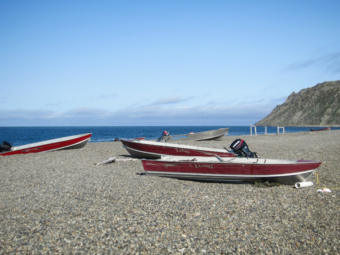
Local hunters’ boats in Gambell in 2017. (Photo by Davis Hovey / KNOM)

Fuel rations have been imposed on all Gambell residents for about a month, after a barge shipment from last year failed to deliver the community’s supply of fuel. The community’s ability to subsistence hunt and stock up on food for the future is being negatively impacted by this fuel shortage.

According to multiple sources, the community’s summer fuel delivery from Crowley could not be unloaded in Gambell last June. City Clerk Charlotte Apatiki said there are a couple reasons why Gambell was left without its yearly supply of fuel, including a leaking fuel line.

“So they (the barge) couldn’t deliver the first run of fuel because of the fuel leak. And then their second attempt was later on in the summer. We were stormy for about a week then or maybe a little over a week, and they couldn’t get to the fuel line over there at north beach to deliver the gas, so they (the barge) just turned back,” she said.

Crowley Fuels was the fuel barge operator trying to unload fuel at Gambell on those occasions. The company is also one of the main fuel providers for many other communities in the Bering Strait region.

The U.S. Army Corps of Engineers has noted that several fuel barge operators say landing a vessel at Gambell is always weather dependent. But residents say the Crowley barge captain could have landed on at least one of the attempts made last year.

After reaching the last of their fuel reserves last month, Gambell’s Native Store, which is owned by the Native Village of Gambell (IRA/Tribal Council), had to put restrictions on resident’s fuel purchases. These make for trying times for Jeremiah Apatiki, the local store manager.

“It’s hard…I have to limit everybody, their ATV. For boating, it’s really hard now because it’s spring time and its boating season and everyone needs their gas. So we limit them now, we limit them [to] two gallons a day per ride and the boat captains (get) 30 gallons for now, per trip,” he said.

Apatiki said 30 gallons per day for their captains is not enough if they’re already having to travel 70 miles or further away from the community to find suitable ice for hunting.

For now, Gambell’s Native store has paid for the community to receive three emergency fuel deliveries via airplane at 3,900 gallons a piece, while ANICA is facilitating the delivery. The hope is that these shipments will support Gambell’s needs until this summer’s fuel barge delivery comes in June. Jeremiah Apatiki said their first 3,900-gallons lasted about a week.

Apaitiki said Gambell’s three main entities: the IRA Council, city, and village corporation, were concerned the cost of flying in emergency fuel would gradually get more expensive and wouldn’t last until the next fuel barge arrives.

“(So) they made a resolution to the governor, asking for assistance, requesting that the National Guard bring shipments in so our [fuel] prices wouldn’t rise. ANICA is probably going to raise the price every time they fly a shipment of gasoline in(to Gambell),” she said.

It is unclear what the state’s response will be to Gambell’s emergency situation as a spokesperson for Governor Mike Dunleavy’s office could not be reached for comment. According to a spokesperson with the National Guard, as of this week they have not been involved in any aviation-mission related to delivering fuel to Gambell.

Apatiki said the community restrictions on fuel usage will be in effect until sometime next month, whenever the next fuel barge can unload.

Nome regional hospital closed to the public after employee tests positive for COVID-19

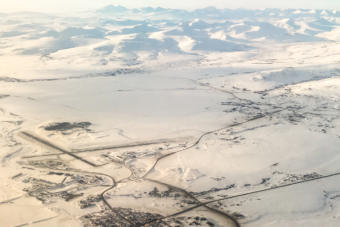
An aerial view of Nome, Alaska, and the surrounding countryside; March 2017. (Photo courtesy KNOM)

A Norton Sound Health Corporation employee in Nome tested positive for COVID-19, the disease caused by the coronavirus. The corporation made that announcement last night, confirming the Bering Strait region’s second case thus far.

According to NSHC, the positive COVID-19 result was found through routine employee testing at the regional hospital in Nome. The corporation says all of their Nome facilities will be closed to the public today. While the employee self-isolates, NSHC will undergo a four-day cleaning and do immediate COVID-19 testing on all of its Nome-based staff.

It is unknown how the NSHC employee contracted the virus, but the State’s Section of Epidemiology is working with the individual to do contact tracing at this time.

NSHC’s spokesperson Reba Lean could not be reached for comment. Norton Sound Health Corporation says it will continue to offer COVID-19 testing for all residents of the Bering Strait region, whether they’re displaying symptoms or not.

Despite previously cancelling today’s call, NSHC will host its daily tribal teleconference this morning at 11am. The call-in line is 1-800-315-6338; access code: 03286#. If you are experiencing symptoms of COVID-19 you can call Primary Care in Nome at 443-3333.

‘Unserviced’ Communities: – Adapting to the coronavirus pandemic without water and sewer

Water operators in St. Michael, pre-quarantine. (JoJo Phillips, KNOM)
Water operators in St. Michael, pre-quarantine. (Photo courtesy JoJo Phillips/ KNOM)

The federal Centers for Disease Control and Prevention has recommended every person across the country wash their hands regularly throughout the day to prevent the spread of germs. Some in rural Alaska, without running water, are left asking: How?

“That’s easier said than done,” said Frank Oxereok Jr., the mayor of Wales, a small coastal community with a population just under of 200.

That’s because his village doesn’t have running water. Wales relies on nearby streams for water and uses honey-buckets to dispose of their sewage in a local lagoon.

And now, the virus is interrupting the planned relief. According to Oxereok Jr., construction on a new washateria is scheduled for July.

“Working with the State of Alaska takes a long time. What with the virus going around worldwide, hopefully it won’t slow down the construction of our new facility,” he said.

Meanwhile, in response to the COVID-19 pandemic, the mayor has imposed quarantine rules and other guidelines on local residents.

“We have people that travel for medical [reasons]. We’re directing them – at first we asked them – but now I think everybody understands they have to self-quarantining up to two weeks once they come back,” he said.

The lack of basic sanitation facilities in rural communities such as Wales has long been a subject of worry for public health watchdogs and government officials. In a Senate Indian Affairs Committee hearing this past December, Sen. Lisa Murkowski detailed this concern.

“We have no running water. We have no sewer facilities. When you are not able to have clean water to drink or bathe in, disease is allowed to accumulate. We have issues – whether they are respiratory issues, whether they are communicable diseases that are shared,” she said.

Frank Oxereok of Wales poses with Senator Murkowski and another Wales resident at the local store. (Karina Borger/Office of Lisa Murkowski)
Frank Oxereok of Wales poses with Senator Murkowski and another Wales resident at the local store. (Photo courtesy Karina Borger/Office of Lisa Murkowski)

However, while Wales faces unique challenges amidst the pandemic, Oxereok Jr. thinks his community is uniquely prepared.

“There’s been concerns about that about [the coronavirus] but not as many as I expected. We’re so used to just hauling our water in and hauling the gray water out. That’s just part of our lives,” he said.

The mayor’s sentiment is echoed throughout the region.

Alice Fitka, tribal president for the Native Village of St. Michael, at the entrance of her home in February 2020. (Photo by JoJo Phillips/KNOM)
Alice Fitka, tribal president for the Native Village of St. Michael, at the entrance of her home in February 2020. (Photo courtesy JoJo Phillips/KNOM)

Alice Fitka is president of the Native Village of St. Michael. Fitka, along with half of her community, has been without running water since the end of December because of crumbling infrastructure. Despite lack of sanitation, she is adamant her community will find a way to follow CDC guidelines.

“People are doing the best they can. They’re trying to be in compliance in what’s required about daily washing your hands. When people do what they have to do, they do it,” she said. “Yeah, people will do what they have to do to survive. They know that in order to be healthy, they have to be in compliance and washing their hands daily.”

City officials in St. Michael have imposed a curfew and limited the number of individuals allowed in local businesses at one time to ten in the local store and five in the post office. Still, as long as the community’s system remains inoperative, those without vehicles must haul water on a sled in a daily ritual. Those in quarantine rely on family and friends to haul water for them. The city mayor, Harold Hawkins, hopes the system will be fixed by the end of April. He explains how the coronavirus has slowed repairs in St. Michael.

“One of our operators is on quarantine and he won’t be getting off until this week sometime,” he said. “That put a bind on getting a crew out there to do the job. We only have one person and it needs two foremen out there to make sure things are going around the clock.”

Other public health officials have been affected as well, causing a slew of problems for the city.

“Both our sanitation workers happen to be quarantined, which is a very serious issue, medically speaking – making sure we get human waste up to the lagoon where it’s supposed to be instead of the bins or on the side of the bins. We had to get someone to fill in the slot until the other personnel is off quarantine,” Hawkins said.

Trained staff are already in short supply in communities like St. Michael. Furthermore, the effects of the pandemic impact are not limited to the physical and financial. It has weighed heavily on Hawkins’ mind.

“It puts a bind on us mentally…you know, people are in their homes. They want to get out and make a living, pay bills,” he said.

While “stay-at-home” orders are being protested elsewhere in the country, rural Alaskans are mostly complying and taking the threat of COVID-19 seriously. Mayor Oxereok Jr. of Wales, who is generally a picture of congeniality, turns somber when he talks about the virus. He and the majority of Wales remember the last pandemic to reach the village.

“Back in 1918, you probably heard about that Spanish Flu, everybody knows about that, I think. Shishmaref saved themselves. What they did is post armed guards on the dog team trail and allowed nobody to enter. But here in Wales it was…we were devastated,” he said.

Oxereok Jr. is referring to the Spanish Influenza, which came to Alaska in the fall of 1918. According to historian Alfred W. Crosby, who wrote extensively about the subject in “America’s Forgotten Pandemic,” the Spanish Flu killed up to 3,000 Alaskans, including eight percent of the Alaska Native population. In many communities, Wales included, the death toll was far worse.

“We never recovered to this day,” Oxeorok said.

Based on Crosby’s figures, it’s estimated that over half of the population of Wales perished in the early months of 1919. What was once one of the largest villages in the region became a ghost town and, a century gone by, empty houses still dot the rugged landscape today. And residents are still feeling the effects.

“My dad and two older brothers…they lost their parents during that time – 1918, epidemic flu,” said elder Raymond Seetok.

Seetok was born in 1946, well after the end of the pandemic. Now an elder, he has lived in Wales all his life. Seetok’s father and uncles were among approximately 40 children orphaned by the 1918 pandemic in Wales, as recorded by a local schoolteacher at the time. The traumatic impact of the Spanish Flu on Alaska Native villages is difficult to articulate; it exists on a generational scale, as Seetok explains.

“A lot of people died. There’s a big white cross at the cemetery. They buried over 600 people there, along the beach. They buried people in the sand. It’s a big white cross. No markings on it. They covered people they buried with canvas, that’s what I remember. That’s what my father used to tell us when we were growing up,” he said.

Like Seetok, Mayor Oxereok Jr. grew up hearing stories of the 1918 Flu. While only one case of Covid-19 has been confirmed in the Bering Strait region as of this report, local entities and medical officials have been working hard to get ahead of the curve.

Even before the coronavirus appeared in the 49th state, Norton Sound Health Corporation officials scrambled to find cleaning supplies for the region’s unserviced communities. As anyone who has surfed Amazon recently knows, supplies of hand sanitizer and Clorox wipes are few and far between.

In an email, Norton Sound Health Corporation’s Self Governance Liaison Megan Alvanna-Stimpfle said that NSHC was “able to secure a small amount of hand sanitizer from a pharmacy in Soldotna. They had to produce it for us, so it’s taken some time for production and delivery.”

As of the beginning of April, the unserviced communities of Wales, Stebbins, Teller, Diomede and Shishmaref were receiving at least one 8-oz bottle of hand sanitizer per home. Alvanna-Stimpfle said that Alaska Native Tribal Health Consortium has lobbied the state for more supplies.

Meanwhile, at the local level, even more creative options are being considered. According to Mayor Oxereok Jr., Wales is experimenting with making its own hand sanitizer.

“I heard about them using rubbing alcohol and mixing it with certain kinds of lotions. If they just use straight alcohol, it would dry out their hands. I guess it’s gotta be certain kinds of lotions that will not react to the rubbing alcohol. I know there’s some rubbing alcohol in the Native store,” he said.

Frank’s younger sister Anna, who is President of Wales’ Tribal Council, said the village has requested bottles of aloe vera from Nome. She recognizes that a strict recipe must be followed if the DIY sanitizer is to be effective. In her words, “in the villages you got to be a MacGyver at all times.”

As summer ends and the tundra reddens, Wales invites its neighbors to participate to an annual celebration: the Kingikmiut Dance Festival. At last year’s celebration, the King Island Dance Group performed the Wolf Dance. The Anchorage Kingikmiut Dancers performed a song about two holy men meeting on the ice between Wales and Diomede.

The Anchorage Kingikmiut Dancers and Singers perform at the 2019 Kingikmiut Dance Festival in Wales. (JoJo Phillips/KNOM)
The Anchorage Kingikmiut Dancers and Singers perform at the 2019 Kingikmiut Dance Festival in Wales. (Photo courtesy JoJo Phillips/KNOM)

Anna Oxereok has already begun to think about this year’s event.

“Hopefully things will all be good so we can start preparing for our dance festival. We’ll need to have a big celebration once this thing [ends],” she said.

If the Kingikmiut Festival isn’t canceled this year, visitors in the fall could see an unfamiliar structure gracing Wales’ shores. Construction on the new washateria is slated to begin in July, pending further delays.

Back in the early 1970s, Mayor Oxereok Jr. was on the crew that built the old facility. Half-a-century later, his brick-laying days are over. The mayor doesn’t mind. There are ribbon-cutting days ahead.

Editor’s note: This is the second story in a two-part series.  The first explores five Alaska Native villages that have spent decades fighting for basic sanitation. 

Nome Mayor Richard Beneville dies at 75

Richard Beneville in 2015. (Photo by Lisa Phu/KTOO)

Nome Mayor James “Richard” Beneville has died.

The city of Nome confirmed in a Facebook post Monday morning that Beneville, 75, died overnight at Norton Sound Regional Hospital. The mayor had been suffering from a recent bout of pneumonia when he was readmitted to the local hospital. He tested negative for COVID-19.

Beneville was elected in 2015 and was in the middle of serving his third term as mayor. He was also president of the Alaska Conference of Mayors.

In the Facebook post, Beneville was remembered for his “colorful personality, passion for the community and love of the arts.”

Nome residents and visitors from around the world will remember the mayor by his iconic phrase: “Hello Central!”

https://www.facebook.com/CityOfNome/posts/2664894327125733

A long-time dancer and former Broadway performer, Beneville moved to Nome in 1988. He suffered a stroke back in February that prevented him from traveling and advocating for Nome in Washington, D.C., earlier this spring.

Since the stroke a few months ago, Beneville had been battling pneumonia and general fatigue.

Nome City Manager Glenn Steckman said that Beneville was deeply frustrated that illness had begun to slow him down.

“But you appreciated his enthusiasm and love for the city of Nome and what the city meant to him, which helped him at some of the darkest times in his life. And he wanted to give back to Nome,” Steckman said.

Beneville was open about many of the joys and struggles in his life. He lived publicly as a gay man and talked openly about overcoming his addiction to alcohol and finding sobriety in Nome.

For years, Beneville made his living as a tour guide with his company Nome Discovery Tours. Like many others, Steckman got his first taste of Nome’s history, culture and surrounding landscape from one of Beneville’s iconic tours.

“He would get so intent on telling you something, he would wander across the road and you were having to remind him to keep his eyes on the road as he was telling you what he knew about Nome,” Steckman said. “He was just a bundle of energy at that point.”

Generations of Nome residents also know Beneville as the man who taught theater in local schools and brought community productions of musicals like “My Fair Lady” and “South Pacific” to the stage.

Beneville tried to put the spirit of public service in everything he did.

Here’s Beneville while giving KNOM a bus tour of the city in 2015:

“And I can say in all honesty I am beyond happy. And it comes down to, I have this tremendous pride to live here. I really do. It’s given me so much, and the Far North has given me so much, and maybe in my tours I try to — not repay. You can’t repay a debt like that. How do you repay that? You don’t. You just try to help things along.”

Steckman said memorial services will be planned in accordance with the wishes detailed in the former mayor’s will and social distancing recommendations from the Centers for Disease Control and Prevention.

Beneville is survived by his two nephews and his cat Ollie.

This story has been updated.

‘Unserviced’ communities: Why some Western Alaska villages lack basic sanitation infrastructure

St. Michael’s water tank is showing its age in 2020. (Photo by JoJo Phillips/KNOM)

‘Down at the bottom of the barrel’

Some communities in Western Alaska rely on crumbling infrastructure to meet their daily sanitation needs. Others depend on untrained water operators.

Currently, the villages of Wales, Shishmaref, Diomede, Stebbins and Teller are considered “unserviced” — meaning they lack access to residential water and sewage.

In Wales, the fight for water and sewer spans generations.

Frank Oxereok Jr. is mayor of the relatively small coastal community. His father, Frank Oxereok Sr., also served in local politics. He instilled in his son the importance of sacrifice from a young age.

“This is what my father and my brothers taught me,” Oxereok said. “Ever since I was younger, our Elders used to say, ‘You have to take care of your children and teach them.’ At the time we never thought about it, but now, at this age, these things come back to me every time I think about community.”

Oxereok wants his grandkids to be able to turn on the faucet and wash their hands before sitting down for dinner. He wants his children to pour themselves a glass of water when they are thirsty.

Although the community’s school and clinic have running water, Oxereok said villagers must rely on natural sources for residential needs.

“We use two different types of water: We use snow water for washing, and we use water from the north and south creek for drinking,” he said.

Over the years, the Wales mayor has learned to pick his battles. Right now he is focused on rebuilding Wales’ 50-year-old washeteria, which is run by the city for community use. It has two working showers for approximately 200 people.

Construction on a new facility is slated to begin in July, but the road to the ribbon-cutting ceremony has been a winding one. Broken promises and poorly-organized coalitions have hardened the mayor’s optimism.

Following in his father’s footsteps, Oxereok has come to realize a certain financial reality.

“I think after he left, I kind of stepped in his shoes,” he said. “And the main thing always comes down to — what I hear more than anything else — is cost. Money.”

Understanding where and when to apply for grants can be the difference between a working septic system and an unserviced community. However, for local governments and tribal entities throughout Western Alaska, the source of funding for large-scale water and sewer projects has long been a subject of confusion and controversy.

Take Wales, where some residents wonder if federal grants are handed out alphabetically.

“Wales is always down in the barrel, so to speak,” Oxereok said. “Like my uncle used to say: ‘Down at the bottom of the barrel.’”

Wales and its nearby countryside and seascape. (Photo by Mitch Borden/KNOM)

‘Deficiency Level 5’

The major sources of funding for sanitation in the Bering Strait region are split between federal and state agencies. At the federal level, the Indian Health Service (IHS), Environmental Protection Agency (EPA) and the U.S. Department of Agriculture (USDA) have individually appropriated congressional funds to be distributed to Western Alaska.

Those three agencies in turn work with state and local entities, such as the Alaska Native Tribal Health Consortium (ANTHC). There’s also Village Safe Water, a subsidiary of the Alaska Department of Environmental Conservation, and the state Department of Transportation and Public Facilities’ Capital Improvement Program (CIP), whose projects are selected by the governor.

Essentially, there is a shared pot of money for the region’s communities. Each year, communities in the Bering Strait region must navigate a labyrinth of bureaucratic red tape in the hopes of ladling from that pot.

Some communities get lost along the way.

According to the Indian Health Care Improvement Act (IHCIA), IHS is tasked with improving public health and providing access to sanitation facilities for communities’ Alaska Native populations. To this end, IHS compiles an annual list of communities suffering from sanitation deficiencies: the Sanitation Deficiencies System (SDS) manual.

“Each project that was in that system has a deficiency level. The purpose of collecting all of that information is to be able to, one, report to Congress what the needs are,” said David Beveridge, the senior director for ANTHC’s Division of Environmental Health and Engineering.

Beveridge said projects are ranked by priority at five different “deficiency levels.”

“Projects in Alaska range from a DL1, which might be just routine replacements, might be painting a water tank or replacing a valve. A DL5 project means a house is without water or sewer. Those are the highest-level projects,” he said.

According to the most recent SDS cycle, the villages of Wales, Stebbins, Teller, Shishmaref and Diomede are all categorized as “Deficiency Level 5” by the IHS. The SDS manual’s priority system awards projects a total score out of 100.

“So when the funding is received by the Indian Health Service, they go down that list of priority projects and fund them in priority order,” Beveridge said.

Other factors include a “Best Practice” score, adopted from the state of Alaska, which Beveridge said accounts for more than 15% of a project’s total score.

In theory, the communities that need the funds most are the first to get them, according to IHS materials. The SDS manual was devised to create a federal record of where those communities are.

Nonetheless, Alaska Native villages have struggled in recent years to get projects funded, despite clear risks to public health.

Megan Alvanna Stimpfle is the self-governance liaison for the Norton Sound Health Corp. (NSHC). She noticed a number of projects in the region weren’t receiving IHS funding.

“Essentially what (the IHS) did last year … they said, ‘We’re only going to serve Native homes. If there are other structures in a community that are not Native homes, you, Tribe, are going to have to find a match for those structures,’” she said.

As stated in the IHCIA, the responsibility of the Indian Health Service is to a community’s Native population. However, by requiring matching funds for structures such as schools, teachers’ homes, tribal offices and post offices, the IHS is placing basic sanitary needs for whole communities out of financial reach.

As Alvanna Stimpfle explained, if a community can’t find the money, “you don’t get the whole funds, (and) you don’t get the whole grants.”

In a congressional hearing this past December, U.S. Sen. Lisa Murkowski, R-Alaska, articulated her displeasure with how the federal agency had changed its model.

“There have been interpretations more recently though the IHS that are perhaps more stringent as to how those rules apply to non-Indian community,” she said at the hearing, “requiring IHS to then pay the pro rata contribution for whole projects, which then make it absolutely impossible, infeasible, to move forward.”

For example, in 2018, Kotzebue was forced to find tens of thousands of dollars in matching funds for a “Deficiency Level 5” sanitation project. They came up short and missed the entire funding cycle. The washeteria project in Wales has struggled with ineligible costs as well.

Speaking to KNOM last fall, Murkowski was more blunt about her reaction to IHS policy on what constituted a “Native community.”

“I think it just boggles the mind to think that this is what we’re dealing with,” she said. “It is a challenge. This is yet one more challenge. We’ll get beyond this one too.”

U.S. Sen. Lisa Murkowski, R-Alaska, at a community meeting in Brevig Mission. (Photo courtesy of Karina Peterson Borger)

The ‘Best Practice’ score

Missing out on a funding cycle means losing an entire year of planning and preparing. The same funds may not be available the next funding cycle, which could result in further setbacks.

This is to say the new interpretations have cost communities a precious resource: time.

On top of that, the SDS model presents other challenges. The “Best Practice” score Beveridge mentioned is an amalgamation of technical, managerial and financial factors. Beveridge is clear to note a project’s score will never preclude it from funding, but the score can have a significant impact on where a community ends up overall.

One example, Beveridge explained, is whether water and sewer operators pass the state’s certification test.

“The operator certification system is not very favorable for rural Alaska,” he said. “There’s about a 7% pass rate on the test right now across the state.”

One potential reason for that low pass rate: Access to certification training is extremely limited in the Bering Strait region.

Racheal Lee, the director of the Office of Environmental Health at Norton Sound Health Corp., organizes training sessions for water operators annually. Lee told KNOM last year there aren’t enough operators in the region.

“We get about $19,000 from the Indian Health Service each year for the training program,” she said.

When asked if that was an adequate amount of funding, Lee replied: “No, absolutely not.”

It’s important to note that IHS is not responsible for all water and sewer funding in the region. According to ANTHC, over half of the money comes from the EPA, USDA’s Rural Development program and matching funds from the state’s Capital Improvement Program.

There’s just one catch: CIP uses the same “Best Practice” score included in the SDS, and the EPA won’t release any funds to a community without a certified water operator.

Take the community of Diomede, sitting just 30 miles west of the Seward Peninsula on Little Diomede Island. The IHS initially appropriated the necessary funds for Diomede to have a new water treatment plant.

However, there was a problem.

“There was an ineligible cost portion of $50,000,” Alvanna Stimpfle said. “I think ultimately (NSHC) paid to secure the funding, but the EPA said they wouldn’t fund it because there is no certified operator in Diomede.”

For years, Diomede has grappled with system failures and, in some instances, tests of Diomede’s drinking water have found arsenic in quantities above the legal limit.

Between the IHS narrowing the definition of a Native community, the SDS’ reliance on the “Best Practice” score and the EPA’s regulatory restrictions, the pot of money available to Western Alaska has grown smaller.

The region’s response? In the past, water and sewer advocates have traveled to Washington, D.C., to make their case. Last year they decided to bring D.C. north to Alaska.

In winter months, air transportation to Diomede, the remote community on Little Diomede Island, involves landing on a runway made of ice. (Photo by Matthew Guiffré/KNOM)

‘A Band-Aid job’

Norton Sound Health Corp. hosted Indian Health Service officials twice last summer, including an August trip from Rear Adm. Michael Weahkee, then the acting IHS director.

Weahkee, a member of the Zuni Tribe, toured sanitation facilities in Wales, St. Michael and Shishmaref. He met with city and tribal officials and, as Alvanna Stimpfle told KNOM, regional leadership were not afraid to speak their minds.

Alice Fitka, the tribal president for the Native Village of St. Michael, even invited the officials into her own home.

Months later, on a weekend in late February, CNN was blaring on the radio in Fitka’s kitchen. Forlorn Christmas ornaments were hanging in the eaves, possibly waiting out the thaw. Her daughter played on the tiled floor.

On the table in front of her sat three red jugs. They’re for drinking water.

“This is how we gather our water, pack our water. We use these,” she said. “Every single day we have to fill them. We use lots of water.”

Fitka, along with half of her community of about 400 residents, had been without running water since the end of December. She wanted to show KNOM what she showed Weahkee.

“After the meeting, I brought about three or four (IHS officials) to individual homes and showed them the sump that we have so much trouble with,” she said. “Those tiny little tanks — we call them sumps — and they’re placed in the home, and to me that’s very unsanitary. Waste is going through there.”

When Fitka’s water system is working, the sump acts as a basic filtration device. Water, oil and general filth collects in the sump. The filth is then pumped outside of the house.

In Fitka’s experience, the little containers back up easily and cause a number of problems.

“A lot of us are having a problem, because when (the sump) fills up, it’s too small. It can’t keep up. It starts smelling, and it really smells like gas. It’s not gas, but it’s coming from that sump in our house,” she said.

St. Michael’s water and sewer system is almost two decades old, according to village grant writer Virginia Washington. Fitka wishes her community had more support from state and federal entities to upgrade their infrastructure.

“It’s hard to tell if they’ll ever be able to meet our needs of wanting a good, operational system,” she said. “Look at the kind of support we’re getting right now. We’re not getting 100% support of getting the system fixed for our village. They come and Band-Aid — just do a Band-Aid job.

“I’m sorry if I sound negative or upset or disappointed, but it’s what we feel has been happening. Would they do that kind of a Band-Aid job in a city? I don’t think so.”

Fitka said she wouldn’t have running water again until the end of spring.

Alice Fitka, tribal president for the Native Village of St. Michael, at the entrance of her home in February 2020. (Photo by JoJo Phillips/KNOM)

‘See it for yourself’

Following his visit to St. Michael back in August, Weahkee and his staff spent the afternoon in the sunlit hallways of the hospital in Nome. The King Island Dancers and Drummers performed for the visitors.

After they played, KNOM asked Weahkee what he would do after seeing the unserviced communities firsthand.

“I can take these stories back east with me when I’m in a hearing with Sen. Murkowski and her committee, to tell them what I saw and what I heard directly,” he said. “And that’s how we get the money necessary within the IHS budget to address these challenges.”

At his official confirmation hearing this past December, a time when temperatures in St. Michael hit 60 degrees below zero, Weahkee had the opportunity to make good on his word.

Addressing a panel of congressional leaders that included Murkowski, Weahkee used his time to speak directly about the Bering Strait region.

“We know that in personal visits I’ve had the opportunity to make to Shishmaref and Wales, I’ve had the opportunity to see firsthand the limited facilities, the solid waste concerns,” he said. “You definitely have my commitment to continue scanning the landscape for innovative solutions and to best use the Indian Health Service’s sources throughout Indian Country.”

When asked to respond to Weahkee’s remarks, Fitka took the opportunity to extend another invitation to the federal government.

“Come to our village and see it for yourself. Then you’ll understand what we’re going through,” she said. “You need to come to our community. Meet with the right people. Go to the homes that have problems with their water and sewer system. Then you’ll understand and maybe you’ll do something to make a change in helping us.”

Rear Adm. Michael Weahkee, far right, surveys sanitation facilities in Shishmaref in 2019. Weahkee was the acting director of Indian Health Service at the time. (Photo courtesy Megan Alvanna Stimpfle)

Frank Oxereok Jr., the mayor of Wales, believes Weahkee’s in-person visit and his remarks show progress.

“They saw firsthand where we live and how we live,” he said.

However, Oxereok is staying focused on Wale’s new washeteria. He won’t be celebrating until the last brick is laid.

“I’m still working with Village Safe Water and with the state, and they would send me paperwork. They’d say, ‘Hey Frank, you gotta sign this paper. This is the final paperwork you’ll have to sign.’ That was a month ago. Two weeks ago, they send me another one. It’s ongoing,” he said. “I’m starting to think I’ll be the happiest man when we cut the ribbon for that facility.”

A similar project in the unserviced community of Shishmaref is also scheduled for 2020, according to NSHC’s SDS database. Teller has applied for funding to rehabilitate its washeteria during the upcoming cycle. At the earliest, construction would begin in 2021.

After breezing through his Senate confirmation hearing on Dec. 11, the Senate unanimously confirmed Weahkee as IHS director in April. His confirmation had been delayed due to another health crisis — the coronavirus pandemic.

Site notifications
Update notification options
Subscribe to notifications