KNOM - Nome

KNOM is our partner station in Nome. KTOO collaborates with partners across the state to cover important news and to share stories with our audiences.
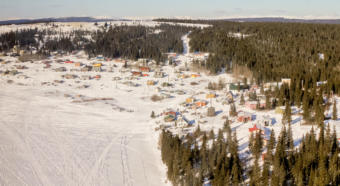
In the middle of the holiday season, White Mountain has no regular mail service

Aerial overview of White Mountain. (Photo by Ben Matheson/KNOM)

White Mountain has been without regular postal service since late October, according to the U.S. Postal Service, after their former postmaster left her position and no full-time staff member has filled the opening.

While the Seward Peninsula community of roughly 200 residents waits to receive their mail, all first-class mail for White Mountain is being held in Nome until further notice.

Residents like Dorothy Barr — Kawerak Inc. Tribal Coordinator and the mother-in-law of the former White Mountain postmaster — are feeling the pressure.

“Especially with Christmas coming. People will be ordering Christmas presents, but thankfully we have Ryan Air,” Barr said, referring to the Alaska-based air cargo carrier.

Amazon packages on cargo flights are the only pieces of mail getting into White Mountain right now. Another main concern is over permanent fund dividends and money orders that have still not arrived, which especially affects elders without debit cards.

“It’s frustrating for folks, because all those people are waiting on bills to come in, they’re waiting for checks to come in — Social Security checks, permanent fund checks,” said White Mountain Mayor Dan Harrelson. “Some of them were distributed here when the itinerant workers came in, but, you know, people have groceries coming in.”

On top of that, anyone who receives their bills in the mail instead of electronically has not been able to receive them in a timely manner. This means that things like child support payments and credit card bills cannot be sent or received, forcing potential delinquencies and late fees.

Without a specific point of contact at the Postal Service, there is confusion in White Mountain about the timeline for when the new hire will arrive. Some residents have been told that there will be postal workers coming from surrounding communities weekly, but inclement weather has made that difficult.

In an emailed statement, Postal Service spokesperson Brian Sperry said that “weather permitting, we will continue to have an employee from another Post Office fly to White Mountain at least once a week to distribute mail and provide retail services until the staffing situation is resolved.”

Sperry also mentioned that the Postal Service has hired two new workers who will be in White Mountain sometime during December, and they’re actively looking to hire more employees in the community. Sperry did not mention whether these two new workers will be full-time.

White Mountain isn’t the only community whose mail has been in a state of flux, however.

Koyuk was without postal service for the majority of this past summer, but it now has a full-time postmaster. A representative from Koyuk’s post office said she was unable to comment due to a Postal Service policy preventing employees from doing interviews with the media.

The former postmaster for White Mountain, Rochelle Adams, did not respond to multiple requests for comment.

Harrelson said that the Postal Service has not been actively communicating with White Mountain, causing anxiety among residents, and no clear timeline has been conveyed to them.

“They haven’t contacted the village, as far as I’m aware of, directly,” Harrelson said. “Several residents of White Mountain called the Postal Service and asked them, ‘What’s going on?’ and, ‘How come we can’t get a itinerant worker in here and get our mail sorted?’ But the Postal Service hasn’t been very outgoing or forthcoming on all that’s going on.”

With the holiday season quickly approaching, White Mountain residents are uncertain if their gifts and packages will arrive in time for Christmas Day.

Some Alaska State Trooper dispatches aren’t posted online. A spokesperson says it’s not mandatory.

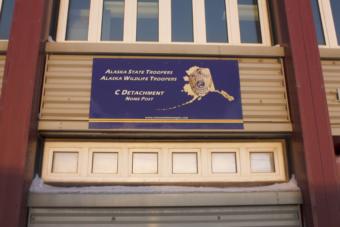
The Alaska State Troopers post in Nome. (Photo by Emily Hofstaedter/KNOM)

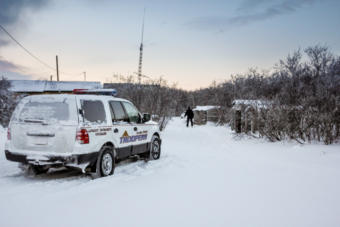
A spokesperson for Alaska State Troopers says some incidents may go unreported in the agency’s online daily dispatches. The spokesperson cited trooper workload as a reason.
Since late October, KNOM has reported on four incidents in which Alaska State Troopers responded to a community in the Bering Strait region but did not post an online public dispatch afterwards.

Two of those incidents without dispatches involved missing persons with accompanying search-and-rescue missions. Another involved the discovery of human remains. The last involved a fatal drowning.

The Alaska Department of Public Safety runs a public webpage listing trooper activity from communities around the state.

In an email to KNOM, DPS spokesperson Tim DeSpain explained that the daily dispatch page is meant to be “essentially a trooper blotter” that can be used as a resource for both media and the public to learn of activities that could be of public concern.

DeSpain wrote that there are a variety of reasons as to why an incident wouldn’t be entered into a public dispatch. One of those reasons, he wrote, is trooper workload.

Troopers at the Nome post confirmed they have been short-staffed this fall. On Nov. 21, there was only one trooper working both the Nome and Unalakleet posts.

Trooper Aileen Witrosky said a full staff should be five troopers in Nome and two in Unalakleet. As of Dec. 2, Witrosky said there were three troopers working at the Nome post, but in February they expect another.

One vacancy in Unalakleet was filled in November, leaving one open trooper position at that post for now. Both Unalakleet spots were vacant in October.

Witrosky said troopers work a two-weeks-on, two-weeks-off schedule.

According to the DPS website, the Nome post alone covers an area about the size of West Virginia, not including the distances over water to St. Lawrence Island and Diomede, which are also under the Nome post’s jurisdiction.

DeSpain wrote that DPS intends to “provide the timely release of information through this online tool.”

But community members like Danielle Topkok of the Teller Search and Rescue have shared concerns with KNOM that information isn’t being made public in a timely manner. She said having dispatches readily available helps them get more searchers and assist more quickly.

A recent search-and-rescue mission for a Brevig Mission man who went missing — and was later discovered deceased — never received a public posting.

In the case of a missing man from Elim, a missing person bulletin was issued by Alaska State Troopers, but no public dispatch was put online.

State troopers posted a dispatch for response to a drowning in Gambell after being contacted by KNOM. KNOM contacted state troopers about that incident on Oct. 23, and a public dispatch was subsequently posted. The incident was originally reported on Oct. 15.

DeSpain encourages anyone with a question about an incident, posted to the online dispatch or not, to reach out to the DPS Public Information Office.

Yukon-Kuskokwim Delta to get new domestic violence shelter in Hooper Bay

Hooper Bay
This slough is the access point to the ocean for many people of Hooper Bay. (Creative Commons photo by Travis)

The community of Hooper Bay has never had a domestic violence shelter before, but that is expected to change in January 2020, when shelter staff said they hope to be operating a new 24/7 shelter to serve women and their children.

Emma Smith, the victims’ services coordinator for the Hooper Bay Victims Services Project, grew up in Hooper Bay. She said the shelter will also serve the surrounding region: including Chevak and Scammon Bay.

The project is a partnership between the Rural Alaska Community Action Program, RurAL CAP, and the Native Village of Hooper Bay. That partnership between a nonprofit and tribe allows them to use nearly $500,000  of funds set aside for tribal entities from the Office for Victims of Crimes. This is a small portion of the $42 million in federal grant funding for rural public safety announced by U.S. Attorney General William Barr last month.

RurAL CAP Chief Executive Officer Patrick Anderson said plans for the shelter have been in the works for about a year, after Hooper Bay listed a domestic violence shelter as their biggest tribal justice need. He expects the shelter to house 12 women and their children.

“The children suffer substantially when they witness domestic violence in the home and usually there are other adverse experiences that they’ve had already so our goal is to figure out how we can provide full wrap-around services and bring the family back to a non-violent state,” Anderson said.

Some of those services include hiring people skilled in trauma-informed care and victim advocates. Ideally, the shelter would be able to give financial advice too, as separation from an abuser can also result in a loss of income. While exact job descriptions are still being drafted, Anderson said RurAL CAP is looking to hire up to 10 people to work at the shelter.

“We expect some to have experience or be trained in how a shelter operates and make sure that only the appropriate people are there and that the safety and security of the residents are assured,” he said.

Construction began in September, renovating a three-bedroom apartment donated by the Sea Lion Corporation. Cathie Clements with RurAL CAP said the shelter is part of the Sea Lion Corporation building and will have two four-person bedrooms, one three-person room and a common area.

In Hooper Bay, Smith is planning out culturally relevant programming to help future shelter residents heal.

For example, she’s looking for elders willing to share knowledge on grass-weaving or sewing. Smith envisions them going out on the tundra for food-gathering or just fresh-air.

“They say the tundra is healing, spiritually healing for someone that is turmoiling inside,” she said.

Many details are still being worked out, Smith said, but hopefully the shelter will accommodate long-term and short-term guests. Specialists and advocates will work out of the shelter, transferring survivors to the Emmonak Women’s shelter or elsewhere if necessary.

For now, Smith is focused on getting the word out to Hooper Bay and surrounding communities about the new domestic violence shelter coming to the Yukon-Kuskokwim Delta.

If you are experiencing domestic violence, or the threat of domestic violence, you can reach out to the National Domestic Violence Hotline at 1-800-799-7233.

Scientists suspect retreating sea ice is changing the color of Alaska’s tundra

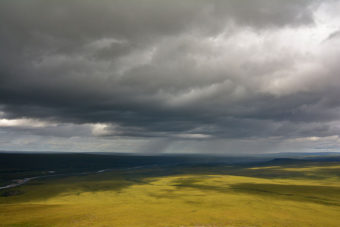
Much of the North Slope of Alaska is characterized by low, sweeping tundra hills, and a complete absence of trees. (Creative Commons photo by Paxson Woelber)

Biologists say early retreating sea ice is potentially causing vegetation productivity changes on the tundra across Alaska and the Arctic.

Uma Bhatt, a climate variability expert with the University of Alaska Fairbanks, said the land warms up more quickly when sea ice recedes earlier than usual.

“‘Cause the tundra is temperature limited, and if it has more warmth available during the course of the summer, things can grow more,” Bhatt said. “That’s the first order effect, but what I think has happened is as the sea ice has gone away even further each year from the coast, there’s more time for open water, and that has led, I think, to increased cloudiness.”

Bhatt said more cloudiness can cool temperatures and potentially reduce plants’ photosynthetic activity or “greening.”

According to a publication recently released by the University of Alaska Fairbanks and the International Arctic Research Center, the tundra on the North Slope has shown the most “greening” over the last five years than any other region in the state.

“But if you look at the Arctic as a whole, it’s greening, and the productivity is increasing,” Bhatt said. “But there’s a lot of spatial variability, and we think it has to do with what the permafrost is doing locally. If things are drying out locally, or if the snow patterns are changing, that’s going to affect what the vegetation is able to do.”

As Bhatt alluded to, there doesn’t seem to be one specific factor or explanation for the trend of significant greening, but on the North Slope increased shrub growth, general warming of the tundra, and more available moisture are possible contributors. According to climatologist Rick Thoman, sea ice extent near the North Slope in the Chukchi and Beaufort seas is still shrinking. It’s currently less than 400,000 square kilometers, which is 37% of what used to be the average seasonal minimum.

In stark contrast, the Yukon-Kuskokwim Delta has seen a decreasing Normalized Difference Vegetation Index (NDVI), or measured greening.

According to Skip Walker with UAF’s Institute of Arctic Biology, the lack of “greening” in the YK Delta doesn’t necessarily mean that the tundra and vegetation is “browning.”

“What is the actual cause of that is a mystery right now,” Walker said. “I don’t think we really understand it fully. And so that seems to be an area that really needs some research, as to what is the cause of that persistent trend and negative NDVI in the YK Delta.”

Walker has been working with Uma Bhatt to study tundra greening in the Arctic for more than a decade. Even though they are focusing on a larger area, Bhatt said the Seward Peninsula seems to be transitioning between the “greening” North Slope and the potential “browning” in the YK Delta.

Across Alaska and areas that Walker refers to as the low Arctic, satellite imagery shows an increasing number of shrubs popping up on the landscape. He said in the near future he expects to see shrubs growing in areas where they weren’t seen before.

“I think overall the increase in shrubs will eliminate a lot of the species’, what we could call, diversity,” Walker said. “The species diversity tends to go down when you have a lot of shrubs in the landscape, and that seems to be happening.”

And if shrub growth continues to increase eventually, Walker said the Alaska tundra will totally transform, but through a gradual process which may not finish during his lifetime.

According to Walker, these landscape changes, such as more shrubs and increased greening, will affect everything in Alaska. To see how wildlife, vegetation and humans living on the tundra could be affected down the line, Walker suggests keeping an eye out for the yet-to-be-released 2019 Arctic Report Card.

Below-average sea ice levels are expanding Arctic shipping options

The Port of Nome at the mouth of the Snake River, June 2018.
The Port of Nome at the mouth of the Snake River, June 2018. (Photo by Gabe Colombo/KNOM)

Marine vessels of all sizes are transiting through the Arctic Ocean this season, some starting from Nome. And they have a couple of options for ice-free routes.

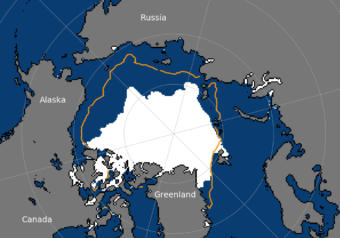
A map showing sea ice extent in 2019 compared to historical averages.
The orange line shows the 1981-2010 average Arctic sea ice extent for September. (Graphic by National Snow and Ice Data Center)

According to the National Snow and Ice Data Center, or NSIDC, Arctic sea ice loss will likely continue for several weeks.

The center says as of Aug. 31, sea ice extent dropped to the third-lowest amount on satellite record for that day: 1.78 million square miles. Around that same time, sea ice concentrations within the Northwest Passage were tracking below the average recorded between 1981-2010.

Mark Serreze, the director of NSIDC, said at least part of the passage seems to be quite navigable.

“When you think about the Northwest Passage, it’s not just one passage. It’s actually a number of ways you can get through those islands in the Canadian Arctic Archipelago, and if you were a real deep-draft ship, you’d want to go through this northern passage, kind of north of Banks Island, but that still has a lot of ice in it,” he said. “It looks very unlikely that that’s going to open up this year. The southern route through the Northwest Passage looks to be pretty much clear sailing.”

For the northern route through the passage, NSIDC said ice coverage is slightly below the previous, 30-year average, while the southern route — the path Roald Amundsen took through the Northwest Passage — is well below the average ice extent and is expected to be completely clear in the coming weeks.

The current track of sea ice extent along the southern route in the Northwest Passage compared to the past average and record low. Photo provided by National Snow and Ice Data Center. (NSIDC)

This would allow polar adventurers Børge Ousland and Mike Horn, who were in Nome recently aboard the sailboat Pangaea, to travel further into the Arctic Ocean before hitting ice.

According to Horn, their journey will include skiing and walking across the frozen Arctic Ocean directly to the North Pole, then end near the Norwegian archipelago of Svalbard, which could take months to complete.

“Our time in Nome was spent fixing the boat, getting the equipment for the Arctic crossing ready, and meeting up with friends,” he said. “The friends I have in Nome went out of their way to help us as much as they could. Really without them, an expedition like this couldn’t happen, because they make things happen.”

Horn has had some equipment issues thus far on his trip, and he reportedly made unplanned stops in Teller and Wales to pick up new water pumps last week.

Going parallel across the opposite side of the Arctic, in a little more luxurious fashion, is the European cruise ship the Silver Explorer. The Silver Explorer started from Nome in early August and sailed through the Northeast Passage, also referred to as the Northern Sea Route, with an escort from a Russian icebreaker. According to Silversea Expeditions, the vessel arrived into Tromsø, Norway, more than three weeks after leaving Nome.

According to the Canadian Coast Guard, more than 15 international cruise ships will attempt at least part of the Northwest Passage this season, including the MV Roald Amundsen. Norwegian company Hurtigruten seeks to have the Amundsen be the first hybrid vessel to traverse the Arctic route later this month.

The Roald Amundsen is expected to end its journey in Nome on Sept. 11. Serreze cautions any vessel attempting to sail through the Northwest Passage right now to be vigilant.

German kayaker passes through Nome on attempt to circumnavigate North America

Freya Hoffmeister looking out at the Bering Sea from the shore near Nome.
Freya Hoffmeister looking out at the Bering Sea from the shore near Nome. (Photo by JoJo Phillips/KNOM)

Adding to a growing list of adventurers who passed through Nome this summer is Freya Hoffmeister, a German sea kayaker. She’s attempting to circumnavigate North America in her kayak, a trip she expects will take her 8-12 years.

At Hoffmeister’s campsite at West Beach in Nome, the tide was high and creeping up on her.

“The sea has lifted,” she said. “It pushes into the whole Norton Sound. I noticed that early on.”

Hoffmeister arrived in Nome the evening before on Aug. 11 — not by flying into the city, but on her own, via sea kayak. Her last stop before Nome was Port Safety.

A lofty goal is what brought her to this corner of Western Alaska: Hoffmeister is attempting to circumnavigate North America by kayak.

This summer marks year three of a journey she expects will take her about a decade. This isn’t her first experience with circumnavigation.

“(I started) small with Iceland, then New Zealand south, then came Australia as a first continent. (Then) South America, and in between, Ireland,” she said.

This leg of the journey started mid-June in Kvichak Bay. Hoffmeister plans to reach at least Kotzebue before heading back home to Germany to rest for a few months. She will then pick up wherever she left off.

Hoffmeister chronicles her journey in a detailed blog on her website. It covers everything, from paddling conditions, to which remote islands she’s found bear tracks on, to the temperament of her various paddling partners.

One entry is from earlier in August, when a stranded Hoffmeister waited for the conditions to clear up near Stuart Island.

“Day two of my unwanted asylum here… but besides boredom I had nothing to suffer,” she wrote. “I kept myself busy by changing my tent site for the third time, just 50 meters to the right… I went for another walk, this time out to the ocean, and felt happy I was on dry land when seeing the sea state…

“I found blueberry bushes and feasted on them,” Hoffmesiter continued. “Not much more to tell for today…”

Hoffmeister considers her blog not just a way for her followers to keep up with her, but also as source of inspiration.

“Not necessarily to paddle all North America, but just go a bit longer, a bit harder, a bit wider, and just a bit more of whatever they are doing,” she said. “Just getting out of their comfort zone.”

Freya Hoffmeister with kayaking partner Ross Elder, looking out at the Bering Sea.
Freya Hoffmeister with kayaking partner Ross Elder, looking out at the Bering Sea. (Photo by JoJo Phillips/KNOM)

The world-class kayaker is a solo voyager most of the time, though she’s traveled with various paddling partners (of various quality, she said) in her 20-plus years of experience. She met her current partner, Ross Elder, for the first time last week in Nome.

Hoffmeister said she met Elder through less-than-extraordinary circumstances.

“Just like anybody else: online, these days,” she said. “Through mutual friends, I kind of knew he had some experience and knew he’d be likely an OK person.”

Hoffmeister sifted through dozens of interested applicants before settling on Elder, a Florida man whose resume boasts many competitive kayak races.

Elder said he was immediately up for the challenge.

“I read what she wanted, somebody to come paddle with her in Alaska,” he said. “I thought about it for a minute, and then I posted right away saying, ‘I gotta do this!’ You know what I mean? It’s like a lifetime experience.”

Standing on the beach the day before the new pair was scheduled to paddle away from Nome, Hoffmeister surveyed the rough ocean tide.

“I hope that it’s not looking like this tomorrow morning,” she said.

The next morning, Aug. 17, brought the calmer conditions the kayakers hoped for, and the two were on their way.

Hoffmeister’s blog notes her last check-in was just before Port Clarence on Aug. 21. She and Elder will complete this leg of the journey in late September in either Kotzebue or Point Hope — weather permitting.

Site notifications
Update notification options
Subscribe to notifications