KNOM - Nome

KNOM is our partner station in Nome. KTOO collaborates with partners across the state to cover important news and to share stories with our audiences.
Warmer waters believed to be main cause for dead pink salmon in Norton Sound

Humpies
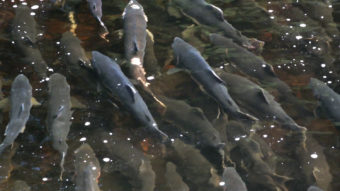
Pink salmon, plus an occasional silver and red, congregate in a pool in this file photo from 2015. (Photo by Matt Miller/KTOO)

Norton Sound residents have reported salmon die-offs in unusually large numbers during the last week.
According to the Norton Sound Economic Development Corporation, dead pre-spawned pink salmon were found in multiple river systems over the weekend.

The corporation’s Fisheries, Research, and Development Director Wes Jones says the numbers of pink salmon being reported are larger than what’s normally seen in the Norton Sound region, spread out across several communities from east to west.

“There’s been reports all the way from here (Unalakleet) in Eastern Norton Sound all the way over to the Nome area. And it’s a very widespread area,” Jones said. “The big change is that it appears that it is a much bigger event happening in Eastern Norton Sound than what you’re seeing as you get closer to the Nome area.”

One of those reports came from Sophia Katchatag, the community coordinator for the Native village of Shaktoolik. On Tuesday evening, Katchatag took her family up the Shaktoolik River to swim and cool off from the excessive heat. She found a creek with “one area completely filled with dead pinks floating on top of the river.”

Katchatag didn’t pick any of them up, and she doesn’t intend to eat them, either.

Based on Katchatag’s observations, they looked to be healthy fish without signs of disease. She said she’s never seen something like this, with so many pink salmon dying before it’s naturally time for them to spawn out.

There are multiple possible explanations for the salmon die-offs, but Jones says the main drivers are most likely warmer water temperatures and a high concentration of fish. According to Jones, the Shaktoolik River weir counted about one million pinks through the river on Wednesday alone. That amount is almost double the number of pink salmon previously recorded for that date in the Shaktoolik River.

Rick Thoman, a climatologist with University of Alaska Fairbanks, confirmed the water temperatures in the Norton Sound have been above average for days now, with no signs of cooling off.

“More immediately impactful will be water temperatures in rivers are thought to be very high right now, and that could have potential impacts on salmon spawning,” Thoman said. “As water gets warm, it holds less oxygen, and that potentially becomes a problem.”

The Norton Sound Economic Development Corporation plans to collect more data on water temperature and dissolved oxygen levels to help confirm this possible cause for the pink salmon die-offs. According to the corporation, this is another example of what could be a larger ecosystem shift in the Norton Sound brought on by warming waters.

Jones, the corporation’s research and development director, says it’s natural to see salmon die-offs, and pink salmon populations crash eventually. But losing this many pink salmon early in the spawning season could be the tipping point.

“The pink numbers are going to go down at some point,” Jones said. “Will this push them down farther? I think where it does happen on specific rivers, this is going to be the trigger that makes the population go down for a while.”

Jones emphasizes that during a time when unusual mortality events and changes are happening in the region, it’s important to be vigilant and report observations to the Norton Sound Economic Development Corporation or the Alaska Department of Fish & Game.

Western Alaska students save abandoned bearded seal pup

Bearded Seal in Svalbard
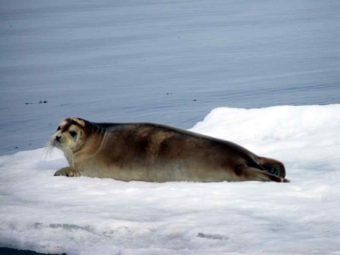
A bearded seal, or ugruk, on the sea ice. (Creative Commons photo by Alastair Rae)

An abandoned and starving bearded seal pup is making her way towards good health thanks to a group of students in Shaktoolik.
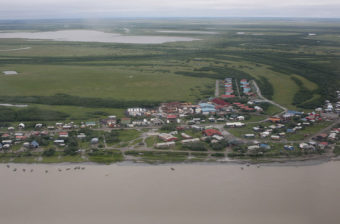
The group of students from the Western Alaska coastal village kept the pup safe from curious pets and harassment until the Alaska SeaLife Center was able to take her on April 13. She was discovered alone on the beach only a few days earlier, and during that time several residents called to alert the National Oceanic and Atmospheric Administration and ASLC. Village police officer Jeffrey Paniptchuk caught the pup, secured her in a kennel and flew her to Seward.

According to a memo from ASLC, she was about a week old upon captivity. Almost one month later, Chloe Rossman, the communications coordinator for ASLC, is “cautiously optimistic.”

“We’re now seeing a more rounded seal shape,” Rossman said. “When you think of a seal, you think of a very round, blubbery animal, and she came in as kind of a peanut shape. You don’t really want to see the neck on a seal. That’s indicating that they’re really underweight.”

Rossman said there could be many reasons a mother and pup could be separated, and there is no way of knowing in this case. The mother could have been killed by a predator, or sometimes new mothers simply abandon their pups.

The Alaska SeaLife Center in Seward very rarely gets bearded seals. Staff said their last bearded seal rescue was 2002. As such, the ASLC’s wildlife response program has to formulate a special diet for her using elements of walrus, harbor seal and fish gruel formulas. Now she is starting to eat whole herring and slowly learning to swim, though her underweight body has difficulty regulating itself in cold water.

Since the bearded seal is harvested by subsistence hunters, NOAA is unlikely to have her released to the wild.

“When we bring a seal into the center to treat them, we are going to be giving them various vitamins, and injections and antibiotics, to help their immune system and whatnot,” Rossman said. “So now that we stepped in to try to help this animal, we could be altering somebody’s potential food source after that.”

Rescued animals aren’t typically given a name until after their 30-day quarantine is over. At that time, the seal will be moved to a bigger pool, where her progress will continue to be monitored.

Emmonak votes to keep alcohol and remain ‘damp’

Emmonak in July 2013. (Photo by Adam DuBrowa/FEMA)

Voters in the Western Alaska community of Emmonak have narrowly decided to continue restricted alcohol sales and remain a so-called “damp” community under local option laws.
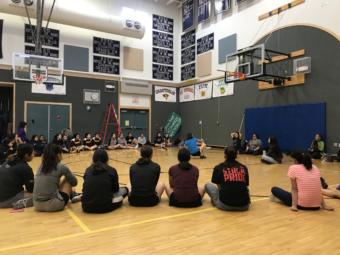
Certified results from the recent election were 122 votes in favor of keeping alcohol in Emmonak and 103 votes against. The community has a total of 502 eligible voters, according to local officials.

Emmonak is a community of more than 700 near the mouth of the Yukon River and had a long history of prohibiting alcohol. But voters in 2016 – also by a slim margin – approved alcohol sales at a facility run by the local government.

Emmonak’s City Clerk, Mona Andrews, has worked for the community during its last two local option elections.

“The first outcome, I thought it would pass, it was so close,” Andrews said. “The second round I was disappointed again. This time I had put signs everywhere in Emmonak to make sure people knew. I’m just sad that the results turned out for Emmonak to still be damp.”

Andrews says Emmonak is working on ways to remove bootleggers and address regional concerns over alcohol in the community. She says surrounding villages have complained about the negative effects alcohol from Emmonak is having on their residents.

Emmonak’s tribal leaders and other stakeholders plan on holding community discussions regarding alcohol.

Andrews expects continued efforts to restrict alcohol in the community. According to Alaska Statutes, Emmonak can start a new petition to hold another election as soon as the past results have been certified.

Behind the scenes of the Regional Native Youth Olympics for Bering Strait School District

Athletes at the 2019 BSSD Regional NYO Competition watch as Summer Sagoonick competes in the Alaska High Kick. (Photo by Katie Kazmierski/KNOM)

Last week, White Mountain, about 60 miles east of Nome, hosted thirteen teams for the Bering Strait School District’s regional Native Youth Olympics, or NYO, including Teller, Brevig Mission, Unalakleet, and Savoonga.

Practice for the Teller Aklaqs — Inupiaq for “Brown Bears” — typically starts in March. But for eleventh-grader Lauryn Garnie, NYO is a year-round sport.

“In the summertime, I try to keep in shape,” she said, “and I join all the other sports to try to keep in shape in the school year, too.”

She sits across from me at a table in the White Mountain School cafeteria, taking a break while other athletes compete in the Alaska High Kick next door in the gym. This year, Lauryn won’t be competing in any of the high kicks, due to a fractured ankle from basketball season. But the injury isn’t keeping her away from her favorite event: One-Hand Reach.

“One-Hand Reach I won two years in a row, and this year might be my third, if I win,” she said. “At practice, I’ve been getting the district record or beating it by, like, half an inch.”

In One-Hand Reach, athletes must “balance their weight on the palm or knuckles, reach with their free hand to touch a suspended ball, then place their free hand on the floor — without otherwise touching the floor.” The ball is raised 4 inches after each round.

If it sounds painful, it is.

“Trying to keep your body up on one hand hurts my legs,” she said. “I always cramp up when I’m reaching, but you gotta reach through it.”

Lauryn did end up reaching through, and winning, One-Hand Reach — with a total height of 55 inches. The state record for girls is 62 inches.

But for her, and many of her fellow athletes who love NYO, it’s not all about the competition aspect of the games. When I ask Lauryn to tell me about her team, she lights up.

“It’s a pretty young team, and they all really like it,” she said. “They stuck with it. And we all help each other out at practice. We tell each other what we need to do to go farther or be better. They really support each other and they’re mostly seventh graders.”

Tamara Ablowaluk is an 8th grader on Lauryn’s team who echoes the support she feels from the Teller Aklaqs.

“They’re helpful; they really like to help and encourage,” she said. “They say we can do it: ‘try your best.'”

Summer Sagoonick is a senior on the Unalakleet team. Like Lauryn, her favorite event is One-Hand Reach.

“Because I’ve become, I don’t want to say a pro, but I’ve become kind of good at it,” she said, “and I also think it’s something that tests out a lot of skills: balance, core…”

Summer is modest when she talks about her own ability: for One-Hand Reach, she’s not just “kind of” good. She came in second place, at 54 inches.

Unalakleet’s team is made up of 12 athletes this year, a few of whom are brand new to NYO. She says the whole team is really strong this year, and she’s quick to point out one of her teammates in particular.

“I would like to highlight Allie Ivanoff; she broke a lot of records last year: for One-Foot, Two-Foot, Scissor Broad,” she said. “I think she’s a great, athletic person, and she’s doing great.”

According to district records, Allie has since tied district record-holder Crystal Newhall Campbell for the most gold medals in the district’s NYO history: 14. And she was awarded Most Outstanding Female Athlete this year.

Summer’s mom, Melanie Sagoonick, watches her daughter from the bleachers. She has followed Summer around the state to watch her compete in basketball, volleyball, and NYO, and she says many of her coworkers in Unalakleet donated airline miles to help make it possible.

She says what she loves about NYO, and what makes it unique, is sportsmanship.

“(There’s) wonderful sportsmanship,” she said, “you know, they all cheer each other on. They encourage each other. It’s not only kids but the coaches as well. It’s nice to see that.”

Coach Darci Kingeekuk from Savoonga has been coaching for 10 years, and before that, she was an NYO athlete herself, from 7th grade all the way up to graduation.

“It’s pretty exciting,” she said. “I like coaching. I get excited for the kids, especially if they’re excited for themselves when they say they beat their personal best. I’m excited with them. I’m happy for them.”

Kingeekuk notes that this year is the biggest team for Savoonga in a while, something she credits to her teaching NYO to the elementary school kids a few years back.

If you ask Darci, who started practicing for the Alaskan High Kick back in kindergarten, no age is too young to get kids started in NYO games.

“I have a two-year-old son I’ve been teaching since he was a baby,” she said. “I have a video of him doing some of these (events). I bring him to practice every now and then.”

Edward Tocktoo is the coach for the Brevig Mission Huskies. To him, NYO’s spirit of community and support is a direct reflection of the rural communities and traditional values the games are tied to.

“They interact with each other,” he said. “Younger and older kids — they help each other out. Just like our villages … we all help each other out. It starts off with our grandparents, and we just obey from there on. I hope it will continue, because our generations are starting to change a lot now, but we still try to represent our traditional values on our youngsters, and it’s still strong.”

Traditional community values are certainly felt in White Mountain over the course of the event — one that brought over 100 people to the 238-person village. Principal David Fair and community members made 15 trips on snowmachines to the airport to pick up NYO teams, who also all spend the night in the small school. White Mountain community members brought things like pickled muktuk, oranges, and caribou to stock the hospitality room for visitors to enjoy.

Feeding all of these additional people takes a large effort, and Rose Titus, the school cook, happily dishes out tray after tray of her homemade meals, like moose spaghetti, to hungry kids, parents, and spectators. She serves breakfast, lunch, and dinner each day of the event. On a normal school day, Rose starts her day around 8 to make breakfast.

“When we have big events like this, I come at 6:30 and start cooking breakfast so I can be on time,” she said. “If I come later, you’re already waiting to eat! So I come at 6:30 and start cooking breakfast.”

But she has help in the kitchen, too: from NYO athletes. Each team pitches in to cover the cleanup after a meal.

“They wash dishes, dry them,” Rose said. “They clear the tables. And if we have to sweep, they’ll sweep.”

In the kitchen after lunch that afternoon is Earl Annogiyuk, laughing with his Savoonga teammates as they wash dishes.

Back in the gym, Earl, a senior, has quite the fan base. Whenever it’s his turn to compete, the crowd goes wild.

He steps up for the Scissor Broad Jump, which requires athletes to cover as much distance as they can, making four continuous hops without losing balance. The crowd quiets down so he can concentrate.

Earl crosses the gym — 33 feet 11.5 inches — and plants his feet on the gym floor in one final thud.

Earl finished in first place for four different events this year: Scissor Broad Jump, Wrist Carry, One-Hand Reach, and Alaskan High Kick. He also got awards for Most Outstanding Male Athlete and Most Inspirational Athlete. When I get a word with him, he’s quiet and modest.

“I just want to say good luck to everyone; everyone tries their best. Everyone did their best,” he said.

The top-placing district athletes head to the State NYO meet in Anchorage on Friday.


Watch this video of Juneau students practicing some of the events featured in the Native Youth Olympics in 2017:

https://www.facebook.com/ktoopublicmedia/videos/1468107013288633/

Emergency response workshop details communication shortfalls in rural Alaska

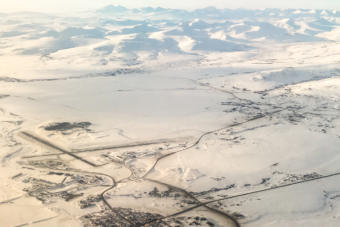
An aerial view of Nome, Alaska, and the surrounding countryside; March 2017. (Photo by Margaret DeMaioribus/KNOM)

The Arctic Domain Awareness Center came to Nome last Friday looking for answers. It wanted to know specifically how rural Alaskans, particularly Alaska Natives, felt they were prepared to handle a major, weather-related crisis.

They invited residents from the Bering Strait region to gather at the University of Alaska–Fairbanks (UAF) Northwest Campus in Nome for an event they called Arctic-focused Incidents of National Significance, or Arctic-IONS.

ADAC is a part of the U.S. Department of Homeland Security Science and Technology Center of Excellence in Maritime Research. They are a research agency, and currently, their biggest client is the U.S. Coast Guard.

Major General Randy Kee, who goes by “Church,” is a retired Air Force general and now serves as the executive director for ADAC.

“What we go for is research that is driven by operational concerns… and looking at shortfalls or gaps in capabilities and looking to see how to essentially cover those gaps to improve research or for research that’s addressing the problem set,” he said.

So ADAC opened up the floor to let people share where the problems are. More than thirty people from all over the Bering Strait region gathered into a conference room, with yet more still joining by telephone.

The workshop at Northwest campus was organized into three parts: presentations, a Kawerak-led “storytelling workshop” where participants shared their stories of storm response, and small workshops where groups were meant to brainstorm solutions to a hypothetical storm situation.

In the storytelling session, Bering Strait residents shared how they responded to crisis, both historical and ongoing. Almost every story had a shared element: communication in Western Alaska is difficult.

Tom Vaden works with Search and Rescue in Nome. In times of crisis, he says inReach satellite technology and internet data communications are invaluable. But, in this region, that isn’t always enough.

“Because there’s times when just the whole West Coast is shut-down,” he said. “And we have good communications in small communities, but I’ve been in winds that are flipping snowmachines over… We’ve got a lot of coms here… there’s a lot of resources regionally, but the reality is, in most cases, it’s going to be a lot of time before you get help.”

Brandon Ahmasuk, the Program Director for Kawerak Subsistence Resources, pointed out that many individuals still do not have access to that technology, especially many subsistence harvesters who are working to feed their families with very little cash income.

Tony Weyiouanna of Shishmaref agreed with sentiments like Ahmasuk’s and brought forward another element: traditional knowledge and language are key elements in understanding weather.

“In our language, we have about 100 different sayings or meanings for snow, so a lot of our young kids can’t read the snow… a lot of our villages, they don’t have those kinds of equipment,” he said. “Communication is a big thing.”

Weyiouanna said the villages need to be able to communicate reliably with one another.

Velma Johnson, the Tribal Coordinator in Unalakleet, participated through a teleconference line. In Unalakleet, she says, they have had to come up with creative solutions for storm management, like building breakwaters out of snow. Based on those experiences, she shared storm-related solutions with locally available resources.

“One of the other things I thought of was to move armories or connexes to places for evacuation shelters for those willing to evacuate,” she said. “There should be one in high-risk villages; for short-term, they should build at least one evacuation shelter or build up around the school.”

Through workshops and storytelling, residents identified various shortfalls in the region’s current infrastructure — but also had plenty of potential solutions, too.

For someone like Brandon Ahmasuk, that is no surprise: the communities have been weathering storms here for thousands of years. Other disasters cause more concern.

“In the events of big disasters, oil spills, pandemics… they’re not capable of handling it,” he said. “Even in a best-case scenario — say, it’s perfect weather, a ship has to anchor out, but they’re getting low on food — where are they going to go? They’re going to the nearest community to get food, but the stores at villages are quite small, and they’re set up to handle their own business, not take on another ship that has two thousand people on it.”

Nome’s event is part of a two-part workshop. The second part takes place in May in Anchorage. General Kee says ADAC will continue the conversation there, incorporating the takeaways from Nome.

These workshops are meant to be incorporated into further research for the U.S. Coast Guard to serve their mission of finding solution “related to gaps and shortfalls” in crisis management.

‘Ragin’ Contagion’ exercise tests Nome’s ability to respond to epidemics

In Shaktoolik during the statewide exercise, health aide Sarah Sampson interviews a local resident to determine if they are “infected” with the pneumonic plague. (Photo courtesy Danielle Slingsby/Kawerak)

The fall of 2018 marked a hundred years since the Spanish flu hit Western Alaska, devastating Alaska Native populations and wiping out some villages in the region.

This month, public health officials participated in a statewide exercise that tested how communities would respond if a similar widespread airborne disease happened today.

The host site in Nome for the statewide pneumonic plague exercise last Friday was the local recreation center. Upon arriving into the mock clinic, residents were asked one simple question: “Are you feeling well?”

If their response was “yes,” then they were directed through stations to receive appropriate medications. But if their answer was “no,” health aides took a different course of action.

“So first, we would have you put on a mask to make sure that you are quarantined from other individuals, because this is contagious,” one of the health aides said. “Then we are going to transfer you over to a quarantined area in the hospital where you can receive treatment.”

Pneumonic plague occurs when the airborne version of the bubonic plague enters someone’s lungs and causes rapidly-developing pneumonia, which can result in respiratory failure or shock. The plague can be spread by being in close proximity to an infected individual.

Deanna Stang is a public health nurse with the State Section of Public Health Nursing and the manager of the point of dispensing, or POD, clinic for this exercise. She said that in this mock emergency, Nome’s ability to respond locally was put to the test.

“Without outside help, between 72 to maybe 96 hours, it might be a long time where we’re not going to be able to have outside help coming in,” Stang said. “So that’s a really good point to emphasize for this particular project: How many people locally can we get available to help us out in the community of Nome? Because we can’t rely on outside public health nurses, or outside CDC officials, or section of epidemiology staff to come help us out and provide the staffing.”

Stang said 19 staff and volunteers helped manage the local POD site. But in order to reach the state’s goal of serving 158 people per hour, she said 48 staff members would be needed in Nome.

In this scenario, only about 80 Nome residents went through the POD process over the course of a few hours.

The volunteer crew for Nome’s “Ragin’ Contagion” exercise, gathered together in the city’s recreation center.
The volunteer crew for Nome’s “Ragin’ Contagion” exercise, gathered together in the city’s recreation center. (Photo by Davis Hovey/KNOM)

Response time is crucial in an emergency plague situation like this. During the exercise, Stang said it took an average of three minutes for each person to complete the process and receive medication.

According to Stang, an unexpected challenge arose before the exercise in Nome even began. Some of the medications were not delivered via commercial airplane in time on Friday afternoon, due to flight delays, leaving the community with about 145 doses on hand.

“So in this particular scenario, since we were weathered out for a day, we would make sure that folks who actually had plague (cases and contacts) were treated first before we opened it (the POD) up (to others),” Stang said.

Charlie Lean was the safety liaison officer for this pneumonic plague exercise, helping to coordinate roles between local entities and anticipate problems before they happened. Lean thought Nome did OK in its response.

“Another part (of the challenge), especially when you don’t have adequate medication, is to separate and to slow the spread of the disease,” Lean said. “You may not be able to stop it, but if you can slow it, then you can deal with treatment, and it gives you more time to get the medication.”

Lean said as a group, the city’s emergency operations center, or EOC, discussed contingency plans like having supply lines at the grocery store to prevent further spread of the plague.

“So you don’t want to put everyone in the grocery store so they can all catch the disease. You want to maybe have an outdoor (option) … like the old-fashioned stores, where you went up to the counter and said, ‘Here, this is my list,’ and they would fill the list and charge you,” Lean said. “This could all be done outside or someplace where the store wouldn’t be ruined and wouldn’t have to be decontaminated.”

Lean knows better than most the devastation a widespread disease can cause in a small, rural community like Nome.

“When I was a small boy, (tuberculosis) was rampant. And people were quarantined, and people were actually taken away, never to be seen again, to sanitariums,” Lean said. “And so in my earliest memories, there was some of this. My own father got TB and didn’t have to be taken away, but it was something he had to worry about the rest of his life.”

Statistics say tuberculosis was the leading cause of death in Alaska until 1950. Although this is thought of as a more historic epidemic in Alaska, it does still remain in some form today, as the state has the second-highest rates of TB in the nation.

Regardless of whether it’s TB or another widespread disease, Stang said another epidemic is inevitable for Nome and the region.

“It’s not a matter of if it’s going to happen, it’s a matter of when, for the next flu pandemic for us,” Stang said. “So, setting up this POD clinic is a great way for us to exercise who can show up, who is available, and are we able to quickly get community members through our open POD in a small amount of time.”

Communities that participated in the statewide exercise, known as “Ragin’ Contagion,” included Anchorage, Bethel, Kotzebue, Nome and Shaktoolik.

Site notifications
Update notification options
Subscribe to notifications