KNOM - Nome

KNOM is our partner station in Nome. KTOO collaborates with partners across the state to cover important news and to share stories with our audiences.
With art exhibit, former Nome resident addresses the ‘collective trauma’ of indigenous suicide

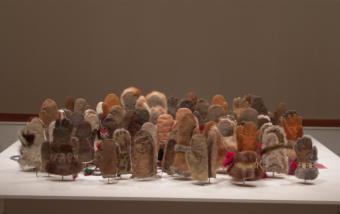
Sonya Kelliher-Combs’ exhibit “Goodbye” at the Anchorage Museum in 2007. (Photo courtesy Sonya Kelliher-Combs)

The following profile addresses the topic of suicide in Northwest Alaska and may be distressing to some readers. If you feel you are in crisis or just need someone to talk to, call the Alaska Careline at 1-877-266-4357.

Fifty two pairs of gloves and mittens are clustered on a pedestal in the Yukon Arts Centre in Whitehorse, Canada.

“People come up to me afterwards and… They haven’t read the statement yet, but they know what it is, you know?” said Sonya Kelliher-Combs, the artist behind the exhibit. “They might not know it’s specifically about suicide, but they know it’s about loss.”

Kelliher-Combs, from Nome and based in Anchorage, calls the exhibit “Goodbye.” She says the goal is to open dialogue on a subject that is increasingly prevalent, but “often taboo” to talk about.

The age-adjusted suicide rate among Americans in 2017 was 14.0 deaths per 100,000. Almost double that and you get Alaska’s rate: 26.9 deaths per 100,000. Almost double that number and it equals the rate among Alaska Natives: 51.9 deaths per 100,000.

Kelliher-Combs says that for “Goodbye,” she chose to focus on that last statistic.

“A big issue within indigenous communities, in particular in the North in Alaska Native rural communities, is suicide. And so, ‘Goodbye’ is a piece that dialogues that… speaks to the huge epidemic of suicide in our rural communities,” she said.

The gloves and mittens used in the art exhibit “Goodbye” are all handmade. Many are made with seal skin or furs; some are beaded.

“I think that there is memory and history that’s connected to everything that is made by hand,” Kelliher-Combs said. “I feel like historically an object would be made to last for a long time, and would be passed from generation to generation, even my grandparents’ couch and their table and things like that. I think that these objects have a history and a memory that somebody’s hands have put into it… and not only that, but also the materials they’re made from, and how they’re imbued with a kind of spirit. There’s an honesty to this material.”

Adding to that spirit is that each pair was loaned to the exhibit by an Alaskan or member of the local Whitehorse community. Kelliher-Combs says there’s a story behind each pair of mittens, even if it’s not immediately visible to the installation. Mary Bradshaw, the director of visual arts at the Yukon Arts Center, agrees.
“We’re borrowing their mittens over the summer. Everyone will get their mittens back in September, which is kind of right in time,” Bradshaw said. “But it was a really lovely opportunity for our community to be involved, and I know we had a number of people who drove in their mits partly in memory of a family member.”

She says visiting “Goodbye” looks something like this: “As you walk in the room itself, it’s quite quiet and kind of darkened otherwise. The lights are just on the mittens and the platform. You’re able to walk the whole way around, and as you walk to the back, you can see the back of the mittens… it’s quite something, you know, seeing these open palms as you walk in, and then as you go around, you kind of get to see the full beauty that’s been put into all of these mittens.”

Bradshaw says the message behind “Goodbye” extends to her corner of the far north.

“Canada’s north is also really affected by indigenous suicides,” she said. “The Yukon doesn’t have the same statistics captured as Alaska; we actually found it very hard to see what the numbers would reflect in our territory… We have 52 and a half pairs… We added an extra pair knowing that these numbers, of course, are just kind of the tip of the iceberg of what was actually recorded and self-identified.”

Paired with the main exhibit is a series Sonya Kelliher-Combs has been doing for over ten years, “Idiot Strings.” She started the series years ago as a memorial to her three uncles who had taken their lives. “Idiot strings” are pieces of string that tether a pair of mittens or gloves together.

“At least, that’s what my mom called them when I was a kid, so you wouldn’t lose your mittens,” she said. “There’s a piece that people can write a message, or a thought, or draw a picture, and then tether it to these ‘idiot strings’; you can tie it onto there. And at some point we’ll have a ceremony, or kind of transform those messages and let them go. Haven’t quite figured that part out yet, because this is the second place it’s gone to, this piece. So it continues to fill up with more messages.”

Mary Bradshaw says there’s been a flood of people sharing and connecting with the “Idiot Strings” part of the exhibit.

“I’ve had to refill the basket of Tyvek over and over because people are really taking the time to send a message,” she said.

It’s messages like these that encourage the connection Kelliher-Combs aims to foster through the exhibit.

“The idea is it’s not just an individual, personal trauma, but it’s a collective trauma that we carry with us,” Kelliher-Combs said. “And to bring to light, to open it up so that people don’t feel afraid to express and deal with, and discuss these kinds of historical traumas.”

She says she thinks the exhibit is helping to bring awareness to statistics around suicide, while opening a dialogue around the topic as well. She’s anticipating that conversation to continue at a fish processing workshop and lecture that will close out the exhibit on August 23-25.

“We’re making fish rawhide,” she said, “and then, we will be beading it and making these little amulets, I call them ‘portable secrets.’”

Kelliher-Combs says participants can wear their “portable secrets” as a reminder of something or someone they’ve lost.

“I’d put a healing stone in there, or maybe your pet’s dog hair, or whatever you were heartbroken from, and you can have that with you and carry it with you,” she said.

“Goodbye” is open to the public in Whitehorse, Canada, until Saturday, August 24.

If you feel you or someone you know are in crisis or just need someone to talk to, please reach out 24 hours a day to the Alaska Careline at 1-877-266-4357. 

Shishmaref man finds 50-year-old Russian message in a bottle

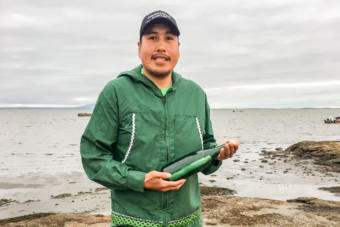
Tyler Ivanoff holds the message-in-a-bottle he found near Shishmaref. (Photo courtesy of Tyler Ivanoff)

It isn’t every day that a 50-year-old message in a bottle washes up on the shores of Western Alaska. But that’s exactly what happened to Tyler Ivanoff near Shishmaref on Aug. 5.

“I was just gathering firewood; everybody was just kind of picking berries,” he said. “I just happened to stumble across the bottle, and I noticed it was a green bottle and had a cork top. Not really cork, but it was a tight cap, and I could see inside the bottle there was a note.”

Ivanoff found two pieces of paper inside.

The message Tyler Ivanoff found inside the bottle. (Photo courtesy of Tyler Ivanoff)

“My kids were pretty excited,” he said. “They were wondering if it was a pirate’s note or treasure.”

But the find didn’t reveal a map leading to buried Spanish galleons or the Fountain of Youth. The first piece of paper was blank, protecting a handwritten note on the second one.

“The paper had Russian writing,” Ivanoff said. “I noticed it because I took Russian in college and in high school.”

The writing was almost perfectly preserved when Ivanoff opened it, so he could make out the letters, but the translation was a bit beyond his ability. Last Monday, he shared his discovery on Facebook.

In 2019, internet posts travel a bit faster than bottles through the ocean, so in three days, it had over 1,000 shares.

https://www.facebook.com/tylerivanoff/posts/2833035660051140

Russian speakers found the post on multiple social media platforms and have translated the message in the bottle to be a greeting from the Russian Navy, dating back to 1969. It has an address and a request for a response from whomever finds it.

Soon, it caught the attention of Russia 1, the state-owned Russian media network whose reporters tracked down the letter-writer himself: Capt. Anatoliy Botsanenko. Last week, they visited Botsanenko at his home in Crimea to tell him the news and provided KNOM with a rough translation of their conversation.

In the news report, a reporter holds up his phone to show the elderly captain the image of Ivanoff’s find. The man begins to tear up when he recognizes his words from decades ago. He claims that at one point during that time in his life, he was the youngest captain in the Pacific, at just 33 years old.

 
The message that washed up near Shishmaref says it was sent from the Sulak, a ship whose construction Botsanenko told reporters he oversaw in 1966 and that he sailed on until 1970.

Tyler Ivanoff isn’t sure if he’ll answer the request to send a letter back. But it has given him some inspiration to keep the nontraditional method of communication going.

“But that’s something I could probably do with my kids in the future,” Ivanoff said. “Just send a message in a bottle out there and see where it goes.”

Nome businesses hope to learn from record cruise season

The cruise liner Crystal Serenity anchored offshore of Nome in 2017. (Photo by Gabe Colombo/KNOM)

Nome is beginning its busiest cruise season to date, and with that traffic comes a learning curve for local businesses and vendors.

Paul Kosto is the executive director for the Nome Chamber of Commerce. Right now, the Chamber doesn’t have data on where past cruise passengers have spent their time and money in Nome. But this season, Kosto is hoping for numbers.

“We do plan on, this fall, polling the businesses in town on how the cruise ship passengers impacted their business,” he said.

Kosto explains that cruise tours tend to fall into two different categories: a port of call and something called a “turn.” They have different economic potentials for the city.

At a port of call, a ship will stop, and the same passengers who got off the ship will get back on later in the day. Sometimes, they might have excursions that are booked directly with the cruise or with a local tour operator.

“And there’s other times where they’ve got a couple hours to just roam around town and go into our different eating establishments, and coffee shops, and gift stores,” Kosto said.

In a “turn,” a ship will dock and unload its passengers, who get directly on a chartered plane to go for another destination. Another group will get off that plane and go directly to the ship to head out to sea.

In those cases, Kosto said, “there’s not very much potential for the passengers to have any economic impact in Nome.”

Some businesses can take advantage of both. Robin Johnson is a partner in Northern Logistics, the parent company for Nome Discovery Tours. They offer a shuttle service between the port and the airport, and they also take cruise passengers on tours throughout Nome and the surrounding area. She says two ships are expected to make ports of call, while the rest are turns.

But like many in town, Nome Discovery Tours also faces the challenge of finding enough transportation. They’re making do with the help of local school buses.

“But more and more ships are coming in the fall now. They used to mostly come in June and July, and now they’re coming in August and September, and a lot of them are coming on school days.”

And, of course, busing students has to take priority.

The ships coming through Nome aren’t typically large compared to some that go through the southern part of the state. The largest boat this season was meant to be Holland America’s Maasdam with about 1,200 passengers, but due to weather, they weren’t able to make port. Right now, she expects their biggest traffic to come from the Roald Amundsen, a ship expected to have about 500 passengers looking to go through the Northwest Passage. Nome Discovery Tours hires anywhere from eight to 35 people to help them accommodate cruisers for a day.

The ships come from around the world, and Johnson says each brings a different kind of tourist.

“Some of them are smaller, high-end luxury adventure cruises,” she said. “There are a few ships that are German. That’s more of a retired clientele: they’re here for the education and to see the place. And then we have our French company where we get a real mix of people.”

Nome-based non-profit Kawerak has already looked to fill some of those entrepreneurial gaps. Barb Nickels leads their Community and Planning Development Program.

In 2017, they surveyed tourists, who told them they wanted more opportunity to buy Native art and meet the artists creating it. Now, on Fridays during cruise season, visitors and locals will see an array of vendors selling crafts under multi-colored tents in Anvil City Square. Artists who don’t live in Nome can get funding to come in for the day. Nickels says some vendors made as much as $400 to $2,000 over the six-week fair last year. That extra can go a long way in aiding a subsistence lifestyle.

Harbormaster Lucas Stotts already anticipates a possible 14 ships for next year. That means this season could be a valuable opportunity for Nome vendors to learn and prepare.

Questions remain as Amazon charges online sales tax in Nome

Amazon boxes
Amazon recently started charging sales tax on some orders in Alaska. (Creative Commons photo by Public.Resource.Org)

In the beginning of this year, Amazon started applying local sales tax to municipalities in Alaska. According to the City of Nome, the online company first contacted them in late 2018, and now, packages sold by Amazon that are shipped to a Nome zip code include sales tax. But that does not include goods from a third-party retailer.

Last year, the U.S. Supreme Court decided that states like South Dakota have the right to collect sales tax from Amazon and other online marketplaces or retailers, even if they don’t have a physical store located in the area. However, Alaska doesn’t have a statewide sales tax, so it is up to each municipality to determine their own sales tax rate within the state.

Nome city clerk Bryant Hammond confirmed that Amazon has purchased a sales tax license from the city, in effect for the 2019 calendar year. As such, the Nome Code of Ordinances states the company can collect 5% sales tax on all goods being delivered to a Nome zip code throughout the year, except during the months when the 7% seasonal sales tax is in effect.

Nome resident Jessica Farley and her husband Howard Farley, Jr. said the city should better explain how this tax will affect local residents.

“I actually think it’s great that the City of Nome is able to collect this revenue,” said Jessica Farley. “However, I think it might have been underestimated in the budgeting process, what a significant boon it could be to the city’s tax base.”

“I think the citizens need to at least know where that money is going to go into,” said Howard Farley. “The city just says ‘slush fund,’ which has no real definition, what they’re going to use it for.”

City clerk Hammond said that the Amazon sales tax revenue does not go to a “slush fund,” but rather, to the City of Nome’s general fund, although Hammond couldn’t provide exact dollar amounts.

Individual customers who make purchases online through the company have the ability, however, to track their own personal expenses and contributions, which is what Jessica Farley did.

“You’ll get a year-to-date report on everything that you’ve spent and where it’s gone and what taxes were collected,” she said. “So, I did that, and I was able to filter out the exact dollar amount that has been sent to the City of Nome by Amazon. I think it was around $780 so far this year.”

Farley estimated that if everyone within city limits of Nome spent half as much as she does on Amazon purchases, then that would be more than $1.3 million dollars going to the City of Nome for the year. However, she pointed out that there is no way for her to know for sure how her spending compares to other Nome residents.

According to Hammond the city does have information about the amount of money Amazon has collected thus far in sales tax on packages shipped to Nome. But the city clerk said that information is proprietary by city code, and he could not divulge it.

Multiple attempts by KNOM to reach Amazon’s public relations department have gone unanswered.

According to the executive director of the Alaska Municipal League, Nils Andreassen, the league is working to create a separate group that can help Alaska communities collect online sales tax as one collective body. He said their discussions with Amazon have focused on smoothing out tax details that aren’t working for various municipalities.

“There are some growing pains. One, there’s a hundred different tax codes we are trying to collect,” he said. “So they’re trying to work through that and trying to work through the different reporting requirements and periods. There’s additional confusion in implementation, because the sales tax boundaries aren’t always consistent with zip code, and that’s something we will address through our centralized administration.”

In a previous article from KUCB Radio, Andreassen said in order to set this up, all 100 existing state tax codes need to be compiled, definitions across municipalities need to be streamlined, and an administrator identified to complete a sales tax boundary map.

It is unclear how or if Amazon differentiates non-profits and other entities whose purchases are exempt from sales tax under Nome’s City Code of Ordinances.

Jessica Farley believes the city should provide a way for people to receive refunds on purchases they feel were improperly taxed.

“The City of Nome shares (zip code) 99762 with Little Diomede and Golovin, and so, we were hoping that there would be some sort of method for people who are exempt from those taxes, or residents of Diomede or Golovin, or have active building permits and they don’t need to pay taxes on certain items purchased (such as construction items) — that there would be some way to get a refund from the city of Nome,” she said.

Farley also pointed out that the state of Washington has a law on the books to accommodate this sort of sales tax refund requests from Amazon and other online retailers. Hammond said the city does not currently have a process in place to address residents’ refunds.

According to Andreassen, Nome is one of several municipalities working with him and AML to form the statewide commission, which could help address incorrect charges and potential refunds from online retailers.

Andreassen hopes the group will be up and running by November of this year.

Years of data suggest ecosystem shifts in the Northern Bering Sea

A summertime view from East Beach, Nome. (Photo by Laura Kraegel/KNOM)

Scientists say based on years of observations and data gathered in the Northern Bering Sea, as well as a recent research cruise, they can see warming waters and biological changes going farther north. This seems to indicate a shift in the Northern Bering from one type of ecosystem to another.

“It’s like taking a balloon and you blow it up, squeeze the bottom of it, and this is the south. And what you’re doing is expanding it into the north,” said Jacqueline Grebmeier with the Maryland Center for Environmental Science.

Grebmeier has been studying areas south of St. Lawrence Island for the last 30 years. And although she hasn’t studied north of the island for as long, her research has concentrated on both areas which make up the Northern Bering Sea.

Grebmeier is mostly focused on the benthos, which is the flora and fauna that live on the bottom of the ocean. That includes animals in the sediments like crabs, clams, and worms. South of St. Lawrence Island, Grebmeier says there is a trend of statistically declining clam populations, but there is no trend yet farther north.

Her hypothesis is that the Northern Bering Sea is changing from the bottom up. Grebmeier says some of the benthic organisms have moved ten to 20 kilometers north in recent years, and if they continue moving north, then the larger marine mammals that eat them, like walruses or whales, will also move.

“If they can, but you know the territory can only go from 100 meters to 100 meters, but they have a certain type of food they want to eat,” Grebmeier said. “So, like, gray whales really don’t want to be eating worms. I guess they could suck them up, but traditionally, they are always wanting these fat lipids, it’s like eating lobster versus eating some skinny thing.”

Through a network called the Distributed Biological Observatory (DBO), different teams of international scientists have measured and shared data from the Bering Sea for years. They focus on an array of factors like salinity, temperature, chlorophyll concentrations, and much more.

Several of these scientists, and Grebmeier, have also been paying attention to the retreating sea ice and how that is impacting the production of algal blooms, which provides a large food source for certain benthic animals.

In addition to these long-term studies, Grebmeier embarked on a research voyage to collect more data earlier this summer on a Canadian Icebreaker, the Sir Wilfred Laurier.

During her trip, Grebmeier studied gray whales’ feeding habits north of St. Lawrence Island, the areas where walruses eat in the Chukchi Sea that are being affected by sea ice loss, and the changing locations where diving seaducks could find ice to rest on.

Rick Thoman, a climate specialist with the University of Alaska Alaska Center for Climate Assessment and PolicyFairbanks’ Alaska Center for Climate Assessment and Policy, says sea ice is currently moving north at a faster rate than ever recorded in the Chukchi Sea.

“From north of the Bering Strait to northwest of the North Slope Coast, (sea ice) is at record low levels,” Thoman said. “There is effectively no ice now in the Chukchi Sea within 150 miles of Alaska, and northwest of the North Slope Coast, the ice edge is a couple hundred miles or more away, and it’s only the end of July.”

https://twitter.com/AlaskaWx/status/1155875159523250176

One type of sea duck is the spectacled eider, which, according to Grebmeier, relies on sea ice for dancing, mating, and eating. She says eiders and even walruses’ food “cafeteria” is now located in areas north of St. Lawrence Island, when it used to be farther south.

“That system is not what it used to be, let’s put it (that way). Without that sea ice there, I think there will be some production, only blooms once a year,” Grebmeier said. “And you don’t have that nice production that you get with sea ice algae, so that was really the carbon that kicked the system off. And so certain animals aren’t going to have their type of food. It would be like having hamburgers instead of steak.”

Grebmeier and other scientists are observing cod, pollock, and other bottom-feeders coming up from the Southern Bering Sea and moving farther and farther north. This reinforces the belief that the thermal cold-water barrier south of St. Lawrence Island is gone.

To get an idea of how many of these warm water fish are moving into the Northern Bering Sea, the National Oceanic and Atmospheric Administration is conducting a bottom-trawl survey of waters in the north starting next week.

Grebmeier says this study and her upcoming research on board the Coast Guard cutter Healy could help scientists identify ecosystem shifts and trends happening in the Northern Bering Sea.

Nome-area ranch works to get youth into reindeer herding

Jackie Hrabok-Leppäjärvi shows kids how to lasso at the Midnite Sun Reindeer Ranch. (Photo by Katie Kazmierski/KNOM)

The Midnite Sun Reindeer Ranch outside of Nome is investing in its future by getting local kids involved in reindeer herding now. The herd wasn’t corralled this year, but Midnite Sun owners Ann and Bruce Davis held their third annual Reindeer Youth Summit anyway earlier this month, to teach the value of an age-old industry in the Bering Strait region.

Ann Davis, who co-owns Midnite Sun Reindeer Ranch with her husband, refers to the annual youth summit as their “exit plan” — the two hope that getting Alaskan kids interested in reindeer herding while they’re still young might inspire them to carry on the tradition.

“If they’re interested, they could become involved in the only viable northern agricultural pursuit… and reindeer are fun!” Davis said.

Amy Phillips-Chan, director of the Carrie M. McLain Memorial Museum, attended the three-day summit, which took place July 18-20. She says she jumped on the opportunity to learn more about modern reindeer herding in the Seward Peninsula, as most of what she knows about it comes from historical sources.

“Information on how it really prospered here and how it tapered off… what’s so amazing about the Davis herd and the Midnite Sun Ranch… [is] connecting the past and contemporary uses and practices using the knowledge, Indigenous science from the past, but connecting that with modern methods and materials for raising reindeer.” Phillips-Chan said.

The Davis’ herd is still currently grazing the tundra, so kids did not get to interact firsthand with any reindeer at this year’s summit. The couple couldn’t say exactly when the herd will return to the ranch, but once it does, caring for the animals is a full-time job. Bruce and Ann Davis will interact with the reindeer as much as possible to “tame them down.”

The herd grazes year-round, foraging on different plants depending on the season, and the Davises bring them to the corral “when necessary for health treatments and tallying.”

Man stands before group of visitors seated at picnic tables inside large building.
Bruce Davis addresses attendees at the Midnite Sun Reindeer Ranch Youth Summit, July 2019. (Photo by Katie Kazmierski/KNOM)

Even without the reindeer present, though, Phillips-Chan noted this year’s camp was a hands-on learning experience. She says her favorite part of her visit was seeing a demonstration by Jackie Hrabok-Leppäjärvi, from the University of Alaska Fairbanks Northwest Campus, on how to lasso reindeer.

“Bruce and Ann devised a program that really tried to get kids really interacting with the materials around the ranch,” Phillips-Chan said.

“See how it’s twisting? You make nice coils, and they’re all in the same direction so when you throw it, it’s not going to get knotted on you,” Hrabok-Leppäjärvi said. “If this was competition, it gets very fierce. It’s like ‘hurry! And always head up!’ You’re always looking at the reindeer, which one do you want. Look, look, look, look…”

Hrabok-Leppäjärvi helped kids and visiting adults try their hands at lassoing reindeer antlers stationed on the ground in front of them. Phillips-Chan was there with a camera in hand.

“It was really neat to see adults and the students working together on that and the kids being engaged by the activity,” Phillips-Chan said. “Even though they weren’t practicing on real reindeer, kind of being able to see how that would work… I think it’s just such an invaluable opportunity to kids, not just here in Nome but around the region.”

According to the Davises, reindeer herding is a valuable career path for young people for a few reasons. For one, it’s an asset to the regional economy. Ann says the region is in need of a cheaper meat source that doesn’t need to be shipped in. And reindeer are not just a food source.

“The economics of arts and crafts with the byproducts of the reindeer… bones, hooves, antlers, hides,” Ann said. “That helps the economics of the region.”

Ann and Bruce Davis say that when working with kids and the reindeer, maintaining positive energy is important.

“If you’re excited about the animals, they’re excited about the animals,” Bruce said. “They follow your example. I know with my daughters, they want to go out reindeer herding. We’ve been herding this winter on snow machines… they’re asking when we can go out.”

“And the grandkids are asking, too,” Ann added. “They want to go out.”

Of the Davis’s six grandchildren, five were present at last week’s Reindeer Youth Summit. Ann and Bruce say they see the kids’ interest in the ranch growing, and that their “exit plan” might be working.

Site notifications
Update notification options
Subscribe to notifications