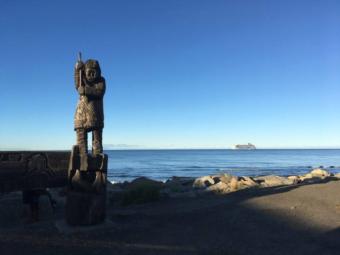
The cruise liner Crystal Serenity anchored offshore at Nome in 2017. (Photo by Gabe Colombo/KNOM)
The first cruise ship to pass through the Port of Nome will arrive in July. According to Lucas Stotts, Nome’s harbormaster, the port is expected to receive the most cruise ships the city has ever had come through Nome waters in one summer.
Robin Johnson of Nome Discovery Tours confirms that, so far, seven ships have booked arrangements to stop in Nome, with a few making multiple layovers through town during the cruise season.
Kenia Najera is one of the spokespeople representing the travel company Hurtigruten. One of the company’s vessels, the Roald Amundsen, plans to make port in Nome at the end of its three-week journey through the Northwest Passage.
“Hurtigruten is an expedition cruise line, so for them, it’s all about adventure and exploring untouched waters and different environments,” Najera said. “So I think Alaska is definitely on their radar, and they expanded in Alaska because of that. There are a lot of things that aren’t explored.”
The Hurtigruten vessel is expected to spend a full day in Nome with a capacity of more than 500 passengers during the month of September. Other scheduled ships include The World and National Geographic Orion.
Stotts said the port’s services to accommodate the Roald Amundsen and other cruise ships will remain the same, allowing some to dock and others to anchor outside the Nome harbor.
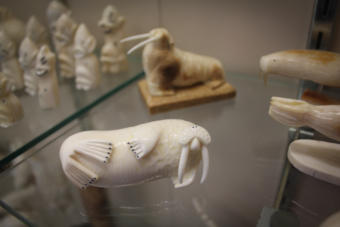
An ivory walrus on display at Maruskiya’s of Nome. (Photo by Emily Russell/KNOM)
Alaska’s congressional delegation introduced legislation in the U.S. House of Representatives and U.S. Senate to pre-empt states from banning walrus ivory, whale bone and other marine mammal products. Through these new bills, the delegation has proposed amending the Marine Mammal Protection Act.
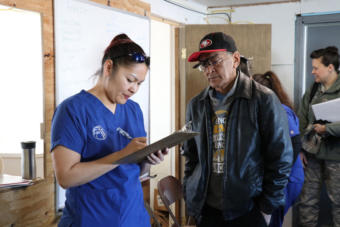
Vera Metcalf, the director of the Eskimo Walrus Commission, said the proposed legislation is a step in the right direction.
“For us, there’s really no way to address the consequences of the ivory ban at the state level, and I’m glad they (the delegation) are moving forward with introducing this legislation that might get us moving and working more to educate the general public about what walrus ivory is to our communities, and why it is important to not include it in the ivory ban,” she said.
The need for this legislation came about when almost 10 states — Illinois being a recent example — passed state bans on some or all types of ivory, which included the resource Alaska Native carvers use for their livelihood. The U.S. implemented a near-total ban on commercial trade of elephant ivory in 2016.
In an announcement from Alaska’s Congress members earlier this month, Sen. Dan Sullivan said these craftsmen have been attacked by “numerous states banning the sale of sustainable arts made of walrus and mammoth ivory and other marine mammal products legally allowed under the Marine Mammal Protection Act, unnecessarily coupling them with the illicit sale of poached elephant ivory.”
During a recent visit to St. Lawrence Island, local carvers told Metcalf that the inconsistency among state’s ivory bans has been negatively affecting their sales.
“I’ve heard people say, ‘Well it’s getting harder for me to sell ivory because of this fear (in) people that buy walrus ivory arts and crafts.’ I think there is fear of potential prosecution, because I think each state has different information,” she said.
The Alaska delegation says its legislation aims to end the confusion created by other states’ laws and protect Native artisans who work with ivory. Metcalf agrees more needs to be done to protect Alaska Native ivory carvers.
While these two new bills go through Congress, Metcalf said she and her working group will continue to spread the message that the walrus population is healthy and does not warrant listing under the Endangered Species Act.
The U.S. Fish and Wildlife Service made that determination in October 2017, so now the species will continue to be protected under the MMPA for Alaska Natives to harvest sustainably.
“I mean, we certainly promote non-wasteful takes, and we have been sending this message. But also, using all of what is given to us, including the ivory, is very much a part of our communities using the resource for food and ivory for making beautiful handicrafts and art,” Metcalf said.
Under current law, the secretary of the Interior is authorized to restrict the take of marine mammals if the population is dwindling, but the secretary must also have evidence to demonstrate that.
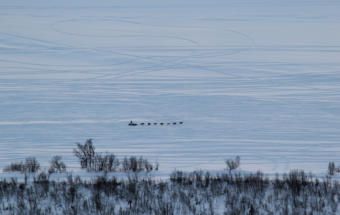
A dog team heading toward the Yentna Station checkpoint. (Photo by Zachariah Hughes/Alaska Public Media)
Iditarod mushers racing their dogs to Nome this year are doing it with a smaller team on the gangline. The race reduced the maximum team size from 16 to 14. This means quite a bit for race strategies, speeds and the trade-offs that mushers face as they travel across Alaska.

Just a day before the race began, defending Iditarod champion Joar Leifseth Ulsom, was facing a tough decision on which dogs to bring to the starting chute.
He hadn’t chosen his 14 dogs.
This year, competitive mushers like Leifseth Ulsom had to be extra choosy in building their lineup.
“I really thought 16 dogs was kind of something that made this race unique and special. Just one of the things, you know?” Leifseth Ulsom said. “Personally I would like to run 16 dogs, but we’ll see how it goes this year. Maybe I’ll like it, we’ll see.”
Over the course of a race, there are eight fewer booties to change, less food to pack and eight fewer paws that need ointment. And that’s one of the main reasons why the Iditarod Board of Directors changed the rule: because of the potential for enhanced dog care. But more dogs mean more pulling and climbing power for mushers looking to move quickly across the country.
Nenana musher Aaron Burmeister said he has mixed emotions. He likes racing 16 dogs and even the 20-dog teams that were allowed when he first started racing.
“Do we need that dog power? No. In today’s Iditarod, with the nutrition, the training, with the evolving of the sled dogs and the incredible athletes they are, you really don’t need more than 12,” Burmeister said.
The Iditarod joins other top races in restricting mushers to smaller teams. The 1,000-mile Yukon Quest only allows 14 dogs, and a few years ago Kuskokwim 300 dropped from 14 to 12 dogs.
Four-time Iditarod winner Martin Buser doesn’t like the new rule, saying it puts heavier mushers at a slight disadvantage.
“I want to maintain an open mind. Maybe we’re selecting a little tighter, so maybe the 14 dogs have no question marks in them. If we have a buffer of 16 or even 20 dogs, we would maybe take a dog that could be left behind,” Buser said. “I don’t mind going one year with 14 dogs, even though we know it’s not because of strategy or race statistics. It’s simply done because of money savings for the race committee, and that’s why I don’t agree with the rule.”
Buser is referring to the hundreds of dogs that are dropped each year in remote checkpoints. Veterinarians and volunteers in checkpoints watch over the dogs before the Iditarod Air Force flies them back to Anchorage.
Mushers have never been required to start with 16 dogs, and some teams chose in the past to start with a smaller string. But more dogs means more options. Mushers can bring a young dog that will gain valuable racing experience but doesn’t need to make the full trip to Nome. And in recent years, some mushers have experimented with carrying a few dogs in the sled bag or in a trailer to both modulate speed and bank extra rest. A smaller team complicates the developing strategy.
2017 winner Mitch Seavey would prefer to stick with 16.
“I predict that mushers are going to be more reluctant to return dogs from the trail. I think they’re going to want to keep them in the team as long as possible,” Seavey said. “I personally would rather see it stay at 16. I think it’s a diminished race, and I think it’s a little bit more stress and pressure put on fewer dogs. We’ve shown we can handle 16 year after year, so that’s really not a problem.”
Once the race is down to the last few days, mushers typically drop their slower dogs and sometimes finish with small teams. When they pass beneath the burled arch, they can finish with as few as five.
Aliy Zirkle at the ceremonial start of the 2019 Iditarod Trail Sled Dog Race in Anchorage. (Photo by Zachariah Hughes/Alaska Public Media)
The 47th running of the Iditarod Trail Sled Dog Race is underway.
Fifty-two dog teams sped out of Willow Sunday afternoon for the 1,000-mile race to Nome. With 35 men and 17 women slated to run, it’s the smallest field of mushers starting an Iditarod in decades. But that doesn’t mean the competition is any easier.
Two Rivers musher Aliy Zirkle is one of the contenders.
“It’s incredibly competitive, just as competitive as last year,” Zirkle said. “The sad part is we’ve lost some folks who do it for the sake of doing the Iditarod, but maybe they’ll come back next year.
This year’s field includes five former race champions, as well as 10 rookies. After poor snow forced the race to relocate twice in recent years, race officials said conditions are better than average. One of last year’s top rookies, Matt Hall, is happy with what he’s hearing.
“Seems like a lot of snow that’s also a slow trail, which is kind of good,” Hall said. “We train a little slower than most teams. We compete in the Yukon Quest right before Iditarod each year, so we’re kind of geared down a bit. I’m looking forward to another sort of soft trail out there.”
And the recent weeks of good weather have four-time champion Martin Buser feeling optimistic about the trail.
“The forecast looks really good, including the trip up and over the Alaska Range. That’s always the challenge,” Buser said.
Trail crews had to build bridges over open water in parts of the Dalzell Gorge. The race’s most technical sections are within the first couple days, a fact that rookie Jessica Klejka knows well.
“I’m just going to take it one checkpoint at a time,” Klejka said. “The sections we all hear about, my husband keeps saying, ‘They’re not that long of sections, you’re going to be fine.’ (And I say) ‘Well what about the steps?’ (He says) ‘There are going to be a few minutes of terror, and then you’ll be fine.’”
There’s spotty snow around the Iditarod checkpoint, and much of the sea ice along the coast is in poor shape after severe winter storms pounded the region.
A winner is expected to reach Nome in about nine days and will take home $50,000 plus a new truck, out of a race purse of $500,000.
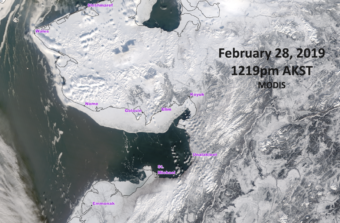
A satellite image taken of the Norton Sound region’s sea ice extent on February 28, 2019. (Photo by Rick Thoman/ACCAP)
Sea ice extent has been reduced to almost nothing after the latest series of storms that hit several communities in the Bering Strait region. Open water can now be seen from the shores of Unalakleet, Shishmaref, and elsewhere along the west coast of Alaska, an abnormal sight this time of year.
“Ice moving out from Diomede, mostly open water to the north of St. Lawrence Island now. It’s really a remarkable situation that we’re in at this point,” said Rick Thoman. Thoman is a climate specialist with the Alaska Center for Climate Assessment and Policy (ACCAP).
He says 15 separate storms have buffeted the Bering Sea in the last five weeks, which continue to erode sea ice.
“Every additional storm, every additional day that we have of these south-to-southeast winds, is another day that will chew away at what ice there is and keep any new ice from forming or any existing ice from strengthening,” he said.
With more open water, the biggest concern for residents of the Bering Sea coast is flooding. According to local reports from early February, residents in Shishmaref saw the winds blow a 20-foot pile of ice right up to their shoreline, near the community’s road. In Kotlik, Philomena Keyes observed flooding impact houses in her community after a Bering Sea storm caused high water levels to back up along the Yukon River from the southern Norton Sound.
According to Thoman, the same storm caused storm surges of ten feet along Unalakleet’s coastline.
Today, the National Weather Service expects elevated water levels to again impact the west coast of the state, including the Southern Seward Peninsula coast and Norton Sound area. Thoman says the weather satellite image from yesterday afternoon shows there is little sea ice left in southern and eastern Norton Sound, with open water now spreading to Norton Bay between Shaktoolik and Koyuk.
“Coastal flooding is certainly a possibility with these storms and all the open water we have,” Thoman said. “The big complicating factor this time of year is ice being so mobile right now, can be moved around, and so the impacts in any one place are very difficult to determine… can get slush berms form very quickly that can help or hurt.”
And residents in Western Alaska won’t be the only ones trying to minimize the hurt or damages caused by the current state of sea ice in the region.
Sea ice near Nome on Jan. 29, 2018. (Photo by Zoe Grueskin/KNOM)
Winter storms and blustery weather buffeting the Bering Sea this month have reduced sea ice coverage by almost 25% since late January. That’s according to climate specialist Rick Thoman.
Thoman works for the Alaska Center for Climate Assessment and Policy (ACCAP) at the University of Alaska–Fairbanks. He says in the last two weeks, more areas of open water have popped up all around Western Alaska.
“As of February 10th, we are seeing significant areas of open water throughout the Southern Norton Sound, as well as areas on the north side of St. Lawrence Island and even on the south coast of Chukotka, west of Provideniya,” Thoman said. Sea ice is typically solid and stable this time of year, but Thoman says even in areas where there is ice, much of it is shifting.
The National Weather Service has issued winter storm warnings for multiple zones within Western Alaska over the last few days, including St. Lawrence Island, the Norton Sound coast near Nome, and Unalakleet. Thoman says sea ice could re-form along the Southern Seward Peninsula Coast faster than in some of the other affected areas.
“If we get through this storm that is in progress currently with decent ice conditions, then we are probably okay,” Thoman said, referring to coast near Nome. “But it looks like a different situation in Eastern Norton Sound, where there is much less ice, and that’s going to take quite a while to form. Might not be much happening as far as crabbing in those areas, same with hunting out on the ice for the Bering Strait communities.”
Thoman adds that in Shishmaref, variable ice conditions could make subsistence hunting on the ice very challenging for the rest of February.
Gay Sheffield works for the marine mammal advisory program, engaging with many whaling communities and hunters in the Bering Strait region. In terms of how subsistence hunting could be impacted by the current sea ice conditions, Sheffield says:
“It’s safe to say our resourceful harvesting communities will take advantage of any conditions… open water isn’t necessarily a bad thing,” Sheffield said.
Looking further north, Thoman says subsistence hunters will have to work around open water, a lack of thick sea ice, and moving ice ridging together.
“Even southern Kotzebue Sound is seeing some open water, as well, and that is really surprising,” Thoman said. “That water is much shallower, and that ice ought to be thoroughly stable here by the time we get to the middle of February — but not this year.”
For residents of Nome and other Bering Strait communities, Thoman recommends waiting for the storm to pass before going back on the sea ice.
“Certainly, if it’s possible, (you) might not want to be out on the ice over the next couple of days until this storm blows through and we see things start to settle down,” Thoman said. “We will have a couple of days of colder, not-so-stormy weather coming up, so while we might not see much in the way of sea ice growth, (we) should see things stabilize at least a little bit.”
As sea ice extent changes dramatically in the Bering Sea, Thoman says it is always helpful to be vigilant and to report your observations. Alaskans who want to share what they see with professional weather observers can contact the local environmental network (LEO).
Close
Update notification options
Subscribe to notifications
Subscribe
Get notifications about news related to the topics you care about. You can unsubscribe anytime.