KNOM - Nome

KNOM is our partner station in Nome. KTOO collaborates with partners across the state to cover important news and to share stories with our audiences.

Nome Officer Who Pleaded Guilty to Assault is Re-Hired by Police Department

Carl Putman, the former Nome Community Service Officer who pleaded guilty in July to charges of assault while on duty, has been rehired by the Nome Police Department (NPD). Putman has been hired on as an emergency hire temporary dispatcher for NPD.

In April, Putman was charged with assault in the fourth degree in Nome District Court after allegedly punching Florence Habros of Nome while he was on duty.

Putman admitted during investigations that when an intoxicated Habros passed out he “became frustrated and punched her in the head with a balled fist.” There is no audio of the event, as Putman “claimed he forgot to turn his audio recorder on” when the incident occurred in Front Street in February. In July, Putman pleaded guilty to the charge and received a one-year suspended imposition of sentence, but no jail time or community service.

When asked if NPD was concerned about safety, Nome Police Chief John Papasadora stressed that Putman would have no contact with the public directly in this new role. Papasadora said Putman would “…work in the office, not down on the road or doing public contact other than by phone.” According to City Manager Tom Moran, this was an emergency hire: meaning that the job is not required to be posted to the public and that the position only lasts for up to six months. At any point, the role could be filled by a qualified candidate.

Both Papasadora and Moran confirmed that Putman was hired because he already knew the necessary operating systems. With the department down by four dispatchers, the move was a matter of “business” made to keep the department operating. While Moran was aware of what he called Putman’s “criminal allegations,” he explained that there are no criminal barriers from working dispatch. There have been previous dispatchers with criminal convictions.

But there are Nome citizens who feel that this furthers the distrust between the police department and community members, including Florence Habros, the victim of the assault in February. Habros says she was not notified by the NPD that Putman had been rehired as a dispatcher. She said she would not feel “comfortable” calling dispatch knowing that he could pick up.

When asked if she would call the NPD to report a crime, Habros said: “… (if) he answered, dispatcher, it’s uncomfortable… I would call the troopers, state troopers, I would call them instead… They would help me out.”

Habros worries that she is not the only person who has been assaulted by Putman. She claims to have heard that other people have been hurt by him as well. She hopes that if this is true they will come forward.

“I know if we keep this going, maybe they’re going to pop out and tell, too,” she said. “They would come out and tell the truth of what he did to them.”

Manager Moran said he is aware of how some people in the community feel about this hiring decision. He said, “We do not have the resources, do not have the people available to us; the applicant pool on file may not be the best applicant the public would feel to be the best candidate.”

Putman’s new role does not include any patrol duties or physical contact with the public, and could expire if a more qualified candidate becomes available.

Sullivan, military brass visit Nome with ambitions for Arctic role in national security

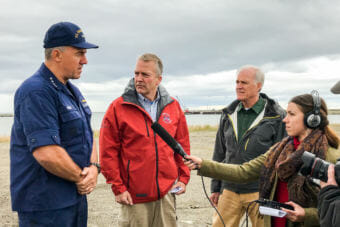
U.S. Coast Guard Commandant Karl Schultz, U.S. Sen. Dan Sullivan, and Secretary of the Navy Richard Spencer talked to reporters from the beach near the Nome Port. Photos by Margaret DeMaioribus/KNOM.

U.S. Sen. Dan Sullivan, Navy Secretary Richard Spencer and U.S. Coast Guard Commandant Admiral Karl Schultz are touring the state in an effort to push for national security in the Arctic.

Their visit Monday in Nome coincides with the National Defense Authorization Act, which was scheduled to be signed by President Donald Trump.
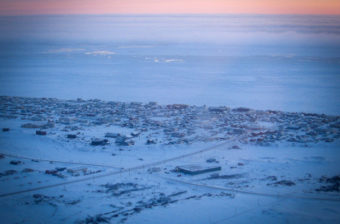
Funds for the construction of six new icebreakers are included in the bill.

“The era of asking our military to do more with less is over,” Sullivan said of the implications for that bill in the Arctic. “And a lot of that money is coming to Alaska.”

Sullivan said the U.S. has been slow to keep up with national security matters in the Arctic.

As Arctic waters open, so does the potential for security threats.

The construction of a deep draft port in western Alaska would allow the Coast Guard and Navy to have a strong presence in the U.S. Arctic.

Spencer said the Russians have already opened up six additional airstrips. China also has put out an Arctic strategy.

“We have to have a plan up here because we are going to be one of the major stabilizing factors of how the Arctic plays out,” Spencer said about Alaska’s role.

Concerns are not limited to national security but also include economic sovereignty, Schultz said.

“Presence equals influence in the Arctic. And we absolutely need to assert our national interest,” he said. “About 13 percent of the untapped fossil fuels remain at the ocean’s floor up here — about a third of all the natural gas — and then you’re looking at a trillion dollars of minerals. And the U.S. wants to assert our sovereign rights over those resources.”

Ultimately, Sullivan stressed that security in the Arctic is a matter of urgency.

His office has had correspondence with the U.S. Army Corps of Engineers, and he expressed concern over their pace with the deep draft port process.

“Trust me, when we get back to D.C., we’re going to reiterate our message to the Corps: ‘No more foot dragging here, let’s finish this study,” Sullivan said. “It’s important for Alaska, it’s important for Nome, it’s important for the country. And again, I think having the top leaders in the country on these issues here on the ground in Nome is going to help us make that point.”

With more seabirds dying in Arctic, research vessel makes a rare voyage

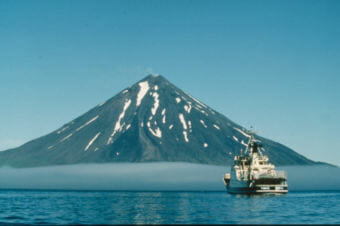
The R/V Tiglax provides critical support for biological work, management programs, and village outreach and education. (Photo courtesy U.S. Fish and Wildlife Service)

The 120-foot research vessel Tiglax is sailing up to Cape Thompson for the first time in more than 20 years to look at seabird populations.

The Tiglax (pronounced “TEK-lah”), which is owned by the Alaska Maritime National Wildlife Refuge, takes its name from the Aleut word for “eagle.”

The Homer-based crew set sail July 30 from Nome.

Like an eagle, it covers vast stretches of Alaska, visiting refuges from Safety Sound and Topkok to Sitka Sound, from Cape Lisburne to the Pribilof Islands.
Alaska Maritime National Wildlife Refuge was formed in 1949 by consolidating dozens of smaller refuges throughout the state.

Voyages to the Northern regions are rare.

Slow-moving vessels, small research teams, and cost make it difficult to study in the northern Bering and Chukchi Seas.

The last trip to Cape Thompson was in 1995.

“This is the closest port to Cape Thompson and Cape Lisburne that isn’t too shallow for our ship to get into,” said refuge supervisory biologist Heather Renner, who explains their teams’ plans for study in Cape Thompson. “We’re going to go see the condition of the seabird breeding cliffs.”

They hope to monitor the size of the population and get an idea of breeding success.

Seabird die-offs have been observed all around the state.

The Tiglax also will stop to make observations at Sledge Island.

Mean temperatures this year in the Bering Sea have been about 4 degrees warmer than usual and sea ice levels were extremely low, Renner said.

“The effects of climate change are more pronounced in the North than they are in other parts of the state.”

The warmer temperatures and low sea ice cause changes in the ecosystem, including recent seabird die-offs, that scientists don’t yet understand.

Necropsies on birds around the state show that the birds are starving.

Sea bird die-offs in the past have been related to warm water.

Renner shared some popular hypotheses, which included prey redistribution and a change in the quality of the prey.

“Fish or plankton just go a little bit deeper to where birds can’t reach them or it can change the quality of the prey,” she said. “We know in warm years that the plankton composition is different. They tend to be different species, and those tend to be less fatty, less lipid-rich, things that are less good for seabirds.”

It isn’t just seabirds in trouble.

Reports of dead or emaciated fish and marine mammals are coming in from around the state.

The researchers found a dead whale in Safety Sound.

The situation has necessitated more communication between scientists and community members.

“The seabird die-offs we’ve been having recently — one good thing I’ll say is that they’re teaching us how to partner and how to collaborate,” Renner said. “Lots of people in communities that are sending in reports from communities around the whole state are helping us to understand what’s going on and how to put the story together.”

While the team won’t have any conclusions following this trip, they will be looking for places to set up camp in Cape Thompson for the future, to allow for more research trips and more data.

The Tiglax will be returning to the Port of Nome on Aug. 10.

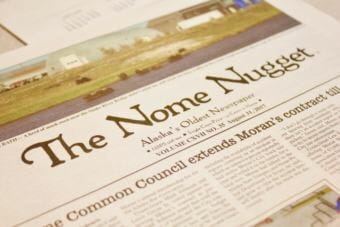
Nome Nugget newspaper under new ownership

The Nome Nugget newspaper is officially under new ownership. As of last week, managing editor Diana Haecker and her husband, advertising manager Nils Hahn, now own the Nome-based newspaper.

The pair purchased the Nugget from the estate of Nancy McGuire, who owned, published and edited the paper from 1982 until her death in 2016.

According to a press release, Hahn joined the staff in 2012, and Haecker has worked for the Nugget as a reporter, and later editor, since 2002.

“That’s our life, you know. That’s what we do,” Haecker said.

Haecker says she got her start in reporting when she was 20 years old and attending school in Frankfurt, Germany, near where she grew up. Since then, she’s worked in TV, radio and at magazines and newspapers.

But Haecker says the independently-owned Nugget is “a reporter’s dream,” because of its nature as a community paper.
“You are embedded in the community, you live in the community, and you report on the important things that affect the community,” Haecker said. So we’re not having to obey any corporation rules that sometimes skew reality.”

Haecker says she sees herself as a “caretaker” of the paper during what she calls a “significant time” for the Arctic.

“It’s in the spotlight because of climate change,” Haecker said. “So we are right here at ground zero for reporting on Arctic issues. We are here. And we report from right here.”

According to Haecker, that reporting will mostly stay the same under the new ownership. She says they’re not planning any formal changes to the paper besides possibly bringing back the Village News column, formerly reported by Janet Ahmasuk.

“Just what’s going on in the communities around us,” Haecker said. “And that’s not always the bad news, but just the regular news: Hey, are the berries ripe? How are the moose doing? Or what’s going on in your community?”

Haecker and Hahn will also now be keeping tabs on sled-dog racing around the world. In March, they purchased the bimonthly Mushing magazine.

The Nome Nugget is one of Alaska’s oldest newspapers, with continuous publication since 1899.

New Alaska law allows license to fish to be on your phone

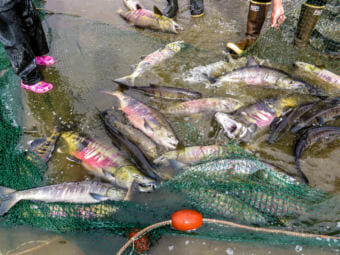
Salmon caught in a seine net in the eastern Norton Sound, just up the Bering Sea coast from Nome. (File photo by KNOM)

Alaskans can now show a recreational fishing, hunting or trapping activities license to officials in digital form.

Gov. Bill Walker signed House Bill 260 into law, allowing carriers to show their license in paper form or on their cellphone. including a digital copy, or a photograph of a paper copy.

The bills sponsor Eagle River Republican Rep. Dan Saddler said in a news release, “This legislation makes it easier for Alaskans to comply with the law and for Fish and Game officials to verify compliance with the law.”

Anyone failing to produce a digital or paper copy has 30 days to cancel their ticket, which can be done by showing a paper or digital license to the citing agency.

The law does not allow for an officer to examine any other content on the digital device other than the license.

Diesel fuel spills in Gambell after pipeline fails

A road in Gambell. (File photo by KNOM)

In late June, a pipeline failed in Gambell causing an estimated 2,500 gallons of diesel fuel to spill, but the spill was only recently discovered, according to the Alaska Department of Environmental Conservation.

The department’s state on-scene coordinator Tom DeRuyter says June 25, fuel was being delivered through a 4-inch pipeline, leading from the barge landing to the Bering Strait School District and Gambell Native Store tank farms.

“The fuel went through this underground piping, and it obviously was compromised,” DeRuyter said. “A subsequent pressure test on the line indicated that it would not hold pressure. And we’re certain that that was the source of the release.”

According to the DEC situation report, the school district received the full amount — about 2,500 gallons — of fuel it ordered.

DeRuyter said the store’s records show it didn’t.

But the problem went unnoticed until last week, when people in the community reported smelling diesel and seeing a sheen in a small pond.

U.S. Coast Guard and DEC responders arrived July 13 to investigate, DeRuyter said. They’re still not sure of the full extent of the spill.

“There’s been no reports of oil getting out into the Bering Sea. Those are the only areas where oil has been noted.”

He said the water supply has not been compromised, since Gambell doesn’t get its water from ground wells.

The valves on both ends of the pipeline have been closed, DeRuyter said.

The next steps include excavating the pipeline to figure out where exactly it broke, repairing it and then cleaning up the oil.

But first, they have to find digging equipment.

“Coming up with equipment out in Gambell is a very difficult thing,” he said. “We’re checking all the entities that we know right now to see if they’ve got equipment, is it operational, do we have an operator, and how soon we can use it if they allow us to.”

Coast Guard and DEC investigation and clean-up efforts will be ongoing, DeRuyter said.

This is the second fuel spill this year on St. Lawrence Island, after 22,000 gallons spilled in March in Savoonga.

Site notifications
Update notification options
Subscribe to notifications