KNOM - Nome

KNOM is our partner station in Nome. KTOO collaborates with partners across the state to cover important news and to share stories with our audiences.
Found in a cave in Northwest Alaska, an ancient tooth offers insights into the first inhabitants of the Americas

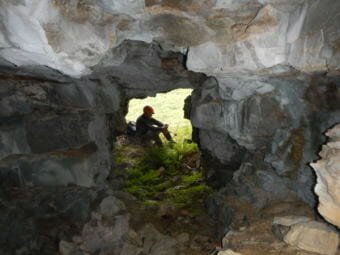
A view from the interior of Trail Creek Cave 2, the site where the ancient Beringian tooth was originally found by Danish archaeologists in 1949.
A view from the interior of Trail Creek Cave 2, the site where the ancient Beringian tooth was originally found by Danish archaeologists in 1949. (Photo courtesy of Andy Tremayne/National Park Service)

A paper published in 2018 analyzes the oldest ancient human remains found in the Arctic: a 9,000-year-old child’s tooth.

The tooth was discovered, and forgotten, way back in 1949 at Trail Creek Caves, right outside the community of Deering. Jeff Rasic, an archaeologist working with the National Park Service, told KNOM what makes its rediscovery so special.

“There are hardly any human remains known from all across the Arctic,” said Rasic, who has done archaeological research across northern Alaska. “The next oldest human remains come from Greenland, and they’re about 4,000 years old. So, this more than doubles the age of the oldest human remains from the Arctic. There are other ancient human remains from central Alaska, interior Alaska, but this is the oldest in the Arctic.”

The tooth’s age is really only part of the story, though, according to Rasic. Through advanced DNA analysis, scientists were able to uncover a wealth of knowledge. The information was published in a paper in the Journal of Science back in November.

“They’re looking at the entire genome of this ancient individual,” he said. “That’s a feat, because the DNA degrades over time, and it takes some luck and some great skill to tease the DNA information from an old specimen like this, especially a small one.”

DNA analysis of the tiny specimen revealed that the tooth belonged to a member of a population called the Ancient Beringians.

“There’s one other individual of that type known, and it’s from central Alaska, about 400 miles away — and a little bit older, about 11,000 years old. So what that tells us is that this population of people was pretty widespread across Alaska, or eastern Beringia, at the time,” Rasic said.

He elaborated further: “Alaska was connected to Asia with a land bridge, the Bering Land Bridge. So this population of people existed in the area at that time and then persisted after the land bridge was severed, after sea levels rose and severed the land bridge. These Ancient Beringians persisted to at least 9,000 years ago, the age of the Trail Creek specimen, and it seems to be a population that maintained its own identity and integrity. There wasn’t a lot of gene flow from other populations coming in.”

The paper published in the Journal of Science looks at 14 other ancient specimens from across North and South America. The tooth provides context for a bigger archaeological picture.

“People resided in Beringia in Alaska for some time, and then some groups traveled further south and went on to colonize all of North and South America,” Rasic said. “So this population in Alaska is an offshoot of this major branch in the family tree of all Native Americans. And the next big branching event occurred in the mid continent, south of the continental glaciers in North America.

“So this person from Trail Creek Caves is a relative of all other Native Americans. The broad strokes of that family tree are really being sketched out in front of our eyes.”

Artifacts from Helge Larsen’s 1949-50 excavations housed at the Danish National Museum in Copenhagen. The human tooth, rediscovered by Jeff Rasic in 2016, hadn’t ever been analyzed; it was lost to time, stored in a box like this one.
Artifacts from Helge Larsen’s 1949-50 excavations housed at the National Museum of Denmark in Copenhagen. The human tooth, rediscovered by Jeff Rasic in 2016, hadn’t ever been analyzed; it was lost to time, stored in a box like this one. (Photo courtesy of Jeff Rasic)

A lab at the University of Alaska Fairbanks was able to examine the chemical signatures of the tooth, shedding light on its ancient owner’s diet, as well as their movement around the region.

“They had a very strong emphasis on terrestrial food sources. And at that time, caribou were really the main option people had. Other animals, bison and mammoth, were extinct by 9,000 years ago,” Rasic said. “The cave is also loaded with caribou bone. That’s another good indication that that was a prominent animal on the landscape at that time.”

But Rasic said examination of the tooth revealed no signs of fish or marine mammals being a part of the Beringian’s diet.

“Which was a little bit of a surprise,” he said. “Archaeologists have debated when that subsistence focus came about. There’s other evidence from other places in Alaska that people were eating salmon, at least, very early on. But it’s unknown when people started to focus on marine mammals. In this case, we have one data point that says this person 9,000 years ago was eating no marine mammals. They weren’t hunting seals or walrus, even though the site is not that far from the coast.”

Rasic pointed out how the Beringian’s caribou-heavy diet at that time bridges the ancient and the present. Additionally, the cave site where the tooth was found is no secret to people in the community of Deering.

“They’re not big, roomy caves that you’d spend a lot of time in. They’re just little hollows where we think even nine and ten thousand years ago, all that people did there was duck out of the rain — they weren’t raising their families there,” he said. “They were probably passing by, and in the course of a hunt, they’d pop in there if the weather was bad … These spots on the landscape have been used in more or less the same way for 10,000 years.”

Rasic said more development on the individual’s movement and their diet will be published in another scientific article in the near future.

Aerial view of Trail Creek Caves on the Seward Peninsula in Bering Land Bridge National Preserve.
Aerial view of Trail Creek Caves on the Seward Peninsula in Bering Land Bridge National Preserve. (Photo courtesy of Jeff Rasic)

Unalakleet constructing assisted living facility to serve elders of Norton Sound

New building under construction in Unalakleet to offer assisted living services to elders throughout the region. (Photo courtesy The Rasmuson Foundation)

Construction is underway for an assisted living facility in Unalakleet, the first building of its kind in the entire Norton Sound region.

Robert Dickens is the project manager for this new facility, which is being spearheaded by the Native village of Unalakleet.

“There’s a total of ten rooms for occupants,” he said. “Two of them are independent living, and the other eight will be for those that have Alzheimer’s or dementia problems. And then we will have two to three personal care attendants [working] ‘round the clock.”

According to Dickens, the Native village has been working to provide services for elders in the region for the past 15 years or so. It is not necessary for a full-time doctor or nursing staff to be at the facility, so Norton Sound Health Corporation will only be a partner in the project as needed.

“What brought a lot of this on is Unalakleet and many of the Norton Sound villages have seen their elders when they get to the point where they can’t receive care from their family, then they get shipped off to Soldotna, Anchorage, Fairbanks and different places, and they deteriorate pretty quickly in that scenario,” he said.

As Dickens states, just because the region’s elders are old in years, they still have things to offer their families and communities. So this new assisted living facility in Unalakaleet will give elders in the region an option to receive services in a location closer to their home communities.

Dickens mentions that even though it’s not his realm of expertise, he believes the assisted living facility will be operated similarly to Quyanna Care Center in Nome when it comes to choosing residents and occupants for the ten available rooms.

The project is estimated to cost $7.7 million, so Dickens has been requesting funds from several organizations, including Norton Sound Economic Development Corporation, Norton Sound Health Corporation, and Bering Straits Native Corporation.

Last week, the Rasmuson Foundation joined the list, by awarding the project $649,730. Todd Shenk, a senior program officer at the Rasmuson Foundation, says the assisted living facility was given a Tier 2 grant from the Foundation because of the need it will fill in Unalakleet and the region.

“We do believe that all Alaskans deserve to age in their own communities and be with family in their home community,” he said. “This project will allow elders from Unalakleet and other villages in the region to stay at home when they need a little extra assistance.”

During the Rasmuson Foundation’s latest board meeting in November, the Foundation selected almost 20 projects across the state to award funds to, including Kawerak, Inc. According to the Foundation, Kawerak’s Head Start building in Nome will receive roughly $260,000 to expand its program and serve more children.

The Unalakleet elders’ assisted living facility project is not fully funded yet, but project manager Dickens says he hopes to find other block grants and is anticipating the facility will be completed by fall of 2019.

According to Dickens, the construction crew on the project, with 40% of its force being local hires, is taking a break for the holidays. Construction should resume in January or early February.

U.S. future in Arctic hinges on expanding its icebreaker fleet, Coast Guard says

The U.S. Coast Guard Cutter Healy (WAGB-20) is in the ice Wednesday, Oct. 3, 2018, about 715 miles north of Barrow, Alaska, in the Arctic.
The U.S. Coast Guard cutter Healy (WAGB-20) is in the ice Wednesday, Oct. 3, 2018, about 715 miles north of Barrow, Alaska, in the Arctic. (Public domain photo by NyxoLyno Cangemi/U.S. Coast Guard)

U.S. Coast Guard vessels stationed in western Alaska have left Arctic waters for the season and are now preparing for their next assignments.

Last week, the Coast Guard cutter Alex Haley returned to homeport in Kodiak after a 66-day multi-mission patrol. The cutter Healy, one of the Coast Guard’s two active icebreakers, went back home to Seattle last month following four months in the Arctic.

From the science side of things, the Healy crew was very productive during its time in the Arctic.

According to a press release from the Coast Guard, the Healy was involved in three research ventures in partnership with the National Science Foundation, the National Oceanic and Atmospheric Administration, and the Office of Naval Research.

Coast Guard spokesperson for the Pacific region, Senior Chief NyxoLyno Cangemi, said some of these missions focused on the oceanography and marine ecosystem of the Arctic, including areas within the Beaufort and Chukchi seas.

“Coast Guard cutter Healy went underway (in September) with a team of about 30 scientists led by Dr. Lee of the Applied Physics Lab in Seattle, and they were studying the stratified ocean dynamics in the Arctic (SODA), which is studying how environmental factors, such as wind and solar radiation and temperature, affect the mixing of the water layers of the Arctic Ocean,” Cangemi said.

According to the senior chief, there’s a heavy demand every summer from scientists and scientific organizations to use the Healy and Coast Guard resources for the purpose of research in Arctic waters. With only two icebreakers in its entire fleet, though, the Coast Guard’s capabilities are limited.

“Supporting future research of the Arctic is going to absolutely involve recapitalization of our fleet and obtaining more icebreakers, especially to work in those high latitudes,” said Cangemi.

Cangemi said building a new icebreaker will cost upwards of $1 billion, and Congress hasn’t yet appropriated the funds to do so. Once that large sum of money is available, the Coast Guard estimates it will still take five-to-10 years to build the new vessel.

From Cangemi and the Coast Guard’s perspective, having a larger presence in the Arctic is crucial for the United States.

“The missions that we have up in the Arctic and in Antarctica are crucially important to the nation’s interests, and (for) recapitalizing, building up that fleet in order for us to remain a competitive nation with countries such as Russia and China,” Cangemi said. “It’s imperative that we start looking at this area as an area of importance for the nation.”

For now, the cutter Healy is preparing for a “dry dock” period with maintenance and upgrades, as its schedule is planned out for next year’s deployment in the Arctic. The Coast Guard’s other icebreaker, the Polar Star, is currently on its way to Antarctica for its annual deployment to support research on the frozen continent.

Mock election helps Nome students — and their parents — prepare for the real thing

“I Voted” stickers at the polls in Nome, August 19, 2014.
“I Voted” stickers at the polls in Nome, August 19, 2014. (Photo by Matthew F. Smith/KNOM)

Americans must be 18 to vote in the general election, but that didn’t stop the students at Nome-Beltz High School from getting involved in the democratic process on Tuesday. Social studies teachers Devin Tatro and Michael Hoyt organized a mock election to get students voting.

The classroom was set up as close to possible as a real polling place. Students sign in with a student volunteer, take one of the sample ballots printed from the Division of Elections website, and walk to homemade voting booths constructed of red, white and blue construction paper in the back of the room.

But Tuesday’s mock elections weren’t meant for students just to play or pretend. Before students went to their makeshift polls, Tatro asked them if their parents voted or if they had ever gone to vote with their parents. Not many hands went up. For many, this was their first experience at anything remotely resembling a polling place.

“My main objective is to demystify the process of voting, which I think happened for a few students,” Tatro said. “I had a few students say, ‘Wow. That’s so much easier than I thought it would be! I got this.’ I had a few 18-year-old students, too, who had felt really nervous about voting, and then after class today they said, ‘OK, I’m going to (vote) after school now, I know what I’m doing.’”

In the days leading up to the 2018 general election on Tuesday, students spent time researching the candidates on third-party websites, the candidates’ own campaign sites, and different campaign commercials. The high schoolers spent time researching Ballot Measure 1 (otherwise known as the “Stand for Salmon” ballot initiative), and middle schoolers were encouraged to ask them for information as they prepared to cast their ballot.

According to Tatro, for some students it was more than just a school affair.

“I’ve had some kids tell me, ‘I told my parent who they should vote for,’ or ‘My parent asked me who they should vote for,’ and they talked about it.”

Election results at Nome-Beltz, like actual returns in the Bering Strait region, added up a bit differently than around the rest of the state. Beltz students elected Democrat Mark Begich for governor and independent Alyse Galvin to the U.S. House of Representatives, and they said “yes” on Ballot Measure 1.

There’s no word yet on whether mock elections will be a regular event at the high school, but this year saw 146 young people cast their ballot at Nome-Beltz. Just like adult Alaskan voters, they got to walk away with one of the specially-designed cartoon “I Voted” stickers — and a little donut treat.

After decades of ineligibility, the small island of Diomede is finally included in Essential Air Service

In winter months, air transportation to the remote island community of Little Diomede involves landing on a runway made of ice. (Photo by Matthew Guiffré/KNOM)

Diomede no longer has to rely on uncertain state funding for airline passenger service. On October 5, 2018, President Trump signed a reauthorization of the Federal Aviation Administration’s Essential Air Service (EAS) program, and for the first time ever, that includes the village of Diomede.

Until this month, Diomede remained ineligible for full EAS service through the Department of Transportation. Residents hope this could mean significant changes for transportation to and from the island.

In 1978, the entire airline industry was de-regulated, causing concern that airlines would flock to larger cities for more profit and leave rural communities without services. John Bioff is an attorney with Kawerak and part of a large team of local organizers and state legislators who worked to have Diomede included in the EAS; he explained the history of the requirements to KNOM.

“The federal essential air service statute was passed to subsidize and make sure that there was going to be air service to these rural communities,” Bioff said. “The way they determined those communities… (was) if they could certify that a community was regularly receiving passenger service as of that date. So, the problem for Diomede was that they weren’t.”

Decades ago, there were no regular passenger flights to the village, so they were determined ineligible. Until 2012, people could only fly to Diomede standby on a mail carrier if there was enough room among the parcels and letters.

There are currently three passenger flights a month to the island community, thanks to the Air Transportation to Non-Eligible Places program, or ATNEP. That program has 50% federal funding, and the other 50% comes from the state, meaning that its security is dependent on state politics and budget. According to Bioff, the amount given by the state has remained stagnant since 2012, and the federal government will only match that.

Francis Ozenna is the Tribal Coordinator of the Native village of Diomede and explains the difficulty in having only three flights.

“We see transportation as one of the hardest experiences when it came to dealing with some of the needs we need,” Ozenna said, “because it involves long-term (consequences): if you’re off Diomede, it’s harder to get back. It deals with… the doctor, eye care, dental, all the other departments.”

Not only does that include all passenger and medical traffic, but social services, law enforcement, and crime investigation, too. Bioff, the attorney, thinks that is reason enough to have more trips to the island community.

“It’s not nearly adequate to have the amount of trips that they’re having now,” Bioff said. “So we’re going to push, on their behalf, to get more trips from the Department of Transportation and increase in subsidy for that reason.”

Diomede’s contract with Pathfinder Aviation is ending later this year, and as of now, it is unknown if that contract will be renewed or how it will be affected by EAS. Ozenna expressed positive sentiments about transportation for the community.

“Now that we have essential air service and are in our third year with them [Pathfinder], we are satisfied with transportation. We’d like to see more of it… that would be good,” Ozenna said.

The effort to secure the community’s eligibility in the reauthorized EAS program included the efforts of Kawerak, the village of Diomede, Senators Murkowski and Sullivan, Congressman Young, Senator Donny Olson, Representative Neil Foster, and Governor Walker.

Nome city manager placed on administrative leave after harassment claim

Nome city manager Tom Moran has been placed on administrative leave after a Nome citizen raised claims of harassing behavior during Monday night’s City Council meeting.

Moran and Mayor Richard Beneville were both absent due to travel. Moran resigned from his office in September but said he would work as City Manager until October 18, per the conditions of his contract.

An emotional testimony was brought forth during citizens’ comments by Ahne Schield, the music director at Nome-Beltz High School. Schield claimed that Moran had harassed her personally and through text message last year.

She claimed that last July, Moran approached her while she was out with friends and began to make vague remarks about her significant other’s professional work that were distressing for Schield. While waiting for a cab, she received text messages from an unknown number; when Schield asked for the sender’s name, she was given the name of a known acquaintance, Mitch Erickson. (At the time, Erickson also worked with Schield’s significant other.)

Via text message with the person she believed was Erickson, Schield then described her earlier conversation with Moran. At this point, she says, the messages that she believed to be from Erickson became lewd.

“He began to make suggestive comments using words like ‘urges’ and the like,” she said. “He invited me to City Hall to discuss our situation. I thought it odd, as he had never made such comments, and as I knew was nothing of his nature.”

Schield ended the messages by saying she was home safe, to which she claims to have received a message saying “I know, and I saw that.” According to Schield, when Erickson was confronted, he denied the exchange. A few weeks later, Schield says she called the number and received the voicemail of Tom Moran.

“That same day, we went to the Troopers, as we also have a distrust of NPD,” she said. “After talking to the Troopers, they indicated the CM did nothing illegal, immoral maybe… We felt helpless, what do we do? File a citizen’s complaint? No way, that goes straight to the CM.”

Schield says she brought the story and text messages to a councilman and was told “we will tell him to tone it down.” She claims she was never questioned by the city council or asked to give statements. When she reached out to Mayor Beneville for a private conversation, she claims that she was told “I am unsure of your expectations,” and for this reason, she says she did not pursue the issue further. According to Schield, this sequence of events took place last year, before Moran’s contract was renewed.

“Tom created fear and doubt in my mind as to what I could pursue or become in my own community that raised me up, one that gave me scholarships that sent me to college, that cheered me on in everything I did, the community I came back to to get a sense of home,” she said. “The community that I feel lucky to now serve in a new capacity.”

Neither Moran or Beneville were present to comment in Monday’s meeting, but Moran did leave a written letter in the agenda as his final City Manager’s report. In his letter, he claimed that the Manager’s lawful decision-making authorities had been weakened and that, as such, effectiveness is difficult. Moran left a list of all of the executive sessions the Council has held where citizens are not allowed to hear the discussion or comment, since executive sessions are off-the-record. He described himself as being paid to be a scapegoat for the City’s problems in his role of City Manager. Moran said in his letter “all citizens must be protected by their elected officials, including employees.”

The Council voted unanimously to place Tom Moran on leave. As of now, the conditions of pay for his leave have not been decided and were not part of the vote. Moran turned in his resignation last month but had stated he would work until the 30 days cited in his resignation were over. On Monday night’s agenda was a resolution to make John Handeland the interim Nome City Manager; the council voted to amend that resolution to make Handeland the acting City Manager retroactively from the date October 4, when Moran left town for other commitments. John Handeland will remain the acting City Manager until that position is permanently filled.

KNOM reached out to Moran through e-mail, in which he confirmed he sent Schield text messages but denied that they were harassing. Moran did admit to pretending to be someone else due to having a previous conversation with Schield about said person (Mitch Erickson); he says that he thought Schield had Erickson’s number and would know that Moran only meant to be joking. Moran says he believes those messages were discussed in an executive session from which he was excluded. In the e-mail, he also said he understands the Council having to make a difficult decision with only one side present and that while he is disappointed in the decision, he does not begrudge the Council.

Site notifications
Update notification options
Subscribe to notifications