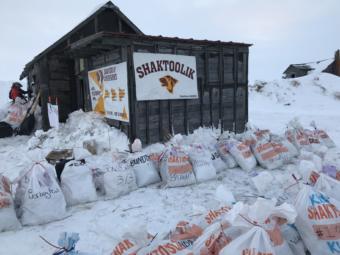
Drop bags are lined up outside the makeshift Iditarod checkpoint near the community of Shaktoolik. (Photo by Emily Hofstaedter/KNOM)
The Native Village of Shaktoolik is being recognized for their makeshift checkpoint during this year’s unusual Iditarod sled dog race. The community has been given the Golden Clipboard Award from the Iditarod Official Finishers Club.
In a press release, the Iditarod Trail Committee said Shaktoolik is being recognized for their commitment to “providing the best possible checkpoint in light of restrictions and concerns over COVID-19.”
Just days before mushers racing the 2020 Iditarod were expected to reach Shaktoolik, city leaders decided to close the community checkpoint to prevent any local spread of the novel coronavirus.
U.S. Sen. Lisa Murkowski said the community’s efforts were an example of rural Alaska resiliency.
“That was very early on in terms of the impact and the response in the state of Alaska,” Murkowski said. “So you had individuals coming together and saying, ‘We haven’t seen this threat (coronavirus) out here, but we know that we need to be prepared.’”
But efforts to protect the community weren’t going to prevent community members from also providing hospitality. They set up their own last-minute shelter.
Shaktoolik residents found a ruined house at the old Shaktoolik site, about two miles from the current village. They outfitted the shelter with food, water, and a warm place to rest for mushers and dogs as the teams prepared to cross the barren sea ice across the Norton Bay.
One of the leaders for that effort was Hannah Lynn Sookiyak, who told KNOM at the checkpoint in March that she comes from a family history of Iditarod volunteering. She said her parents were checkers for the race when it first started in the 1970s.
“I don’t know how many years they did it but they did it in their own personal two-story home with 11 of us kids,” she said. “And back when it first started, we had no running water, no sewer, so my brothers were busy hauling ice and dumping honey buckets!”
Iditarod Race Director Mark Nordman said he, “appreciated Shaktoolik’s efforts to go above and beyond for the race teams.”
The actual award will be given to the community at a later date.
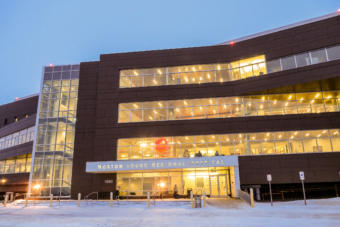
Nome’s Norton Sound Regional Hospital. (Photo by Laura Kraegel/KNOM)
Norton Sound Health Corp. announced Tuesday that the Bering Strait region has its first confirmed case of COVID-19.
At this time, NSHC is not sharing information on which of the sixteen communities in the region the patient is from, according to public relations manager Reba Lean. However, the individual is reportedly self-isolating and is in contact with the state’s Section of Epidemiology.
“In our region, every community is so small, and as soon as we identify the location, people start making assumptions and guesses, and it becomes a violation of privacy,” said Lean.
Lean also said that the regional hospital has been preparing for this situation for weeks, and their existing policies and regulations will remain in place to keep the coronavirus contained. The corporation learned of the diagnosis on Tuesday.
“Confirmed patients and even presumed-to-be-confirmed patients, we ask them to self-isolate,” said Lean about the region’s policy.
NSHC encourages everyone to continue following the local and state health mandates, which include wearing face coverings when going out in public.
The latest mandate issued by Gov. Mike Dunleavy’s administration allows the state to utilize non-congregate shelters for housing specific groups of people.
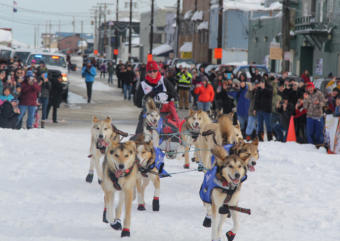
Aliy Zirkle and her team arrive in Nome at the end of the 1,000-mile Iditarod Trail Sled Dog Race on Wednesday, March 13, 2019. (Photo by Zachariah Hughes/Alaska Public Media)
Iditarod mushers will still be finishing on Front Street in Nome next week, but the city of Nome will not be hosting any festivities.

After meetings with state medical officials, the Iditarod Trail Committee announced Thursday that they are postponing the Iditarod Finishers’ Banquet and Musher Meet and Greet.
The Nome Common Council voted to follow suit and postpone all Nome Iditarod events, including the famous annual Lonnie O’Connor Iditarod Basketball Classic, an event that attracts visitors from the across the state and hosts crowds of between 500-800 people in the Nome Recreational Center.
After listening to recommendations from public health officials and hearing testimony from the community, the Nome Common Council reasoned that the precautions were necessary to restrict any potential spread of the coronavirus — not only just within the city, but also especially for rural communities outside of Nome, where Elders may have more limited access to medical care.
Before the Iditarod started, race officials said they planned to step up sanitation this year and distribute information about best practices to avoid getting sick, including washing hands.
The Iditarod confirmed Thursday that there are no plans to call off the race.
Alaska Public Media’s Tegan Hanlon contributed to this report.
Owner of the Kugzruk Kommons, Janice Wilson shares canned salmon and other homemade goods in the community kitchen. (Photo by Emily Hofstaedter/KNOM)
Janice Wilson starts the tour by making tea in the kitchen. “And I love that the kitchen is so large that all the tenants can come in and do as they wish. There’s enough space!”
The Kugzruk Kommons used to be a local Baptist church on 3rd Avenue. That church was built in the traditional medieval style; in the shape of a cross. Now the long vertical arm of the cross has been converted to eleven single-occupancy bedrooms while the shorter, horizontal arm has space for the kitchen, bathrooms, a spacious common area, and laundry. They’re not traditional apartments, it’s more like a boarding house, or as Wilson calls it, “a common house.”
Wilson purchased the space in November and got to construction right away. She had planned to start renting rooms by February but folks around Nome had other ideas.
“And they’re like, ‘no.’ We want to move in now. And I said, ‘OK, if you’re willing!’ All the tenants here are absolutely comfortable and I’m comfortable with them.”
All 11 rooms are already fully booked. That may be due, in part, to an overcrowded region where housing can be hard to find. “We’re sort of locked into what a house, or what an apartment requires. There’s a full spectrum of needs,” said Sue Steinacher, a longtime regional housing advocate and former housing specialist. There’s a need, she says, for all types of housing in Nome: ranging from affordable rent for families, to housing for working professionals. But there can be a range of options to consider.
“It’s the cost of getting materials in. And then it’s the cost of supporting workers if you need to bring workers in. It’s also the cost of expanding the power lines, the sewer system, and the roads.”
The Kommons already had small rooms built-in and is hooked up to city utilities; making it easier to transition from an old church to living units.
Wilson says the Kommons is meant to be a place where someone can show up with just a suitcase. The rooms are furnished with beds, a lamp, and shelves. The kitchen is stocked with the essentials like bags of flour, sugar, coffee, and tea. Wilson says furniture and household donations from the community have helped her go far on a shoestring budget.
The linoleum floors are still being installed as of early January and small bits of furnishing are still coming in. “I’m just so excited for all of it to come together and then people will be able to just come and sit with me during the day or the evening.”
Wilson envisions people coming out of their rooms to spend time watching TV or playing games together. And it’s that sense of community she wants to cultivate. After all, she’s living there too in a converted loft apartment on the third floor.
When Wilson moved to Nome three years ago, she saw that people needed more than just a roof over their heads.
“It’s transitional housing meant for people that are in between homes and that they can find someplace before they find a home in Nome,” she said. “I want people to come in and see what it feels like to be loved and cared for and in a home that provides all the necessities so that when they go to their own home, they can do the same thing.”
She’s especially hopeful that it can help inform some of the young adult residents who haven’t yet had their own home to run.
The Kommons aren’t funded by any specific grant so Wilson is paying the mortgage on her own, which means residents do have to be employed. There’s flexibility there too, like with one resident who cleans in exchange for a room.
And although her vision is transitional housing, she says some people have already decided they’re in it for the long haul, and that’s fine with her. The idea was natural to Wilson; it’s how she grew up in her village of Nondalton in the Bristol Bay Region.
“My parents invited people to stay with us and get back on their feet and when they did, they took off! It’s kind of something I’ve done my entire life and now I’m doing it again.”
This is a lifelong dream for Janice Wilson, who is Inupiaq and Athabascan. As the building became a reality, she immediately saw a way to honor the region and her family who inspired her.
“The name comes from my mother’s side of the family. It is her maiden name, which came from the Northern region of the Bering Straits: Wales and Shishmaref. Kugzruk Kommons just flowed with me. It was one of the first names that came to mind, it was perfect!”
Wilson has more dreams for housing in Nome, but for now she’ll focus on laying down the linoleum inside the Kugzruk Kommons.
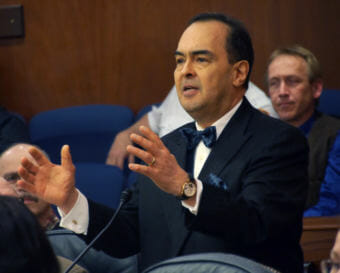
Sen. Donny Olson, D-Golovin, speaks at the Alaska Legislature, April 15, 2016. (Photo by Skip Gray/360 North)
One Alaska state senator wants Gov. Mike Dunleavy to ask President Donald Trump for an extension of the REAL ID deadline, as well as additional funding for outreach in rural communities.
Sen. Donny Olson, D-Golovin, wrote to the governor on Dec. 31, saying that both Dunleavy and Trump have a responsibility to ensure the ID mandate is implemented properly so as not to infringe upon Alaskans’ rights to travel.
As of Oct. 1, 2020, a REAL ID or other acceptable identification, such as a passport or a Bureau of Indian Affairs card with a photo, would be required for commercial air travel and to enter federal buildings or military bases.
Alaskans in remote communities sometimes rely on air travel for medical appointments. Olson said they’re concerned.
“Let’s say that somebody out of Shishmaref or Savoonga goes ahead and gets medevaced straight to Anchorage,” he said. “If they get down there and don’t have a REAL ID, they will be prohibited from getting on the jet to go back to Nome and go back to their respective villages.”
Alaskans are not able to apply for a REAL ID by mail, meaning many village residents, like Olson himself, will have to fly to their nearest Division of Motor Vehicles location in hub cities such as Nome or Bethel.
“So here in Golovin, to get to Nome it’s $190,” Olson said. “That’s $380 round trip.”
Olson’s letter follows a December announcement from Administration Commissioner Kelly Tshibaka asking for $60,000 to create a rural outreach program to help rural Alaskans obtain the REAL ID.
In his letter to Dunleavy, Olson calls the REAL ID mandate “unwanted,” writing that the state should be doing everything possible to reach out to every rural Alaskan to be REAL ID compliant by the Oct. 1 deadline. He suggests a rural outreach program where officials would make multiple visits to villages.
Gov. Mike Dunleavy’s budget proposal for fiscal year 2021 includes funding for 15 additional Alaska State Trooper positions including one in Nome, one in Unalakleet, and potential new posts in St. Michael, Ambler, and Anchor Point on the Kenai Peninsula.
Troopers are the first responders in some of those communities, like St. Michael, although they are not currently based there. St. Michael’s only option for local law enforcement is the Village Public Safety Officer program, but their VPSO position is currently vacant.
In the fiscal year 2020 budget, Dunleavy cut $3 million and 8 positions from the VPSO program, citing an inability to fill authorized vacancies. His proposed budget for the next fiscal year does not include additional funding for the VPSO program.
After the current year’s budget passed in June, which did not include any funding for new trooper positions, trooper Col. Barry Wilson said the new proposal is a good start.
“There’s a lot of need for additional positions but we know that we can only fill a certain amount over the year because we have retention, and recruitment,” Wilson said.
In the proposal, the Dunleavy administration acknowledges that many rural Alaska areas depend on troopers for law enforcement and that current trooper staffing levels delay responses to violent crimes, including sexual assault and murder. The administration now believes the troopers’ recent recruiting success requires budgeting additional positions. Wilson agreed.
“We had up to 42 vacancies recently. That’s a lot of vacancies for us to be carrying and it’s very hard on people to work in that environment,” Wilson said. “We’re starting to see the light at the end of that tunnel. We’re starting to see a future that’s much brighter than what we’ve seen in the last five years. If you’d given me positions last year, I couldn’t have filled them. This year? I think we can fill them by the end of FY 21.”
With recruitment and training, Wilson said it takes about two years to make a new state trooper. He also stressed that this is an early proposal, subject to change by the Legislature.
While most of the governor’s proposed budget remains relatively flat compared to the last budget, under the proposed budget, the Department of Public Safety would get 7.5% more funding. Nearly $7 million is proposed for hiring 31 Department of Public Safety positions, which includes the 15 troopers.
The proposal calls for two troopers for Ambler, two for Anchor Point, one in Bethel, one in Dillingham, one in Emmonak, one in Glennallen, two in Kotzebue, one in Nome, one in St. Mary’s, two in St. Michael, and one in Unalakleet.
Close
Update notification options
Subscribe to notifications
Subscribe
Get notifications about news related to the topics you care about. You can unsubscribe anytime.