KNOM - Nome

KNOM is our partner station in Nome. KTOO collaborates with partners across the state to cover important news and to share stories with our audiences.

‘Pulse’ of marine debris in Bering Straits likely coming from Russia

Empty milk bottles that washed up in the Bering Strait Region within the last few weeks. (Austin Ahmasuk, courtesy Alaska Sea Grant)

An influx of empty bottles and potentially hazardous marine debris have washed up in communities across the Bering Strait region. The consensus from those involved in the cleanup process is that the debris is coming from the other side of the strait.

Robb Kaler, a biologist with the U.S. Fish and Wildlife Service, recently shared a collection of reports and observations from at least five different communities in the Bering Strait region. Those include Diomede, Wales, Shishmaref, Gambell, Savoonga, Unalakleet and Nome. All of them found unusually high amounts of marine debris and trash along the beaches of Western Alaska.

“A lot of water bottles, but some of it butane, some of it penetrating oil — really not good things. And you can see that the writing is not U.S. writing on these. So that increased vessel traffic, I think it’s important to somehow outreach and make sure they understand that our folks that are fishing on the other side of the [Bering Strait], that they know not to be dumping,” Kaler said.

Some of those reports came from regional residents like Erika Apatiki of Gambell. She picked up marine debris with her mother on August 3 near an important subsistence area. Apatiki says she has seen some trash wash up on the coast of Gambell before, but not on this scale.

One stretch of Gambell’s coastline near an important subsistence area, littered with blue plastic wrappings and other marine debris. (Erika Apatiki, courtesy Alaska Sea Grant)

“It’s actually pretty heartbreaking, especially since we see on the media that the whales are dying…from plastic pollution, all over the world,” she said.

After one day of picking up trash on a 3-mile stretch of beach, Apatiki filled up roughly 19 40-gallon trash bags. She said the beach was mostly littered with blue plastic wrappings for filleted fish with words written in a foreign language on them, which she thought might be Russian or Korean.

Then in Nome, Austin Ahmasuk of Kawerak collected a sizable amount of trash on his own earlier this summer. Ahmasuk preferred not to comment for this story, but Gay Sheffield with Alaska Sea Grant summarized his efforts and observations from his time traveling in the Nome area.

“So Austin went from Sinuk River back to Nome and had 124 different items [in total]. He picked up about 75 that he had in trash bags, and we went through each one… it was shocking.”

When looking at vessel traffic in the Bering Strait recently, there have been significantly more fishing vessels and tankers traveling along the coast of Eastern Russia than there are in Western Alaska. Kawerak Inc. believes the increased vessel traffic is at least partially to blame for the influx of marine debris.

In the tribal consortium’s letter to the U.S. Coast Guard, Kawerak said, “residents in our communities have taken it upon themselves to become first responders and despite efforts to reach out to the National Oceanic and Atmospheric Administration’s Marine Debris program, and the U.S. Coast Guard, it seems as though responding to this event has not been adequate to meet our concern and we are having to bear the cost of cleaning our shores ourselves.”

Jacob Martin, the tribal resources director with Nome Eskimo Community, has been facilitating a beach cleanup program every summer since 2017. Martin says the program is funded through an Environmental Protection Agency grant, and with that support they’re able to clean up most local and close recreational areas around Nome, the Nome River and various beaches.

He noted that Nome Eskimo Community only found one bottle with foreign writing on it this year, and the amount of trash seems to have slightly declined this summer compared to previous years. However, Martin also points out that more members of the public have picked up trash recently, and they could have collected other items.

Peter Murphy is the Alaska Coordinator for NOAA’s Marine Debris program. He says the network of agencies and individuals involved in responding to the recent marine debris in the region is still gathering more information to determine the source of the trash. However, Murphy suspects this is related to a large amount of debris released in one place and time.

“A lot of what we’re seeing in this pulse right now, that’s been reported, are relatively really fresh items. So, the labels are clear, the writing is clear, they aren’t weathered. Whereas the items that would’ve come from previous events or just what is unfortunately, chronic everyday debris that’s already out in the ocean and circulating, that’s going to look different. It’s going to be more faded, it’s going to be harder to distinguish.,” he said.

Kawerak, along with several communities in the Bering Strait region, have urged the Coast Guard to investigate the source of this marine debris and enforce national and international rules governing the dumping of plastics into the world’s oceans.

COVID-19 cases confirmed in St. Lawrence Island communities

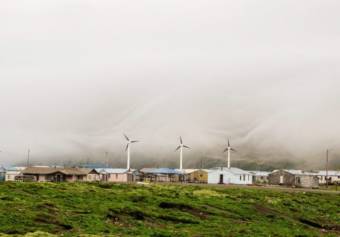
An overview of Gambell, Alaska. (KNOM file photo)

A person in Gambell has tested positive for COVID-19, the Norton Sound Health Corp. confirmed in an email Aug. 18.

KNOM has previously reported on other cases in unspecified Norton Sound communities, but this is the first Gambell case publicly confirmed by NSHC.

According to NSHC, the latest patient was tested because they were a close contact of the case reported in Savoonga Aug. 16. State epidemiologists will investigate the case and their close contacts, but NSHC believes the cases from Savoonga and Gambell are connected.

NSHC did not give a cause for the Savoonga case initially,  but they now say the Savoonga and Gambell cases both might have resulted from travel.

NSHC says they do not suspect widespread community transmission on the island, but they do recommend people in the Norton Sound region continue to maintain social distance, wear face masks in public and wash their hands frequently.

Community leaders in Gambell are encouraging residents to get tested and practice safety measures.
NSHC says that Norton Sound residents outside of Nome should call their local clinics to arrange a COVID-19 test — but results may take longer because they are conserving rapid tests.

COVID-19 restrictions spark food security concerns in Western Alaska

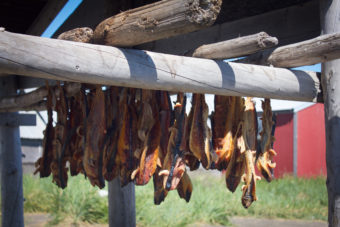
Salmon drying in Stebbins. (Photo by Emily Russell/KNOM)

Western Alaska communities have been restricting travel between villages to control the spread of the coronavirus. But in places like Stebbins, that also makes it harder to get groceries.

Stebbins residents typically have to drive to nearby St. Michael, which has an Alaska Commercial Company Store — called the “AC Store” — for groceries. A 12-mile road connects the communities in summer, but when both villages reported positive cases of COVID-19 last month, the road was closed.

Ward Walker is the incident commander for the Stebbins IRA and City of Stebbins.

“It was a little bit of a hardship while the road was closed, but I think we managed to get through it,” said Ward Walker.

The road was closed for about three weeks. After monitoring local spread of COVID-19, the community response teams decided to re-open the road at the start of August.

Walker says they certainly lost a variety of options, in particular their selection of fresh food. But he doesn’t think the community of Stebbins experienced a true food shortage.

“I actually set up that system so that people could purchase food in St. Michael for those three weeks and then have it delivered to the check-point,” said Ward Walker.

While the road was closed, Stebbins residents could go to the border between the two communities and pick up their food orders along the road. But as one Stebbins resident told KNOM, that’s only useful for people who are able to drive the nine miles to the checkpoint.

Shelley Pete, the general manager of the Stebbins Native Store, thinks the community would have had a food shortage without online shopping or the AC store in St. Michael. The only grocery store in Stebbins is operated by ANICA Inc., and Pete says many residents travel to St. Michael because the local Native store struggles to stay stocked. ANICA Inc. did not respond to KNOM’s request for an interview.

Pete said empty shelves were a common sight in Stebbins even before the coronavirus began.
“By the time I send in my order, usually come in four or six, maybe seven days,” he said. “But for my last order it’s been a week overdue, sometimes two weeks overdue until I put in another order.”

Pete isn’t sure if those delays are related to having fewer workers in the warehouses in Anchorage or Unalakleet.

Their food orders come in through all of the regional cargo air carriers, but earlier this spring, Stebbins also lost the service of RAVN Air as a source for cargo and passenger service. Even when they were serviced by many air carriers, Pete says the store still received shipments of moldy produce or food that had thawed out and gone rancid.

With empty food shelves and expensive prices in village stores, it’s difficult for regional residents to prepare for a two-week quarantine by relying on local goods. In Stebbins, resident John Rivers told KNOM that he isn’t relying on the grocery store if there’s another lockdown. Rivers has a freezer he keeps filled with subsistence food instead.

The situation in Stebbins isn’t exactly unique either. On the western side of the Seward Peninsula, many Teller residents travel the 72-mile Nome-Teller highway to purchase groceries and fuel in Nome. The community of less than a hundred is experiencing what Norton Sound Health Corporation considers a small outbreak of the coronavirus. So NSHC responded by sending in care packages as incentives for locals to get tested.

“Those included some grocery food supplies,” said Reba Lean, NSHC’s public relations manager. “Typical grocery items things like eggs, potatoes, peanut butter, snacks. Keeping everyone in the community is just a really good idea right now.”

Both Teller and Stebbins are communities without running water and have received shipments of hand sanitizer and cleaning supplies to deter spread of the virus. Lean said NSHC is prepared to help other Norton Sound communities that experience outbreaks of the virus or whose stores close if workers become sick.

Mysterious Bering Strait seabird die-off enters fourth year

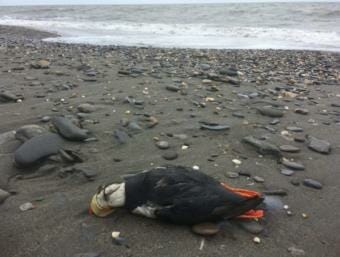
A dead Puffin found along one of the beaches of Nome in June, 2020. Photo from Gay Sheffield, used with permission.

Reports and observations of dead seabirds on the shores of Western Alaska increasingly point to another large die-off in the Bering Strait region.

Robb Kaler with the U.S. Fish and Wildlife Service says the summer’s first report from the region was about a dead murre found in Nome around June 2.

“That was a little bit later fortunately then we’ve been getting reports from Gay [Sheffield] from the Bering Strait region for the previous two or three years,” he said. “We were hopeful that maybe it wasn’t going to be another die-off year, but…”

This would be the fourth consecutive year of die-offs for the region, and six years in a row for Alaska waters as a whole.

According to Kaler, the majority of the roughly 50 deceased birds reported last month were either murres or horned puffins. Most came from Nome, while a couple were found in Shishmaref and on St. Lawrence Island.

Then, during the first two weeks of July, Gay Sheffield of Alaska Sea Grant said she received reports of an additional 60 dead seabirds. Initial test results from a handful of those birds have indicated that all of them were emaciated.

As Sheffield explains, the unanswered question remains why these birds and the hundreds from previous years were starving to death.

“So you have a skinny bird starving. That bird could either not find food, even though he’s healthy and looking for food, or he could be sick with something and not feel like eating. Those are two different avenues. If you start looking at starvation, you really want to know whether it’s a lack of food or if there’s an overlying problem.”

Since residents and scientists are finding multiple species of birds washing up dead in the region, Sheffield says she tends to think that indicates a larger scale issue going on in the Bering Sea ecosystem.

Six dead seabirds on a beach. "Nome, 8/16/19" is written in the sand.
A few species of dead seabirds near Nome, Alaska, August 2019. Photo courtesy of Sara Germain, Alaska Department of Fish & Game.

Scientists with the USFWS and the U.S. Geological Survey are still testing seabird carcasses to try to answer that question. Kaler says they are testing for a host of things like infectious diseases such as Avian flu and biotoxins from harmful algal blooms. So far, infectious disease seems to have been ruled out for these particular seabirds.

Meanwhile, residents of the Bering Strait region continue to rely on the birds and their eggs for subsistence.

Brandon Ahmasuk, Kawerak’s vice president of natural resources, says it’s alarming for the region to see large numbers of dead seabirds for this many years in a row, and he says it seems that less harvesting is happening this year.

“So normally my family will go out to Sledge Island and get a cooler full of murre eggs. And I think this year my brother got one. Other communities, like Diomede, had very little egg harvest. So when you combine those two things and think about how that affects everything, then it gets scary.”

This summer could have been an opportunity to shed some light on this mysterious series of die-offs, but now, due to the coronavirus pandemic, essentially no outside research vessels will be coming to the region.

Sheffield says despite this survey setback, the Bering Strait region won’t be left floundering.

“Lack of scientific data in a region does not mean there’s a lack of knowledge. Our communities in the Bering Strait region utilize the seabirds every year, spring and fall, for food…When people are calling in with information that is not normal, that is immediately a highlight to me that we need to get an answer.”

While the region awaits more test results and answers from the federal agencies, Sheffield encourages Bering Strait residents to report any dead seabirds or unusual observations they find this summer.

Luxury adventure cruises to the Arctic aren’t going to happen this year either

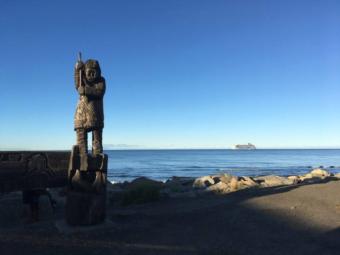
The cruise liner Crystal Serenity anchored offshore at Nome in 2017.
The cruise liner Crystal Serenity anchored offshore at Nome in 2017. (Photo by Gabe Colombo/KNOM)

There will be no cruise ships coming into Nome in 2020 after recent federal and international travel regulations have made those Arctic trips impossible.

As of late June, there were three voyages of the National Geographic vessel Orion still holding out to stop in Nome during the coming months. But now, Nome’s Port Director, Joy Baker says no cruise ships will be docking here this year.

“For the first time since the early 90s we are without a cruise ship for the summer and it’s unfortunate because the city [of Nome] was hoping to see at least a few before the end of the year after all the COVID requirements were worked out,” she said.

This year would have been a big year for cruising in Nome with fourteen ships originally scheduled to make port. But then the Centers for Disease Control and Prevention extended their international no-sail order until July 24. And most of the ships coming to Nome have to stop in Canada as part of their itinerary, but Canada has banned ships with more than 100 passengers until at least October 31.

Baker says that Nome’s local travel regulations have nothing to do with the canceled ships. She reiterated that it was, “completely out of our [Nome’s] hands.”

While most cruises around Alaska have long been canceled or postponed, Nomeites still had some hope for the local cruise season because it looks so different in Western Alaska than in other parts of the state.

The cruise ships coming to this region tend to be smaller luxury adventure cruises that stop in Nome either in August or September. That timeframe potentially allows tourists a glimpse at sea ice as they travel through the Northwest Passage or the Chukchi Sea.

Despite the disappearance of cruise traffic, Baker says other summer businesses in Nome have been booming.

“The cargo, gravel and fuel industry are moving along as if nothing has changed. We’ve been extremely busy with gravel. We’ve had a few more cargo vessels than normal and the fuel just started coming in. We’ve got more fuel coming next week,” she said.

Research vessels coming into Nome this summer have slowed and most of those have been canceled for the year, but Baker says there are some vessels that have made arrangements to continue working safely during the COVID-19 pandemic.

Fishing seems to be slower Baker notes, but she suspected fishing vessels might return in greater numbers when the halibut fishery opens. Norton Sound Seafood Products is not buying Norton Sound Red King Crab this summer and that could be another reason there are fewer fishers on the water.

Baker is hopeful that cruises will resume their stops in Nome for the summer of 2021.

Census officials say they’ll count all rural Alaskans, but workers on the ground aren’t so sure

2020 Census materials including envelope and plastic bags for leaving census forms
2020 Census materials distributed by this year’s enumerators. (Davis Hovey / KNOM)

A handful of Census workers in rural Alaska are running out of time to count the tens of thousands of people living off the road system. But U.S. Census officials say the 2020 Census is transitioning into the next phase which will follow up with those who have yet to be counted.

“Update leave” is the name of the counting phase some rural Alaskan communities are in, as Sue Steinacher, one of the two Census workers based in Nome, explains.

“We are confirming where the residential homes and units and apartments are and adding any new ones – so that’s the updating part,” she said. “The leave is simply once we’ve entered the code for each unit, we leave the Census form in a plastic bag on the doorknob or wherever we think they’ll see it.”

The COVID-19 pandemic has created extra challenges for the 2020 Census, even as the government moves forward with its plan to release final counts in the spring of 2021. Steinacher said she is concerned about how many rural Alaskans will actually get counted.

“We are not actually knocking on people’s doors and completing the questionnaire with them. We are asking them to take this questionnaire that we have delivered and to complete it,” she said.

Earlier in the year the Census planned to count rural Alaskans in person, by going door to door with enumerators. But now, the Census’s Tribal Partnership Specialist for Alaska, Donna Bach, says they are relying on this updated leave process to count people during the summer subsistence season.

“Which impacts a lot of the regional hubs similar to Nome – like Bethel, Utqiagvik, Kotzebue,” she said. “Those are considered update leave areas where we know a lot of Alaskans generally receive their mail through a P.O. box. They fall into a special enumeration category because most people don’t receive their mail at a physical address.”

For these update leave areas across Alaska, local Census workers have until July 6 to count their entire community in person.

Danielle Slingsby, the other Census worker in Nome, is almost certain they won’t meet that deadline locally.

“So we’re trying to educate and advocate to as many people as we can to say it is likely we are not going to get to everyone, it is highly possible, in fact I can guarantee it, that we will not get to everyone,”‘ she said, adding that that will mean less federal revenue coming into the region.

Bach expects that more Census workers will be employed in rural hubs like Nome later on this summer as the Census is currently accepting more job applications for enumerators.

Regardless of how many people are counted by next week’s deadline, the Census will transition into the next phase called non-response follow-up. Bach explains this is only meant to count people who have not responded to the Census.

The nonresponse follow-up phase in Alaska starts in August and lasts until October 31. Again, Bach reiterates this nonresponse follow-up phase is only for those residents who have not filled out a Census questionnaire online nor the paper document left on their door.

According to Bach and the Census website, regional communities in remote areas throughout the state have already been counted, for the most part. However, they had to rely on tribal leaders in those communities instead of hired Census workers.

Bach notes there are still about 15 villages in Alaska that have yet to be counted, but those are expected to be completed soon.

As of July 2, Bach says less than 50% of Alaskans have responded to the Census questionnaires, which includes only about 17% of Nome’s population.

Site notifications
Update notification options
Subscribe to notifications