KUAC is our partner station in Fairbanks. KTOO collaborates with partners across the state to cover important news and to share stories with our audiences.
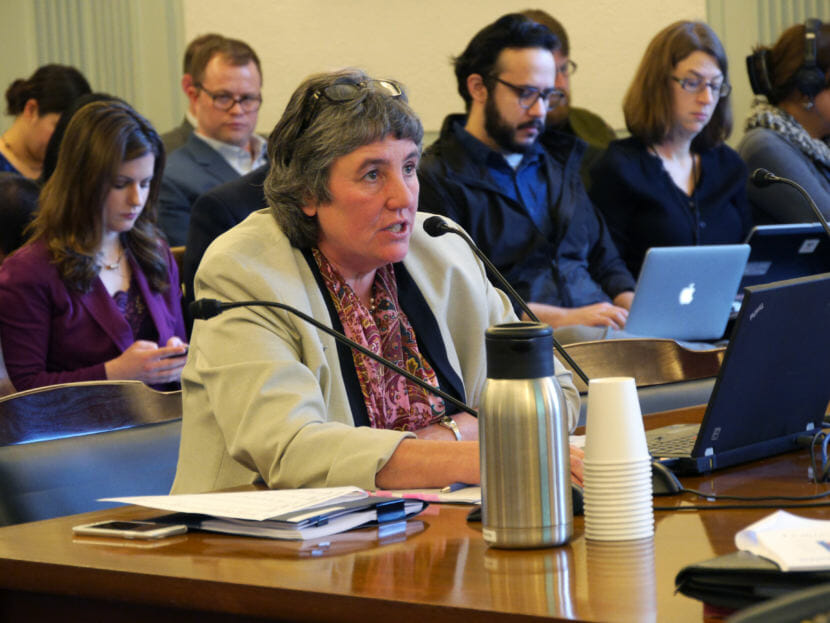
University of Alaska President Pat Pitney at a 2016 Senate Finance Committee meeting when she was the state budget director. (Photo by Skip Gray/360 North)
The University of Alaska Board of Regents has upped President Pat Pitney’s status from interim to permanent. Regents unanimously voted for the change on Feb. 25 at the end of a 2-day board meeting.
Regents Chair Sheri Buretta congratulated Pitney, noting the historic significance of shifting status from interim to permanent University of Alaska president.
“It’s taken over a hundred years, but you are the first female in that role for the university,” she said.
Pitney is a long-time University of Alaska administrator and former state budget director who was called on to fill in as UA president after the resignation of Jim Johnsen in summer of 2020.
Buretta thanked Pitney for helping the university navigate the past 2 years, during which it dealt with major state budget cuts and the Covid 19 pandemic.
“This is a time for forward momentum and celebration of our progress in getting through some difficult challenges,” she said.
Speaking to the regents following Friday’s vote to change her status from interim to permanent, Pitney called the appointment a true honor.
“I’m humbled to be able to represent this great university system and the faculty, staff and students who are engaged,” she said. “I will continue to focus on building team, and that’s team among our universities, that’s teams within our universities and that’s teams with industry, the legislature and the executive branch.”
Regent’s move to make Pitney UA’s permanent president was not without controversy, as faculty, staff and student governance groups all had passed resolutions opposing the action. The resolutions did not take issue with Pitney, but with the regent’s failure to follow precedent and policies regarding governance groups’ participation in the decision-making process.
UA Coalition of Student Leaders chair Shanone Tejada questioned the regents’ action.
“The board has talked about turning the corner and moving together as a university,” he said. “But there is no togetherness if the board acts unilaterally and in disregard for governance groups.”
Regents countered that the current situation is unique because of Pitney’s qualifications, track record, wide-based support and the added sway they said that making her the permanent president would provide as she advocates for the university during the remaining months of state legislative session.
Correction: An earlier version of this article gave the incorrect gender for Shanone Tejada.
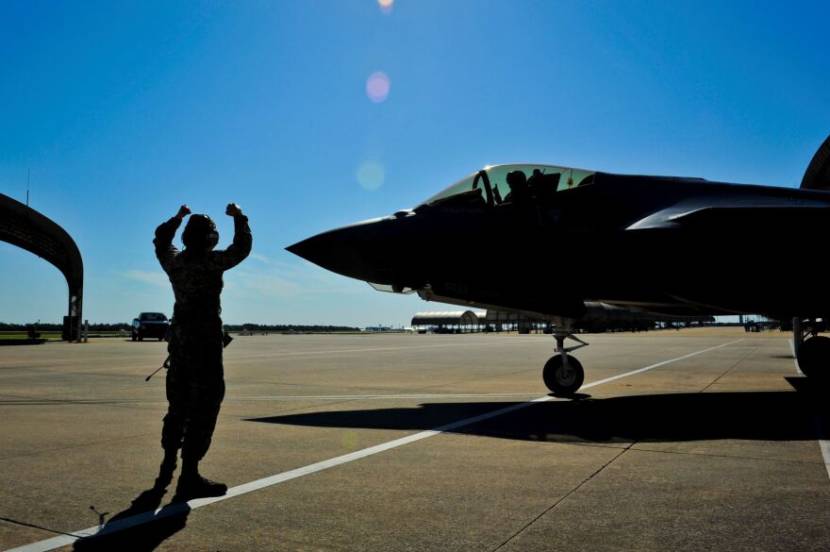
An F-22 taking off from Joint Base Elmendorf-Richardson during exercises in 2015. (Photo by Zachariah Hughes/Alaska Public Media)
U.S. Defense Secretary Lloyd Austin has ordered another 7,000 troops to Europe Thursday to bolster NATO member nations in response to Russia’s invasion of Ukraine. But Army and Air Force commands based in Alaska aren’t sending military personnel nor equipment to support the U.S. response.
Spokespersons for both U.S. Army Alaska and the Air Force’s Alaskan Command both said Thursday that the Pentagon has not directed their commands to contribute to the U.S. response.
According to the New York Times, the order to deploy the First Brigade of the Army’s Third Infantry Division will increase the number of U.S. troops that’ve moved closer to Ukraine in recent days to 14,000. And they’ll bring the total number of U.S. troops in Europe to about 100,000.
Sophie Sergie (Photo courtesy of Alaska State Troopers)
The jury deliberated for 20 hours over four days.
To protect the identity of the nine women and three men, Fairbanks Superior Court Judge Thomas Temple read the verdicts out loud:
“Murder in the first degree of SS. We, the jury find the defendant guilty of murder in the first degree of SS dated at Fairbanks Alaska, the 10th day of February, 2022. Sexual assault in the first degree of SS. We, the jury find the defendant guilty of sexual assault in the first degree of SS dated at Fairbanks Alaska this ninth day of February, 2022, signed by the jury foreperson.”
Temple then polled the jurors individually to make sure the verdicts were indeed unanimous.
Steven Downs was an 18-year-old first-year student at UAF in 1993 with no known connection to the Sergie, who was 20 years old and from Pitkas Point.
Sergie had been a marine biology student at the university but had taken the semester off to work and save money. She returned to Fairbanks on the weekend of April 25, 1993 for an orthodontist appointment. She stayed in a friend’s room on one of the women’s floors at UAF’s Bartlett Hall but left to have a late night cigarette.
In the afternoon, Sergie was found murdered in the bathtub off the shower stalls in a restroom down the hall.
Downs lived one floor above. He was never suspected of the crime until 2018, when DNA collected from the crime scene was partially matched to a profile in a commercial genealogy database. That profile was Downs’ aunt. Alaska State Troopers traced the genealogy to Downs, and later got a match on DNA taken directly from him.
Defense attorney James Howaniec responded by text to the Lewiston, Maine Sun-Journal after today’s court session, saying he’s obviously disappointed by the guilty verdict. He didn’t indicate whether Downs would appeal.
“We are obviously disappointed at the verdict. We had a thoughtful jury that examined the evidence over four days. A number of them were clearly very emotional during the verdict. We respect their verdict. It was a very difficult case for all involved. We are going to take a step back and assess Steven’s options from here,“ he said.
The victim’s two brothers listened to the verdict remotely from St. Mary’s, in the Yukon River delta. Older brother Alexie Sergie said that he feels relieved.
“With the DNA, I’m pretty sure it’s the right guy,” he said. ‘Nowadays DNA won’t lie to you.”
Alexie Sergie said he forgave the perpetrator decades ago in an effort towards closure.
“My religion, you know, I’m Russian Orthodox. You’re supposed to pray for all your enemies — forgive them for everything. I forgave him for what he did. But I will never forget.”
The judge scheduled sentencing for Sept. 26-27.
Tanana Chiefs Conference is partnering with the Alaska Native Women’s Resource Center and the Fairbanks Native Association to host a community vigil in memory of Sergie at noon on Friday in front of the Rabinowitz Courthouse.
This story has been updated.
A maintainer marshalls an F-35 on the flightline at Eglin Air Force Base, Fla., in 2015, when the Air Force first began training women pilots to fly F-35s. (Photo by Marleah Cabano/U.S. Air Force)
The Air Force has developed a new device to help fighter pilots urinate during long flights. It’s a challenge that pilots stationed overseas often face, because they routinely fly missions to faraway destinations. That’s why an Eielson Air Force Base pilot helped test the new in-flight bladder relief system — one that’s designed for women.
It’s one of the most basic human functions. But if you’re a fighter pilot strapped into a cramped cockpit flying at 500 knots and headed into a faraway combat zone, the need to pee can become a major concern.
“It might sound like a weird thing to talk about, but … if you’re so focused on that instead of flying the aircraft, it could be a real hindrance,” saysMaj. Nikki Yogi, an F-35 pilot stationed at Eielson Air Force Base.
Yogi knows all about that. Five years ago, when she was a captain flying A-10s, she had a bad experience with an older in-flight bladder relief system that she says was issued a week before deploying overseas. She was able to make it work, with the help of another woman fighter pilot who recognized that the kit was missing some parts.
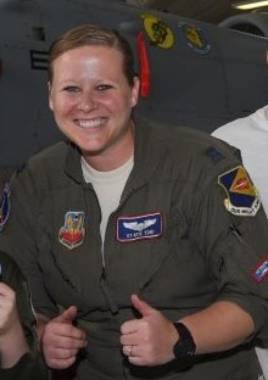
Then-Capt. Nikki Yogi in 2017, when she flew A-10s while assigned to the 354th Fighter Squadron at Davis-Monthan Air Force Base in Arizona. (Air Force photo)
But still, she says, “It did not go very well.”
Yogi said in a recent interview that she had problems with the device in part because the Air Force has only just begun modifying bladder relief devices that until then had been used almost exclusively by men. She says that’s because until the 1990s, only men were allowed to fly combat missions.
Yogi said the first women fighter pilots didn’t want to complain so they wouldn’t be accused of not being tough enough for the job.
“When women first started flying fighters back in the early ’90s,” she said, “it was such a new concept, and there was a lot of eyes on them, and they were just kind of trying as hard as they could for people not to look at them.”
Yogi says that’s why she didn’t say anything about the problems she had with the device. And so she resumed what she had been doing to avoid having to urinate in-flight: She stopped drinking fluids a few hours before flying. But that caused other problems, especially on one particular mission.
“I was dehydrating myself to the point where I was throwing up in the jet, and had to come back early,” she said. “And so I was not ready to take the fight where it needed to be, and what I was tasked to do.”
So-called “tactical dehydration” is common among pilots who can’t use bladder relief devices. But it can reduce combat performance and endurance and tolerance for G-forces. And it also can lead to kidney stones and urinary-tract infections, says Scott Cota, an aircrew flight-equipment expert with the Air Force’s Air Combat Command at Joint Base Langley-Eustis in Virginia.
“So it’s important for us to try to work on these devices so that we can reduce the long-term health effects associated with tactical dehydration,” he said in a recent interview.
“This is really about the health and safety of the aircrew, so they can focus on the thing they need to focus on — which is the mission,” he said.
Omni Defense Tech website image of the Skydrate male and female in-flight bladder relief systems. (Omni Defense Tech Screenshot)
Yogi came to the same conclusion. And with the encouragement of her commander and a realization by senior leadership on the growing need to accommodate women in the service, she and other female pilots, along with a group of both men and women pilots, did some research on bladder relief systems.
“And some of this comes down to – this bladder relief stuff, like it’s not within anyone’s job title to be caring about this stuff,” she said.
After months of testing with Cota’s team and Vermont-based Omni Defense Technologies, the contractor the Air Force hired to upgrade the devices, the pilots recommended a version called the Gen. 3 Skydrate.
Yogi says they the Air Force and Omni’s testing staff really appreciated her real-world experience with older devices. And, she says, “I was really grateful to be able to provide them feedback on the system and then be able to hear about and see some of the new improvements for Skydrate.”
Those improvements apparently impressed Air Force officials. The service got its first shipment of the Skydrate in December, and Cota said they’ve ordered the first batch of 250 that’ll be delivered over the next few months to Air Force bases around the country and overseas – including Eielson.
Yogi says she’s looking forward to using the improved device for her next flight to military training exercises around Guam – a flight that takes about 10 hours.
Sophie Sergie (Photo taken by Joann Sundown on April 24, 1993. Screenshot obtained with the prior permission of the Alaska Court System.)
Content warning: This story contains graphic details from Sophie Sergie’s murder trial that may be disturbing to some readers.
Lawyers in the Sophie Sergie murder trial stepped the jury through evidence and testimony in four hours of closing remarks on Monday.
Steven Downs, 47, is charged with first-degree murder and first-degree sexual assault in the 1993 slaying of 20-year-old Sergie in a University of Alaska Fairbanks dorm.
On Monday, Special Prosecutor Jenna Gruenstein wanted the jury to link the two charges together, telling them the person who committed the rape also committed the murder.
She reminded them of how investigators found semen in the victim.
“Not in her underwear, not on her thighs. Just her vagina,” she said. “Because dead women don’t stand up.”
The defense claimed Downs was with his girlfriend Kate Deschweinetz Lee, at the time of the murder, in her room with other students, drinking and watching movies. But Gruenstein reminded jurors that Lee remembered a particular incident at that party.
“In fact what she said was, he was in and out of her room, that he wasn’t there the whole night, particularly in the very early hours of April 26th. She knew that he wasn’t there because that was when Bill Wilson tried to kiss her. And she knew for sure, Mr. Downs wasn’t in the room when that happened,” Gruenstein said.
The prosecution centered on DNA evidence. Gruenstein reminded the jury that the DNA profile from the semen was a match for Steven Downs, and that all of the alternative suspects raised by the defense were ruled out by their DNA not being on the victim or at the crime scene.
Downs’s defense attorney James Howaniec says semen found in the victim could be from consensual sex. He reminded the jury of testimony from Dr. Norman Thompson, a forensic pathologist, who testified on Jan. 26 about Sergie’s autopsy.
“It would not be surprising to find semen in a dead person who had sex even days before,” he said.
Howaniec said Sergie’s friend Shirley Aklekok testified about she and Sergie having dinner together Saturday evening, and Joann Sundown testified about Sergie visiting her at Wickersham Hall down the hill later on.
“We do not know what Sophie did Saturday night. We don’t know if she went to a party. We don’t know who she hung out with. We do know she had an eclectic group of friends, some of them up on the third floor where Steven Downs lived,” Howaniec said.
The defense focused on problems with the investigation.
Howaniec said James McCann, the lead Alaska State Trooper investigator in 1993, wrote in his notebook about other investigators, housing and medical staff who were called, and custodial staff who discovered the body.
“The crime scene had been corrupted. Some 19 people including students and possibly even the media had been to the bathtub scene before Jim and his team arrived,” he said.
He reminded jurors that troopers and UAF police were frustrated by not having enough people to investigate.
“There were 777 students in the three-dorm complex, but they only got to interview a small fraction of them,” he said.
The defense asked the jury to question the DNA evidence. Howaniec criticized the chain of custody of samples from the autopsy and crime scene.
“How confident are you in these DNA results? Did the state make their case on the DNA? You feel confident about these samples that were collected back in 1993?” he asked.
Howaniec said the state never connected Downs with the murder weapon, saying none of the guns Downs ever had was connected to shooting Sergie.
“Some of them like Nick, who became lifelong friends, paint a picture of a happy, well-adjusted kid from Maine. Nick testified that he could never in a million years fathom that Steve could have done something like this,” he said.
Vicky Persinger at the Fairbanks Curling Club in 2016. (Indie Alaska screenshot)
Fairbanks curler Vicky Persinger and U.S. mixed doubles teammate Chris Plys of Minnesota did not advance to the medal round at the Olympics in Beijing.
Persinger and Plys lost their final four matches in round-robin play, finishing with a 3-and-6 record and placing 8th out of 10 teams. Only the top four teams qualify for the semifinals.
The Star Tribune reported that Persinger and Plys lost 6-5 to Switzerland on Sunday night, eliminating them from metal contention. On Monday morning, they finished the round-robin play with an 8-4 loss to Great Britain.
While this year’s Olympic competition is over for Persinger, Plys is also a member of the U.S. men’s curling team, which begins play on Wednesday.
Close
Update notification options
Subscribe to notifications
Subscribe
Get notifications about news related to the topics you care about. You can unsubscribe anytime.