KUAC - Fairbanks

KUAC is our partner station in Fairbanks. KTOO collaborates with partners across the state to cover important news and to share stories with our audiences.

Deep snow is forcing bison onto the Alaska Highway

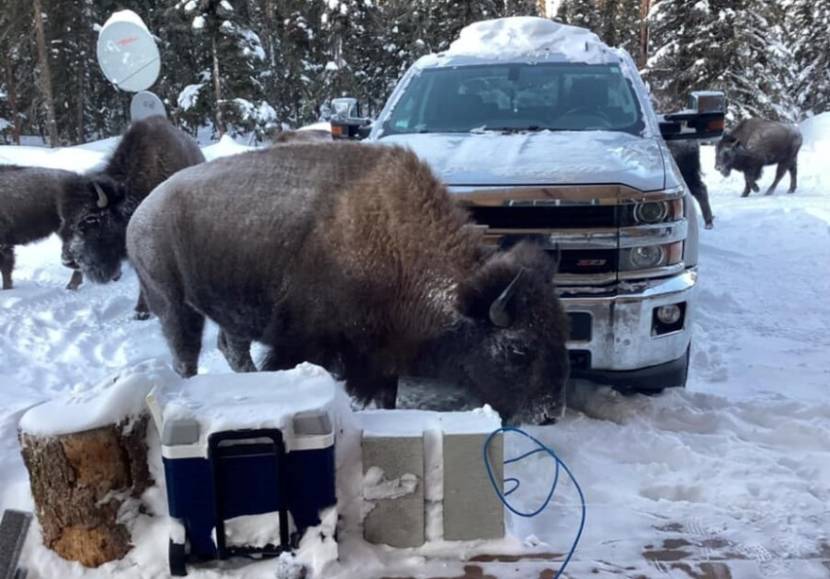
A bison standing in front of a parked truck in a driveway, with more bison in the background
A half-dozen bison looking for food wandered into the driveway of Elena Powers’ home on Spruce Road in the agricultural area south of Delta Junction last month. (Courtesy of Elena Powers)

Bison have been spending their winters in the farmlands near Delta Junction for decades. But this year’s deep, icy snow pack has forced the animals to forage at farms and travel on roadways. And that’s put both the bison and drivers at risk.

A video making the rounds on YouTube illustrates what can happen when vehicles encounter bison on a roadway. It shows how, with no other way to get around the vehicle except through deep snow off the sides of the road, the bison charged and trampled over the top of a car.

The car was seriously damaged, but the driver reportedly was OK. Neither he nor the person who recorded the video could be reached.

An Alaska State Trooper spokesperson says the agency hasn’t gotten any reports of bison-related wrecks. But Delta Junction-based state Fish and Game Department wildlife tech Clint Cooper says he’s gotten at least two reports of run-ins between the animals and vehicles, one of which killed a bison.

“They’re having a tough time right now, getting through that ice crust and getting to their normal forage,” he said in an interview last week.

Cooper says the December storms that dumped snow and then rain on top have made it very hard for the animals to move around and forage.

“The bison are sticking to the road more, more so than normal, that’s for sure,” he said. “They’re doing whatever they can to stay out of that snow with that crust on the top.”

Cooper says it’s tough for bison and other wildlife to slog through three or four feet of snow. And he says the two-inch layer of ice inflicts injury as they break through it and then lift their legs back up and out of it.

“It’s painful,” he said. “It’ll scrape and cut up their legs when get through that ice.”

So the bison are taking to roadways around the agricultural area south of Delta Junction, including the Alaska Highway and side roads like Barley Way, where the car-trampling incident occurred.

“There’s been quite a few folks that’ve expressed some concern about the bison being on the roads,” Cooper said. “And I’ve talked to a few people who’ve had some damage to their vehicle.”
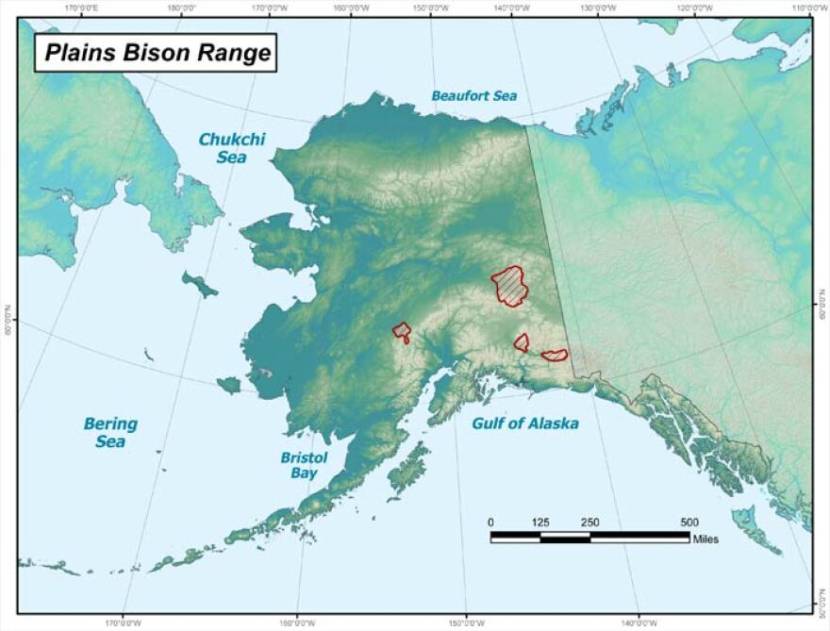
A map of Alaska showing the range of the bison
The 300-head Delta Bison Herd is descended from a couple dozen plains bison from Montana introduced into the Interior nearly a century ago. The herd, the biggest of four that’ve become established around the region, overwinters in and around the Delta Bison Range south of Delta Junction. (Alaska Department of Fish and Game)

Farmers around the area are accustomed to groups of the Delta bison herd barging through fences and hanging out in fields and other cleared areas during the winter. But Cooper says this year, with the lack of natural forage, farmers have told him the problem is even worse.

“Anywhere they are able find some hay, they’re trying to get to that,” he said.

Cooper says that in response, Fish and Game and the state Forestry Division are working together on a project to clear some paths and forage areas in the 90-thousand-acre Delta Bison Range.

“Forestry brought down a D7 bulldozer from Fairbanks, and they were planning to do some habitat work out on the Delta Bison Range,” he said. “And so we were able to take that dozer and have him redirect his efforts and have him plow some snow and break through some of that crust.”

Cooper says Fish and Game thinks that’ll give at least some of the bison another place to forage. He says in the meanwhile, area residents should be on the lookout for bison on the roads. And he says if they encounter them, drivers should either just be patient and give them time to move away. Or, if they must get by the animals, motorists should proceed slowly and give them a wide berth.
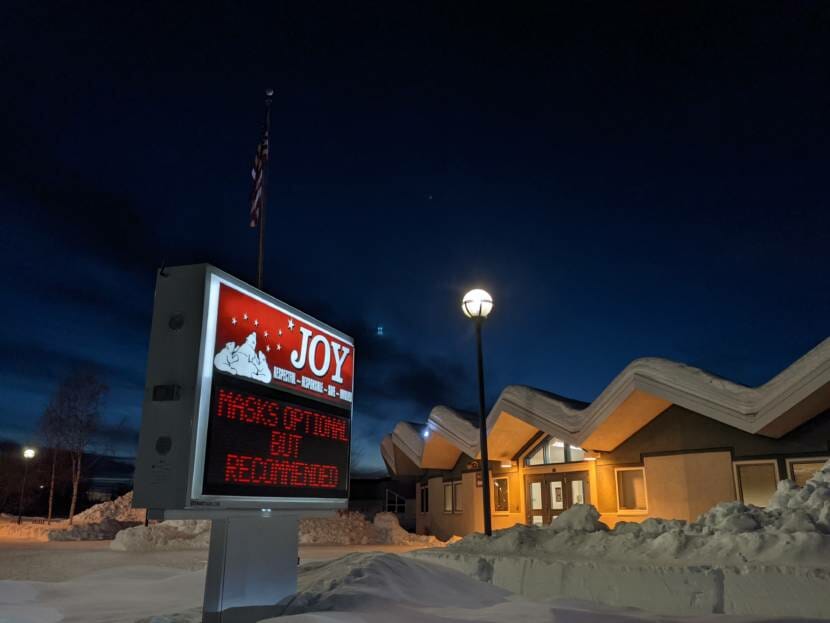
3 elementary schools to close in Fairbanks area due to low enrollment, budget challenges

Joy Elementary School in Fairbanks. Photographed Wednesday, Feb. 2, 2022. (Lex Treinen/Alaska Public Media)

The Fairbanks North Star Borough school board has voted to close three elementary schools because of declining enrollment and as a way to save money.

The school board narrowly approved the changes at a Tuesday meeting, where it also approved adjusting the district’s middle school format. Numerous people testified opposing the changes.

The three schools that will close are Joy and Nordale elementary schools in Fairbanks and Anderson Elementary School on Eielson Air Force Base. Students will be moved to nearby elementary schools, according to the district.

“Closing a school is not something that school districts do very often,” the district said in an online statement. “It can have a significant impact on families and change of this magnitude can be difficult. While a school closure will have short-term impacts, the long-term goal is to provide better and more efficient services for students.”

The schools will be closed after the current school year ends, according to a district spokesperson.

The district’s statement says now that it has a direction from the school board it will begin finalizing next steps.

The plan includes the district repurposing Nordale Elementary into a home for alternative learning programs. The district will also restructure district middle schools to encompass grades 6 through 8, while most elementary schools will become K-5 schools.

Many people who testified at Tuesday’s school board meeting said they opposed closing Joy Elementary and repurposing Nordale Elementary. Student Kyler Lanz made a heartfelt plea to save Nordale.

“I’ve gotten comfortable enough at Nordale that I am in the school musical and I play violin in the orchestra. I like these activities so much,” Lanz said. “I am grateful for the opportunity to do them at Nordale. I am grateful for all Nordale has done for me. I want it to stay open.”

Some parents questioned the decision-making process and the targeting of Nordale and Joy, which are Title I schools, a designation based on the percentage of students who qualify for free or reduced-price lunch. Parent Jessica Wagner told the board that Joy also has a high number of special education students.

“Having one of the highest rates of low-income families and numbers of children with disabilities, Joy provides a supportive environment,” Wagner said. “Joy also has facilities that help children with disabilities function and learn life skills. Children with disabilities are highly influenced by any change in their environment and care providers.”

School district officials acknowledged the pain the plan will cause but pointed to a roughly $20 million projected budget shortfall over the next two years. Karen Melin, the chief school administrator, underscored that the district’s budget has become misaligned with its mission.

“In short, we’re funding buildings and not students,” Melin said.

The school changes are projected to save $3 million annually. Melin defended the process the district employed to come up with them, adding that repurposing Nordale for home school and other district alternative education programs presents an opportunity.

“To be visionary as we look to the future of what choice and innovation might be,” she said. “Using a current facility to grow the programs we currently offer, is one step in visioning what the future [of] education for Fairbanks North Star Borough School District might be.”

The district’s statement on the closures said districtwide enrollment has dropped by 2,000 students over the past decade.

“Fewer students in schools reduces the amount of staff allocated to those buildings,” the statement said. “That, paired with the challenge of filling vacancies and hiring highly-qualified staff, leads to fewer educational opportunities for students.”

Board member Mathew Sampson said he’d have preferred to keep Nordale as is, but the priority is teachers.

“To retain the educators and support staff with those funds,” Sampson said at Tuesday’s meeting.

School board member Tim Doran unsuccessfully pushed for each school change to be considered independently, and for the district to come up with firm plans for repurposing Nordale and transitioning middle schools.

“Each of these components has a ramification, and I think we need to have those out in the public,” Doran said.

Doran, and fellow board members Chrya Sanderson and Erin Morotti, voted against the school closure and realignment plan. Morotti offered condolences to disappointed students and parents.

“It’s unfortunate that it’s our most vulnerable students and that we couldn’t come up with a better solution,” Morotti said.

Board members Sampson, Maggie Matheson, April Smith and board president Jennifer Luke voted in favor of the plan. Luke reflected on the vote before adjourning the meeting.

“I just want to say that it’s not easy to lead when times are hard,” Luke said. “These are the times that we have to make really hard decisions.”

The district says it “intends to absorb most staff positions into schools throughout the district. However, final staff numbers will be determined based on actual enrollment and next year’s final budget.”

Some board members anticipated that additional school closures will be required in coming years.

Alaska Public Media’s Tegan Hanlon contributed to this report.

USDA approves Alaska’s industrial hemp plan

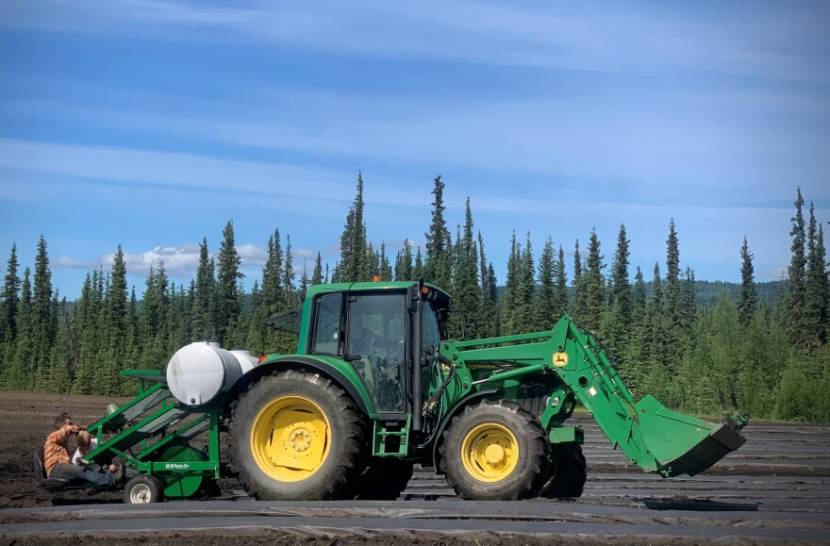
A green tractor in a field with spruce forest in the background
Mado CBD partners Paul Quist and Daniel Ponickly planting hemp seedlings last year at the company’s farm off Cripple Creek. (Photo courtesy of Mado CBD)

Earlier this month, the U.S. Department of Agriculture approved Alaska’s plan to promote and regulate the production of industrial hemp. The head of the Alaska Division of Agriculture says that means Alaska farmers will be able to diversify by growing a different crop that can be made into products that are increasingly in demand here and worldwide.

Hemp is a type of cannabis that only contains a tiny amount of the psychoactive ingredient THC. It’s a versatile plant used for biomass and the manufacture of materials like rope and fabric, as well as for a variety of CBD-based products for things like pain relief, health and beauty.

“This is already a more than 2-billion-dollar-a-year industry,” state agriculture division director David Schade said. “And that’s (expected) to grow exponentially around the world.”

Schade says hemp holds a lot of economic promise for Alaska. And he says the state has what it takes to grow the stuff.

“We have clean water, clean soil, clear air,” he said. “So we can, in the right regions, grow great plants.”

Schade says that’s been proven by nine growers located from Fairbanks to Homer who’ve cultivated hemp on a total of 70 acres outdoors and some 14,000 square feet of indoor space. The cultivation took place as part of a hemp pilot project that was established through a provision of the federal 2014 Farm Bill.

He expects the harvest will grow now that the USDA has approved the state’s plan to promote the industry, as authorized by the 2018 Farm Bill.

“That really opens up the market to Alaska,” he said. “And of course, you get an Alaska Grown label, in the Pacific Rim, that’s going to help sell your product.”

Zoe Quist, a partner in the Fairbanks-based hemp venture Mado CBD, agrees.

“What differentiates our product from a lot of competitors nationally and internationally is that it’s all natural,” she said.

Quist helps run the state’s most productive hemp-growing operation, which is on a family farm near Cripple Creek, just west of Fairbanks. The operation grew 5,000 plants on 6 acres last year, using organic growing methods and no pesticides.

Quist says the harvest will be used to make CBD products that will have greater appeal to health-conscious consumers.

“We are working with a few different companies in-state for different forms of processing,” she said.

Quist agrees that the Alaska CBD market is small, made somewhat larger by tourists and other visitors. But she and her family-member partners were all born and raised in Fairbanks, and they believe they’re doing more than just growing the raw ingredient of a product that’s increasingly in demand by people here and worldwide.

“We hire local people to work on the farm,” she said. “The money stays in the economy. And we just want to put our products in Alaskans’ hands and just keep it a home-grown operation.”

That’s the kind of sustainability Schade says the state is trying to promote through efforts like the industrial hemp program.

“We’re trying to do food security,” he said. “But food security also includes making sure that we have a strong, vibrant economy so that everybody can produce food.”

Investigators testify about losing potential witnesses after 1993 UAF campus murder

""
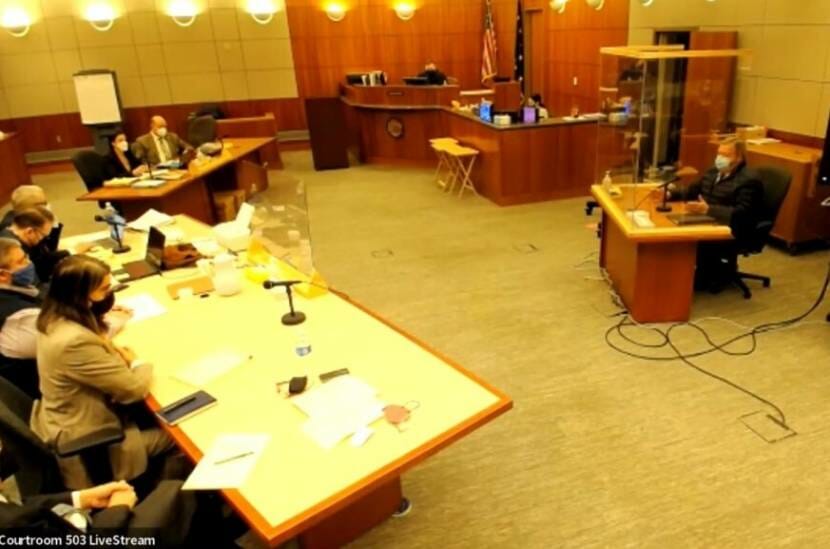
Former Alaska State Trooper Lantz Dahlke (far right) testifies in the murder trial of Steven Downs. Screenshot obtained with prior permission of Fairbanks Superior Court. (Alaska Court System screenshot)

The chaos of students taking finals and then leaving at the end of the spring semester frustrated investigators in the days after 20-year-old Sophie Sergie was found dead on the University of Alaska Fairbanks campus.

That’s according to testimony from Alaska State Troopers last week in the cold case from April 1993, in which former student Steven Downs is charged with Sergie’s rape and murder.

The fledgling UAF police department had summoned help from the Alaska State Troopers on that Monday, April 26, 1993. Trooper Timothy Hunyor said he arrived about 2:30 p.m. and worked to identify the victim, who was found stabbed and shot in a bathroom on one of the women’s floors of Bartlett Hall.

“I just walked around, knocking on the door and trying to find out information from other people,” he said. “They may have known who the victim was, they may have seen her, if they heard anything.”

The university’s housing office reports there were likely 350 people living in Bartlett Hall that semester, and close to 750 living in the three-building complex of Moore, Bartlett and Skarland Halls on top of the hill at UAF. Some of them had finished their final exams for the semester and then left the university for the summer, or for good.

“One of the problems we had, a lot of them, people were not in the dorms or anything,” said Hunyor. “They weren’t there anymore. We had a difficult time trying to contact people.”

Hunyor worked in Fairbanks from 1981 to 1994, and investigated major crimes like homicides. He worked that week with the University Police Department, and with other trooper investigators generally focused on the second floor of Bartlett Hall, where Sergie’s body was found in the bathroom.

Hunyor’s frustration was echoed by testimony from another trooper investigator, Lantz Dahlke, who canvassed all three dormitories that week.

“I thought that for sure, we would find people that saw the activity considering, you know, this is a college campus; people are up all day, all night,” said Dahlke. “But as I said, we had a lot of people leaving the campus. Potentially, we were losing witnesses every day.”

Hunyor testified last Friday by teleconference from Ohio, and Dahlke was in the courtroom in person.

Dahlke told the court that he tried to figure out who might have heard a gun going off in that second-floor bathroom.

“I’ve got a little bit of experience with .22s, and what you do is kind of recreate the sound that that may or may not have made,” he said. “And so, what I did was I went into the bathroom, dropped the stack of books on the floor to create a loud bang. When we did that, I had people out in the bathroom and also out in the hallway and they didn’t even know I did it.”

Later that summer, Hunyor was assigned to investigate another murder — that of Alaska Independence Party founder Joe Vogler. Dahlke said leads dried up in the Sergie murder case, but for him it was never closed.

Steven Downs, now 47, was an 18 year-old first-year student at UAF in 1993, living on the third floor of the dorm where Sergie was killed. The case went cold for decades until 2018, when a DNA profile from Downs’ aunt from a commercial genealogy database was matched to semen found on the victim. Downs is charged with first-degree murder and first-degree sexual assault.

The court has applied strict rules to media recording, giving permission on a case-by-case basis. The court granted prior permission for KUAC to record.

Former University of Alaska Fairbanks janitor testifies in 1993 cold-case murder trial

A night photo of a young woman in a blue jacket smiling and playfully holding her arms out from her sides
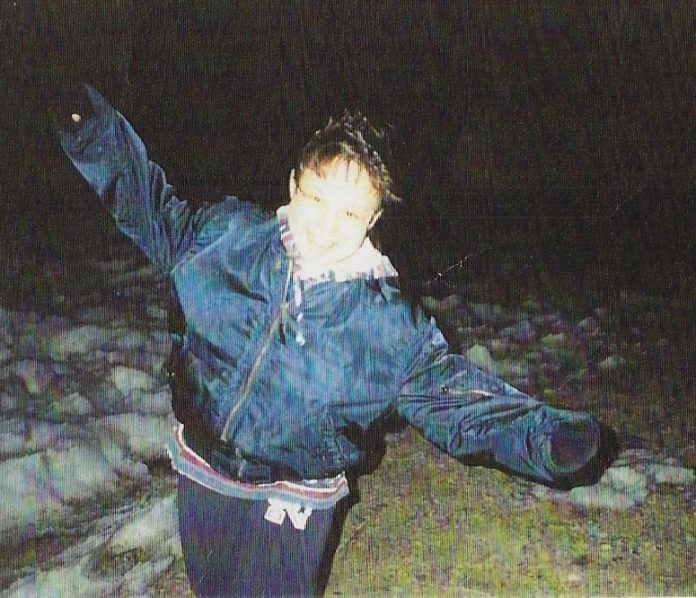
Sophie Sergie (Photo courtesy of Alaska State Troopers)

Content warning: This article contains descriptions of a crime scene that some readers might find disturbing.

The first person who reported seeing Sophie Sergie’s body was janitor Okcha Ancheta.

Ancheta testified Thursday in the trial of Steven Downs, who is charged with Sergie’s murder and sexual assault.

She testified by video conference from Anchorage, telling the Fairbanks Superior Court that she was cleaning the bathroom on the second floor of the University of Alaska Fairbanks’ Bartlett Hall Monday afternoon, April 26, 1993. She said that while her work partner cleaned the toilets, she usually cleaned the shower and bathtub room.

“Some shower room is curtain just open, and some shower room is usually open, but that time was closed,” she said. “And then when I open curtain and then I saw — I was screaming — when I open and then there’s a bathtub, and then I saw a young lady lying down.”

Ancheta said she ran screaming from the tub area. She said her work partner joined her and then went to report what they had seen.

Within minutes, university police and fire arrived at the dorm.

Mitch Flynn was a battalion chief on duty that Monday in 1993, and he arrived at the Bartlett Hall bathroom shortly after other fire and police officers.

“When I came in, I first saw my medic and one of the other medics in there,” Flynn testified. “And when I went into the bathroom, looked to the right, then there was a body.”

He said Sergie’s body was wounded, but he couldn’t tell if the wounds came from a knife or a gun.

Alaska State Troopers also arrived and called the state crime lab in Anchorage to ask for forensic help. During the trial on Thursday, James Russel Wolfe testified that his team flew to Fairbanks and arrived in the evening of April 26.

“The first impression was that it just seemed very clean for a crime scene where blood was shed,” he said.

He testified that their job was to gather evidence.

“And we did a close exam. We looked at the walls, the doors, the toilets went through the garbage containers,” he said.

Wolfe said the forensic team photographed the whole area.

Wolfe was only about halfway through his testimony before court adjourned on Thursday.

Editor’s note: The court has applied strict rules to media recording, giving permission on a case-by-case basis. The court granted prior permission for KUAC to record.

Former UAF students describe what they heard and saw in dorm in 1993 before Sophie Sergie was found dead

A night photo of a young woman in a blue jacket smiling and playfully holding her arms out from her sides
Sophie Sergie (Photo courtesy of Alaska State Troopers)

Prosecutors sought to establish this week if any University of Alaska Fairbanks students who were up late on a Sunday night in 1993, before final exams, saw anything suspicious on the second floor of the Bartlett Hall dorm.

That was where Sophie Sergie of Pitkas Point, 20, was found dead on a Monday afternoon. She had been shot in the back of the head, stabbed in the face and raped. Steven Downs of Maine, now 47, is charged with her murder and sexual assault.

Over the last two days of Downs’ murder trial in Fairbanks Superior Court, prosecutors called on people who are now in their 50s who were UAF undergraduates in 1993.

One of them was Vanessa Allen, a freshman living in the dorm that semester. In her testimony on Tuesday, she described feeling uneasy late the night of April 25 as she entered the bathroom on the east side of the building. She said she saw a light on in the tub room, which she thought no one ever used.

“It was a bathtub area, and it had a door. And I remembered the door was closed and the light was on,” she said. “And that light is never on.”

She said she had a final exam the next morning and wanted to take a shower. She described noises she heard coming through the wall.

“I don’t know if it was, like, firecrackers, or — that’s what it kind of sounded like,” she said.

Allen also described a rustling sound she heard while showering.

Jennifer Roy was also up late that night. In her testimony on Wednesday, she said she was a graduating senior and wanted to keep studying in preparation for an exam the next day.

“I was really tired and was trying to wake myself up, so I decided a shower might help,” she said.

On the second floor of the dorm there were two bathrooms with showers, one on each hallway. The bathrooms were in the middle of the floor and shared a common wall.

Roy said that while she was in the bathroom on the west side, at about 1:30 a.m. Monday, she heard noises through the wall in the other bathroom.

“Because it was the middle of the night, it was quiet,” she said. “And then all of a sudden I heard someone enter into the bathroom on the other side and then enter into the bathtub room. And then suddenly there was a loud thud against the wall.”

Roy described hearing murmuring through the wall, but could not discern distinct voices or tell how many people were in the bathtub room.

“Now, I assumed it was a male and a female, just because of the time of evening. And, you know, sneaking into that little room,” she said.

Later that day, Roy was returning from class and met a janitor in the hallway.

“I had taken my final. I was coming back to my dorm to sleep, and a janitor — she was running out of the bathroom, really upset, said she couldn’t tell me what was happening,” said Roy. “I couldn’t understand her. So she sort of pulled me in to show me. She pulled me into the bathroom room.”

Roy told the jury she and the janitor saw Sergie’s body in the bathtub. She ran to get a resident assistant on the first floor, who summoned law enforcement.

Former UAF Police Officer James French got to the scene about the same time as medics from the University Fire Department.

“I walked into the bathroom first and make sure the scene was safe, not realizing exactly what we had at that point, besides a student that needed medical attention,” said French. “And so I had them respond into the bathroom, once I cleared it, which only took a second.”

Earlier this week, the jury heard Sophie’s brother, Alexie Sergie, describe getting a phone call from Sophie’s dentist on Monday saying she did not show up for her morning appointment — the reason she flew to Fairbanks that spring.

Another friend, Joann Sundown, told the jury that Sergie had visited her on that Saturday night, and they looked through the college catalog together.

And her former roommate, Jolene Nanouk, and friend Eric Newlin told the jury they drove with Sophie and another friend out to see a movie and then up to Murphy Dome on Sunday evening to see a late April sunset and take the photo of Sophie — the image through which many Alaskans know her.

A lot more witness testimony is expected as the trial continues.

The court has applied strict rules to media recording, giving permission on a case-by-case basis. The court granted prior permission for KUAC to record.

Site notifications
Update notification options
Subscribe to notifications