KUAC - Fairbanks

KUAC is our partner station in Fairbanks. KTOO collaborates with partners across the state to cover important news and to share stories with our audiences.

Heavy snowpack in several Alaska river basins raises concerns of possible spring flooding

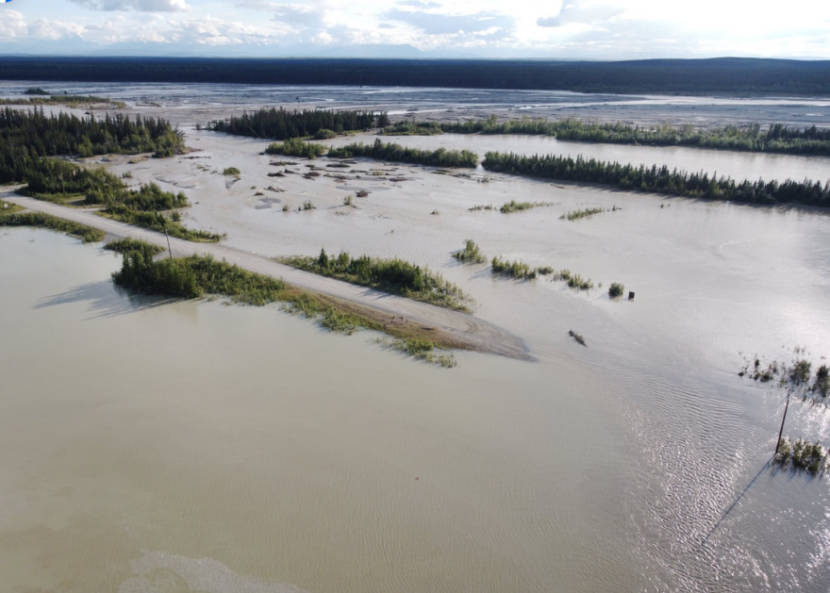
A wide river that has flooded far outside its banks
The runoff-swollen Delta River in 2020, near the confluence of the Delta and Tanana rivers. National Weather Service experts says this winter’s snowfall has created record amounts of snowpack in several river basins around the state. Meteorologists are looking at the potential for a spike in temperatures next month that mould trigger rapid melting and flooding. (KUAC file photo)

The National Weather Service’s Alaska-Pacific River Forecast Center says the Yukon, Tanana, Koyukuk, Kuskokwim and Susitna basins all have more snowpack than usual — and some are well above normal.

“We are having some of these basins with record snowfalls being reported,” says Karen Endres, a senior hydrologist with the weather service’s Fairbanks office.

Endres said in an interview Friday that it’s too early to say whether data from sensors up in higher elevations accurately reflect the entire snowpack in those basins. That will have to be confirmed by overflights and other analyses to be conducted next month.

“We aren’t sure exactly what we’ve got up there,” she said, “but that’s our best guess right now — that we are sitting on a very large snowpack.”

The River Forecast Center says the Tanana Basin, which includes Fairbanks and Delta Junction, registered the greatest above-normal snowpack — about 220% more than usual. The Upper Yukon, in Canada, had about 160% of median; the Middle Yukon, which includes Eagle and Circle was at 190% of normal; and the Lower Yukon, including Ruby and Galena, was at 150% of normal.

“We are concerned with pretty much all of the forecast area,” Endres said.

But snowpack isn’t the only indicator of flooding potential. She says river-ice thickness is another, although so far the data show that’s about normal.

Another indicator is the onset of warmer-than-normal temperatures in late breakup that could trigger rapid melting of snowpack. But Endres says long-term forecasts are inconclusive on whether that might happen.

“Until we get those April numbers that confirm how much snow is up there, and better numbers for what the temperatures might do, we don’t make any real predictions,” she said.

Climate expert Rick Thoman agrees it’s too soon to draw conclusions from data available so far.

“I think the short answer is that at this point, we’re just going to have to wait and see,” says Thoman, a climate specialist with the University of Alaska Fairbanks’s Alaska Center for Climate Assessment and Policy.

He says the weather service’s Alaska Climate Prediction Center forecasts a small chance of cooler-than-normal temperatures in April around the eastern Interior. But he said in Friday’s ACCAP climate outlook webinar that conditions could change by mid-month.

“So if it’s really cold the first two weeks of the month and then temperatures pop up in the second half of April to slightly above normal,” he said, “we could still have a rapid transition to thawing weather in late April and early May.”

Thoman says cooler weather throughout April would help slow the melting of all that snow up in the mountains.
House bill would streamline approval of small nuclear reactors in Alaska

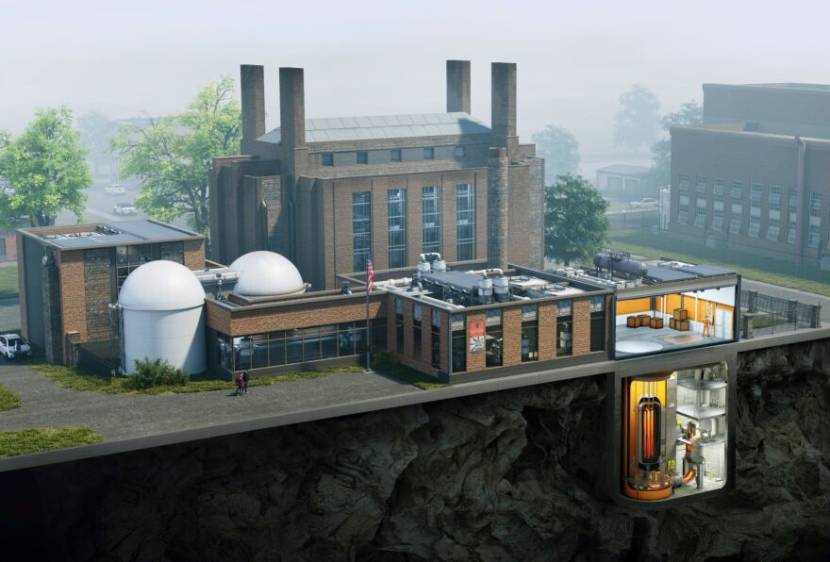
An illustration of a proposed micronuclear plant
The University of Illinois Urbana-Champaign is considering acquiring a nuclear microreactor from Ultra Safe Nuclear Corp. that’s similar to the one Copper Valley Electric Association is studying. (Ultra Safe Nuclear Corp. illustration)

A bill moving through the Alaska Legislature would streamline the state’s approval process for small nuclear reactors, which have been touted as cleaner, more cost-effective sources of energy for Alaska.

There are no microreactors operating anywhere in the United States. But a few pilot projects are planned, including one at Eielson Air Force Base. The federal Nuclear Regulatory Commission must approve any new reactor, but House Bill 299 from Gov. Mike Dunleavy would exempt microreactors from some decades-old state requirements.

At a state House committee hearing, Alaska Department of Environmental Conservation environmental health director Christina Carpenter said the bill would exempt microreactors from multi-agency study and legislative siting approval requirements.

“When our atomic energy authority was drafted, I think back in the 70s, it had in mind those large legacy reactors,” she said. “But those microreactors would still be subject to local approval, as well as DEC permitting and NRC permitting.”

HB 299 arose from recommendations made by the the Alaska Center for Energy and Power at the University of Alaska.

“This cleanup of state statutes enables communities or industry to make decisions around considering nuclear reactors as part of their future energy mix,” said Gwen Holdmann, the center’s director.

Holdmann said microreactors are safer than larger, so-called legacy nuclear power plants, which rely on pumping water for cooling as opposed to the smaller unit’s passive cooling design.

“If a site lost all power, you’re not reliant on backup power and things like that. It’s going to cool down through natural physics and thermos-dynamic processes,” she said. “The reaction will shut itself off automatically rather than require some sort of active involvement in order for that to happen.”

Holdmann says microreactors’ uranium fuel is encapsulated in a heat-and-crush-resistant ceramic jacket, and that the uranium would typically last about 10 years before needing to be replaced and shipped out of state.

Michael Rovito, with the utility trade group Alaska Power Association, described microreactors as a viable option for safe reliable and affordable power.

“So electric utilities considering microreactors can move forward with their potential projects confidently knowing that a portion of the permitting process has been streamlined,” he said.

But Alaska Community Action on Toxics executive director Pam Miller describes nuclear power as destructive throughout its lifecycle.

“While these nuclear microreactors are being touted as a solution for the climate crisis and energy needs in rural Alaska, I believe that it’s a false solution and that these reactors are actually quite dangerous,” she said. “From the mining of uranium, which usually takes place on Indigenous lands, through the enrichment process. And then there is the untenable problem of radioactive waste disposal, and that has not been solved.”

Miller said she is also concerned about the security of microreactors in Alaska, especially if deployed in remote locations.

Under the bill, microreactors proposed for areas without local government would still need to get siting approval from the legislature.

Weeks after its roof collapsed, Delta Junction’s only grocery store has been torn down

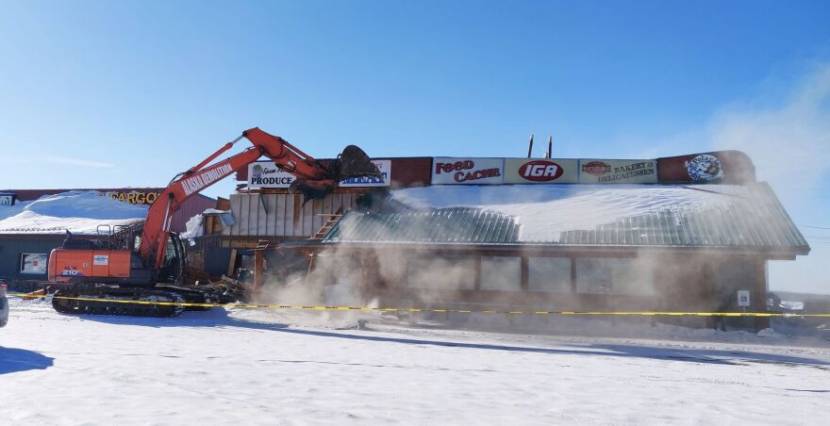
An excavator beginning to demolish the front of a grocery store
An excavator begins demolishing the IGA Food Cache building in Delta Junction Monday morning. (Photo courtesy of Tiki Levinson)

Workers tore down the building that housed Delta Junction’s only grocery story Monday, nearly three months after its roof collapsed under the weight of an extreme snow load. The owner plans to build a new store in the same location.

The old IGA Food Cache had been boarded-up since its roof partially collapsed on Dec. 26 after a heavy snow and rain storm. So when heavy equipment began demolishing the 50-year-old structure Monday morning, it caught locals like Lori Yates by surprise.

“Well, look at this! This is unbelievable!” she said as she watched the demolition.

By mid-afternoon, all that was left was a pile of rubble.

Store General Manager Jeff Lisac says that as soon it’s hauled away, work will begin on a new store.

“We’re definitely rebuilding,” he said in an interview at the site Monday. “We’re going to build a better store than we had. Everything will be brand new inside of it.”

That’s necessary because almost all of the inventory and equipment in store, including some new freezers they’d just installed, were too damaged to salvage.

“Couldn’t save anything in here,” he said, “so, the shelving, everything has to be replaced.”

Lisac says there’s no official dollar estimate of the damage yet. He says store owner Ed Larson is still working on insurance claims and other issues. They’ve also have had to work around supply-chain issues and the high cost of materials like the type of steel used for shelving.

Lisac says it’ll take a year for the new shelving to be delivered. So the new store will be set up with a more basic temporary system.

Meanwhile, Larson has been serving customers with a sort of mini-grocery set up in his liquor store next door. It’s pretty limited, but customers like Monica Gray say it helps fill the gap left by the loss of the town’s only grocery store.

“It’s nice to have stuff in the liquor store, but I mean, it’s not a grocery store,” she said.

Gray says it’s better than trying to buy staples from the two convenience stores in town, which run out of inventory pretty quickly these days.

“No milk, no eggs. You know, it’s like there’s usually a dozen eggs down at the gas station,” she said, adding, “because you don’t want to have to buy it at the gas station — until that’s the only place to get ’em!”

Gray says her family hasn’t had to deal with that because her dad is retired military and can shop at the commissary on Fort Greely. But most folks, like Peter Osipchuk, don’t have those privileges. So they’re driving a hundred miles to shop in Fairbanks.

“Right now, we more, go to Fairbanks (to) buy more food,” he said during a quick stop at the store.

Bruce Smith says he’s OK with buying his groceries at Larson’s liquor store.

“You can get a lot of stuff here — most of it, anyway,” he said.

Smith is a trucker, and he often picks up groceries after making a delivery. He says that’s better than driving the icy Richardson Highway to get to stores in traffic-congested Fairbanks.

“We’ll stop at Three Bears in Tok and get a lot of stuff instead of having to deal with Fairbanks and the nightmare road.”

Lisac says that if all goes well, the new IGA Food Cache may open in the fall.

Delta Junction’s Slavic community, reeling over Ukraine war, launches relief effort

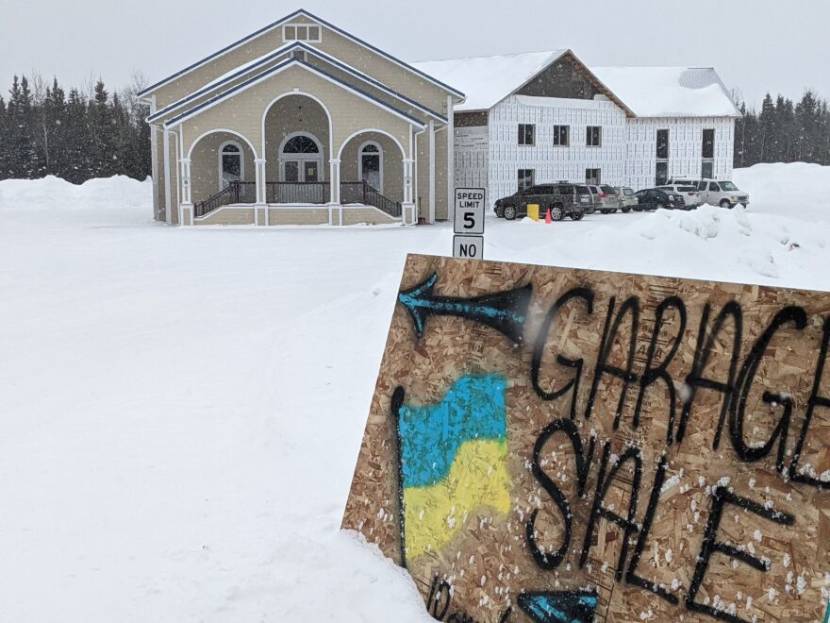
A garage sale sign with a Ukrainian flag painted on it, outside a church
The Word of Life church near Delta Junction is holding a weeklong garage sale/bake sale to raise money to help the people of Ukraine. (Photo by Tim Ellis/KUAC)

Victoria Shestopalov says she began worrying about loved ones in Ukraine a few weeks ago, when the Russian military was conducting large training exercises near the Ukrainian border. She says when she called to check in, they reassured her all was well.

“We have family in Kharkiv, and then we have family in Kyiv, and then spread out in small villages as well,” she said. “And they said, ‘It will be OK, everything’s going to be OK. No one’s panicking.’”

But when Russian President Vladimir Putin sent tanks into Ukraine a couple of weeks ago, Shestopalov says her worst fears had come to pass.

“And then,” she said, “just all of a sudden, it kind of just happened. And, yeah, we were all very crushed with the news.”

Since then, Shestopalov says she and many other members of Delta Junction’s Slavic community have been trying to monitor the situation in Ukraine and keep in touch with those who are still there.

“It really breaks our heart,” she said. “It’s really touched us. I didn’t realize that I would feel this way. It’s just happening — in the 21st century. It’s just unbelievable.”

A family photo of a daughter with her parents at a table
Vicky Shestopalov with her mother, Sirje, and father, Paul. (Courtesy of Vicky Shestopalov)

Shestopalov’s family was among the first in a wave of refugees that began arriving in Delta Junction in the 1990s. They came from Russia and Ukraine and other nations in the former Soviet Union’s orbit, many looking for a place where they’d be free to worship according to their conscience.

The Slavic community here now constitutes about a fifth of the area’s population. And Shestopalov says they’re united against the war in Ukraine.

“I know the Russian people don’t this war to be happening,” she said. “Our friends from Russia are reaching out — actually, all over Europe. Nobody wants this to be happening.”

Shestopalov’s dad is Ukrainian. Her mom was born in Finland but moved to Estonia, where Shestopalov was born. And her husband is Russian. She says some members of her family are now wondering whether their country will be the next to be attacked.

“I spoke to my cousin in Finland, which is right there. She said Finland is on pins and needles. They are prepared. They are ready to act,” she said.

Delta Junction’s Slavic community also is ready to act, says Diana Gelever. Her family is one of those that came to Delta Junction from Ukraine back in the 1990s.

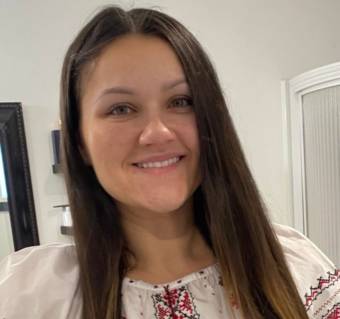
A portrait of a woman in a house
Diana Gelever is helping her church, The Word of Life, raise money to help people in Ukraine. (Courtesy of Diana Gelever)

“A couple of the ladies in our church have been reaching out to family in Ukraine,” said Gelever, a member of the Word of Life Church in Delta Junction.

And she says the responses that fellow congregants have been getting from family members in the old country are heart-breaking.

“There are people just hiding in bunkers and underground, in the subway and stuff,” she said. “And there are children down there, others, pregnant women, some men here and there, as well. And they’ve just been reaching out, (saying) that they have nothing. And they’re scared.”

To relieve the suffering, the Slavic community has been sending donations directly to family and friends in Ukraine and neighboring countries. And Gelever says members of the church have launched a weeklong garage sale and bake sale to raise money for the cause.

“They’re baking as many goods that they can,” she said. “They’re trying to sell as much as they can as fast as they can to get the money out there as soon as possible to help those who need it.”

Copper Valley Electric Association is considering a nuclear power plant

An illustration of a proposed micronuclear plant
The University of Illinois Urbana-Champaign is considering acquiring a nuclear microreactor from Ultra Safe Nuclear Corp. that’s similar to the one Copper Valley Electric Association is studying. (Ultra Safe Nuclear Corp. illustration)

Copper Valley Electric Association is considering a nuclear microreactor similar to the one scheduled to begin operating on Eielson Air Force Base by 2027.

Right now, the utility relies on inexpensive hydro power during the warmer months of the year but switches in the winter to more costly oil-fired power generation.

Copper Valley chief executive Travis Million says the utility has been trying for years to find a cheaper and greener alternative to its diesel- and naphtha-fueled generators.

“There’s no predictability of the cost,” he said. “Just this year alone, between December and January, we saw a 44% price increase for the diesel fuel that we use.”

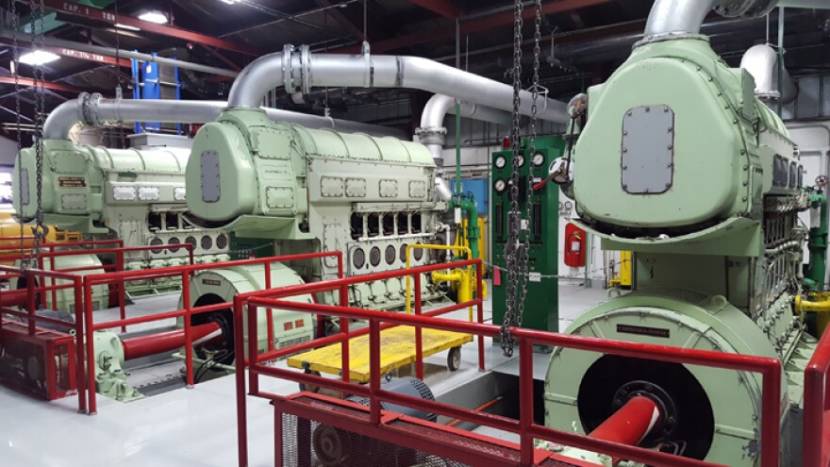
Three large diesel generators
During the cold months, Copper Valley must use diesel-fueled generators, like these at the co-op’s 8-megawatt Glennallen Diesel Plant, to provide electricity to its members. (Photo courtesy of Copper Valley Electric Association)

Million says Copper Valley’s board adopted a policy last year to reduce the utility’s greenhouse-gas emissions, and co-op staff studied wind, solar and other renewables.

He says they found none would reliably provide electricity in the winter without backup from the expensive fuel-fired generators. So they turned to nuclear-powered generation.

“The technology has been there a long time,” Million said, “but there just hadn’t been a way to manufacture these type of reactors.”

Micro-modular reactors are small, self-contained reactor systems that can be brought onto a site and replaced every 20 years for refueling. The 10-megawatt facility that Copper Valley is considering would be similar to a 5-megawatt microreactor planned for Eielson Air Force Base.

“With the advanced manufacturing technologies that are out there today, it now makes it feasible to where they can mass-produce these types of smaller-scale reactors,” Million said.

After studying the industry, Copper Valley began working with Seattle-based Ultra Safe Nuclear Corp. Company officials came to Alaska last summer to survey the co-op’s facilities and service area, which includes the Copper River Valley, areas along the Richardson Highway from Valdez to Gakona and the Glenn Highway from Glennallen to the Mat-Su boundary.

The company’s now working with the utility on a feasibility study that’ll be completed in July, when the co-op’s board will decide whether to move ahead with the project.

So far, Million says it looks promising.

“This could be possibly the answer that we’ve been looking for for decades — a generation source that is a stable, cost-efficient way to produce electricity,” he said.

Million says he hopes the study will show that the microreactor will help keep the cost of electricity down to somewhere around 20 to 25 cents per kilowatt hour. He estimates the plant would cost $80 million to $100 million to build, which compares to the University of Alaska Fairbanks’ $245 million, 17-megawatt coal-fired power plant that went online in 2018.

Million says the federal infrastructure bill could help pay for the co-op’s microreactor.

“There was $2.4 billion for demonstration projects for advanced nuclear reactors,” he said.

Other utilities have expressed interest in Copper Valley’s proposal.

“We’re really excited to be able to follow the progress that’s happening at Eielson and Copper River,” says Meadow Bailey, a spokesperson for Golden Valley Electric Association. “If it ends up being something that is safe and reliable and cost-effective, then in the future it’s definitely something that we would consider.”

If Copper Valley’s board decides to move ahead on the project, it would be Alaska’s first commercial nuclear-powered electrical-generating station. Two others were proposed in recent decades, one for Galena and one for Ester, but neither panned-out.

The Army built a nuclear powerplant on Fort Greely that operated for about 10 years before it shut down in 1972.

Army commander seeks to normalize mental health care amid string of soldier suicides

""
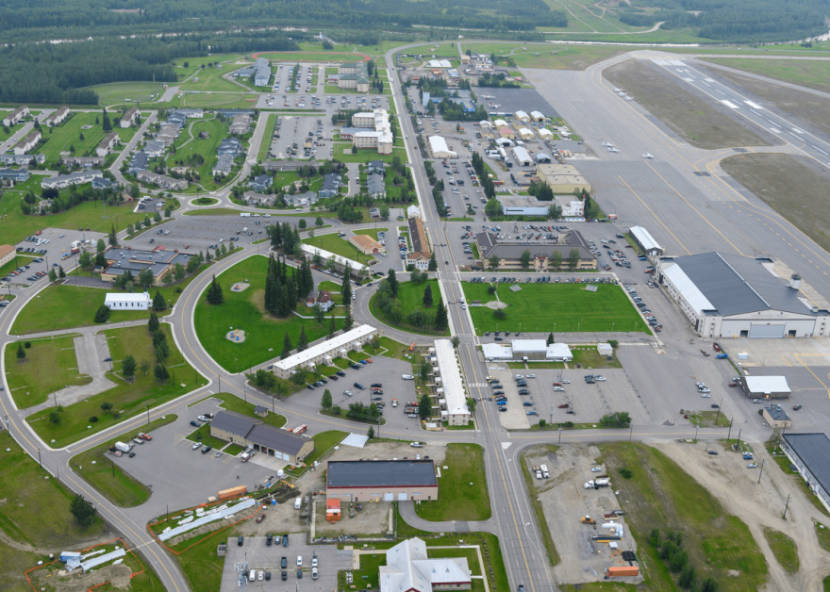
Aerial view of Ft. Wainwright. (U.S. Army photo)

The Army has confirmed that 11 Alaska-based soldiers died by suicide in 2021. Six of the soldiers were based at Ft. Wainwright, and five were at Joint Base Elmendorf Richardson. The deaths of another six Alaska soldiers, five of whom were Ft. Wainwright-based, are under investigation.

That compares to seven deaths by suicide in 2020 and eight in 2019.

Speaking with reporters, U.S. Army Alaska commander Major General Brian Eifler said suicide prevention is his number one priority.

“We’ve got a lot of things going on in the world right now. A lot of things that we’ve got to pay attention to, but this is what’s hurting our soldiers, so we’ve got to figure it out,” he said.

Ft. Wainwright has one of the highest suicide rates among U.S. Army posts. And while military suicides have been climbing nationwide in recent years, Eifler said Alaska’s extreme environment can magnify mental health challenges.

“So maybe a small problem in the Lower 48 would be big problem here,” he said.

Eifler reflected on a 2019 Ft. Wainwright suicide study that gave rise to mental health and quality of life initiatives, including over $200 million in facility upgrades.

“Obviously and tragically we still have long road ahead of us,” he said.

Eifler focused on a list of suicide prevention measures, including a campaign to keep soldiers better connected.

“Leaders connected with the soldiers and soldiers connected with each other. Leaders contact a hundred percent of our soldier’s spouse or next of kin. A hundred percent of our soldiers will get a wellness check from behavioral health or the military family life counselor,” he said.

Eifler said many of the deaths happen during a soldier’s first year in the state. He highlighted a new Army climate that encourages reaching out.

“Every week, every week we have people coming forward and saying hey, first sergeant, I’m really struggling here, and here’s my weapon, take my weapon away from me. I need some help,” he said.

Eifler said the goal is to normalize mental health care within the ranks. He also pointed to a new initiative to identify soldiers who are a good fit for Alaska and to bring and keep them here.

Site notifications
Update notification options
Subscribe to notifications