"As Managing Editor, I work with the KTOO news team to develop and shape news and information for the Juneau community that's accurate and digestible."
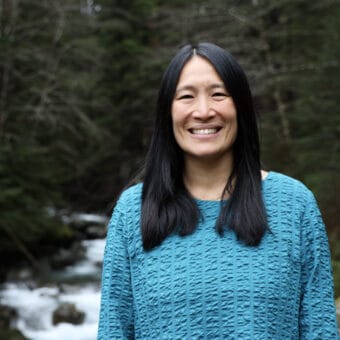
Barbara Sheinberg (Photo courtesy of Barbara Sheinberg)
Only one person has applied for a vacancy on the Juneau Assembly as of Monday afternoon. Barbara Sheinberg declared candidacy for the District 1 seat. The deadline to apply is Tuesday at 4:30 p.m.
The District 1 seat became vacant when Deputy Mayor Mary Becker succeeded Mayor Greg Fisk upon his death Nov. 30. The assembly has since decided to hold a special election March 15 to elect a mayor to serve the rest of Fisk’s 3-year term which ends October 2018.
Becker has said she doesn’t plan to run; that means she’d return to the District 1 seat after a new mayor is sworn in. In that case, the person appointed to the vacant seat wouldn’t hold it for very long.
Sheinberg said that’s part of the reason she applied.
“It would be good to have somebody that can fill this position that doesn’t need a lot of time to come up to speed because you got to get there and start working right away. I think given the experiences that I’ve had, I’m able to do that,” Sheinberg said.
Sheinberg is the owner and principal of Sheinberg Associates, a community and strategic planning consulting business. Her firm worked with the McDowell Group recently to prepare the Juneau Economic Plan. She says she’s also familiar with municipal budgets, including Juneau’s, through her work forecasting revenues for local governments.
Sheinberg was on the Planning Commission for five years and currently sits on the city’s Board of Equalization. She’s never run for Juneau Assembly.
If Becker does decide to run for mayor, she’d forfeit her District 1 seat, and the person appointed to the vacancy would hold it until the next regular election in October.
To apply for the vacancy, submit a Declaration of Candidacy form, letter of interest and resume to the Municipal Clerk’s office by 4:30 Tuesday. The assembly plans to interview applicants Jan. 11 and make a final decision during a Jan. 12 special meeting.

The nominating period for the mayoral Special Election runs Jan. 15 to Jan. 25.
New Year’s Eve revelers can get a free taxi ride home Thursday night. The Juneau/Lynn Canal CHARR has spent about $100,000 since 2005 on the Safe Ride Home Program.
“If you’re downtown where the majority of our establishments are, we’re going to have cabs and vans with green flashing lights and signs that say ‘Free Cab Ride’. Get in one of those cabs or vans and they will take you home,” said Leeann Thomas, owner of the Triangle Club Bar and a member of Juneau/Lynn Canal Cabaret, Hotel, Restaurant and Retailers Association.
Free rides will also be provided from locations in Douglas and the Mendenhall Valley.
The program has grown over the years. When it first started on New Year’s Eve 2005, Safe Ride provided about 440 free lifts home.
“Last year on New Year’s, we did 727 rides so we would love to do 1,000 rides this New Year’s, but if we’re above 727 rides, we’re going to be happy,” Thomas said.
Free rides home are available from 9 p.m. to 3 a.m. If you can’t find a taxi or van with a flashing green light, ask a bartender or server at a participating establishment to call one for you.
For those unable to utilize the Safe Ride program, Juneau Police Lt. David Campbell advises people to plan ahead for a designated driver or call a taxi.
He also says to use common sense around fireworks. The use of fireworks is legal in Juneau, but Campbell said how they’re used could violate other laws, like disturbing the peace.
“If a person is on their back porch and they’re lighting off really loud fireworks in a densely populated area, there’s a good chance they’re probably disturbing somebody. If they’re doing it out the road and there isn’t really anybody around, then the likelihood of you disturbing someone is going to be a lot less,” Campbell said.
Historically, JPD receives many reports of fireworks on New Year’s Eve, which officers do respond to.
The department will have up to nine officers on duty; usually only four work on a Thursday evening.
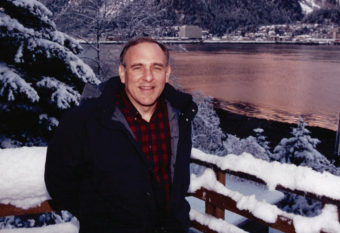
Jamie Parsons was named Juneau Citizen of the Year in 1994, around the time this photo was taken. (Photo courtesy Win Gruening)
Former Juneau mayor Jamie Parsons died Saturday in Washington state after more than a decade battling cancer. He was 74.
Friends and former colleagues remember his sense of humor, his love of sports and his unfailing commitment to the capital city.
Jamie Parsons moved to Juneau in 1972 to become the city’s first Parks and Recreation director. He served on the Juneau Assembly for most of the 1980s and became mayor in 1991.
“I considered him a dear friend. He was a tireless promoter of Juneau and he’s going to be deeply missed by this community,” said Juneau Senator Dennis Egan, who served as Parson’s deputy mayor.
“One year we went to the Gold Medal Tournament. Albert Kookesh and Jamie and I are in the free throw contest. I can’t shoot a free throw and here we’re in front of all these fans and, of course, I missed,” said Egan.
But Parsons said Egan could have Kookesh’s points “and Kookesh could have mine, so I won,” Egan said, laughing.
Parsons was nonpartisan, Egan said, and got along with all the assembly members.
“I don’t care who you were; he’d sit down and talk to you. A lot of that is missed right now. I didn’t know if he was Republican or Democrat. We never talked politics. We talked about Juneau and making Juneau better,” Egan said.
Paulette Simpson was another close friend and worked on Parson’s mayoral campaign in 1991.
“Jamie excelled at friendships and he understood that, especially in politics, friendship was foundational if you were going to be successful,” Simpson said.
If there was a legislator who spoke against Juneau being the capital city, “Jamie’s reaction to that was to go make friends with the person and invite them to dinner,” Simpson said. “And he and Mary Beth were absolutely the most gracious, hospitable leaders we’ve probably ever had and I think that went really far with people. Because he excelled at friendship, he put that to work for the capital city.”
Wife Mary Beth Parsons and Jamie Parsons (Photo courtesy Win Gruening)
After one term as mayor, instead of running for re-election, Parsons put his energy toward fighting a 1994 ballot initiative to move the capital to Wasilla.
Parsons traveled throughout Southeast to encourage voter turnout and traveled north as well. Longtime legislative aide Christopher Clark was working in Anchorage as a field coordinator in the campaign against the measure. He said Parsons was key to defeating it.
“He helped organize it. He’d go out door-to-door. He’d give speeches. He’d talk to editorial board meetings. He’d go to newspaper interviews. And it all worked. Jamie was with me in Anchorage on the night of the election returns and we were jubilant. We once again had dodged a bullet and managed to keep the capital here in Juneau and Jamie deserves a lot of the credit for that,” Clark said.
Like Parsons, close friend Win Gruening also served as Chair of the Alaska Committee. He said Parsons helped Juneau become an even better capital city by making it more accessible. It was his idea to do C-SPAN coverage of the Alaska Legislature – what’s now known as Gavel Alaska.
“He bridged a lot of gaps. There’s a lot of polarization in politics today. He never paid attention to that. He listened to people and he always tried to figure out a way to get people to some sort of an agreement so that they could move forward on things,” Gruening said.
Parsons also owned the Juneau Racquet Club with John McConnochie for about 20 years. McConnochie now co-owns Cycle Alaska with his wife. He called Parsons a mentor who taught him the concept of “paying your civic rent.”
“Where businesspeople in town have an obligation to give back to the community that’s being supportive of them, and he certainly exemplified that throughout his whole life,” McConnochie said.
McConnochie and Parsons were also very close friends. While traveling in New Zealand, McConnochie spoke with him days before he died.
“What was amazing about that is Jamie was so positive and had great energy. Even though he was on some pain medication, that spark was still there,” McConnochie said.
Parsons also once served as CEO of the Juneau Chamber of Commerce. In a letter to chamber members about Parson’s death, executive director Craig Dahl called him an “inspiration” and wrote, “Juneau has never had a more committed advocate.”
The Parsons family will hold a memorial service at Centennial Hall July 16, 2016 at 2:00 p.m.
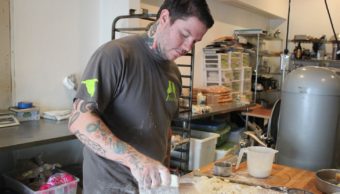
Beau Schooler makes ricotta gnocchi in the kitchen of Panhandle Provisions. (Photo by Lisa Phu/KTOO)
Another Juneau restaurant empire is taking form with the opening of an Italian restaurant next month in the space recently known as the Silverbow Bakery. In Bocca Al Lupo will be the newest restaurant venture by the people who run The Rookery Café, Panhandle Provisions and The Taqueria.
In the kitchen of Panhandle Provisions on Seward Street, Beau Schooler cracks a few eggs in a big metal bowl. He’s making ricotta gnocchi.
“A cheese-based form of gnocchi, which is an Italian dumpling,” Schooler says.
He stirs up the eggs, whole milk ricotta and some salt, and then grates in some Grana Padano, which is similar to Parmigiano-Reggiano. It’s like “like parmesan’s younger cousin.”
The flour comes next. Gnocchi is usually made with potatoes, but it can be made with other ingredients, like spinach or sweet potato. It’s treated just like pasta – boiled till done and tossed with a sauce. The Rookery Café currently offers the ricotta gnocchi with a ragout made with pork from the Matanuska-Susitna Valley.
“When we get the Italian place open, we’ll always have one kind of gnocchi on the menu,” Schooler says.
Schooler went to Calabria, Italy in 2008 to learn the basics of Italian cuisine.
“So you get there and it’s basically like six days a week, 12 hours a day, you just eat, sleep, breathe Italian food. That’s all you do,” he says.
In Bocca Al Lupo will always feature a kind of gnocchi on the menu. (Photo by Lisa Phu/KTOO)
For the restaurant, Schooler will stay true to the roots of Italian cooking while also incorporating Alaskan ingredients. He’s working with friends who produce traditional-style fermented Italian cheese curds.
“The mozzarella that you can make with their curds is, I call it, life changing. It blows you away,” Schooler says. “So we’ll probably have a traditional Margherita-style pizza with the San Marzano tomatoes and the fresh-made mozzarella with this fermented curd and the Alaska sea salt and thin garlic. And we might play around with smoked salmon on a pizza just because it’s Alaska and you got to do something like that.”
“In bocca al lupo” is Italian for “break a leg,” though it literally translates to “in the wolf’s mouth.” The restaurant will feature handmade pasta and wood-fired pizzas ranging in price from $12-20, with entrees like roast chicken or duck costing more. The restaurant will also serve beer and wine.
Travis Smith first opened The Rookery Café in November 2010. In Bocca Al Lupo will be his third restaurant. (Photo by Lisa Phu/KTOO)
This will be the third restaurant opening for Travis Smith. Many of Juneau’s favorite restaurants are owned and operated by the same groups of people. Twisted Fish, Hangar on the Wharf and Pizzeria Roma all have at least one common owner. As do Tracy’s Crab Shack, Saffron, Salt and McGivney’s.
Smith started The Rookery Café in November 2010. Schooler joined the restaurant a couple of years later. They opened the deli Panhandle Provisions in June 2014, which they plan to move into the Italian restaurant location. The Taqueria opened February 2015.
Once you have the mechanics down for one restaurant, Smith said, it’s possible to open more.
“We couldn’t operate The Taqueria if we didn’t have another location where we could store their product off-site and have some prep work done because they just don’t have the space. Similarly, we couldn’t do what we’re doing in The Rookery if I hadn’t moved the bakery to a different location in 2013,” he said.
In the past couple of years, the restaurant group has gone from 12 to about 50 employees. But not everything Smith and Schooler touch turns to gold.
“We did have a little food cart operation that we shut down after a month that took us a year and a half to open. It was called the Chowder Shack, and we were just going to be selling our halibut chowder, but it turns out that that’s not something that people just wanted to buy and walk around and eat,” Smith said.
Smith is confident they have the staff and ability to run In Bocca Al Lupo, and he doesn’t plan to open any more restaurants.
“We’re going to stop at three. Essentially, our three children. The family is done,” Smith said.
Fresh gnocchi takes about three minutes to cook in boiling water. (Photo by Lisa Phu/KTOO)
Back at the kitchen, Schooler cooks the gnocchi in a small pot of boiling salted water for just a few minutes.
“Once they’re floating at the top, then they’re done. The key to these, really, is to pull them as soon as they start floating,” Schooler says.
He ladles some into a small bowl and grates some cheese.
“So that’s just pasta water, butter and then Grana Padano, and that’s kind of like how they do it over there,” Schooler says.
I plunge a fork into the bowl. Schooler’s gnocchi is sublime. Each one is a soft pillow in my mouth – a couple bites and then it melts.
Originally from Long Island, N.Y., Jeff Campbell moved to Juneau in 1985. He’s been decorating his house since the early 1990s. (Photo by Lisa Phu/KTOO)
Juneau resident Jeff Campbell bought two truckloads of Christmas lights and decorations at a garage sale more than 20 years ago. Ever since then, he’s been decorating his house in a big way, making his downtown neighborhood a more festive and bright place. People joke that you can see his house from space.
On a drizzly Monday night, 8-year-old Ferguson Wheeler counts the number of Santa Clauses at Jeff Campbell’s house in a neighborhood near the Federal Building known as The Flats.
“I add Santas every year,” Campbell said. “That’s always new. The kids come and count the Santas.”
“How many Santas?” I asked.
“I can’t tell you. The kids got to count them.”
Neighborhood kids love counting the number of Santa Clauses at Jeff Campbell’s house. He adds new ones every year. (Photo by Lisa Phu/KTOO)
Besides Santas, the busy holiday display includes reindeer, candy canes, nativity scenes, nutcrackers, drummer boys, Disney and Winnie the Pooh characters, and thousands of lights. There’s not much room to walk around the yard. Campbell has even wired some outdoor speakers to play Christmas music.
He creates his own decorations as well.
“Snoopy on his house, because of the new Peanuts movie. Whatever the newest kid movie out – the Christmas movie – I try to do a character from that,” Campbell said.
More than 600 lights on a plywood board in the shape of Snoopy radiate heat and good cheer.
Campbell has been covering his house and yard with lights and decorations since the early 90s and each year the display grows.
“Ninety-eight percent of it is from garage sales, unless I get something on a blow-out sale at a store,” Campbell said.
He starts setting up for Christmas right after he takes the Halloween lights and decorations down. He tends to put things in the same spot every year for simplicity’s sake.
“Some of these guys are marked where they go, so I don’t have to think about it and it gets out a lot faster,” Campbell explained.
He points to a written message on the back of a Santa: Under the ash tree.
“So I know where he goes.”
Jeff Campbell gets 98 percent of his decorations from garage sales. (Photo by Lisa Phu/KTOO)
Campbell debuted the lights Dec. 4 by flipping eight switches. The lights turn on daily after work, and off around 9 p.m. or 10 p.m. He’ll turn them off for good in early January.
His electricity bill has been doing better since LED lights became part of his collection.
“It used to triple from what we normally had. Now, it’s doing better. It’s a little over double,” Campbell said.
The cost of holiday joy, though, is priceless. Campbell’s house is known around town.
Cars constantly slowdown and children walk into his yard to pose for photos — something Campbell has no problem with.
“A neighbor, one time, did hijack a Santa and he took pictures around town with him — up on the tram and the glacier and had pictures of them sent to us,” Campbell said.
Campbell occasionally receives donated decorations, as well. There’s Goofy next to some bushes on the edge of the property, but he needs a better spot.
“He was put here. Someone left him. Either I’ll move him out further or I’ll find a place in the yard for him. I got one already so I have to keep them separated. I don’t want fighting,” Campbell said, laughing.
Jeff Campbell’s house is located on W 11th Street in downtown Juneau. (Photo by Lisa Phu/KTOO)
If you haven’t yet stopped by Jeff Campbell’s house on West 11th Street in The Flats, make sure you do, and don’t forget to count the Santas.
About 400 people attended the Glory Hole fundraiser Monday night at the Elizabeth Peratrovich Hall. Five local Native dance groups organized the event, raising about $32,000. (Photo by Anne Stepetin)
Five local Native dance groups organized a fundraiser Monday night, raising about $32,000 for Juneau’s shelter and soup kitchen. About 400 people attended and contributed money to the Glory Hole through donations, silent auction, fry bread sales, dancing, raffle and a $9,500 matching donation by the Rasmuson Foundation.
Nancy Barnes is head of the Yees Ku.oo dance group. She helped organize the fundraiser with Kolene James, who was inspired by a Juneau Empire story on the Glory Hole’s financial deficit. Barnes was blown away by how much the event raised in two hours.
“I don’t think anybody thought we were going to make that much money. Somebody said, ‘What’s your goal?’ And I was saying, ‘If we raised $5,000 just to help them have a wonderful Christmas that will be great,'” Barnes said.
The other dance groups at the fundraiser were Ldakát Naax Satí Yátx’í (All Nations Children), Eagle/Raven Dancers, Yaaw Tei Yi and Woosh.ji.een.
Martin Stepetin Jr., Konrad Frank and Bryson Stepetin are part of the Woosh.ji.een dance group. (Photo by Joyce Frank)
“Our culture is about holding each other up and the Glory Hole is an entity that’s always holding our people up, so it’s time when they’re hurting to give back and help them out,” Peterson said.
Glory Hole Executive Director Mariya Lovishchuk said the funds raised Monday night, plus other donations, will close the $58,000 deficit the shelter was in when the story ran in the newspaper earlier this month.
Lovishchuk said the deficit was largely due to a burst pipe that flooded and closed down the shelter last December. The inside of the building had to be rebuilt. The shelter has also been focusing more on getting the Housing First project built than on fundraising.
Lovishchuk said she can’t say thank you enough to the dance groups, community organizations and people who contributed to Monday’s fundraiser.
“This is beyond gratitude. This was a really amazing thing and it really ensures that we’re going to be able to meet our mission of providing everyone in need of food, shelter and compassion. It also means that we’ll keep on working on the Juneau Housing First project and making it a reality,” Lovishchuk said.
She said it’s an honor to be supported by the Alaska Native community and to start the New Year on a positive note.
Close
Update notification options
Subscribe to notifications
Subscribe
Get notifications about news related to the topics you care about. You can unsubscribe anytime.