Internal Revenue Service taxes forms are seen on Feb. 13, 2019. (Keith Srakocic/AP)
This year’s federal tax filing deadline of April 18 is quickly approaching, and Americans generally pay some mixture of federal, local, and in most cases, state taxes. But the tax burden of some states significantly outpaces others, data shows.
WalletHub, a personal finance website, released a report this week analyzing total tax burden by state. Tax burden is defined as the proportion of a person’s income that goes toward taxes.
It measured a combination of the proportion of property tax, income tax and sales tax that people paid. These were the states with the highest and lowest tax burdens.
Highest tax burdens
New York – 12.47%
Hawaii – 12.31%
Maine – 11.14%
Vermont – 10.28%
Connecticut – 9.83%
New Jersey – 9.76%
Maryland – 9.44%
Minnesota – 9.41%
Illinois – 9.38%
Iowa – 9.15%
Lowest tax burdens
Alaska – 5.06%
Delaware – 6.12%
New Hampshire – 6.14%
Tennessee – 6.22%
Florida – 6.33%
Wyoming – 6.42%
South Dakota – 6.69%
Montana – 6.93%
Missouri – 7.11%
Oklahoma – 7.12%
When broken down by category, the states with the highest burden for property tax were Maine (5.33%), Vermont (4.98%) and New Hampshire (4.94%), while the lowest were Alabama (1.39%), Tennessee (1.66%) and Arkansas (1.68%).
The states with the highest burden for income tax are New York (4.72%), Maryland (4.21%) and Oregon (3.62%). There are seven states with no income tax – Nevada, Washington, South Dakota, Florida, Wyoming, Alaska and Texas.
The states with the highest sales tax burden are Hawaii (6.71%), Washington, (5.66%) and New Mexico (5.62%), while the states with the lowest sales tax burden are New Hampshire (1.07%), Delaware (1.09%) and Oregon (1.11%).
Copyright 2023 NPR. To see more, visit https://www.npr.org.
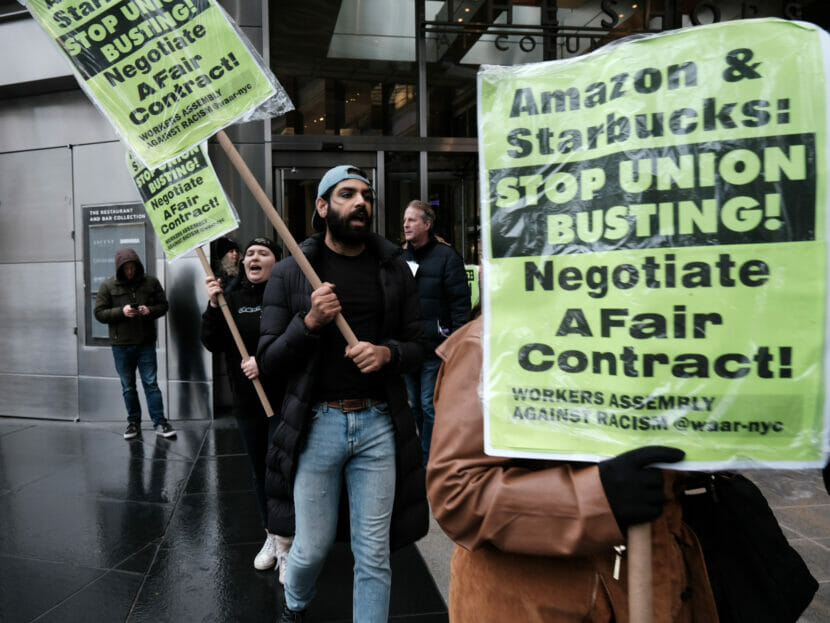
Members of the Amazon Labor Union and others protest outside the New York Times DealBook Summit on Nov. 30, 2022, as Amazon CEO Andy Jassy is scheduled to speak. (Spencer Platt/Getty Images)
It was the Champagne pop heard around the economy. One year ago this week, a fired Amazon warehouse worker turned labor activist sprayed Champagne and then drank from the bottle outside federal labor offices in New York City.
Swarmed by supporters and media, Chris Smalls toasted a victory: the first Amazon union in the U.S., led by Smalls and other workers at an 8,300-person warehouse on Staten Island, a feat few believed they could pull off.
Since then, though, the Amazon Labor Union has gained little ground. It has yet to win another union election. And Amazon still refuses to sit down for contract negotiations.
In fact, despite the buzz around what seemed like a labor resurgence — the historic win at Amazon, as well as spirited campaigns at Starbucks, on college campuses and retail stores across the country — the overall picture for unions remains bleak.
This week, we may get a window into why. On Wednesday, fresh from his third stint as Starbucks CEO, Howard Schultz will head to Capitol Hill, where he’ll face questions about everything Starbucks is doing to discourage its workers from joining unions.
Only about 1 in 10 U.S. workers is a union member
Just 10% of American workers belonged to a union in 2022, the lowest in Labor Department records going back to 1983, when the rate was 20%.
Never mind that 71% of Americans approve of unions, the highest in nearly six decades and up from 48% in 2009, a Gallup poll conducted last summer found.
The bottom line is that labor law itself is tilted in favor of employers, say researchers who study labor movements, often making corporate hostility toward unions too hard to overcome. The recent groundswell of public support is far from enough to spark a union comeback.
“Those of us who have been watching this stuff for many decades have actually been pleasantly surprised by the success that has occurred, but it’s too modest in scope and too fiercely resisted by employers” to move the needle, says Ruth Milkman, a labor sociologist at the Graduate Center at the City University of New York.
Since December 2021, nearly 300 Starbucks stores — less than 3% of its company-owned locations in the U.S. — have unionized, and not without a fierce fight.
Unfair labor practice charges against Starbucks are piling up at the National Labor Relations Board. The agency’s regional offices have issued scores of formal complaints, and its administrative law judges have so far found that Starbucks violated labor law in eight separate cases across the country.
Starbucks denies engaging in unlawful activity. The enforcement actions taken by the National Labor Relations Board do not appear to be forcing a change of heart.
In fact, the law allows companies to engage in anti-union activities, including finding ways to slow down every stage of the organizing process, Milkman says.
One big weapon against unionization: delay, delay, delay
Starbucks, for example, insisted early on that individual stores, which often employ just 25 to 30 people, should not be allowed to hold union elections, but rather, all stores in a geographic region must vote together in one election, increasing the degree of difficulty for union organizers. Federal labor officials ruled against Starbucks, and elections proceeded at the store level, but not without significant delays.
Labor law also allows for a lengthy appeals process, which Amazon is using to great effect to delay collective bargaining at the Staten Island warehouse.
Following a marathon Zoom hearing last summer, federal labor officials found Amazon’s objections to the Staten Island union election to be meritless and in January ordered the company to begin negotiations with the union.
But Amazon has since formally requested a review of that decision. If that review doesn’t go in its favor, Amazon can still take its case to federal circuit court for another round.
Toothless penalties for violating labor law and a fix that’s going nowhere
Unions have fought back, filing hundreds of unfair labor practice charges over anti-union activities, citing things like companies closing stores, cutting hours, and threatening and firing organizers at stores that had or were trying to unionize. (Companies have also filed unfair labor practice charges against unions, but far fewer.)
But even where the NLRB has found violations of workers’ rights to organize, the board’s decisions don’t have much financial bite. The agency’s administrative law judges can only impose what are called “make whole” remedies, things like back pay, reinstatement and reimbursement for financial harms suffered as a result of unlawful activities.
“It’s a cost of doing business,” AFL-CIO President Liz Shuler said in Senate testimony earlier this month.
“Right now, you actually get a bigger fine for violating fishing laws in many states than you do for busting unions.”
President Biden and Democratic lawmakers have pushed for passage of the Protecting the Right to Organize Act, known as the PRO Act, to fix some of the weaknesses of current labor law, starting with civil penalties of up to $50,000 for violating workers’ rights.
But with a divided Congress, hopes for passage are slim. And without any change in the law, Milkman says it’s hard to imagine a significant uptick in the unionization rate in the U.S.
A public shaming expected on Capitol Hill
With the PRO Act going nowhere, Sen. Bernie Sanders is turning to public shaming of those in power. Earlier this year, Sanders threatened to subpoena Schultz, calling on him to end the “relentless union-busting campaign” at Starbucks.
While Schultz’s testimony this week may generate fireworks, it’s unlikely to have much long-term impact.
Schultz is expected do what he’s done proudly for decades, outlining the competitive wages and industry-leading benefits that Starbucks affords workers, including free college tuition and company stock, even for part-time employees.
He’ll likely make the same case he’s made for the past year and a half — that Starbucks employees don’t need unions to fight on their behalf.
At a shareholder meeting last week, Starbucks’ new CEO Laxman Narasimhan and other executives did not indicate any change in the company’s feelings about unions, stressing the importance of maintaining a direct relationship with its employees.
There is some outside pressure for Starbucks to reconsider its anti-union stance. At that same meeting, shareholders voted on a proposal, brought by heavyweight investors including New York City’s pension fund, for a third-party audit of the company’s labor practices.
Results are expected this week, but even if the proposal wins a significant number of votes, it’s unclear how much weight it would have. In encouraging shareholders to vote down the proposal, Starbucks said it had begun its own third-party human rights impact assessment.
Editor’s note:Amazon is among NPR’s financial supporters and pays to distribute some of our content.
Copyright 2023 NPR. To see more, visit https://www.npr.org.
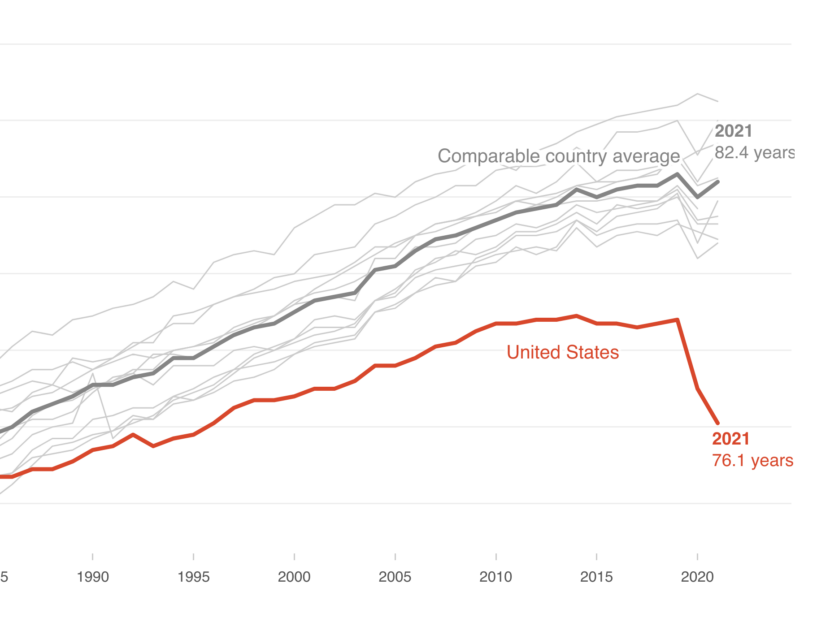
(Source: Peterson-KFF Health System Tracker Credit: Ashley Ahn/NPR)
Just before Christmas, federal health officials confirmed life expectancy in America had dropped for a nearly unprecedented second year in a row – down to 76 years. While countries all over the world saw life expectancy rebound during the second year of the pandemic after the arrival of vaccines, the U.S. did not.
Then, last week, more bad news: Maternal mortality in the U.S. reached a high in 2021. Also, a paper in the Journal of the American Medical Association found rising mortality rates among U.S. children and adolescents.
“This is the first time in my career that I’ve ever seen [an increase in pediatric mortality] – it’s always been declining in the United States for as long as I can remember,” says the JAMA paper’s lead author Steven Woolf, director emeritus of the Center on Society and Health at Virginia Commonwealth University. “Now, it’s increasing at a magnitude that has not occurred at least for half a century.”
Across the lifespan, and across every demographic group, Americans die at younger ages than their counterparts in other wealthy nations.
How could this happen? In a country that prides itself on scientific excellence and innovation, and spends an incredible amount of money on health care, the population keeps dying at younger and younger ages.
An unheard alarm
One group of people are not surprised at all: Woolf and the other researchers involved in a landmark, 400-page study ten years ago with a name that says it all: “Shorter Lives, Poorer Health.” The research by a panel convened by the National Academy of Sciences and funded by the National Institutes of Health compared U.S. health and death with other developed countries. The results showed – convincingly – that the U.S. was stalling on health advances in the population while other countries raced ahead.
The authors tried to sound an alarm, but found few in the public or government or private sectors were willing to listen. In the years since, the trends have worsened. American life expectancy is lower than that of Cuba, Lebanon, and Czechia.
Ten years later, here’s a look back at what that eye-popping study found, and why the researchers involved believe it’s not too late to turn the trends around.
Beyond bad habits
Americans are used to hearing about how their poor diets and sedentary lifestyles make their health bad. It can seem easy to brush that off as another scold about eating more vegetables and getting more exercise. But the picture painted in the “Shorter Lives” report could shock even those who feel like they know the story.
“American children are less likely to live to age 5 than children in other high-income countries,” the authors write on the second page. It goes on: “Even Americans with healthy behaviors, for example, those who are not obese or do not smoke, appear to have higher disease rates than their peers in other countries.”
The researchers catalog what they call the “U.S. health disadvantage” – the fact that living in America is worse for your health and makes you more likely to die younger than if you lived in another rich country like the U.K., Switzerland or Japan.
“We went into this with an open mind as to why it is that the U.S. had a shorter life expectancy than people in other countries,” says Woolf, who chaired the committee that produced the report. After looking across different age and racial and economic and geographic groups, he says, “what we found was that this problem existed in almost every category we looked at.”
That’s why, says Eileen Crimmins, professor of gerontology at the University of Southern California who was also on the panel that produced the report, they made a deliberate choice to focus on the health of the U.S. population as a whole.
“That was a decision – not to emphasize the differences in our population, because there is data that actually shows that even the top proportion of the U.S. population does worse than the top proportion of other populations,” she explains. “We were trying to just say – look, this is an American problem.”
Digging into the ‘why’
The researchers were charged with documenting how Americans have more diseases and die younger and to explore the reasons why.
“We were very systematic and thorough about how we thought about this,” says Woolf. The panel looked at American life and death in terms of the public health and medical care system, individual behaviors like diet and tobacco use, social factors like poverty and inequality, the physical environment, and public policies and values. “In every one of those five buckets, we found problems that distinguish the United States from other countries.”
Yes, Americans eat more calories and lack universal access to health care. But there’s also higher child poverty, racial segregation, social isolation, and more. Even the way cities are designed makes access to good food more difficult.
A fruit seller at Dom Pedro market in Coimbra, central Portugal. A lack of access to fresh fruits and vegetables in the U.S. may contribute to Americans shorter lifespan. (Patricia De Melo MoreiraA/AFP via Getty Images)
“Everybody has a pet thing they worry about and say, ‘it’s oral health’ or ‘it’s suicides’ – everyone has something that they’re legitimately interested in and want to see more attention to,” says John Haaga, who was the director of the Division of Behavioral and Social Research at the National Institute on Aging at NIH, before he retired. “The great value of an exercise like this one was to step back and say, ‘OK, all of these things are going on, but which of them best account for these long-term population level trends that we’re seeing?’ ”
The answer is varied. A big part of the difference between life and death in the U.S. and its peer countries is people dying or being killed before age 50. The “Shorter Lives” report specifically points to factors like teen pregnancy, drug overdoses, HIV, fatal car crashes, injuries, and violence.
“Two years difference in life expectancy probably comes from the fact that firearms are so available in the United States,” Crimmins says. “There’s the opioid epidemic, which is clearly ours – that was our drug companies and other countries didn’t have that because those drugs were more controlled. Some of the difference comes from the fact that we are more likely to drive more miles. We have more cars,” and ultimately, more fatal crashes.
“When we were doing it, we were joking we should call it ‘Live free and die,’ based on the New Hampshire slogan, [‘Live free or die’],” Crimmins says. “The National Academy of Sciences said, ‘That’s outrageous, that’s too provocative.’ ”
There are some things Americans get right, according to the “Shorter Lives” report: “The United States has higher survival after age 75 than do peer countries, and it has higher rates of cancer screening and survival, better control of blood pressure and cholesterol levels, lower stroke mortality, lower rates of current smoking, and higher average household income.” But those achievements, it’s clear, aren’t enough to offset the other problems that befall many Americans at younger ages.
All of this costs the country tremendously. Not only do families lose loved ones too soon, but having a sicker population costs the country as much as $100 billion every year in extra health care costs.
“Behind the statistics detailed in this report are the faces of young people – infants, children, and adolescents – who are unwell and dying early because conditions in this country are not as favorable as those in other countries,” the paper’s authors wrote.
Little action, despite the stakes
“Shorter Lives” is filled with recommended next steps for the government, especially the NIH, which has a budget of more than $40 billion annually to conduct research to improve Americans’ health.
The NIH should undertake a “thorough examination of the policies and approaches that countries with better health outcomes have found useful and that may have application, with adaptations, in the United States,” the authors wrote.
In other words: let’s figure out what they are doing that works in other places, and do it over here.
Dr. Ravi Sawhney, who helped conceive of and launch the “Shorter Lives” study at NIH before he left the agency, had high hopes that the report would make a mark. “I really thought that when the results came out, they would be so obvious that people would say: Let’s finally do this,” he says.
Ten years on, how much of the detailed action plan has been done?
“To be brief, very little of that happened,” Woolf says. At the time, he says, NIH officials didn’t seem very interested in raising awareness about the panel’s findings or in following up on its proposed research agenda. “There was some media coverage at the time that the report rolled out, but NIH was not involved in trying to promote awareness about the report.”
Crimmins agrees. “There was a little bit more research, but there wasn’t any policy reaction,” she says. “I thought there might be, because it’s embarrassing, but it just tends to be ignored.” Those who are interested in this issue, she notes, tend to be those invested in “marvelous things they think are going to delay aging,” even though people older than 75 are the only age group in the country that already does comparatively well.
Haaga, the former NIH division director, also thinks the response at the agency was lacking. “Not nearly enough has been done, given the stakes and given what we could learn,” he says.
In response to NPR’s request for comment for this story, NIH pointed to a subsequent panel on midlife mortality, several initiatives the agency has undertaken on disparities between subgroups within the U.S., and a recent paper funded by NIH that looked again at international life expectancy.
Outgoing NIH Director Francis Collins told NPR in 2021 that it bothered him that there hadn’t been more gains to American life expectancy during his tenure. In his view, the success of NIH in achieving scientific breakthroughs hadn’t translated to more gains because of problems in society that the research agency had little power to change.
Woolf calls it a misconception to assume that America’s great scientific minds and medical discoveries translate to progress for the health of the population. “We are actually very innovative in making these kinds of breakthroughs, but we do very poorly in providing them to our population,” he says.
‘We can’t touch everything’
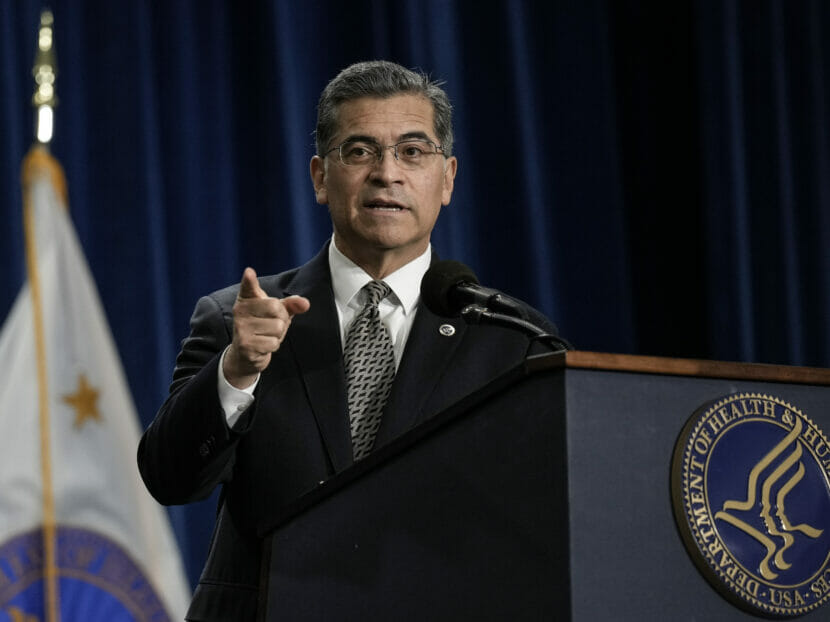
Department of Health and Human Services Secretary Xavier Becerra answered NPR’s question at a press conference earlier this month about work the agency was doing to address lagging life expectancy by mentioning COVID-19 and vaccine hesitancy, along with mental health issues and gun violence.
“There’s so many things that we’re doing,” Becerra said. “We can’t touch everything. We can’t touch state laws that allow an individual to buy an assault weapon and then kill so many people. We can only come in afterwards.”
Secretary of the Department of Health and Human Services Xavier Becerra at a news conference at HHS headquarters in Washington, D.C., on March 9, 2023. Becerra said gun violence contributes to shorter lifespans in the U.S. (Drew Angerer/Getty Images)
CDC Director Rochelle Walensky responded by listing some of the agency’s work on mental health and vaccines, and acting NIH director Larry Tabak pointed to research on health disparities.
HHS did not answer a follow up question about whether the agency has considered a national commission or similar effort to address American life expectancy and poor health.
Sawhney thinks the federal government should try harder to fix the problems documented in the “Shorter Lives” report. He doesn’t think lack of public awareness is the problem. “I really think that most Americans know that Americans are more overweight and obese and that we have higher rates of disease and live shorter lives than other countries,” he says, “It’s just the NIH and the CDC that don’t want to take the responsibility for that failure or to do anything about it.”
Crimmins says, in her experience, lawmakers and federal health officials don’t like talking about how the U.S. is lagging behind other countries.
“I convened a meeting in Washington with the National Center for Health Statistics [part of CDC] about increasing healthy life expectancy,” she recalls. “It was a relatively small meeting, but we brought experts from Canada.” An official at the time gave what she calls a “typical” response, saying: “Oh, we can’t have anything but an American solution to these issues – we can’t listen to other countries.”
“International studies are not the flavor of the month – they never will be,” says Haaga. “The problem with foreign countries is that they’re not in someone’s congressional district.”
It’s more than a missed opportunity, says Woolf. It’s a tragedy.
“If you add up the excess deaths that have occurred in the United States because of this unfolding problem, it dwarfs what happened during COVID-19, as horrible as COVID-19 was,” Woolf says. “We’ve lost many more Americans cumulatively because of this longer systemic issue. And if the systemic issue is unaddressed, it will continue to claim lives going forward.”
Small victories are possible
Taking stock of the many ways in which Americans are sicker and die younger can be overwhelming, says Haaga. “It’s such a long list, that might partly be why the issue doesn’t grab people,” he says. “They just go, ‘Oh, my gosh, that’s depressing, what’s on the other channel?’ But there’s a lot of things that could be done, and small victories are victories.”
According to the “Shorter Lives” report, “the important point about the U.S. health disadvantage is not that the United States is losing a competition with other countries, but that Americans are dying and suffering at rates that are demonstrably unnecessary.”
Rather than feel overwhelmed at the immensity of the problems, Sawhney suggests, the focus should instead be on the fact that every other rich country has been able to figure out how to help people live longer, healthier lives. That means that Americans could do it too, he says.
He believes that the changes might not be as hard as some policymakers and health officials seem to think. “You look at these healthier countries, they’re free countries – England, France, Italy – they’re not banning delicious foods. They’re not chaining people to treadmills,” he says. “Americans love to travel to Europe, to Australia, to Canada to enjoy their foods and their lifestyles, and so the idea that we might say, ‘Hey, maybe we could bring some of those lifestyles back’ – I don’t think people are going to go up in arms that we’re taking away their freedoms.”
Getting policy ideas from other countries is just an obvious move, Woolf adds. “If a martian came down to earth and saw this situation, it would be very intuitive that you [would] look at other countries that have been able to solve this problem and apply the lessons learned,” he says.
In historical research he’s been doing, “I found that there are dozens and dozens of countries on almost every continent of the world that have outperformed the United States for 50 years,” he says. “It’s worth taking a look at what they’ve done and Americanizing it – you don’t have to take it right off the shelf.”
Some of the policies he’s identified as helpful include universal, better coordinated health care, strong health and safety protections, broad access to education, and more investments to help kids get off to a healthy start. These policies are “paying off for them,” he says, and could for Americans, too.
Copyright 2023 NPR. To see more, visit https://www.npr.org.
A Passport Processing employee uses a stack of blank passports to print a new one at the Miami Passport Agency June 22, 2007 in Miami, Fla. Passport processing times are high due to increased demand. (Joe Raedle/Getty Images)
If you’re planning a summer getaway outside of the country, make sure you get your paperwork in order sooner rather than later.
Passports are in “unprecedented demand,” U.S. Secretary of State Antony Blinken said Thursday during a House Appropriations subcommittee budget hearing. In 2022, the State Department issued a record 22 million passports — and 2023 is “on track to break” that record, Blinken said.
The U.S. State Department is fielding half a million passport applications a week, Blinken said. “That’s 30 to 40% above last year, so it’s dramatic.”
The standard processing time for a passport is 10-13 weeks, and an expedited request takes about seven to nine weeks. That doesn’t include mailing time, which can take up to two weeks each way.
“Processing times fluctuate throughout the year depending on demand and we anticipate that they will rise, especially as we approach the busier travel season,” according to a State Department news release.
During the pandemic, “demand went way down,” Blinken said, and the department pulled back the number of staff dedicated to processing passport and visa requests. “Emerging from COVID, we’ve had to build back.”
He said the State Department has hired more staff, authorized overtime and opened satellite offices to process passport applications more quickly.
As pandemic restrictions eased, travel ramped up, with 52% of Americans planning to travel in the next six months, according to the U.S. Travel Association. Travel spending and demand for flights are both higher than 2019’s pre-pandemic levels.
Demand used to be cyclical, with a busy season starting in March and ending in late summer, Blinken said, but now it’s consistently high.
Americans who already have a passport soon will be able to renew it online. The department halted a pilot program “to make sure that we can fine-tune it and improve it before we roll it out in a bigger way,” Blinken said, but “65% of renewal customers for passports will be able to do so online, once this program is fully up and running.”
For those looking to travel to the U.S., the median wait time for visitor visa interview appointments is about two months, half as long as a year ago, and it’s shorter in many parts of the world. Blinken said the department is prioritizing visas with economic impact, like those for students, temporary workers and business travelers.
“In category after category, we’re actually getting back to and even better than pre-pandemic levels,” Blinken said, touting the fact that so far in fiscal year 2023, the department has issued 18% more non-immigrant visas than the same period in fiscal year 2019.
Immigrant visas “are a whole other issue,” Blinken said.
Copyright 2023 NPR. To see more, visit https://www.npr.org.
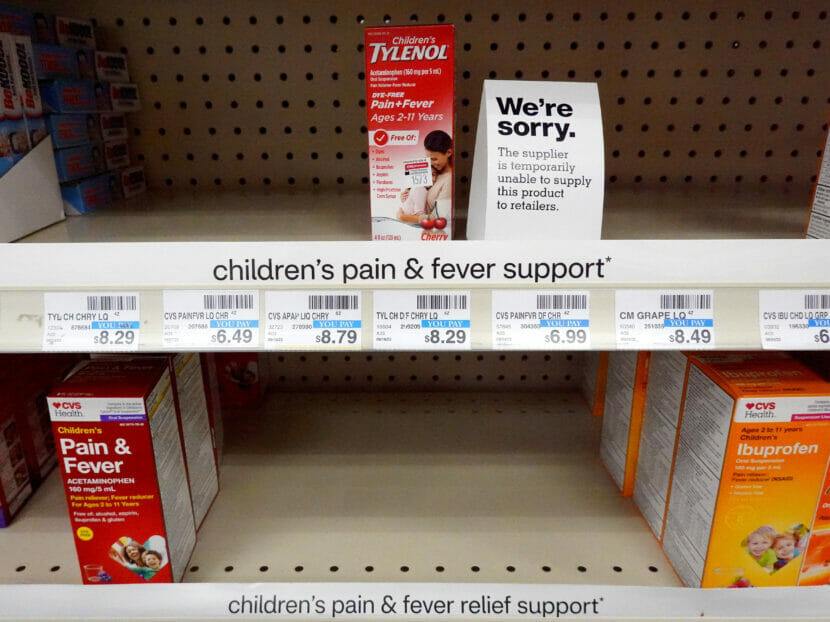
Children’s flu medication was hard to come by in December 2022 as a wave of respiratory viruses spread across the country. (Mario Tama/Getty Images)
It’s not just your imagination: Drugs such as children’s flu medication, common antibiotics and ADHD treatments are getting harder to buy, according to a Senate report published Wednesday.
But even before the pandemic, the U.S. had struggled to overcome essential supply shortfalls. More than 15 “critical care drugs,” such as common antibiotics and injectable sedatives, have remained in short supply for over a decade, the report says.
Reliance on foreign manufacturers is the top reason the U.S. struggles to head off shortages, says Sen. Gary Peters, the Michigan Democrat who chairs the Homeland security committee.
“Nearly 80% of the manufacturing facilities that produce active pharmaceutical ingredients […] are located outside of the U.S.,” he said during a hearing about the issue on Wednesday.
That’s also creating an “unacceptable national security risk,” he says.
The Administration for Strategic Preparedness and Response told the committee staff that 90 to 95% of injectable drugs used for critical acute care rely on key substances from China and India. In other words, a severe breakdown in the supply chain could leave emergency rooms scrambling.
What could be done to solve the drug shortages?
The report also found that the federal government and industry regulators lack visibility into the supply chain for such drugs, making it harder to predict shortages. The Food and Drug Administration doesn’t know, for example, the amount of starting material a manufacturer has available, or, in some instances, how many manufacturers are involved in producing the final drug.
And even in cases where they do have this kind of data, they’re failing to retain it in ways that would help predict shortages. The data stays “buried in PDFs,” the report says. To fix this, the FDA could create a central database of starting-materials levels and track production volume.
Committee Democrats are also recommending that a team of federal agencies pair up to perform regular risk assessments on the supply chain, increase data sharing requirements on private manufacturers, and then increase data sharing between agencies and industry partners.
Increasing federal investments in drug manufacturing would also help wean the U.S. drug supply off foreign countries, according to the report. That might mean incentivizing domestic production or building academic-private partnerships to advance research and development capabilities.
Peters said he’s planning to propose legislation to try to make these long-term recommendations a reality in the near future.
Copyright 2023 NPR. To see more, visit https://www.npr.org.
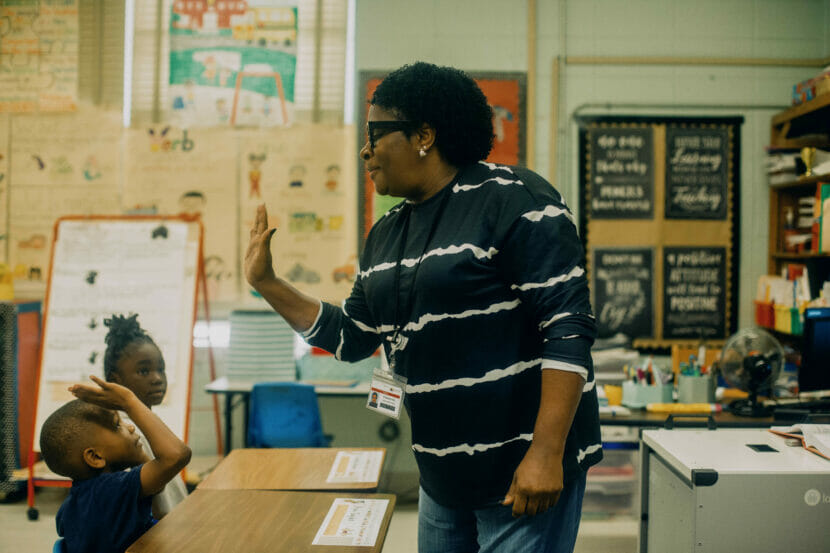
First-grade teacher Kimberly Pate, 52, worked for nearly two decades as a classroom assistant. Through the Mississippi Teacher Residency, she’ll earn a master’s degree plus dual certification in elementary and special education, all at no cost. “How could you pass that up?” she laughs. (Imani Khayyam for NPR)
Wearing an effortless smile and a crisp, gray suit with a cloth lapel flower, Tommy Nalls Jr. projects confidence. Which is the point. In a ballroom full of job candidates, no one wants to dance with a desperate partner. And, as badly as his district needs teachers, Nalls doesn’t want just anyone.
“They have to have this certain grit, that certain fight,” says Nalls, director of recruitment for Jackson Public Schools, in Mississippi’s capital city. “That dog in ’em,’ so to speak.”
On this sun-kissed morning in March, he’s a couple hours north of Jackson, in a ballroom on the campus of Mississippi State University, at a job fair full of soon-to-graduate teachers and school district recruiters from all over the state, and even out-of-state, competing to hire them.
Many districts across the country are grappling with teacher shortages large and small. Limited federal data show, as of October 2022, 45% of public schools had at least one teacher vacancy; that’s after the school year had already begun. And schools that serve high-poverty neighborhoods and/or a “high-minority student body” were more likely to have vacancies.
For several months, NPR has been exploring the forces at work behind these local teacher shortages. Interviews with more than 70 experts and educators across the country, including teachers both aspiring and retiring, offer several explanations: For nearly a decade, fewer people have been going to school to become teachers; pay remains low in many places; and, with unemployment also low, some could-be teachers have chosen more lucrative work elsewhere. Researchers and educators also point to a cultural undertow pulling at the profession: a long decline in Americans’ esteem for teaching.
Educators shared stories of students learning Spanish from computers, and superintendents doing double duty as substitute teachers. But they also shared stories of creative, committed efforts – from San Antonio to Hooper Bay, Alaska – to grow a new generation of teachers, while doing more to make sure veteran teachers want to stay.
Jackson’s story is instructive, if not unique. On average, Nalls says, the district loses 1 in 5 teachers every year. Salaries there start at just $44,000, and, back at the job fair, Nalls has to compete with a suburban Texas district, a few tables over, advertising $58,000.
Jackson’s shortage is also exacerbated by a years-long water crisis and poverty, which can follow students to school in the form of trauma, disruptive behavior and lower test scores. In Mississippi, districts are publicly rated on student performance – a rating novice educators are well aware of. Just a few years ago, Jackson was an F-rated district, and this job fair has plenty of districts with higher salaries and technicolor banners trumpeting their A ratings.
It takes 20 minutes for the first teacher candidate to pause at Nalls’ table.
“I’m looking for a good work environment,” says Kierra Carr, who plans to become an elementary school teacher. “And I just want to have fun with the students, basically.”
“You hadn’t considered ever coming to work and teach in Jackson?” Nalls asks playfully, low-pressure. “Why not?! We’ve got some of the best elementary schools in the state!”
Carr leaves her name and email on Nalls’ interest list, while admitting she has reservations about teaching in Jackson: “It’s kind of scary. I think that’s why most people stray away from teaching there because of what’s been said on the news a lot.”
Nalls leans into these headwinds with patient optimism. Jackson is on the rise, he points out, earning a C rating from the state last year. And he’s proud to make that pitch to the eight candidates he interviews at the fair and the half dozen more who leave their contact information.
“They’re not beating the table down trying to get to Jackson,” Nalls says toward the end of the fair. “But we’re working on that part of it.”
It’s hard to know the size of the problem
“Teacher shortages are poorly understood.” That’s according to a paper published last summer. The reason they’re poorly understood? A profound “lack of data” at the federal- and state-level.
So the paper’s researchers built their own dataset by combing through news reports and the websites of state departments of education. Their conclusion, what they consider a “conservative” estimate of teacher shortages nationwide: at least 36,000 vacant positions and many times more jobs being filled by underqualified teachers. One of those researchers, Tuan Nguyen, shares his data at the easy-to-remember teachershortages.com.
A nationally representative survey, by the RAND Corporation, found that “teacher turnover increased 4 percentage points above prepandemic levels, reaching 10 percent nationally at the end of the 2021–2022 school year.”
It’s important to think of school staffing challenges not as one, national shortage, but as innumerable, hyper-local shortages. Because nationally, “we have more teachers on a numeric basis than we did before the pandemic, and we have fewer students” due to enrollment drops, says Chad Aldeman, a researcher who studies teacher shortages.
“Contrary to popular talking points, there is no generic shortage of teachers,” reads one deep-dive into the available data. “The biggest issue districts face in staffing schools with qualified teachers is… a chronic and perpetual misalignment of teacher supply and demand.”
Some kinds of teachers are consistently in short supply. Jackson Public Schools need special education, science and math teachers. But so does every other district at the job fair.
The misalignment of supply and demand is also geographic and economic, though.
There’s an inequity around teacher shortages
“Some schools are harder to staff,” Aldeman says.
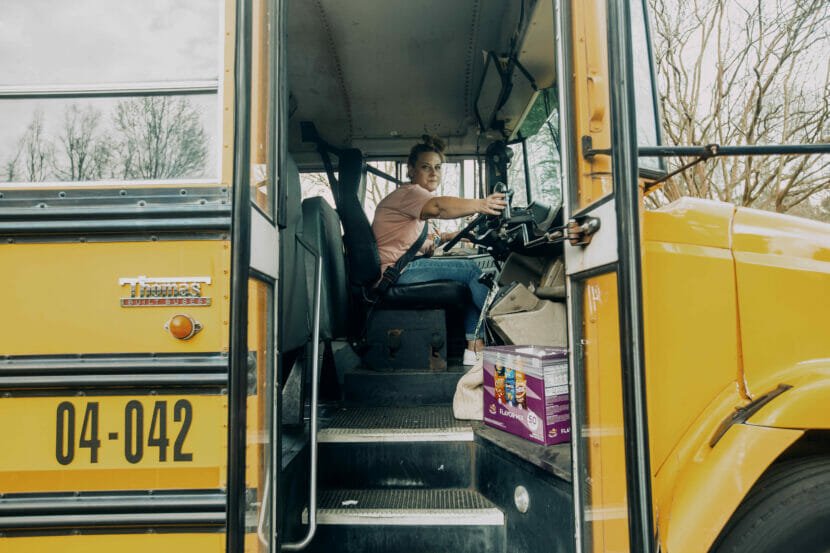
Jennifer Carter earned her master’s degree in December through the Mississippi Teacher Residency. She’s now a special education teacher by day and drives a bus before and after school to make extra money. (Imani Khayyam for NPR)
Many districts “have dozens of teachers applying for the same positions,” Tuan Nguyen explains. “But in a nearby district that is more economically-disadvantaged or has a higher proportion of minority students, they have difficulty attracting teachers.”
In Jackson, the median income of school district households is under $39,000, and 95% of students are Black, after generations of white flight from the district.
It turns out, shortages are a lot like school districts themselves. They often begin and end at arbitrary lines that have more to do with privilege and zip code than the needs of children.
At the job fair, Nalls meets a few candidates who, though they’re from the Jackson area, say they’re more interested in teaching in nearby, more affluent suburban schools.
“It’s the kids that need the most that are getting the least,” says Margarita Bianco, who studies teacher recruitment at the University of Colorado Denver. “And it’s perpetuating an already horrific problem in terms of an opportunity gap between kids of color and their white, more affluent peers.”
Pay and the cost of college also play a role
Given that economically-disadvantaged districts like Jackson are generally hit harder by shortages, the answer to why has to start with money. According to federal data, teachers in the U.S. earned an average of $66,397 in 2021-22. But there are a few wrinkles in that number.
First, it hides enormous variation in school funding and teacher pay from state to state. The average salary in Connecticut, $81,185, may be a comfortable wage, but the average in Mississippi was just $47,162. Keep in mind, that’s not the average starting salary; that’s the average for all public elementary and secondary school teachers in the state.
Salaries can also vary wildly from district to district.
“If I moved down to the district in which I live and taught there, I would probably get a $10,000 pay raise just from switching districts,” says Renee, a veteran high school English teacher in rural Ohio who asked that we not use her last name for fear of reprisal from her district. “We lose a lot of teachers in my district after one, two, three, four years, because if they’re single, especially, it’s not enough money to have even just an apartment by themselves.”
What’s more, after adjusting for inflation, the average teacher’s salary has stagnated since 1990. According to research from the Economic Policy Institute, that means teachers also earned 23.5% less than comparable college graduates in 2021. Even after factoring in other benefits, teacher compensation still lagged other college grads by roughly 14%.
“I’m more educated than my husband,” says Renee in rural Ohio. “I have two master’s degrees and a bachelor’s degree, and I earn way less than he does.”
Renee echoed something NPR heard from many teachers – that she’s tired of hearing school leaders and politicians talk of teaching as “a calling,” while pay remains so low.
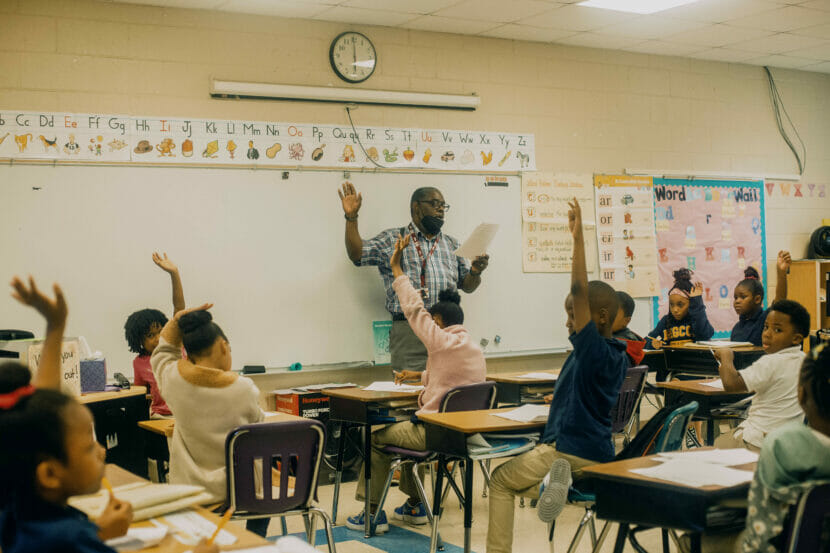
Pastor Dwayne Williams, aka Mister D, started as a substitute teacher, but fell in love with the work and eventually enrolled in the Mississippi Teacher Residency program. Now the 61-year-old is teaching second-graders. “You may not change everybody,” Williams says, “but you can change somebody.” (Imani Khayyam for NPR)
Yes, she says, “it’s a calling. But it also should be a career.”
There’s also the front-end cost of becoming a teacher. Most places still require at least 4 years of college, and federal data show that, while teacher pay has been stagnant since 1990, the inflation-adjusted cost of college has nearly doubled, from about $15,000 a year in 1990 to $29,000 in 2020.
Making matters worse, federal loan forgiveness programs meant to help teachers shed college debts have made headlines for doing the opposite. The rising cost of college is forcing an uncomfortable cost-benefit analysis on aspiring teachers. Ominously, between 2010 and 2018, enrollment in traditional teacher preparation programs dropped by roughly a third.
One important caveat to that decline, and an early sign of good news, is that since 2018 “the data suggest that things are getting better, not worse,” says researcher Chad Aldeman.
The prestige associated with teaching isn’t what it used to be
Pay, specialty and zip code matter a lot when it comes to local teacher shortages, but Matthew Kraft, who studies teacher hiring and training at Brown University, says subtler, no less important forces are also at work – about how we perceive teaching.
Meaning, do we, as a culture, think teaching is prestigious? Is it a worthwhile pursuit that rewards hard work and earns the respect of peers? Are teachers happy they chose teaching?
Kraft and his colleague studied more than a dozen datasets in an effort to gauge the health of the teaching profession over time. They looked at a nationally-representative poll of high school seniors and multiple job satisfaction surveys of educators themselves.
“Across every single indicator we measure, our findings show that the overall wellbeing of the teaching profession today is at or near historically low levels,” they write.
Perceptions of teacher prestige have fallen in the last decade, they write, “to be at or near the lowest levels recorded over the last half century.”
So too has interest in teaching fallen among high school seniors and college freshmen: “50% since the 1990s, and 38% since 2010, reaching the lowest level in the last 50 years.”
So that’s generations of could-be teachers choosing other paths. What about those who do choose teaching?
“Teachers’ job satisfaction is also at the lowest level in five decades, with the percent of teachers who feel the stress of their job is worth it dropping from 81% to 42% in the last 15 years.”
And that drop is not simply the result of pandemic stress, the researchers write. “Most of these declines occurred steadily throughout the last decade suggesting they are a function of larger, long-standing structural issues with the profession. In our view, these findings should be cause for serious national concern.”
In NPR interviews, former and current teachers offered story after story that echoed these broader findings – that teaching through the pandemic was incredibly difficult, but that many challenges had begun long before COVID-19.
“We have definitely hit a new low,” says Sandy Brumbaum, an elementary school teacher and literacy coach in the California Bay Area, who says teachers have felt micromanaged and disrespected by political efforts at the national, state and district level for years. “When politicians and parents get involved and say, ‘You can’t teach this, and you can’t teach that.’ Like, you’re judged and you’re shamed for how you’re teaching. I think that is demeaning.“
In rural Kansas, Chelsey Juenemann has been teaching middle school language arts for most of her 20-year career, but, in November, she told her superintendent she’d be leaving at the end of the school year.
“The view of education, the view of teachers has changed,” Juenemann worries. “There’s not a lot of respect for education and educators. And it just takes it out of you after a while.”
Teachers were once thought of as “heroes,” Juenemann says, echoing generations of polling. “These heroes that make such a difference in children’s lives. And I don’t feel like education and educators are viewed that way anymore.”
“Fix the teacher shortage? Well, how about you have supported teachers,” says Christina Trosper of Knox County, Ky., who’s in her 21st year of teaching. Trosper says, as a high school social studies teacher, the politics around what she can teach have become toxic. “I’ve struggled. I have been ostracized. I have been straight up harassed. I have had death threats.”
But Trosper says she won’t stop teaching. “I f***ing love it. I love it. It is my passion.”
Marie, an elementary school teacher for 10 years in Milwaukee, resigned in summer 2020. She says she loved working with children; it was the lesson-planning on nights and weekends, low pay, tension with some parents and lack of support from school leaders that led her to leave. Marie didn’t want to use her full name because she still sometimes works as a substitute teacher in the district.
“I cried so hard writing that resignation letter,” she says. “I mourned the loss of that part of me and what could have been. And I was really heartbroken because it didn’t have to be like this. Like, education could be good. It could be a good profession. But it just wasn’t for me.”
How some districts are trying to convince people teaching is for them
There is still plenty states and districts can do to better support current teachers and invest in the next generation of educators.
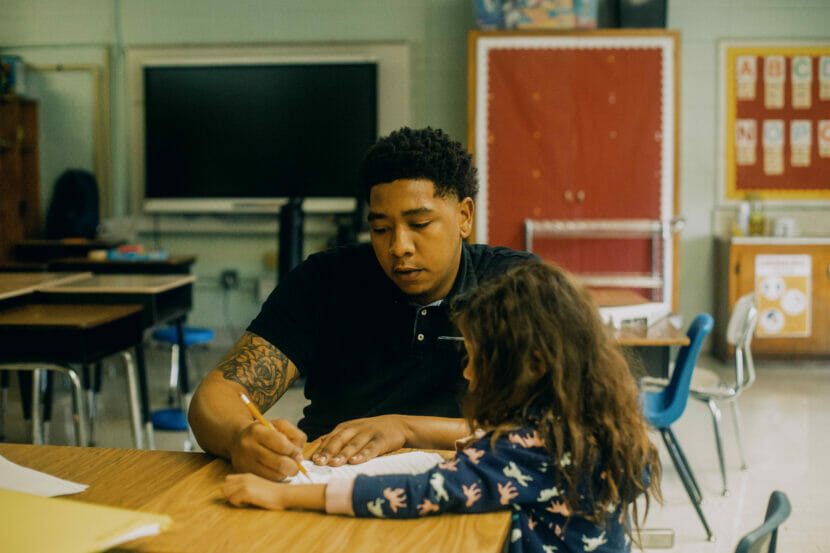
Elementary school teacher Jonah Thomas, 22, is new to the classroom. Later this spring, he’ll earn his master’s in education through the Mississippi Teacher Residency. (Imani Khayyam for NPR)
One option stems from a national movement around Grow Your Own (GYO) programs, in which teacher candidates are cultivated from the local community. The hope is a community member will be more personally invested in the school system, and more likely to stick around.
Drawing teachers from the community also makes it easier for students to see themselves and their life experiences reflected in their teachers.
According to New America, at least 35 states have some sort of GYO policy on the books and/or fund a GYO program. Among those states is Mississippi, where Kimberly Pate now teaches first grade.
Pate, 52, worked for nearly two decades in Jackson’s schools as a classroom assistant.
The pay was “peanuts,” Pate says, “so I was working literally two full time jobs to make ends meet.” With four children of her own, she couldn’t afford to go back to college, to become a fully-licensed teacher. That is, until she was offered a slot in the Mississippi Teacher Residency.
The pitch was hard to believe: In one year, she’d get a fully-paid-for master’s degree from nearby Jackson State University and a better salary. She’d be assigned an experienced mentor at the school where she works (in her case, the assistant principal) to support her. Plus, Pate could keep working full-time while being a student – so she could support her family.
“If it wasn’t a full salary, I don’t think I would be able to do it,” says Pate, who will earn her master’s, plus dual certification in elementary and special education, later this spring. “It’s like, how could you pass that up?”
In return for all of that, Jackson gets a few things. A fully licensed elementary and special education teacher, both in short supply there. Also, a promise from Pate that she will keep teaching in the city for at least three years.
The Mississippi Department of Education is focusing its Grow Your Own efforts in 42 districts across the state that have had the hardest time finding and keeping staff. The Mississippi Teacher Residency stands out for its generosity.
“It’s really a no-cost pathway. It is a Cadillac package,” says Courtney Van Cleve, who heads teacher talent acquisition for the Mississippi Department of Education. “We cover everything: tuition, books, testing fees.”
Originally paid for by a grant from the W.K. Kellogg Foundation, the Residency is now funded with federal dollars, through the Elementary and Secondary School Emergency Relief (ESSER) Fund.
Not only does the program cover the full costs of a master’s degree while allowing candidates to continue working full-time, it is also explicitly intended to diversify the teacher workforce. According to the state, 70% of the program’s residents identify as teachers of color.
“Fewer than 1 in 5 teachers are people of color, but more than half of U.S. students are young people of color,” wrote U.S. Education Secretary Miguel Cardona in a recent op-ed. “We know that our students benefit from being taught by teachers of all backgrounds.”
In Jackson, that means using the Residency program to continue to train and retain teachers of color, including Pate and Jonah Thomas, 22, whose classroom is just down the hall from Pate’s.
“You don’t see too many black male teachers in elementary [school],” says Thomas, who daps up a group of boys at the cafeteria door as he walks to class. “Their father may not be here or their parents may not be getting along, so they’re not seeing their father.”
Thomas says, “I’m here for them. And I can talk to [them] about anything that [they] may be going through.”
Thomas wears a crisp black shirt, the sleeves just short enough to show his brother’s name, Jonathan, tattooed on his right arm. He’s an example of how GYO programs use incentives to reach college grads who might not have even considered teaching. He studied economics in college.
“I was still looking for accounting jobs,” Thomas says, when he heard about the Mississippi Teacher Residency. “If it weren’t for this program, I wouldn’t even be a teacher.”
But he was enticed by the idea, having seen first-hand the power of great teaching.
“I watched my mom teach growing up as a little boy. She treated other kids like they were her kids. Like, I remember being jealous sometimes,” Thomas laughs.
He says taking master’s-level classes while also working in the classroom has been exhausting, but kind of amazing. “Everything that we learned we can apply it to our classroom. Like, we’d have classes sometimes where we may learn Wednesday something we can come to school and apply Thursday.”
Eighteen full-fledged Jackson teachers have already come out of the Residency program, and about as many are on their way.
Kimberly Pate says, if it weren’t for the Mississippi Teacher Residency, she likely wouldn’t be where she is now either, in her own classroom, facing a room full of eager first-graders.
Working on a reading lesson, the children smile on the edge of their chairs, sounding out P-ai-n-t.
It’s hard work, reading. But they know they have Ms. Pate, and she isn’t going anywhere.
Edited by: Nicole Cohen
Visual design and development by: LA Johnson and Ashley Ahn
Research by: Jonaki Mehta
Audio stories produced by: Lauren Migaki
Audio stories edited by: Steven Drummond and Nicole Cohen
Copyright 2023 NPR. To see more, visit https://www.npr.org.
Transcript :
STEVE INSKEEP, HOST:
Almost half of America’s public schools were down at least one teacher this school year. You can blame low pay and politics and pandemic burnout. NPR’s Cory Turner and Lauren Migaki visited a job fair in Mississippi where recruiters were seeking new teachers.
UNIDENTIFIED RECRUITER #1: Hey. I’m from Frisco, Texas. We’re, like, busting out the seams (laughter). So we’re going everywhere to find good teachers.
UNIDENTIFIED RECRUITER #2: We have a lot of openings.
UNIDENTIFIED RECRUITER #3: Math and some science.
UNIDENTIFIED RECRUITER #4: We have a shortage of math teachers.
UNIDENTIFIED RECRUITER #2: Foreign language. Special education.
UNIDENTIFIED RECRUITER #5: High school English.
UNIDENTIFIED RECRUITER #6: So we’re looking for a music teacher. We have…
UNIDENTIFIED RECRUITER #2: Yeah, a little bit of everything.
INSKEEP: Cory Turner shadowed a recruiter for Jackson, Miss.
CORY TURNER, BYLINE: Dr. Tommy Nalls Jr. used to teach high school science in Mississippi’s capital city, Jackson. Now he’s trying to convince a new generation of teachers to do the same.
TOMMY NALLS JR: They have to kind of have that certain grit, that certain fight – like we say, that dog in them, so to speak – where they are tenacious, you know, they fit us.
TURNER: Nalls is head of recruitment for Jackson Public Schools. And even before the pandemic, he had a tough job. On average, the district loses 1 in 5 teachers every year. It doesn’t help that Mississippi ranks near the bottom in teacher pay. And Jackson is embroiled in a years-long water crisis. And then there’s the city’s poverty. It follows children to school in the form of trauma, disruptive behavior and lower test scores. But Tommy Nalls is an optimist. And on this sunny March morning on the campus of Mississippi State, he’s arrived early with a plan.
(SOUNDBITE OF SUITCASE ROLLING)
TURNER: Nalls wears a grey plaid jacket with a blue cloth flower in his lapel. In one hand, coffee – in the other, he pulls a suitcase full of job fair pamphlets and giveaway goodies.
NALLS: I have eight interviews set up this afternoon (laughter).
TURNER: Eight interviews.
NALLS: Eight interviews. My first one starts at 11:30.
TURNER: When he checks in…
NALLS: Good morning.
UNIDENTIFIED PERSON: Hi. Good morning.
TURNER: …Good news. Jackson’s been given a table just inside the doors.
NALLS: Prime real estate.
TURNER: Even now, as the school year winds down, Jackson schools still have 88 vacancies out of about 1,700 teaching positions. To give you a sense of the impact of just one vacancy, we’re going to leave this ballroom for a minute and go to Jackson.
(SOUNDBITE OF DEVICE BEEPING)
TURNER: At Forest Hill High School, home of the Patriots, Principal Torrey Hampton walks fast with a walkie talkie. He’s winded when he shows me around. I ask, how hard has it been to find a qualified Spanish teacher?
TORREY HAMPTON: Still hard. Hadn’t found one yet.
TURNER: And yet Hampton’s walking me to a classroom full of students taking Spanish 2.
HAMPTON: So I had to do what’s best for the children and change the class, but through our online platform.
TURNER: That means when we get to the room, instead of hearing Spanish, we hear this.
(SOUNDBITE OF JAZZY COFFEE’S “RUBBER CATS”)
TURNER: Smooth jazz plays through speakers at the front of the class while students sit at their desks, library quiet.
UNIDENTIFIED STUDENT: This one is…
TURNER: They’re trying to translate English phrases into Spanish through a computer program on their laptops.
Wait, what just happened? I saw a big, red X.
UNIDENTIFIED STUDENT: (Laughter) If you get it wrong, it gives you a chance to try again.
TURNER: How do you like this?
UNIDENTIFIED STUDENT: I think it’s all right. Like, I think it would be better if we actually had a teacher.
TURNER: For much of the past decade, enrollment in teacher training programs dropped nationwide by roughly a third. With fewer new teachers in the traditional pipeline, Jackson has to compete more than ever with better funded suburban districts. So back at that job fair, just listen to these pitches from the competition.
UNIDENTIFIED RECRUITER #7: We are an A-rated district.
UNIDENTIFIED RECRUITER #8: There are a lot of high expectations. And, you know, we are that A-rated school.
UNIDENTIFIED RECRUITER #9: We have a beach that most places don’t have. So…
UNIDENTIFIED RECRUITER #10: Listen; let me talk about the town a little bit. Vicksburg is very close-knit.
UNIDENTIFIED RECRUITER #11: Western Line is family. So everyone really gets to know each other.
UNIDENTIFIED RECRUITER #10: You still got a little bit of shopping that you can do.
UNIDENTIFIED RECRUITER #12: All right. So we have our own health clinic for teachers that’s free. We can reimburse them for if they go and workout.
UNIDENTIFIED RECRUITER #9: We have instructional coaches at every one of our campuses.
UNIDENTIFIED RECRUITER #12: We pay really well. Texas probably pays better than most. Next year, it should be about 60,000.
TURNER: In Jackson, the starting salary is less than 44,000. There’s also those A ratings we just heard about, doled out by the state for things like student test scores and absentee rates. Well, all over this job fair, districts trumpet their A ratings on banners, districts that haven’t had to deal with the poverty or systemic racism that Jackson has. So I asked Tommy Nalls, Jackson’s recruiter, does that bother him?
NALLS: I mean, I’m of the mindset that, hey, if you’re A district, regardless of how you got it, you know, you’re A, you know? Promote that.
TURNER: Nalls proudly points out that Jackson’s gone from an F rating just a few years ago to a high C.
NALLS: We’re going to promote that we’re a C. But one day, just understand and know that our district is going to be right there with you. And we’re going to be able to promote that we did it without all of the resources and without all of the affluence.
TURNER: Nalls faces one more challenge. Most of the candidates here are young white women, which reflects the teaching force nationwide. Jackson’s students, on the other hand, are predominantly Black after generations of white flight from the city. It takes more than 20 minutes for just one teacher candidate to stop at Nalls table. Kierra Carr says she’s hesitant to work in Jackson.
KIERRA CARR: It’s kind of scary. I think that’s why most people stray away from teaching there, because of, like, what’s been said on the news a lot.
TURNER: Nalls does get her attention, though, when he mentions the district is offering a signing bonus.
NALLS: Yeah, for elementary, we do 7,500.
CARR: That sound nice, too.
NALLS: I should’ve led with that, huh (laughter)?
CARR: Yeah, you didn’t say that.
TURNER: While the bonus helps, Nalls says he wants teachers who want to work in Jackson. Later, a trio of promising candidates drop by Nalls’ table, including Sydney Bearden (ph).
SYDNEY BEARDEN: More than ever, we need to show up and show out and show these kids, here I am, dedicating my time to teach you and advocate for you.
TURNER: In the end, I ask Nalls, how would he rate this job fair?
NALLS: Yeah. I would say B, B-plus, not quite an A because they’re not beating the table down trying to get to Jackson. But we’re working on that part of it. But nice, solid fair, good traffic.
TURNER: Tommy Nalls packs up his pamphlets and keychains and readies himself for another job fair and another chance to make his case for the children of Jackson.
Cory Turner, NPR News, Starkville, Miss.
(SOUNDBITE OF DORENA’S “LET US LIVE”) Transcript provided by NPR, Copyright NPR.
Close
Update notification options
Subscribe to notifications
Subscribe
Get notifications about news related to the topics you care about. You can unsubscribe anytime.


9(MDEwMjQ0ODM1MDEzNDk4MTEzNjU3NTRhYg004))
9(MDEwMjQ0ODM1MDEzNDk4MTEzNjU3NTRhYg004))

9(MDEwMjQ0ODM1MDEzNDk4MTEzNjU3NTRhYg004))

9(MDEwMjQ0ODM1MDEzNDk4MTEzNjU3NTRhYg004))
9(MDEwMjQ0ODM1MDEzNDk4MTEzNjU3NTRhYg004))