NPR News

KTOO is the NPR member station in Juneau. NPR offers its members radio and digital stories.

In Florida, far-right groups look to seize the moment

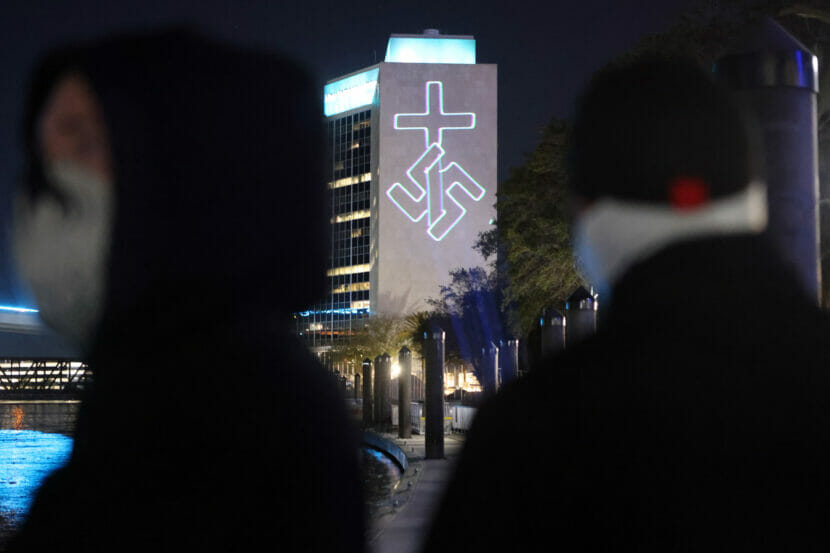
Members of the white nationalist group National Socialist Florida use a laser projector to display white nationalist and anti-LGBTQ images on the side of the CSX building and other high-rise buildings in Jacksonville, Fla. (Jim Urquhart for NPR)

JACKSONVILLE, Fla. — It’s an unseasonably cool January evening. Helicopters buzz overhead as a NFL playoff game gets underway. In a downtown alley not far from the stadium, masked men have their sights on the 37-story Wells Fargo Center.

Two of the men wear white gaiters with the acronym of their white nationalist group, National Socialist Florida, written in the typeface of German WW II propaganda posters. One of the men kneels down in the alley and takes off his backpack. He removes a commercial grade laser projector that retails for about $3,000. Smaller than a loaf of bread, compact, powerful and mobile.

Josh Nunes, the leader of the small band of white nationalist extremists, keeps a lookout for police while the other man aims the laser onto the skyscraper, careful to avoid helicopters flying overhead and possible detection. He projects a rolling ticker tape onto the building that reads, “Why are child friendly drag shows legal? @ Ron DeSantis.” Nunes cranes his neck to see how it looks.

This demonstration might not seem like much, but for these far-right groups, it’s a way to punch above their weight and get noticed.

“What we’re really going for is people putting it on social media and spreading it around and pushing the conversation in the public arena,” Nunes says.

Finding people with like minds

Nunes and his group first tried the laser projections last year during a college football game. They projected a message onto the stadium that read, “Kanye is right about the Jews!” The line was a nod to recent antisemitic rants by the artist and business mogul Ye, formerly known as Kanye West. On that night Nunes says he brought along the leader of another small neo-Nazi group in Florida to observe and “to see if it was worth picking up.”

Nunes and his group regularly coordinate with other far-right groups, forming what the advocacy organization Anti-Defamation League calls an unprecedented level of coordination among white nationalist groups in Florida.

“What we have seen is certain types of activism definitely gets interest and recruitment up. And that’s where like the drag queen shit — like everybody wants to be a part of the team shutting that down,” says Nunes, referencing the manufactured hysteria over children and drag events stoked by politicians and pundits and spurred on by extremists like himself.

Nunes and his group are intentionally choosing messages meant to resonate with a mainstream conservative audience. At the same time, mainstream political figures like Florida Gov. Ron DeSantis have fused some far-right talking points into their political rhetoric.

This year, the governor tapped into outrage fueled by disinformation over Critical Race Theory by threatening to end high school advanced placement courses in African American Studies. Last year, DeSantis signed the so-called “don’t say gay” law that barred classroom discussion about sexual orientation or gender identity in kindergarten through third grade.

There were 141 incidents of anti-LGBTQ protests and threats targeting specific drag events last year according to the Gay & Lesbian Alliance Against Defamation, an advocacy organization. In addition, protests against drag shows have been a growing target among far-right groups, according to data from The Armed Conflict Location & Event Data Project.

“We’ve just seen the largest upticks in recruitment from the drag stuff,” Nunes says.

He says the group began with just a handful of followers going out to protest drag shows last year. But it’s been growing, with demonstrations becoming a monthly occurrence.

“It’s not uncommon to show up with 20 dudes now,” says Nunes. “We’re hoping by the end of this year maybe we got 30 or 40 guys.”

A nice way to go about it

“Hang on one second. Hello?” says Nunes, pulling out his phone. “Cross the bridge and I’ll drop you a pin.” Moments later, the man Nunes was talking to appears and walks into the alley. He covers his face with a black gaiter and doesn’t want to give his name. Two more men will join the same way, covering their faces and withholding their names. The group continues projecting different messages onto the building, most of them about drag shows.

“A lot of this is pretty boring, to be honest with you,” Nunes says. “Most of the time we don’t have much interaction.”

Nunes oversees this campaign to spread hate like a foreman watching his crew pour cement. “So it’s like when we’ve got two or three guys out here, we’re not trying to have people accost us,” he says, explaining that they’re looking to avoid confrontations with pedestrians or police.

Nunes touts tolerance even as his group spreads noxious hate. “Obviously, we’re critical of racial issues” he says, couching racist rhetoric in civility. “But there’s a nice way to go about it, that’s not gonna get your teeth punched out of your head.”

The group is careful mostly to avoid attracting the attention of Antifa, far-left activists who would look to stop Nunes and his crew through physical force. Antifa has become a boogeyman of sorts for the right, even being called Nazis themselves in some right-wing media. Nunes and his group find that frustrating – it’s a mantle they’d like to claim.

“They’re like, ‘Antifa’s the real Nazis,’ ” Nunes says in exasperation. “You know, they say stuff like that and it’s like, ‘Yeah, you know, I don’t know.’ ”

An unhoused man in the alley can’t sleep with some of the noise Nunes and his crew are making. He gets up and asks what they’re doing. Nunes offers the man some homemade coffee he brought for the guys in the group, brushing away questions. Nunes suspects a police helicopter might be overhead. They begin packing up to move to a different spot. They take off their gaiters and walk through downtown Jacksonville unnoticed.

People flood out from the bars and restaurants. It’s a mixed crowd: white, Black, Latino. The five men mask up and set up again near the waterfront, keeping a lookout for police. One of the men shines an image onto the CSX building. “That’s a cross and a swastika,” Nunes says with pride. At five stories tall, the image is visible for miles.

Projecting power

In 2021, the Department of Homeland Security designated white nationalists the biggest domestic threat the U.S. faces. Experts say there’s a strategy behind the kinds of things Nunes is doing.

“These groups are looking to sanitize this imagery like this,” says Ben Popp, a researcher with the Anti-Defamation League’s Center on Extremism. Over the past two years, the ADL has tracked over 400 instances of white nationalist literature being disseminated in Florida. Popp says the normalizing of racist imagery is one way that white nationalists look to gain a foothold.

“They want the community to view this as a normal occurrence, so they’re attempting to make it a normal occurrence by going out every weekend and using these laser projectors to do this,” Popp says.

These kinds of actions, he adds, are meant to project power, to portray the group as larger and more powerful than they are – which, for the moment, is a handful of masked men standing at the waterfront on a Saturday night.

But Nunes’ small group continues to grow, as once-fringe white nationalist rhetoric and ideas gain traction. A 2022 poll by The Associated Press–NORC Center for Public Affairs Research found that 1 in 3 Americans believe in certain aspects of “Replacement Theory” when it comes to immigration, subscribing to the idea that liberal elites are trying to replace native born Americans with immigrants for electoral gains. It’s a false conspiracy theory long circulated amongst white nationalists and now part of popular political parlance, and regularly cited by right-wing mainstays like Fox News’ Tucker Carlson.

“It’s a good way to relate to normal people.”

Nunes believes he is able to draw men into the group by offering community to men who are looking for meaning, trapped in a digital culture.

“I think our society is pretty fractured. It’s like, for the average male in America right now, a lot of dudes don’t have one friend,” he says. “They don’t have one person they can call and borrow $500 if they needed to. And that is a thing that’s real within this group. If one of our buddies needs help, we’re gonna help them. There is a fraternity there.

“We’re like regular working-class white people that are racially aware. And so we’re Nazis, right?” Nunes says while overseeing the Saturday night laser projections, “And so stuff like this, we feel like it’s a good way to relate to normal people.”

Nunes is emblematic of today’s white nationalists, embracing whiteness as descendants of Europeans rather than obsessing over Aryan bloodlines. He says he’s half-Portuguese – in a movement historically fixated on perceived purity that would’ve been a barrier to entry in the past.

“I’ve definitely got some Iberian blood. And there’s, you know, there’s all types in the movement. There’s people that are, like, super hard, purity spiralers. But it’s like, at the end of the day, that’s never going to work in America,” Nunes says.

The face of hate

“I think it’s tempting to look for simple explanations for complex behaviors,” says Mike German, former FBI agent and current fellow at the Brennan Center for Justice. He worked undercover in the 1990s infiltrating white supremacist groups. German says those who adhere to white nationalist ideology today or who traffic in it don’t always fit the stereotype of people marching with jack boots and swastika tattoos.

“They are part of our society. And it’s not as fringe as we’d like to believe. There are people in law enforcement who subscribe to these ideas. There are people in government, people in elected office. White supremacists just had dinner with the former president of the United States,” German says, referencing Donald Trump’s meeting late last year with Ye and white nationalist Nick Fuentes. Fuentes and Ye have formed a bizarre alliance over a shared love of Hitler and antisemitic rhetoric.

As the nation grapples with how to confront the rise of domestic extremism, local city governments face their own challenges with people like Josh Nunes. The city of Jacksonville has passed a city ordinance that makes it illegal to project images onto buildings without the building owner’s consent — a misdemeanor offense. But it’s unclear how such a move will bear up under legal scrutiny. Many political groups have used projectors in public areas as forms of demonstration, an act that lower courts have historically upheld as protected by the First Amendment.

Copyright 2023 NPR. To see more, visit https://www.npr.org.

Climate solutions do exist. These 6 experts detail what they look like

Researchers say protecting mangroves that soak up carbon is a great climate solution. But they caution against programs that slap carbon offsets onto it as those offsets can be hard to verify. (Marie Hickman/Getty Images)

Scientists say there’s a lot we can still do to slow the speed of climate change. But when it comes to “climate solutions,” some are real, and some aren’t, says Naomi Oreskes, historian of science at Harvard University. “This space has become really muddied,” she says.

So how does someone figure out what’s legit? We asked six climate scholars for the questions they ask themselves whenever they come across something claiming to be a climate solution.

A big climate solution is an obvious one

It may sound basic, but one big way to address climate change is to reduce the main human activity that caused it in the first place: burning fossil fuels.

Scientists say that means ultimately transitioning away from oil, coal and gas and becoming more energy efficient. We already have a lot of the technology we need to make this transition, like solar, wind, and batteries, Oreskes says.

“What we need to do right now is to mobilize the technologies that already exist, that work and are cost competitive, and that essentially means renewable energy and storage,” she says.

Think about who’s selling you the solution

It’s important to think about both who’s selling you the climate solution and what they say the problem is, says Melissa Aronczyk, professor of media at Rutgers University.

“People like to come up with solutions, but to do that, they usually have to interpret the problem in a way that works for them,” she says.

Oreskes says pay attention when you see a “climate solution” that means increasing the use of fossil fuels. She says an example is natural gas, which has been sold as a “bridge fuel” from coal to renewable energy. But natural gas is still a fossil fuel, and its production, transport and use release methane, a greenhouse gas far more potent than carbon dioxide.

“I think we need to start by looking at what happens when the fossil fuel industry comes up with solutions, because here is the greatest potential for conflict of interest,” Aronczyk says.

A solution may sound promising, but is it available and scalable now?

Sometimes you’ll hear about new promising technology like carbon removal, which vacuums carbon dioxide out of the air and stores it underground, says David Ho, a professor of oceanography at University of Hawaii at Manoa.

Ho researches climate solutions and he says ask yourself: is this technology available, affordable, or scalable now?

“I think people who don’t work in this space think we have all these technologies that are ready to remove carbon dioxide from the atmosphere, for instance. And we’re not there,” Ho says.

If it’s adding emissions, it’s not a climate solution

These days all kinds of companies, from airlines to wedding dress companies, might offer to let you buy “carbon offsets” along with your purchase. That offset money could do something like build a new wind farm or plant trees that would — in theory — soak up and store the equivalent carbon dioxide emissions of taking a flight or making a new dress.

But there are often problems with regulation and verification of offsets, says Roberto Schaeffer, a professor of energy economics at the Federal University of Rio de Janeiro in Brazil. “It’s very dangerous, very dangerous indeed,” he says.

He says with offsets from forests, it’s hard to verify if the trees are really being protected, that those trees won’t get cut down or burned in a wildfire.

“You cannot guarantee, ‘Okay, you’re gonna offset your dress by planting a tree.’ You have no guarantee that in three years time that tree is gonna be there,” he says.

If you make emissions thinking you’re offsetting them, and the offset doesn’t work, that’s doubling the emissions, says Adrienne Buller, a climate finance researcher and director of research at Common Wealth, a think tank in the United Kingdom, “It’s sort of like doubly bad.”

If a solution sounds too easy, be skeptical

Many things sold as carbon offsets — like restoring or protecting forests — are, on their own, great climate solutions, Buller says. “We need things like trees,” she says, “To draw carbon out of the atmosphere.”

The problem is when carbon markets sell the idea that you can continue emitting as usual and everything will be fine if you just buy an offset, Buller says. “It’s kind of a solution that implies that we don’t have to do that much hard work. We can just kind of do some minor tweaks to the way that we currently do things,” she says.

Schaeffer says there is a lot of hard work in our future to get off of fossil fuels and onto clean energy sources. “So people have to realize there is a price to pay here. No free lunch.”

It’s not all about business. Governments must play a role in solutions, too

We often think of businesses working on climate solutions on their own, but that’s often not the case, says Oreskes. Government often plays a big role in funding and research support for new climate technology, says June Sekera, a visiting scholar at The New School who studies public policy and climate.

And governments will also have to play a big role in regulating emissions, says Schaeffer, who has been working with the United Nations’ Intergovernmental Panel on Climate Change for 25 years.

That’s why all the scholars NPR spoke with for this story say one big climate solution is to vote.

Schaeffer points to the recent election in Brazil, where climate change was a big campaign issue for candidate Luiz Inácio Lula da Silva. Lula won, and has promised to address deforestation, a big source of Brazil’s emissions.

There’s no one solution to climate change – and no one can do it alone

Aronczyk wants to make one thing clear: there is no one solution to climate change.

“We’re human beings. We encounter a problem, we wanna solve that problem,” Aronczyk says, “But just as there is no one way to describe climate change, there’s no one way to offer a solution.”

Climate solutions will take different forms, Sekera says. Some solutions may slow climate change, some may offer us ways to adapt.

The key thing, Aronczyk says, is that climate solutions will involve governments, businesses, and individuals. She says: “It is an all hands on deck kind of a situation.”

Copyright 2023 NPR. To see more, visit https://www.npr.org.

Walgreens won’t sell abortion pills in red states, including Alaska, that threatened legal action

A Walgreens pharmacy is pictured on Jan. 5 in New York City. Walgreens says it won’t sell mifepristone in states where Republican attorneys general threatened legal action. (Michael M. Santiago/Getty Images)

Walgreens won’t distribute abortion pills in states where Republican officials have threatened legal action — including some places where abortion is still legal and available. The pharmacy chain said in a statement to NPR on Friday that it’s still taking steps to sell the drug in “jurisdictions where it is legal and operationally feasible.”

The confirmation came a month after 20 Republican state attorneys general, mostly from states where abortion is banned or heavily restricted, sent letters threatening Walgreens and other pharmacies with legal action if they dispensed mifepristone, an abortion pill.

The Food and Drug Administration finalized a new rule in January allowing retail pharmacies to get certified to distribute the drug, and companies including Walgreens and CVS said they’re applying for certification. Medication abortion — not surgery — is the most common way that people terminate pregnancies, especially in the first trimester, when most abortions occur.

“At this time, we are working through the certification process” and not yet distributing the drug anywhere, Walgreens said in a letter to Kansas’ attorney general last month. “Walgreens does not intend to dispense Mifepristone within your state.”

The company said in a statement to NPR that it has responded to all of the attorneys general to assure them it won’t distribute mifepristone in their states.

Mifepristone — which is also used to ease miscarriages — is still allowed in some of the states where Walgreens won’t sell it, including Alaska, Iowa, Kansas and Montana. The situation underscores how challenging it can be to obtain an abortion even in states where it remains legal.

The other pharmacy chains to which Republican attorneys general sent their letters — including CVS, Costco, Walmart, Rite Aid, Albertsons and Kroger — did not immediately respond to NPR’s request for comment about whether they are considering following suit.

For more than two decades, only specialty offices and clinics could distribute mifepristone. An FDA decision in December 2021 permanently allowed doctors to prescribe mifepristone via telehealth appointments and send the drug through the mail.

An ongoing case before a Trump-appointed federal judge in Texas seeks to challenge the FDA’s original approval of mifepristone altogether.

Copyright 2023 NPR. To see more, visit https://www.npr.org.

The number of mothers who die due to pregnancy or childbirth is ‘unacceptable’

A traditional birth attendant massages a pregnant woman before assisting in delivering her baby in the Kibera slum of Nairobi, Kenya.
(Photo by Brian Inganga/AP)

There’s been virtually no progress in reducing the number of women who die due to pregnancy or childbirth worldwide in recent years. That’s the conclusion of a sweeping new report released jointly by the World Health Organization and other United Nations agencies as well as the World Bank.

The report estimates that there were 287,000 maternal deaths globally in 2020 — the most recent year these statistics cover. That’s the equivalent of a woman dying every two minutes — or nearly 800 deaths a day.

And it represents only about a 7% reduction since 2016 — when world leaders committed to a so-called “sustainable development goal” of slashing maternal mortality rates by more than a third by 2030.

The impact on women is distributed extremely unequally: Two regions – Australia and New Zealand, and Central and Southern Asia – actually saw significant declines (by 35% and 16% respectively) in their maternal mortality rates. Meanwhile, 70% of maternal deaths are in just one region: sub-Saharan Africa.

Many of these deaths are due to causes like severe bleeding, high blood pressure and pregnancy-related infections that could be prevented with access to basic health care and family planning. Yet the report also finds that worldwide about a third of women don’t get even half of the recommended eight prenatal checkups.

At a press conference to unveil the report, world health officials described the findings as “unacceptable” and called for “urgent” investments in family planning and filling a global shortage of an estimated 900,000 midwives.

“No woman should die in childbirth,” said Dr. Anshu Banerjee, an assistant director general of WHO. “It’s a wake-up call for us to take action.”

He said this was all the more so given that the report doesn’t capture the likely further setbacks since 2020 resulting from the impacts of the COVID pandemic and current global economic slowdowns.

“That means that it’s going to be more difficult for low income countries, particularly, to invest in health,” said Banerjee. Yet without substantially more money and focus on building up primary health care to improve a woman’s chances of surviving pregnancy, he said, “We are at risk of even further declines.”

Copyright 2023 NPR. To see more, visit https://www.npr.org.

Off the air, Fox News stars blasted the election fraud claims they peddled

Trump supporters crowd the East Plaza of the Capitol on Jan. 6, 2021, two hours before the building was breached. (Liz Ruskin/Alaska Public Media)

In the days and weeks after the 2020 elections, the Fox News Channel repeatedly broadcast false claims that then-President Donald Trump had been cheated of victory.

Off the air, the network’s stars, producers and executives expressed contempt for those same conspiracies, calling them “mind-blowingly nuts,” “totally off the rails” and “completely bs” – often in far earthier terms.

The network’s top primetime stars — Tucker Carlson, Laura Ingraham and Sean Hannity — texted contemptuously of the claims in group chats, but also denounced colleagues pointing that out publicly or on television.

Ingraham called Trump campaign attorney Sidney Powell “a bit nuts.” Carlson, who famously demanded evidence from Powell on the air, privately used a vulgar epithet for women to describe her. A top network programming executive wrote privately that he did not believe the shows of Carlson, Hannity and Jeanine Pirro were credible sources of news.

Even so, top executives strategized about how to make it up to their viewers — among Trump’s strongest supporters — after Fox News’ election-night team correctly called the pivotal state of Arizona for Democratic nominee Joe Biden before other networks. A sense of desperation pervades the private notes from Fox’s top stars, reflecting an obsession with collapsing ratings.

“It’s remarkable how weak ratings make… good journalists do bad things,” Bill Sammon, at the time the network’s Washington managing editor, privately wrote on Dec. 2, 2020. Network executives above him stewed over the hit to Fox News’ brand among its viewers. Yet there was little apparent concern, other than some inquiries from Fox Corp founder Rupert Murdoch, over the journalistic values of fairness and accuracy.

The audience started to erode severely that fall, starting on Election Night itself. Fox executives and stars equally obsessed over the threat posed by the smaller right-wing network Newsmax. Hannity texted Carlson and Ingraham that Fox’s Arizona call “destroyed a brand that took 25 years to build and the damage is incalculable.” Carlson shot back that it was “vandalism.” Others hosts, including Dana Perino, were equally shocked.

Fox News host Neil Cavuto was attacked by colleagues for pulling his show away from a presentation by then White House spokeswoman Kayleigh McEnany in which she made unfounded claims of fraud once more. (McEnany is now a host on Fox News.)

Those revelations and far more surfaced in legal filings made public late Thursday afternoon as part of Dominion Voting System’s blockbuster $1.6 billion defamation lawsuit against Fox and its parent company. Dominion sued after Fox hosts and guests repeatedly claimed, without evidence, that the company had switched Trump votes to Biden.

The material presented in the remarkable 178-page brief reflects there were no illusions that there was heft to the allegations of election fraud even among those Fox figures who gave the most intense embrace to Trump allies peddling those lies.

Instead, Dominion’s attorneys paint a portrait of inner turmoil, anger and angst at the news network.

“Dominion has mischaracterized the record, cherry-picked quotes stripped of key context, and spilled considerable ink on facts that are irrelevant under black-letter principles of defamation law,” a Fox News spokesperson said.

Fox leaders worried turning away from false allegations of voter fraud would hurt their brand

After Fox’s correct projection of Arizona for Joe Biden, network leaders schemed to woo back Trump supporters. Fox News chief executive Suzanne Scott texted Lachlan Murdoch, the Fox Corp co-chairman, that “the AZ [call] was damaging but we will highlight our stars and plant flags letting the viewers know we hear them and respect them.”

A team led by then-Fox Corp senior vice president Raj Shah, formerly a White House aide to Trump, warned other top corporate leaders of a “Brand Threat” after Cavuto’s refusal to air McEnany’s White House press briefing on baseless claims of voter fraud.

The claims against the election tech company recurred on Fox News despite Dominion sending thousands of communications dissecting and disproving the false claims — even taking to the opinion pages of Fox News’ corporate cousin, the Wall Street Journal, to do so. (Both Fox News and the Wall Street Journal are part of the Murdoch family’s media empire.) Dominion says it sent more than 3,600 communications to Fox staffers taking issue with the false claims of election fraud.

Fox News host Maria Bartiromo was first to interview Powell, the Trump attorney, on Nov. 8, 2020, a few days after the election. Powell would become one of Trump’s most fervent legal advocates. In her deposition, Bartiromo conceded Powell’s claims lacked any substantiation.

Fox News: ‘A lot of noise and confusion generated by Dominion and their opportunistic private equity owners’

For its part, Fox’s attorneys call Dominion’s suit an attempt to punish the news network for reporting on “one of the biggest stories of the day.” The network says it could dissuade journalists in the future from reporting allegations “inconvenient to Dominion—and other companies.”

In a separate filing, also released to the public on Thursday, the cable network’s attorneys say Dominion’s ten-figure request for damages is designed to “generate headlines” and to enrich the company’s controlling owner, the private equity fund Staple Street Capital Partners.

“According to Dominion, [Fox News] had a duty not to truthfully report the President’s allegations but to suppress them or denounce them as false,” the Fox attorneys argue. Fox further asserts that Dominion did not suffer harm as a result of the broadcasts, and that the company’s value as a business is nowhere near the $1.6 billion in damages it is seeking.

“There will be a lot of noise and confusion generated by Dominion and their opportunistic private equity owners,” Fox News said in a statement today. “The core of this case remains about freedom of the press and freedom of speech, which are fundamental rights afforded by the Constitution and protected by New York Times v. Sullivan.”

Dominion Voting Systems: ‘Every person acted with actual malice’

Under the high legal bar of actual malice, defined in that 1964 U.S. Supreme Court decision involving The New York Times, Dominion has to show Fox acted either with knowledge that what it was broadcasting to the public was false, or that it acted with reckless disregard of the truth.

“Here,” Dominion’s legal team wrote in its filings, “every person acted with actual malice.” It offered one example after another that key Fox figures knew what the network was putting on the air was false.

On Nov. 5, 2020, just days after the election, Bret Baier, the network’s chief political anchor texted a friend: “[T]here is NO evidence of fraud. None. Allegations — stories. Twitter. Bulls—.”

The following week, a producer for Ingraham sent a note conveying similar disgust. “This dominion s— is going to give me a f—ing aneurysm.”

In answering questions from Dominion’s attorneys under oath, former Fox Business host Lou Dobbs said he had never “seen any verifiable, tangible support” that Dominion was owned by a second voting-tech company Smartmatic. Yet that claim was repeatedly said on air by Fox hosts and guests. Dobbs also said he was aware of no evidence that Dominion rigged the election, according to Dominion’s legal filings.

On the air, Dobbs was among the most muscular proponents of Trump’s baseless claims of election fraud. He was forced out of Fox the day after Smartmatic filed its own $2.7 billion defamation case against the network.

A purge of journalists behind accurate Election Night call

Meanwhile, fixated on the erosion of viewers to smaller right-wing rivals, Fox News executives purged senior journalists who were fixated on reflecting the facts. In a note to the network’s top publicity executive, Fox News CEO Scott denounced Sammon, the former Washington managing editor. Scott wrote Sammon did not understand “the impact to the brand and the arrogance” in projecting Arizona for Biden, saying it was Sammon’s job “to protect the brand.”

His departure two months later was termed a retirement by Fox News; through an intermediary, Sammon has declined to comment on that, citing the terms of his departure.

Despite their contempt for Powell and Giuliani, the two Trump campaign attorneys appeared repeatedly on Fox shows. On several occasions, so did Trump.

On Jan. 5, 2021, the day before Congress was to ceremonially affirm Biden’s win, and an angry pro-Trump mob sacked the U.S. Capitol to prevent it, Rupert Murdoch forwarded a suggestion to Fox News CEO Scott. He recommended that the Fox prime time stars – Carlson, Hannity and Ingraham – acknowledge Trump’s loss. “Would go a long way to stop the Trump myth that the election was stolen,” he wrote. They did not do so. “We need to be careful about using the shows and pissing off the viewers,” Scott said to a colleague.

As the election tech firm’s attorneys wrote in their filing, Fox never retracted the claims made about Dominion on its airwaves.

Karl Baker and Mary Yang contributed to this story.

Copyright 2023 NPR. To see more, visit https://www.npr.org.

Shopify deleted 322,000 hours of meetings. Should the rest of us be jealous?

The amount of time people spend in meetings tripled in the pandemic, Microsoft found in one study. Now, companies are looking at ways to cut back. (woojpn/Getty Images)

It was the announcement heard round the internet: Shopify was doing away with meetings.

In a January memo, the e-commerce platform called it “useful subtraction,” a way to free up time to allow people to get stuff done.

An emotional tidal wave washed through LinkedIn. While some called the move “bold” and “brilliant,” the more hesitant veered toward “well-intentioned, but an overcorrection.” Almost everyone, though, expressed a belief that meetings had spun out of control in the pandemic and a longing for some kind of change.

So, a month in, how’s it going?

“We deleted 322,000 hours of meetings,” Shopify’s chief operating officer Kaz Nejatian proudly shared in a recent interview.

That’s in a company of about 10,000 employees, all remote.

Naturally, as a tech company, Shopify wrote code to do this. A bot went into everyone’s calendars and purged all recurring meetings with three or more people, giving them that time back.

Those hours were the equivalent of adding 150 new employees, Nejatian says.

The e-commerce company Shopify announced in January that it was purging employee calendars of recurring meetings. A month later, Shopify’s COO Kaz Nejatian says people are happier. (Sean Gallup/Getty Images)

Nejatian has gotten more positive feedback on this change than he has on anything else he’s done at Shopify. An engineer told him for the first time in a very long time, they got to do what they were primarily hired to do: write code all day.

To be clear, meetings are not gone all together at Shopify. Employees were told to wait two weeks before adding anything back to their calendars and to be “really, really critical” about what they bring back. Also, they have to steer clear of Wednesdays. Nejatian says 85% of employees are complying with their “No Meetings Wednesdays” policy.

Nejatian says the reset has empowered people to say no to meeting invitations, even from senior managers.

“People have been saying ‘no’ to meetings from me, and I’m the COO of the company. And that’s great,” he said.

Meetings upon meetings upon meetings

Three years into the pandemic, many of us have hit peak meeting misery.

Microsoft found that the amount of time the average Teams user spent in meetings more than tripled between February 2020 and February 2022 (Microsoft Teams is a virtual meeting and communications platform similar to Zoom and Slack.)

How is that possible? People are often double-booked, according to Microsoft.

But if Shopify’s scorched-earth approach to meetings doesn’t appeal, there are other options out there for alleviating the suffering.

Many companies, NPR included, are trying out meeting diets. A day after Shopify’s news dropped, NPR newsroom managers sent out a memo imploring people to be on the lookout for meetings that can be shorter, less frequent or eliminated all together.

You can also put yourself on a meeting diet. Before you hit accept, ask yourself: Do I really need to be at this meeting?

Meetings are dead, long live meetings

Steven Rogelberg, an organizational psychologist at the University of North Carolina at Charlotte, is emphatic that meetings are not in and of themselves the problem.

Bad meetings are.

They’re made up of the stuff that inspires constant phone checking and longing looks at the door: the agenda items are all recycled, there are way more people than necessary in attendance, one person dominates, and they stretch on and on.

In fact, last year, Rogelberg worked on a study that found companies waste hundreds of millions of dollars a year on unnecessary meetings.

But good meetings? Rogelberg may be their biggest cheerleader.

“Meetings can be incredibly engaging, satisfying sources of inspiration and good decision making when they are conducted effectively,” he said.

Moreover, studies have found that companies that run excellent meetings are more profitable, because their employees are more engaged.

And Rogelberg is “pretty darn excited” (his words) about how virtual meetings are helping with this.

With everyone reduced to a small rectangle on a screen, there are no head-of-table effects. The chat box, too, lets more marginalized and less powerful voices be heard.

And for those of us who feel fatigued after staring at our own faces on Zoom for three years, he’s got a solution: Turn off your self-view.

Needless to say, Rogelberg is not a fan of the Shopify-style meeting purge. But he does see a silver lining. He’s been studying meetings for decades. He’s written books about how to fix them. He talks a lot about what to do in meetings, and what not to do.

And now, we all do too.

“I am talking to organizations all the time, and I am just finding the appetite for solutions the highest it’s ever been,” he said.

Copyright 2023 NPR. To see more, visit https://www.npr.org.

Site notifications
Update notification options
Subscribe to notifications