Pablo Arauz Peña, KTOO

Juneau schools change course on plan for in-person learning

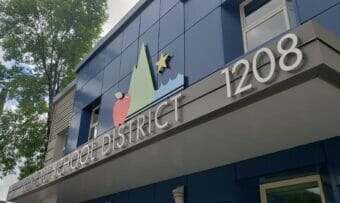
The offices of the Juneau School District, pictured here on Aug. 6, 2020, are located at 1208 Glacier Ave., in Juneau.
The offices of the Juneau School District, pictured here on Aug. 6, 2020, are located at 1208 Glacier Ave., in Juneau. (Photo by Jeremy Hsieh/KTOO)

The Juneau School District has shifted gears on its decision to expand in-person classes. Earlier this week, the district announced that kindergarten students could go back to the classroom later this month. But after several discussions between teachers, parents and staff, that plan has been postponed until after the holidays.

Superintendent Bridget Weiss said the change was a response to the COVID-19 alert Gov. Mike Dunleavy sent to Alaskans Thursday morning.

“It was simply looking at the cause of concern that that announcement made in our staff,” Weiss said. “It made sense to wait until January before we started new cohorts.”

Those cohorts are the small groups of preschool through first-grade students the district planned on bringing back to in-person classes first. Now, in-person classes for all students are set to begin Jan. 11 at the earliest.

“We decided initially, to delay until the 11th for any in-person just to provide a little more distance for any staff or families that may travel over the holidays,” Weiss said.

Schools are still providing online instruction and in-person services for students who need them. Weiss noted that the district will not go to full distance delivery and continue to provide these services safely as long as Juneau stays below a level four risk level, which is the highest level. The community is currently at level three.

Juneau School District divided over return to in-person classes

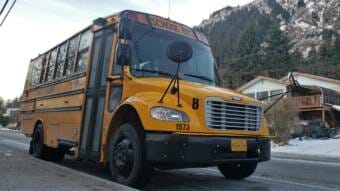
school bus idles at JDHS
A school bus idles outside Juneau-Douglas High School: Yadaa.at Kalé in Juneau on Nov. 10, 2020. (Photo by Jeremy Hsieh/KTOO)

The Juneau School District announced the start of in-person classes for preschool students earlier this week.

Kindergarten students could return to in-person classes by the end of the month. But with the state currently at a high-risk level and holidays coming up, the school district is divided over whether that needs to happen.

The decision to bring students back to in-person classes has been part of the district’s SMART Start plan since June. 

Schools have already been allowing individual students and small groups into buildings — with health and safety measures in place. The district made the announcement to expand in-person classes on Monday.

During the city’s COVID-19 community update, Superintendent Bridget Weiss said that a small group of Kindergarten students could return to in-person classes as soon as Nov. 30.

“Starting with those students who definitely are more challenged, receiving their education via Zoom,” Weiss said.

But a day after the announcement, parents, teachers and staff voiced their concerns over the decision at this week’s Board of Education meeting. 

Recently elected school board member Martin Stepetin advocated for families who can’t afford internet service and have to use satellite sites and third-party locations for classes.

“Is there a way that we could prioritize those students to get them in at all or just to help?” Stepetin asked. “You know, use this opportunity, if at all possible, to bring some relief to those families who Zoom is not working already in the first place, or is really difficult for them?”

Boardmember Deedie Sorensen quizzed Weiss about whether the district had met with teachers about its decision — noting that all kindergarten and first-grade teachers are unanimously against expanding in-person learning.

The Juneau Education Association — the local teacher’s union — voted unanimously against the expansion to in-person classes. 

Kelly Stewart, president of the association, says while it has been working with the district on the plan, teachers found out about the rollout dates last Friday.

“What I’m hearing from the majority of our K-1 teachers is that they do not want to come back until after winter break just because of all of the different holidays and the traveling,” said Stewart. “They just think it would be safer, and give us more time to have the safety protocols put into place.”

Weiss is meeting with all kindergarten and first-grade teachers on Thursday. The superintendent also said the district’s plans may change.

Sealaska Heritage Institute awarded federal grant to publish Tlingit, Haida archives for language revitalization project

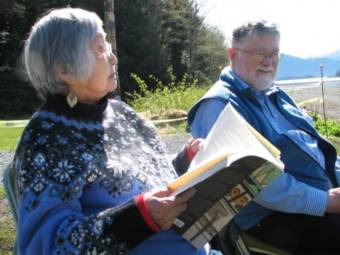
The late Nora and Dick Dauenhauer in Sitka in May 2014. The couple carried the knowledge of Southeast Alaska’s native languages into the 21st century. (Photo by Emily Forman/KCAW)

Late Tlingit scholars Nora Ḵeixwnéi Marks and Richard Xwaayeenák̲ Dauenhauer once dedicated the first volume of their book “Classics of Tlingit Oral Literature” to Tlingit orators. They co-edited the four-volume series and were two-time winners of the American Book Award.

The couple carried the knowledge of Southeast Alaska’s Native languages into the 21st century.

Recently, the federal Institute of Museum and Library Services awarded Sealaska Heritage Institute a two-year grant to process and digitally publish a massive collection of Tlingit and Haida documents archived by the late scholars.

In one of the recordings, Marks Dauenhauer has a conversation with a Tlingit speaker. The recording is just one part of the Dauenhauers’ archive.

Richard died in 2014, and Nora died in 2017. But what they left behind will last for generations.

“They came up with a method that’s kind of the standard now,” said Chuck Smythe, Director of Culture and History at the Sealaska Heritage Institute. “People are taking this as a starting point and are enhancing it and further, further developing it but it all started with the Dauenhauers.”

The Dauenhauer Literary Estate is a massive inventory of fieldwork documents and audio collections of both Tlingit and Haida languages. The estate is made up of several dozen boxes of documents and audiotape of translations and transcriptions that go back decades.

“Their books and files were so heavy that their house was literally splitting apart,” Smythe said.

The Dauenhauer Literary Estate includes more than 275 linear feet of documents, three boxes of journals, 18 boxes of media and 89 boxes of books, which will be processed over two years and made available to the public. (Photo courtesy of Sealaska Heritage Institute)

Will Geiger, a foremost scholar in Tlingit, is working on the project. He said much of the Tlingit oratory the Dauenhauers archived is to Southeast Alaska what Homer is to Ancient Greece.

“This new batch of materials, which is mostly papers, so there’s going to be a lot. I’m sure we’re gonna come across a lot of, say, draft documents that transcriptions of recordings that just haven’t been circulated or made public or published,” Geiger said.

Emily Pastore, archives collection manager at SHI, is also working on the project.

“Without the Dauenhauers, Tlingit language revival would not be where it is today,” Pastore said. “And so by making these new papers available, we could be fostering new developments in Tlingit and Haida language revitalization that could not be done without them and without these papers. ”

She says when it comes to their fieldwork, the Dauenhauers talked to everyday people.

Pastore also says the archives will also provide a way for future generations of Tlingit learners to connect to the language by giving them access to a wide range of Tlingit and Haida documents.

Once the project is done, the digital archive of the Dauenhauer Literary Estate will be public for everyone, not just academic researchers.

The song included in the radio version of this story is titled “Where Are You?” and is the exclusive property of the Lukaax̱.ádi clan.

Watch: Juneau School District superintendent joins city officials for COVID-19 community update

CBJ COVID-19 Community Update placeholder
(Image courtesy of City and Borough of Juneau)

Juneau city officials are holding their weekly COVID-19 community update at 4 p.m. today. You can watch on the City and Borough of Juneau’s Facebook page or on Zoom.

The city reported 17 new cases on Tuesday.

Over the 14-day period from Oct.  26 to Nov. 8, there were 107 people in Juneau who tested positive, down from 138 in previous weeks.

According to the city, 85% Of the most recent cases are being attributed to two different clusters. One involves cases among Juneau’s vulnerable and unsheltered population, along with their close contacts. There are 93 people associated with this cluster who have tested positive.

A cluster associated with Mendenhall Auto Center currently has 45 cases. Transmission among household members within the cluster continues to be a source of disease.

Juneau School District Superintendent Bridget Weiss is also attending the meeting to discuss the incremental start of in-person classes for pre-school and kindergarten students.


Alaskans react to CNN poll labeling Native voters ‘something else’

Screen capture of CNN on Election Night 2020.

Native communities in Alaska and around the country responded to a graphic in CNN’s Tuesday election coverage labeling voters that don’t identify as white, Black, Latino or Asian as “something else.” 

The gaffe led to the hashtag #SomethingElse trending among Natives on social media calling out the cable news network for its ignorance. 

While many Native voices made light of the situation with comedic memes and tweets, others said they were frustrated with the continued Native erasure.

Barbara Wáahlaal Gíidaak Blake was checking her social media feed early Thursday morning when she noticed posts referencing CNN’s poll graphic.

“It was rough to be to see our population ‘invisiblilized,” she said. “It seemed to perpetuate the erasure of indigenous people as we stand today in this great land.”

Blake, who is Haida, Tlingit and Ahtna, is the director of the Alaska Native Policy Center with the First Alaskans Institute. She said given that Alaska Natives are almost 20% of the state’s population and Native voters have made an impact nationally, it’s time for the Native vote to be recognized.

“Our voter contribution, oftentimes the swing vote in many states, needs to be acknowledged. It needs to be uplifted and recognized in a manner that upholds the 10,000 years of existence that our people have held on these lands,” Blake said.

X̱’unei Lance Twitchell is a professor of  Alaska Native Languages Arts and Sciences at the University of Alaska Southeast. He’s also Tlingit, Haida and Yup’ik.

“The way it contributes to erasure is that we don’t get to be part of the graphic,” Twitchell said. “We don’t get to be part of the analysis as far as indigenous peoples, and we should be.”

But Twitchell said the memes created with #SomethingElse did make a difference. His team has also translated the phrase in Tlingit.

“The humor is really fun because I think indigenous peoples are really good at taking something and to make it into something funny,” said Twitchell. “But then to see once you run it through our language, how it becomes a statement of inclusivity and importance.”

Lenzy Krehbiel-Burton was monitoring election coverage when she noticed a screenshot of the graphic on her feed.

“It’s 2020 and we’re still seeing folks refer to voters who don’t neatly fall into one of four categories as ‘something else.’ It’s one thing to be referred to as other, which is still problematic in and of itself,” Krehbiel-Burton said. “But to see that like to see that label, it was a slap in the face, frankly. ”

Krehbiel-Burton is a citizen of the Cherokee Nation and the vice president of the Native American Journalists Association. The organization put out a statement saying the cable news network’s graphic is a clear example of Native erasure.

“We did receive an email,” she said. “It did not include an apology.”

Krehbiel-Burton also said CNN has contributed to NAJA’s scholarship fund, but that was 15 years ago.

As of Friday, CNN apologized for the graphic according to the LA Times.

The Canada-based Aboriginal People’s Television Network also received a statement from CNN saying the network corrected the graphic. It said the network did not “intend to minimize the importance of indigenous communities and the Native American vote.”

Newscast – Wednesday, Nov. 4, 2020

In this newscast:

  • Alaska Republican candidates and conservative causes did well in early results reported on election night.
  • In Alaska House District 34, incumbent Democratic Rep. Andi Story holds a 14-point lead over independent challenger Ed King.
  • The Petersburg School Board adopted a new policy requiring COVID-19 testing for staff and students returning from in-state travel.
  • The state’s top medical team says that communities that still have a relatively low case count should act conservatively when it comes to travel during the holiday season.
Site notifications
Update notification options
Subscribe to notifications