Pew Charitable Trusts

Are State-Sanctioned Heroin Shooting Galleries a Good Idea?

Used heroin syringes and cooking spoons in a park in Ohio. Some local and state officials are pushing for legal sites where heroin users can inject drugs under medical supervision. AP

A bustling economy. Record-low unemployment. A ballooning heroin problem.

That’s how Mayor Svante Myrick describes Ithaca, New York, where he hopes to open the nation’s first safe injection facility — a place where heroin users could shoot their illegal drugs under medical supervision and without fear of arrest.

His proposal, part of a plan to address drug abuse in the 31,000-person college town in central New York, is not a novel idea. Safe injection sites, which also connect clients to treatment programs and offer emergency care to reverse overdoses, exist in 27 cities in other parts of the world. Some have been around for decades.

But no safe havens for injecting illegal drugs exist in the United States, which is experiencing an epidemic of opioid addiction and a rising tide of overdose deaths. Some lawmakers in California and Maryland want to change that and make legal what addiction specialists say is already going on at many clinics or needle-exchange programs across the country.

Proponents of the sites say they reduce the risk of dying from heroin use because addicts are drawn out from alleys, public restrooms and run-down buildings and into supervised settings where they can be quickly treated for overdose symptoms. Once there, access to clean needles reduces an addict’s exposure to infections, as well as diseases like hepatitis C and AIDS. And, supporters say, drug users are more likely to pursue addiction treatment once they develop trusting relationships with clinic staffers.

Other lawmakers, however, warn that supervised heroin shooting galleries run contrary to state and federal drug laws and would encourage illegal drug abuse.

In New York’s Tompkins County, a jurisdiction of just over 100,000 people that includes Ithaca, at least 14 deaths were drug-related in 2014, up from six in 2010. An addiction treatment center there reported that more than a quarter of its admissions in 2014 were for opioids, second only to alcohol.

“We’re not the capital of heroin in America or even in New York state,” Myrick said. “But we’re losing people.”

Studies of safe injection sites, largely in Canada and Australia, have found that they help reduce overdoses and don’t increase drug use or trafficking in the communities where they’re located.

Sites in the United States could violate the federal Controlled Substances Act, which prohibits possession of drugs such as heroin or cocaine or operating a place where people use them. But Congress could change the law or the U.S. Justice Department could make exceptions for the sites, said Leo Beletsky, a law and health sciences professor at Northeastern University.

Most state laws mirror the federal act and would also need to be amended to allow injection sites to operate legally, he said. Though if states begin legalizing them, the federal government could choose not to prosecute people who run and use them — just as the Justice Department has decided not to enforce federal laws for possessing, processing or selling marijuana in states that have legalized it.

“Do you try to solve these [legal] problems first? Or do you proceed with what you know is needed, the innovation that is needed in, really, a time of national crisis?” Beletsky said.

Advocates would rather establish the injection sites through legislative action, but creating the sites through executive orders issued by mayors or county executives could create quicker access to care, he said.

Even with the approval of the district attorney in Tompkins County, Gwen Wilkinson, Myrick is not interested in opening a site in Ithaca without permission from the New York Legislature and Democratic Gov. Andrew Cuomo.

“Our hope is once this is put in place, we’ll be ready for the next epidemic,” he said.

Legislative Effort

Maryland state Del. Dan Morhaim, an emergency room physician, wants to create safe injection sites in his state, saying supervised injection would help break the cycle of drug use by exposing addicts to counseling and making them less prone to drawing others into the habit of drug use.

Morhaim’s proposal received little opposition during a recent legislative hearing, and officials at the University of Maryland School of Medicine said they would “seriously consider” establishing a pilot program to evaluate the concept if the legislation passes.

“If all our polices were doing great, we’d be talking about how addiction rates are down and streets are safer,” said Morhaim, a Democrat.

Opioid deaths in Maryland increased by 76 percent between 2010 and 2014, to nearly 900. And according to the American Society of Addiction Medicine, drug overdoses are the leading cause of accidental death in the United States. In 2014, heroin contributed to about 10,600 deaths nationwide.

But proposals like Morhaim’s and Myrick’s are not without opposition.

Steve Schuh, a Republican county executive from Anne Arundel County, Maryland, called Morhaim’s bill one of the most “irresponsible” that the General Assembly has ever considered.

Providing those in the throes of addiction a place and the tools to use heroin is “careless, reckless, and unconscionable” and tantamount to making the state an accomplice to murder, he said in a letter to the chairman of the health committee, which held a hearing on the bill this week.

New York state Assemblyman Edward Ra, a Republican, opposes Myrick’s Ithaca plan because he said it would stand in the way of cooperation between local, state and federal law enforcement. The state should instead focus on treating more heroin addicts, Ra said.

“I object to the idea that this drug can be used safely. It’s a drug that kills people.”

Matt Curtis, policy and program director at Voices of Community Activists & Leaders (Vocal), a nonprofit that offers counseling, hepatitis screening, syringe exchanges and other services to drug users in New York City, said it would be easier to establish injection sites locally than at the state level. A campaign for injection sites in New York City already has the support of at least one city councilman.

“We’re not quite there,” Curtis said. “We are still in the stage of getting people familiar with the idea.”

Already Happening

Although no sanctioned injection sites exist, advocates for them say informal sites exist at needle exchanges around the country where addicts can already get clean syringes and substance abuse counseling.

Organizations that operate exchange programs say they do not condone drug use and injection is still prohibited on-site. But because people use bathrooms at the exchanges to shoot up after receiving new needles, the organizations have taken steps to make those spaces safer.

In the past, staff at some exchanges tried to discourage drug use by installing black lights so users couldn’t find their veins and timing how long each person spent in the bathroom. But these practices led to overdoses as drug users rushed to take large amounts of heroin before being detected by staff members.

“That is terrible public health practice and you’re basically saying, ‘Go out and use it in the street,’ ” said Curtis of Vocal, which runs a facility in Brooklyn.

Now, many exchanges have installed syringe disposal boxes, put intercoms in the bathrooms and installed emergency locks so staff members can get into a bathroom to help if someone becomes unresponsive.

Vocal made similar renovations to its facility in 2014, not because very many people were using drugs in the bathroom, Curtis said, but because the changes make the site safer for clients and staff.

Reducing Harm

Supervised injection sites are part of a “harm reduction strategy” to reduce the negative effects of drug abuse through public health initiatives. The harm reduction theory stresses the rights of drug users and acknowledges that abstaining from drug use is not the only measure of improving the quality of life of an addict.

The Boston Health Care for the Homeless Program is applying this theory in its new Supportive Place for Observation and Treatment Center. The center prohibits drug use and won’t offer needle exchange. But users can come there after they inject to wait out their high under medical supervision and there is an exchange close by, said Jessie Gaeta, the group’s chief medical officer.

As many as a handful of clients overdose at the main Health Care for the Homeless site each week and Gaeta said she thinks the rate of overdoses in the Boston area is increasing because people are taking heroin that is combined with other drugs like benzodiazepines, which also have a sedative effect.

“Dead people don’t recover,” Gaeta said. “Our hope is to make it less dangerous for the people who are currently using, who are not seeking treatment or not able to access treatment. I like to think we’re enabling people to live.”

Read original story -March 11, 2016
Are State-Sanctioned Heroin Shooting Galleries a Good Idea?

Lights, Cameras, Accountability: State Legislatures on TV

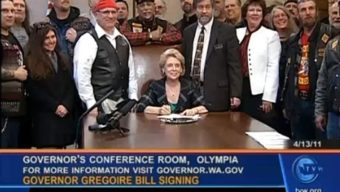
Former Gov. Chris Gregoire on Washington’s public affairs network, TVW, signing a bill dealing with police profiling of motorcyclists. At least 20 states have channels that offer coverage of state government. AP

In Kentucky, state lawmakers will consider in coming days whether to make tuition at community colleges free. In Connecticut, they’ll look at laying off 3,000 state workers to cover a $200 million budget deficit. In Arizona, they will debate scrapping presidential preference primaries. And in those states, people can watch the debates unfold on television — sometimes to the chagrin of lawmakers.

They are among the 20 or so states that have their own public affairs networks that broadcast state legislative proceedings in a fashion similar to C-SPAN’s broadcasts from the U.S. House and Senate. The programming — mostly committee hearings, live gavel-to-gavel floor debate and votes — is on cable and public access channels underwritten by taxpayers or cable companies, usually at a cost of about $3 million to $5 million a year in each state.

The coverage is designed to lift the veil on how laws are made, how taxes are raised and spent, and how viewers’ elected representatives are voting.

“The hope is that making these hearings public makes government and legislators more accountable and leaves the public more informed and with a better understanding of the process itself,” said Michael Delli Carpini, dean of the University of Pennsylvania’s Annenberg School for Communication.

Unlike C-SPAN, the viewership of state legislative proceedings isn’t large, a maximum of a few million in some states compared to the 47 million who say they watch C-SPAN at least once a week.

Though the channels’ audiences may be small, they are potentially significant.

If they are anything like C-SPAN’s, the viewers are influential, said Steve Frantzich, a political science professor at the U.S. Naval Academy who has studied C-SPAN. Lobbyists and government workers tune in; but people who watch are more likely to vote and donate to campaigns.

The transparency the networks provide doesn’t come without conflict — over funding, what should be shown, and how lawmakers should behave when the cameras are rolling. Some legislators are hesitant to be in the glare of the camera, and securing funding leaves some networks at their mercy.

Most state channels started in the 1990s, offering a feed of floor action. Viewers now have more government programming to watch and more ways to watch it. Even with just one TV channel, many stations are able to broadcast hearings, news conferences, and coverage of the executive and judicial branches by streaming them online.

Such intense coverage can mean clips are picked up in other media, leading to the occasional viral video or dispute.

After Florida Republican Gov. Rick Scott blocked state employees from using the terms global warming or climate change, the state’s public affairs network captured the state’s emergency management director trying to avoid using them under questioning by a legislator. Both awkward and funny, the clip made the rounds on late night talk shows.

In Ohio, where the channel is funded with state money, a legislator’s comments on an abortion bill were edited and then posted to YouTube by an advocacy group. Although the channel owned the rights to the original video and asked that the clip be taken down, YouTube refused, citing fair use policies.

Working with Legislators

Instances like those can lead to conflict over how much legislative action should be broadcast, jeopardizing transparency and endangering funding for channels that are often paid for with tax dollars appropriated by the lawmakers.

“I want to have as much televised as possible,” said Ohio state Rep. Jim Buchy, a Republican. “The more people have a chance to watch their government in action, the better it gets. But the converse is true: The less coverage government gets, the worse it gets.”

But Ohio is a state where lawmakers have limited the broadcasts to floor sessions and coverage of the House’s and the Senate’s finance committees. Before the flap over the YouTube video, the channel’s executive director, Dan Shellenbarger, thought he had convinced lawmakers to expand coverage to more committee hearings. The plans were scrapped.

Shellenbarger, who had spent 18 years trying to convince Ohio lawmakers to expand coverage, said the use of the footage for political motives is a problem that channels in other states struggle with, too.

“Across the nation we’re grappling with how our video can be misused, and there is always the concern of it ending up in a campaign video,” he said. “We don’t want the resources, time and money we put into the feed to be used for political gain. Ohio is still struggling with that.”

In many states, the channels have a policy of not allowing their footage to be used in campaign commercials or attack ads. In the case of Florida, it’s the law.

Unlike unfettered journalism, the channels in some states are restricted in what they can show viewers. In Washington, for example, the Legislature has a memorandum of understanding with the state channel. It requires that cameras focus only on legislators who have been recognized to speak on the floor and does not permit reaction shots of other legislators. The sessions must be broadcast unedited.

A former director of TVW, Washington state’s channel, resigned after it covered a Democratic Party event designed to look like a legislative hearing, upsetting Republican members. The network had been trying to get new equipment at the time. The resignation cleared the way for things to settle and the station was able to get its funding.

Different Funding Sources

Channels must maintain a good relationship with legislators whether they are funded by them or by cable companies. The legislators ultimately determine access. But where the money comes from can also affect the programming.

“We can ask any question we want because we’re not paid by them,” said Brian Lockman, president of the Pennsylvania Cable Network, funded largely by cable subscribers. But he said keeping the channel going also means running some infomercials and local sports.

The Connecticut Network’s director, Paul Giguere, is currently trying to switch from state to cable funding, something that would allow the channel to expand its coverage of government while saving the state $3 million a year, the amount it currently pays to support the channel. Despite Connecticut’s budget problems, the idea has not been an easy sell. State Sen. Steve Cassano, who is handling the bill, said cable companies oppose the change because they don’t want to pay for a service that many will access online.

Despite problems with expanding coverage, Ohio’s Shellenbarger said he’s happy to be funded by the state.

“More people are unplugging their cable boxes and going to the Internet,” he said. “But we’re the archive for the state, and we’re expected to maintain that forever.”

Impact on Democracy

Some lawmakers are concerned about how being on television affects members’ behavior and lawmaking.

In West Virginia, where the Legislature is being broadcast for the first time this year, on theWest Virginia Channel, lawmakers are speaking up more. They want to isolate the clips from the channel’s website and post them to their own social media pages, said state Sen. Chris Walters, a Republican.

“Now the process is more transparent, but we’re also engaging with people more because when we share a video, people comment on it,” Walters said. “We get so much feedback — both positive and negative.”

Being on TV affects how business is conducted on the floor, according to the West Virginia Republican majority leader in the House, Daryl Cowles.

“We’ve got some more unique parliamentary procedures being used,” Cowles said. “We’ve had a bill read in its entirety, which we almost never do. We’ve had people use the opportunity to explain their votes afterward. We had someone try to discharge a bill from committee and bring it straight to the floor.”

Showboating for the camera is one reason many Ohio lawmakers are reluctant to expand coverage to all committees. Another is just a reluctance to have all the lawmaking on TV.

“Some folks don’t want people to see the man behind the curtains,” said state Sen. Frank LaRose, a Republican. “But I disagree because we work for Ohioans. Our entire political system relies on informed people who want to hold elected officials accountable.”

Read original article – March 14, 2016

Building a Ground Army to Fight Heroin Deaths

A sign for a Baltimore overdose reversal program. To stem the death toll in the opioid epidemic, cities and states, as well as the federal government, are promoting greater use of the overdose rescue drug naloxone. (The Pew Charitable Trusts)

BALTIMORE — A crowd quickly gathers here on one of West Baltimore’s many drug-infested street corners. But it isn’t heroin they’re seeking. It’s a heroin antidote known as naloxone, or Narcan.

Two city health department workers are holding up slim salmon-colored boxes and explaining that the medication inside can be used to stop someone from dying of a heroin overdose. Most onlookers nod solemnly in recognition. They’ve heard about the drug. They want to know more.

Nationwide, more than 150,000 people received naloxone kits from community outreach programs like Baltimore’s between 1996 and 2014, and more than 26,000 overdoses were reversed using those kits, according to a recent survey funded by the U.S. Centers for Disease Control and Prevention.

In addition, police, emergency medical technicians and emergency room physicians have used the drug to save tens of thousands of lives. Baltimore police officers started carrying the kits last year.

But as the opioid epidemic seeps into nearly every small town and suburb across the country, state, local and federal officials are trying to make the life-saving prescription drug available everywhere, particularly at local pharmacies.

To accomplish that, New Mexico last week became the 29th state to adopt a law that allows doctors and other prescribers to write a naloxone prescription known as a standing order, enabling local pharmacists to distribute the overdose rescue drug to anyone who asks for it.

Maryland adopted a similar measure in October. The day after it took effect, Baltimore’s health commissioner, Dr. Leana Wen, wrote a standing order for the entire city, allowing anyone who completed a simple naloxone training — like the demonstration offered on the West Baltimore corner last week — to walk into a pharmacy, show a certificate of completion, and walk out with a kit.

“I like to say I became the prescriber-in-chief,” Wen said.

New Mexico’s new law updates a 15-year-old law that allowed lay people to administer naloxone. In addition to allowing standing orders, the new measure allows people without a medical license to distribute naloxone kits in their communities, a legal provision found only in Maryland and 12 other states. This exception allows jails, treatment centers, homeless shelters and others to hand out the drug. Even the local PTA could offer it.

“It needs to be in everyone’s first-aid kit and medicine cabinet,” Wen said.

Building a Ground Army to Fight Heroin Deaths

A Nationwide Movement

Forty-two states have enacted laws to make naloxone available beyond hospitals. New Mexico, which has had one of the highest drug overdose rates in the country for more than two decades, was the first to act with its 2001 law.

After more than a decade, Massachusetts in 2012 became the second state to enact a law. Most other states adopted so-called rescue drug measures in 2014 and 2015 after the opioid epidemic began making headlines.

This year, “States are going back and expanding or tweaking their laws,” said Amber Widgery, who tracks these and other drug related laws at the National Conference of State Legislatures.

Thirty states also have adopted so-called good Samaritan measures, which give limited legal immunity to a bystander or friend who calls 911 to report an overdose. Those laws also need to be expanded, said Corey Davis, an attorney who tracks the laws for the Network for Public Health Law.

In Maryland, for example, the law only protects overdose bystanders from being arrested, charged or prosecuted for possession of a controlled substance or use of drug paraphernalia. It does not protect them against arrests for open warrants or probation and parole violations, which are common among heroin and opioid addicts. As a result, residents of West Baltimore or other communities where drug use is prevalent may be unwilling to call 911.

In addition to state and local actions, initiatives at the federal level are picking up. Last week, the U.S. Senate passed a comprehensive opioid addiction and overdose prevention bill that would expand the use of naloxone, and the U.S. Department of Health and Human Services announced additional funding for naloxone and other drug treatment services.

Building a Ground Army to Fight Heroin DeathsA ‘Miracle’ Drug

The majority of opioid overdose victims die from lack of oxygen one to three hours after they have taken a drug, leaving a substantial amount of time for someone to intervene and administer naloxone or call for help.

Naloxone, approved by the U.S. Food and Drug Administration in 1971 in injectable form and widely used as a nasal spray, is a relatively cheap generic drug that has been proven safe and effective at reversing the deadly lung suppression that can cause a fatal overdose. Once the drug is administered, most victims instantly begin breathing again; they also experience nausea and other withdrawal symptoms.

But until the late 1990s, naloxone was only used, intravenously, in hospital emergency departments and operating rooms. Even emergency medical personnel and other first responders did not use it initially.

In 1996, a community group in Chicago that provided clean needles and other assistance to drug addicts began handing out naloxone as a nasal spray as well. Later, similar pilot programs began cropping up in places like San Francisco and New York.

When people began coming back and reporting that they had saved a life with naloxone and wanted another kit, researchers took notice. Eventually, these and other programs handing out naloxone caught the attention of federal and state officials, said Daniel Raymond, policy director for the Harm Reduction Coalition, which advocates for the greater availability of naloxone and other health care services for drug addicts.

In 2006, Massachusetts began using naloxone in public health and social service centers. Along with New Mexico, it funded statewide distribution of the life-saving medication in communities with large numbers of known drug addicts.

But in other parts of the country, naloxone initiatives were limited and mainly local. Then in 2012, the FDA, along with the National Institutes of Health and the CDC, convened a meeting with state and local officials to discuss ways to expand availability of the drug nationwide. Initially, some objected to making naloxone widely available, arguing that it would simply enable more drug addicts to continue shooting up.

Now that more Americans are dying of heroin and prescription painkiller overdoses than from homicides — roughly 28,000 people in 2014 — that argument rarely comes up. Politicians from both parties vigorously support the use of naloxone. Along with increased access to treatment and safer opioid prescribing, expanding the use of naloxone is among the Obama administration’s top three weapons against the epidemic.
Baltimore’s commitment to naloxone began when the health commissioner, Wen, took office, in January 2015. Since then, the department has distributed nearly 6,000 kits to city residents. In addition, the department launched an online training site, dontdie.org, last month. Wen said she plans to work with local pharmacy chains to make it easier for people to walk in, get trained, and leave with naloxone.

Building a Ground Army to Fight Heroin DeathsMore Work Needed

In February, the pharmacy chain Walgreens announced it had used state standing order authority to make naloxone available without a prescription across New York and would do the same in Indiana and Ohio. Pharmacy chain CVS made a similar commitment in Ohio.

But advocates for greater use of the overdose reversal drug worry that most local drugstores won’t stock the drug or supply it on demand. They also fear that pharmacists won’t allow people to use their insurance plans to pay for it.

According to Davis, the public health law researcher, insurance companies are on board with covering the drug. But, because people with naloxone prescriptions won’t be using the drug on themselves, many pharmacists appear to be worried they won’t get reimbursed for, essentially, a third-party prescription, the claims for which are traditionally rejected by insurance companies.

Baltimore has negotiated a $1 copay with the state Medicaid agency and private insurance companies have generally agreed to cover it, Wen said.

Even in Massachusetts, where standing orders have been allowed for years, not all pharmacies stock the medication and not all pharmacists know about it, according to Dr. Alexander Walley, medical director for the state health department.

“We have the legal pathways but not the implementation experience, yet, to make it as successful as policymakers had hoped,” he said. “We’re in the steep part of the learning curve right now.”

From their folding card table in West Baltimore last week, Daryl Mack and Darryl Burrell handed out 15 naloxone kits in less than a half-hour.

After witnessing friends, family members and strangers die on these streets from overdoses, most onlookers seemed eager to try to prevent at least one fatality.

Speaking one-by-one to each person who wanted a kit, Mack emptied the contents of a box onto the table and quickly demonstrated how to assemble and activate the tiny nasal atomizer used to squirt naloxone into an overdose victim’s nostrils.

You’re not going to harm someone who’s unconscious by giving them naloxone, he told them. And you can’t give them too much. But first, try to make sure they’re not just sleeping or passed out from alcohol, Mack said. Rub your knuckles up and down their chest bone to try to wake them up. If that doesn’t work, they need help, he said.

Maryland is the only state that requires anyone using naloxone to complete a brief training, Davis said. Several people who approached the table already knew the drill and were there to get refills. They also got a copy of Wen’s standing order so they could pick up additional kits at their local drugstore if needed.

One passerby heard the word “heroin” and waved the health workers away, saying, “I don’t have nothing to do with that stuff.” But when Mack explained that he could save someone’s life, the elderly man stopped and signed up.

Read original article – March 16, 2016
Building a Ground Army to Fight Heroin Deaths

Aging Voting Machines Cost Local, State Governments

A poll worker leads a voter to an electronic voting machine in Columbus, Ohio. Many computerized voting machines are reaching the end of their life span and governments must figure out what to replace them with and how to pay for it. AP

This year, as Americans select the next president, the entire U.S. House of Representatives and a third of the Senate, as well as an array of state and local officials, many voters will cast ballots on a generation of electronic voting machines that is nearing extinction.

Most of the machines, adopted by local governments after “hanging chads” left the 2000 presidential election in the balance for weeks, are at least a decade old. And they create a perilous situation: an equipment breakdown on Election Day could mean long lines, potentially leaving some people unable to vote.

But replacing the old machines with newer models is costly. The latest computerized machines typically cost between $2,500 and $3,000 each, and election boards should budget for one machine per 250 to 300 registered voters, according to the National Conference of State Legislatures (NCSL).

That high cost is just one reason the computerized machines, which record ballots via a touch-screen, push-button or dial mechanism, have been falling out of favor with cash-strapped local governments. Some elections officials and lawmakers also worry the machines could be hacked and lead to voter fraud.

Some states are already turning to other approaches. This year Maryland voters will cast paper ballots that can be scanned by machines. Optical scanners that read paper ballots cost up to $5,000, but only one is needed per polling location, making them a cheaper approach than computerized voting machines. In Virginia, officials have ditched most of their voting machines in favor a similar system, and legislation before the General Assembly would get rid of all voting machines in the state by 2018.

In New Hampshire, a proposal would create a municipal grant program to support local governments that want to change their election procedures, and lawmakers in Ohio put a provision in the state budget to save money by eliminating certain special elections.

About 25 percent of voters will use electronic voting systems this year, said Pamela Smith, president of Verified Voting, a nonprofit focused on ballot accuracy. That’s down from 30 to 40 percent when the machines were more popular.

In most states, those machines are at least 10 years old, an age at which most reach the end of their life span, according to a report from the Brennan Center for Justice. Nearly every state is using machines that are no longer manufactured.

Jurisdictions have to “make sure they have good emergency provisions in place,” Smith said. “If you have a good paper ballot and scanner system in place as your voting system, even if your scanner breaks down, voters can still vote.”

Cost of Voting

State and local governments first began to buy computer voting machines in the early 2000s under the federal Help America Vote Act. Some states still have HAVA money on hand, but additional federal help is not expected and many governments have trouble paying for new election equipment — typically from a combination of state and local coffers.

Election funding often butts against the need to pay for more in-demand priorities like schools and roads, said Colorado Secretary of State Wayne Williams, a Republican.

“You can’t wait for it to break to fix it,” he said. “You can wait for a road to have issues to fix it, but if you wait to do that in an election, it’s too late.”

Across the country, officials in at least 31 states want to purchase new voting machines within five years, but at least 22 of them don’t know where the money will come from, according to the Brennan Center report.

The Center estimates the total national cost of replacing existing machines could exceed $1 billion. The country’s largest jurisdiction, Los Angeles County, has allocated $70 million to design and develop its own voting system for the 5 million registered voters who live there. County officials are pursuing a system that will allow voters to cast ballots on a touch-screen device that would issue a printed ballot that they would place in a ballot box to be counted.

But other county and local governments will have to get by with existing equipment because many states have cut their election budgets in recent years. In 2014, Virginia lawmakers stripped $28 million from the state budget that was intended to pay for new voting machines.

In Utah, Republican Rep. Brad Daw is pushing legislation that would replace the state’s aging computer-based machines. His proposal would set up a selection committee to recommend voting equipment and help counties pay for the machines if they choose to use the state-selected brand.

Daw, who is also a software engineer, said he’s never been a fan of the state’s computer voting machines — they require a lot of equipment and their operating systems are easy to hack, he said.

Opponents of the machines also say they create long lines as voters have a hard time figuring out how to use them; they are prone to crashes as the software ages; and they are vulnerable to attack. A 2014 analysis of Virginia’s computerized voting machines found that hackers could access the wireless networks the machines ran on to view or change votes.

A system by which voters mark paper ballots that are scanned by machine could be a better option, Daw said.

“Marking a piece of paper is pretty old school,” he said. “But marking a piece of paper and putting it through a scanner” is just as efficient.

As the computer models fade out, most jurisdictions are replacing them with the scanner systems, which are more affordable and were recommended by experts following the 2000 presidential election. But, the high-tech (for the time) computer systems were more attractive, Smith said, because “nobody wanted to be the next Florida.”

Voting by Mail

To save on election costs, a few states have turned to voting by mail.

Oregon, Washington and Colorado require that all elections be conducted by mailed ballots, though many others permit localities to conduct mail-in special elections. California, Hawaiiand Oklahoma are also considering mail-in systems.

In Oregon, the first state to adopt a mail-in process, in 2000, all eligible voters are mailed a ballot, which can be mailed back to the election board, completed in person at a county clerk’s office or placed in a public drop box. People with disabilities are able to vote on machines at a clerk’s office.

The ballots are examined by election board workers who verify voters’ signatures and then pass them through scanners that tabulate results.

Phil Keisling, Oregon’s former secretary of state who is credited with pioneering the vote-by-mail program, said it not only saves money — an estimated $3 million per election cycle in Oregon — by reducing the number of polling places and machines required to hold an election, but also increases turnout.

A 2015 analysis from The Pew Charitable Trusts shows more people are voting by mail. In 2012, 19 percent of U.S. ballots were cast by mail, up from 10 percent in 2000 (Pew also funds Stateline).

During the 2012 presidential election, 64.2 percent of voters cast ballots in Oregon, compared with a national voter turnout of 58.6 percent.

In the last four general elections, 40 percent of Oregon voters returned their ballots by mail and roughly 56 percent returned them via public drop boxes, said Jim Williams, elections director for the Oregon secretary of state. The remaining ballots were cast by walk-in voters.

Last year, San Mateo County, California, held its first mail-in special election, garnering a nearly 30 percent voter turnout, almost five percentage points higher than a similar electiontwo years earlier. Only 2.5 percent of ballots were cast at a precinct or voting center in the 2015 election, down from 24 percent in 2013.

While Oregon has had success as the first state to move to a mail-in system, few others are interested, Keisling said.

Some states are resistant to mail-in ballots simply because they buck tradition, said Wendy Underhill of NCSL.

“Cost is one consideration,” Underhill said. “But it is by no means the only consideration. [Mail-in voting] does change the feel of Election Day. That’s not a small consideration.”

Read original article – March 02, 2016
Aging Voting Machines Cost Local, State Governments

Some States Help College Students Avoid Unplanned Pregnancies

Donyell Hollins, 18, holds a picture of her daughter. Mississippi’s teen birth rate is highest among 18- and 19-year-olds, and the state wants colleges to address it. AP

At 10 a.m. on Wednesday, the 11 students in Carol Jussely’s “Essential College Skills” class were talking about sex.

Crammed into school chairs and clustered in groups of three or four, they leaned together to confer and then shouted out answers to trivia questions like, “Fact or fiction: You can’t get pregnant from having sex in a hot tub.”

Mississippi has among the highest teen-pregnancy rates in the country, and the teens most likely to get pregnant are college-age. So in 2014, the state passed a law that requires public colleges like Hinds Community College here to teach students how to avoid unplanned pregnancies. Arkansas passed a similar law last year.

Lawmakers in both conservative, Bible Belt states have fought for years over whether and how high schools should teach students about sex. Yet the new laws, which affect legal adults, were surprisingly uncontroversial.

And amid a national push to increase the share of Americans who have a postsecondary certificate or degree, other states and college systems are paying attention. Seven percent of community college dropouts leave because of an unplanned pregnancy, according to the American Association of Community Colleges.

Like most community colleges, Hinds doesn’t collect data on why students stop showing up for class, and it’s not clear if unplanned pregnancies are widespread or a major risk factor for dropping out.

But young mothers can be found all over Hinds’ six campuses. As students settled into their seats in Jussely’s classroom, a pony-tailed 21-year-old stood up and grimaced. “He’s kicking,” she said apologetically, putting her hand on her belly.

A Different Conversation

Mississippi state Sen. Sally Doty said she couldn’t believe it when Gov. Phil Bryant — “our Republican, tea party governor” — said in his 2012 inaugural address that he wanted to reduce teen pregnancies.

Doty, also a Republican, joined Bryant’s teen pregnancy task force and started doing research. “I realized that 70 percent of our [teen] pregnancies were 18- and 19-year-olds,” she said. “They may not even think of themselves as teenagers.”

There were 5,644 teen pregnancies in Mississippi in 2012, according to state records, and 3,913 were among older teens. Although the state’s teen pregnancy and birth rates have fallen steeply over the past 20 years, Mississippi’s rates were among the highest in the nation in 2014, according to the nonprofit National Campaign to Prevent Teen and Unplanned Pregnancy.

When teenagers have kids, they and their children often struggle. Teen mothers are less likely to pursue further education and get good jobs, and the children of teenage mothers are more likely to drop out of high school, experience health problems, go to jail and face unemployment as adults, according to the Centers for Disease Control and Prevention.

Yet Mississippi lawmakers have been reluctant to require public schools to teach comprehensive sex education.

“Any time that you talk about sex ed, it seems to be a volatile issue,” Doty said. Mississippi only started requiring high schools to teach such classes in 2011, with a focus on abstinence.

With advice from the National Campaign and the Women’s Foundation of Mississippi, Doty wrote a bill to require colleges to come up with a plan for addressing “the prevention of unintended and unmarried pregnancies among older teens.”

The measure, which Bryant signed into law in March 2014, describes steps colleges could take, from giving students unplanned pregnancy prevention information to working with community health centers. And it suggests that colleges identify barriers single parents face, such as lack of access to child care.

Although Mississippi’s law doesn’t limit the discussion to abstinence, it didn’t ruffle many feathers.

Arkansas — which also has a high pregnancy rate among older teens — passed asimilar law in 2015, and it didn’t stir much controversy there, either.

Doty noted that a lot of college students, particularly at community colleges, can be in their late 20s or 30s.

And many lawmakers consider unplanned pregnancy, at the college level, to be a workforce issue. “This is all about college retention,” said Republican state Rep. Robin Lundstrum, a co-sponsor of the Arkansas bill.

Most governors, including Arkansas Gov. Asa Hutchinson, a Republican, want more residents to earn postsecondary credentials that will prepare them for high-skilled jobs.

“We’ve got to get students to stay in school and finish their degree or certificate or whatever program they’re in, because we want them to be contributing members of society, we want them to be successful, we want the incomes in Arkansas to go up,” said Angela Lasiter of the Arkansas Department of Higher Education.

Delen Lee Jr., a 28-year-old who attends Hinds’ Jackson campus, knows how hard it is to stay in school when you have a new baby at home. “I want to be there for the mother of my child,” Lee said. For a while that meant nights spent filling bottles for his son, on top of working as a dishwasher and going to class. Overwhelmed, he took last semester off.

Getting Students Talking

In a way, the Mississippi and Arkansas laws extend services public colleges and universities already provide, like teaching students about sexual harassment.

Community colleges have historically paid less attention to students’ health than residential four-year colleges. At the University of Mississippi, for example, students can head to the campus health center to be tested for sexually transmitted diseases and get birth control prescriptions. Hinds can’t afford that kind of on-campus amenity.

Yet CDC statistics show that groups more likely to attend community college — low-income, African-American, Hispanic and Native American youth — are also more likely to experience a teen pregnancy.

Hinds began working on its pregnancy prevention and sexual health initiative before Mississippi passed its law, thanks to a small grant from the National Campaign. The initiative, branded “Back Off Baby, I’m in School,” uses materials and strategies developed by the nonprofit.

Mississippi lawmakers appropriated $250,000 for college unplanned pregnancy prevention efforts in 2015. Hinds has mostly spent its portion of the state funds on promotional materials and faculty stipends, according to Mary Lee McDaniel, the head of counseling and testing.

McDaniel arrived in Jussely’s cinderblock-walled classroom last week with a PowerPoint presentation full of trivia questions and a basket of chocolate chip cookies decorated with Back Off Baby tags. The trivia contest’s winning team got pens emblazoned with the Back Off Baby logo.

Teachers like Jussely have received $250 stipends to come up with lessons that incorporate family planning. The ideas range from the obvious — using teen pregnancy statistics in a statistics class — to the creative, such as teaching the scientific method by asking students to test the strength of different brands of condoms.

Hinds also requires students to take online lessons on unplanned pregnancy prevention during orientation; includes Back off Baby information at campus health fairs; and invites officials from the Health Department to campus to talk about safe use of contraceptives. Hinds’ rural Utica, Mississippi, campus is planning seminars this month on healthy relationships and communicating with someone you’re dating.

Daphine Ndishabandi, an 18-year-old freshman at the Utica campus, said she’s learned pretty much everything she knows about sex and its dangers from the Bible and Back off Baby.

“I think it’s really cool,” she said of the initiative. “Because being away from home, you don’t really have that mother to give you advice.” (Unlike most community colleges, Utica is a residential campus; about 80 percent of its students live in dorms, according to McDaniel.)

What Do Students Need?

Although Hinds has partnered with the state Health Department, access to health care remains a challenge. To buy condoms, students on the Utica campus would have to drive to the Dollar General store, 3 miles away.

Mississippi didn’t expand Medicaid under the Affordable Care Act, so many community college students across the state lack health insurance. Mississippi does offer family planning services to low-income residents, but many people don’t know that, said Jamie Bardwell, deputy director of the Women’s Foundation of Mississippi.

And while a focus on colleges helps further state workforce goals, colleges may not be the best place to reach 18- and 19-year-olds at risk of an accidental pregnancy. “For sure, the most high-risk population, most likely in the deepest poverty, are not going to be in college,” Bardwell said.

That said, community colleges like Hinds serve a range of students, including high school students earning college credits and young adults studying for their GED. And the Mississippi and Arkansas laws encourage colleges and student groups to reach out to local K-12 schools.

Jussely said that in her remedial class, it’s not unusual for her to teach students who dropped out of high school because of a pregnancy.

After the trivia contest, McDaniel and a visiting Stateline reporter got the students talking. Of the 11 students — all African-American — two were pregnant. One had a baby at home. (The mother and soon-to-be mothers were all on the winning trivia team.)

An older student said some women get pregnant to prevent their partners from leaving. A pregnant 22-year-old said most people in exclusive relationships don’t use condoms because they trust each other.

Everyone seemed to know someone who had dropped out of high school or college because of a baby. The 22-year-old said she planned to stay enrolled once she’d had her child. After her first baby was born prematurely and died, she and her husband spent a year trying to conceive again, she said.

About 10 percent of female community college students in Mississippi plan to have a child while they’re in college, according to a 2014 survey of about 550 women commissioned by the Women’s Foundation. Forty-six percent don’t use birth control or contraception.

After the students took their cookies and trooped out, Jussely and McDaniel talked about the Back off Baby exercise. Jussely said, emphatically: “You need the program in the high school.”

Read original article
Some States Help College Students Avoid Unplanned Pregnancies

What Does It Take to End a Teacher Shortage?

Kelci Gouge teaches third-graders at a summer reading academy in Oklahoma City. Oklahoma is one of several states grappling with a severe teacher shortage. AP

Prairie View Elementary School doesn’t usually have trouble attracting new teachers. It’s one of the more affluent schools in rural Enid, Oklahoma, housed in the district’s newest building, which looks out on to wheat fields.

“When I started having trouble hiring teachers — I can only imagine what the other principals are doing,” said Prairie View’s principal, Clark Koepping.

Schools nationwide are reporting teacher shortages that go beyond the chronic struggle to fill positions at low-income schools and in subjects such as science and special education. Oklahoma, where education funding has been slashed, may be the hardest hit state.

Like many of her counterparts, Republican Gov. Mary Fallin has focused on one solution: giving teachers a raise. Her latest budget proposal finds money for teacher pay increases despite declining revenue and a projected $1.3 billion deficit for fiscal 2017.

In South Dakota this week, the House approved Republican Gov. Dennis Daugaard’s plan to raise the state sales tax to fund teacher pay increases. New Mexico’s Republican Gov. Susana Martinez has proposed raising entry-level teacher salaries and expanding student loan repayment and scholarships. Washington’s Democratic Gov. Jay Inslee has also called for increasing teacher compensation.

Raising teacher pay is a simple policy lever for lawmakers to pull — most states have increased K-12 spending in recent years, including spending on teacher compensation. But there are other things states can do to close the gap, such as establishing residency programs, akin to those for young doctors, to give new teachers more support.

“The solution is to improve the job,” said Richard Ingersoll, a professor at the University of Pennsylvania Graduate School of Education. Some approaches, such as raising teacher salaries and reducing class sizes, cost a lot of money. Others, such as giving teachers a bigger role in how classrooms are run, do not.

Is Low Pay a Driving Factor?

When this school year started, about 1,000 teaching positions across Oklahoma weren’t yet filled. Schools there have canceled courses, crammed more children into classrooms, and hired more teachers on emergency licenses as the shortage has worsened over the past few years.

Enid’s hiring problems now go beyond a longtime difficulty finding math, science, foreign language and special education teachers, said Amber Graham Fitzgerald, director of human resources for the school district.

To Shawn Hime, head of the Oklahoma State School Boards Association, the reason is clear: Oklahoma teachers haven’t had a pay raise since 2008. Oklahoma teachers new to the profession earn about $31,600 a year, less than they could earn in cities in neighboring states.

Although $31,600 is higher than the average private sector salary for a new college graduate in Oklahoma, after 10 years private sector workers earn 37 percent more than teachers do, according to an analysis commissioned by the School Boards Association and the Oklahoma Business and Education Coalition.

Fallin’s budget would spend $178 million to raise every teacher’s salary by $3,000. “The education of our students remains my biggest priority in my budget, even in fiscal climates like this,” she said in her State of the State address this month.

State legislators have put forward their own proposals for raising teacher pay. Meanwhile, David Boren, president of the University of Oklahoma and a former Democratic governor and U.S. senator, is leading a drive for a ballot initiative that would raise money for schools (including teacher salaries) through a $0.01 sales tax increase.

The ballot initiative could also fund additional pay for highly skilled teachers and science, technology, engineering and math teachers, Boren says.

Many Oklahoma teachers are already eligible for additional compensation, in the form of federal loan forgiveness for working in a designated shortage area. Last year, the Legislature passed bills that allow districts to offer one-time bonus payments to attract rookie teachers.

A Broader Focus on Recruitment and Retention

Low pay may not be Oklahoma’s only problem, however. Teacher shortages involve many factors, including teacher retirements, a growing school-age population, and efforts to reduce class sizes. Educators, advocates and researchers nationwide have different theories about why schools may have trouble recruiting qualified teachers.

Koepping, the elementary school principal, said he thinks there’s a supply problem: Fewer young people are getting bachelor’s degrees in education. Nationally, college education programs are producing fewer graduates than they used to, and it’s not clear why.

But Ingersoll says that focusing on college graduates misses the point. Public schools hire teachers of all ages, including people who enter the profession through an alternate route, such as the Teach for America program. In any case, students will return to education programs once the economy improves and teacher hiring picks up, he said.

“The problem isn’t shortages, so much as it is too much turnover,” he said. The latest federal survey data shows that 17 percent of new teachers leave the profession in five years or less.

New teachers are more likely to stay in the profession if they’re connected with mentors and additional training, Ingersoll said. As of 2012, a majority of states required such a program; Oklahoma suspended its statewide mentoring program in 2010 but reinstated it in 2014.

In California, a Senate bill would put a twist on the idea by giving money to districts, counties and charter school operators to establish a residency program for trainee teachers working toward their teaching credentials.

Lawmakers also are removing regulatory barriers that keep out some qualified teachers. In Oklahoma, a 2015 law made it easier for teachers certified elsewhere to work in the state. Lawmakers are considering a bill that would allow retired teachers to return to the classroom and earn $18,000 a year without losing their retirement benefits.

Lawmakers can also consider scaling back the bureaucratic rules and paperwork that teachers find frustrating once they’re in the classroom. The latest federal K-12 education law, which gives states more control over their schools, could provide an opportunity for rethinking requirements placed on teachers, Hime said.

Enid’s Path Forward

Schools and districts can also take steps to address local teacher shortages. Enid matched new teachers with mentors even when the state didn’t require it. The high school offers a teaching career training course. A partnership with a local university helps get student teachers into Enid’s pre-K classrooms.

But all those efforts are up against years of education funding cuts. Since 2008, Oklahoma has cut per-pupil education funding by 24 percent, the deepest reduction in the country, according to the Center on Budget and Policy Priorities.

The Enid school district anticipates a 15 to 18 percent reduction this year, and eliminated 20 positions last year to get ready. “The crisis that we’re facing is so large — it’s hard to be prepared for it,” Fitzgerald said.

With schools under so much stress, teacher salary increases aren’t enough, education advocates say. The ballot initiative in Oklahoma would create a constitutionally protected education fund for schools, higher education, career education and early childhood education. According to organizers, the proposal would raise about $615 million per year.

Further funding cuts aren’t inevitable, said Republican state Sen. David Holt. He hasproposed raising teacher pay by $10,000 over several years, by eliminating tax breaks and funneling new revenue into education — once the state budget recovers.

Oklahoma lawmakers have to find a way to protect education funding and deal with teacher pay, Holt said. “If we don’t figure out this issue this year, even with the budget shortfall, I think Republicans will pay a political price — and deservedly so.”

Read original article – Published February 25, 2016
What Does It Take to End a Teacher Shortage?

Site notifications
Update notification options
Subscribe to notifications