Pew Charitable Trusts

Teen Xanax abuse is surging

Clonazepam (traded as Klonopin), diazepam (Valium) and alprazolam (Xanax) are among the class of widely prescribed anti-anxiety medications known as benzodiazepines. Addiction treatment experts say teens are abusing the drugs and mixing them with opioids and alcohol. (Photo by Pew Charitable Trusts)

BALTIMORE — Teen drug use during the summer often goes unnoticed. It’s when school starts and students nod off in class, exchange pills in the hallways and fail tests that the truth becomes apparent.

This school year, addiction specialists say they’re expecting an onslaught of teens addicted to Xanax and other sedatives in a class of anti-anxiety drugs known as benzodiazepines, or “benzos.” Many teens view Xanax as a safer and more plentiful alternative to prescription opioids and heroin — with similar euphoric effects.

But addiction experts warn that the pills kids are taking, often found in their parents’ or grandparents’ medicine cabinets, can be just as deadly as opioids, especially when taken in combination with other drugs or alcohol. And it’s much harder to kick the habit.

Like any addictive substance, Xanax when used early increases the risk of addiction later in life. According to the U.S. Surgeon General’s 2016 report on drugs and alcohol, nearly 70 percent of adolescents who try an illicit drug before age 13 will develop an addiction within seven years, compared with 27 percent for those who first try an illicit drug after age 17.

Nationwide, prescription drug abuse among adolescents has dropped dramatically in the last 15 years, according to survey results published in December by the National Institute on Drug Abuse. Last year’s results indicate that about 4 percent of high school seniors misused prescription painkillers, a sharp decline from 2004, when nearly 1 in 10 teens misused opioids.

In fact, an increasing percentage of high school kids — at least 26 percent of seniors in 2014, up from 5 percent in 1976 — are abstaining from all substances, including alcohol, marijuana and tobacco, according to an historical analysis of the survey data published in July.

Even so, addiction practitioners say they’re seeing a surge in the number of young patients who are hooked on Xanax. Many take high daily doses of the drug, sometimes in deadly combination with opioids and alcohol.

Addiction treatment centers are “the tip of the spear,” said Sharon Levy, director of adolescent addiction treatment at Boston Children’s Hospital and lead author of the adolescent drug use study. “We see things first. So, I’m not surprised that the spike in Xanax use isn’t reflected in national data yet.”

“Adolescent benzo use has skyrocketed,” Levy said, “and more kids are being admitted to hospitals for benzo withdrawal because the seizures are so dangerous.” At the same time, she said, far fewer kids are seeking treatment for prescription opioid addiction.

“When I ask them if they’re using opioids, they say, ‘No. I wouldn’t touch the stuff.’”

High doses

Marc Fishman, an addiction psychiatrist and professor at Johns Hopkins University School of Medicine, said benzos are quickly overtaking opioids as the primary prescription drug of abuse among the adolescent patients he sees at Mountain Manor Treatment Centers in Baltimore and other Maryland locations. And many of them are extreme, high-dose users, he said.

Like opioids prescribed for pain, benzodiazepines prescribed for anxiety eventually stop working, forcing users to take higher and higher doses to get the same effect. Kids who can’t get the pills at home buy them on the dark web or concoct designer versions of benzos in their bathtubs, he said.

People with mental illness are at much higher risk for developing an addiction to opioids, and Fishman said the connection between mental illness and benzos is even stronger.

Three FDA-approved medicines are available to treat the symptoms of opioid addiction: buprenorphine (most often sold as Suboxone), methadone and Vivitrol, a long-acting injectable medicine that blocks the euphoric effects of opioids and alcohol.

But no medicines exist to blunt the withdrawal symptoms and cravings associated with benzodiazepine addiction. Instead, patients typically enter residential treatment where a specialist gradually tapers them off the medication. If stopped too quickly, benzodiazepine withdrawal can result in seizures and even death.

For people who overdose on opioids, Narcan is widely available and can easily be administered by first responders, friends and family members to block the deadly respiratory depression of opioids. A similar drug, flumazenil, can block the respiratory depression of benzodiazepines, but it is rarely available outside of hospitals.

Plentiful supply

The burgeoning abuse of Xanax and other benzodiazepines among high school kids and young adults over the last several years primarily stems from the fact that there are more of the pills out there, Levy argued.

As more adults are prescribed Xanax, Valium, Ativan and other benzodiazepines to calm their nerves and promote sleep, “we’re creating these vast reservoirs for kids to find,” she said.

The other problem, she said, is that adolescents think the benzos are safe because their parents use them. Many kids say they don’t take the pills to get high; they take them to feel normal, Levy said. “Some patients even ask me to just prescribe Xanax for them so they don’t have to buy it illegally. They think it’s good for them.”

“That one idea — that something is safe or beneficial or medical — has launched many an epidemic in the past,” Levy said. “So, my colleagues and I are watching this with trepidation.”

Melissa Ellis, now 24, started using Xanax when she was in high school. Nationwide, treatment experts say they’re seeing a surge in Xanax use disorders among adolescents and young adults. (Photo by Pew Charitable Trusts)

Easy to love

Melissa Ellis, who grew up in Baltimore in what she described as an addiction-prone family, loved Xanax from the first time she tried it. “I noticed this new guy I was dating kept nodding off so I asked him what he was taking. He told me it was Xanax and gave me a handful of bars [the pill form with the highest dose]. I’d never heard of it before. But as soon as I tried it, I knew it was for me.

“It takes away everything you have in your mind that’s bothering you and everything you feel that hurts, and before you know it, those feelings are just gone.”

Melissa was 15 then and just entering high school. Now she’s 24 and struggling to take care of her 3-year-old son. She says she’s determined to beat her addiction to Xanax and be free of all drugs except the depression medicine she’s been taking for more than a decade. Otherwise, she said she could lose her son.

The first time Melissa tried to stop taking Xanax, she was four months pregnant. She managed to get through her pregnancy without relapsing. “But the day after my son was born, I told my friend in the hospital to bring me some. And I started all over again.”

Melissa also started injecting heroin then. “The two drugs are made for each other,” she said. “What one doesn’t have, the other one does. With the dope [heroin], the high doesn’t last as long as Xanax. So, I was more into the Xanax.”

But after she started combining the two, she overdosed, and her mom found her passed out on the floor one day. That’s when she first checked into Mountain Manor.

Melissa detoxed from both drugs, spent two weeks in residential treatment and started taking Suboxone to relieve her opioid cravings. She also attended outpatient classes and stayed sober for a year.

“I got so much closer to my son back then,” she said wistfully. “Everything was better. I was doing so good. But I started hanging out with old friends and I relapsed on Xanax.”

Now, she’s back at Mountain Manor, trying again. She hopes to leave treatment by the end of the week and move into a mother-and-child sober living facility nearby. For now, her mother is taking care of her son.

“It’s really hard,” Melissa says. Withdrawal from Xanax can cause irritability, insomnia, anxiety, panic attacks, tremors, nausea and other flu-like symptoms. And unlike opioid withdrawal, which usually lasts for about a week, it can last for months.

“Treatment is scary all around. It’s fine when you’re here. You can’t go down the street and meet your dealer. The scariest part is when you go back out there.”

How to bring the ballot to aging Americans

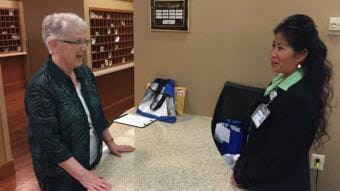
Kathleen Henry, 80, leads voter registration at Greenspring retirement community in Springfield, Virginia. New mobile polling programs aim to bring the vote to residents of long-term care facilities. (Photo by Pew Charitable Trusts)
Kathleen Henry, 80, leads voter registration at Greenspring retirement community in Springfield, Virginia. New mobile polling programs aim to bring the vote to residents of long-term care facilities. (Photo by
Pew Charitable Trusts)

SPRINGFIELD, Va. — Kathleen Henry, 80, wants all her neighbors to vote, even if they can’t drive, read or remember as much anymore.

Soon after the former civics teacher moved to the Greenspring retirement community here in 2003, she took a leading role in running the campus’s polling place and registering voters.

Just this year, Henry said, she’s registered 72 residents as new voters. If a resident doesn’t have an up-to-date government form of identification — as is the case for 18 percent of citizens over 65 — Henry works to bring in a county official to take their picture to comply with Virginia’s voter ID law.

When Election Day rolls around, she and a small group of volunteers set up polling stations in the conference center, a short elevator ride down from the cafeteria and library. The community’s Democratic and Republican clubs post tables with candidate information just outside the voting area. Volunteers shuttle in residents from assisted-living and skilled-nursing facilities. The roughly 2,000 residents of Greenspring, average age 80, are the only voters in this precinct.

“Our motto is if they care enough to come, by golly we’re going to help them vote,” Henry said. “We’ve got it down pretty pat, believe me.”

Now, the gated community about 15 miles southwest of Washington, D.C., boasts some of the highest voter participation rates in Virginia. Turnout for general elections at Greenspring is consistently well above 70 percent, compared with the national average of 55 percent. During the 2004 presidential election, voter turnout here hit 94 percent.

Kathleen Henry talks with a staffer at Greenspring retirement community in Springfield, Virginia. Henry leads voter registration at the precinct. (Photo by Pew Charitable Trusts)

Bringing the ballot to residents of long-term care facilities, many of whom may have impairments that limit their ability to cast a vote independently, is a proven way of increasing voter access, said Jason Karlawish, a professor of medicine, medical ethics and health policy at the University of Pennsylvania who has studied voting and cognitive ability.

“It’s the right thing to do,” Karlawish said. “We have an obligation as a society to allow people to vote.”

But many nursing home residents aren’t as lucky as those at Greenspring. Voting for these seniors depends heavily on state laws — such as early voting, voter ID and same-day registration — and individual long-term care facilities, where staff may or may not be inclined to help residents vote.

Access to the ballot for the 8.4 million residents of long-term care facilities nationwide is an issue of equity, said Nina Kohn, a professor at Syracuse University College of Law.

Running elections the way Greenspring does requires resources and a high degree of volunteer labor, which are more available at a facility where it costs several thousand dollars a month to live than at a nursing home funded by Medicaid, Kohn said.

“Some of these facilities couldn’t have better access,” she said. “At a high-amenity facility, access to voting might be treated as another amenity. ‘We have plays, we have good food, and you can vote here.’ But there are many other facilities that have individuals with similar needs that don’t have polling.”

The lack of ballot access at certain facilities affects specific populations. Nearly two-thirds of publicly funded nursing home residents are women, according to the Centers for Medicare and Medicaid Services. Residents of these facilities, Kohn said, also tend to be poorer than residents of other long-term care facilities.

“We are essentially undermining access to entire interest blocs,” Kohn said.

Barriers to the ballot

For many residents at publicly funded facilities, absentee ballots may be their only access to voting. Every state will mail an absentee ballot to voters who request one. But relying on absentee ballots brings its own challenges, Kohn said.

In some facilities, residents may not have access to information about candidates and deadlines for requesting a ballot. Ballots may be hard to read and fill out for those with disabilities.

In Louisiana and North Carolina, staff at residential facilities are banned from helping residents vote. And in states where staff can help, ethical questions arise over the independence of residents’ vote, Kohn said.

While there is no evidence of systemic voter fraud at nursing homes, Kohn said, she is concerned staff may have filled out absentee ballots without a resident’s permission and that residents may have been unduly influenced by staff. She said she has seen scattered reports of this in her research.

Several studies have found that some facilities across the country have screened residents to determine whether they are mentally capable of voting, even if they expressed a desire to vote. In a 2013 study of Virginia long-term care facilities, professor Richard Bonnie at the University of Virginia School of Law found that it’s “commonplace” for staff to disenfranchise residents based on a diagnosis or their perception of a resident’s mental capacity.

A 2011 study by Karlawish found that staff at long-term care facilities are unsure of how to properly assist voters, confused about whether they are legally allowed to judge a person’s capacity to vote, and burdened by the time commitment of helping with the voting process and paperwork.

Ideally, if asked to help, staff should read the ballot out loud to the residents and ask residents to make a choice among candidates, Kohn said. Every resident who expresses a desire to vote should be allowed to vote, she said; there shouldn’t be a litmus test.

At Greenspring, while staff typically help residents just with mobility when it’s time to vote, they will help residents cast an absentee ballot if requested, said Scott Sawicki, director of corporate affairs at Erickson Living, which runs the retirement community. Still, he said, voting is a delicate issue, especially assisting voters who have dementia and other cognitive issues.

“These situations can get very complex,” Sawicki said. “What you consider doing the right thing is a gray area.”

These concerns will grow over the years, as the U.S. population continues to age. According to the U.S. Department of Health and Human Services, the number of long-term care residents is expected to double by 2050.

During the 2016 presidential election, 70 percent of people 65 to 74 years old voted, according to the U.S. Census Bureau. The voter participation rate of those 75 and older reached only 66 percent that year.

Bringing the vote to them

The best way to get beyond these barriers is for states and local governments to embrace mobile voting, said Karlawish, the University of Pennsylvania professor.

Mobile polling allows bipartisan pairs of election officials to bring ballots directly to long-term care facilities, where they can assist when needed and register new voters if deadlines allow. This system of voting is allowed in 23 states, but laws vary on whether state or local governments are responsible for administering it.
“We need to maximize the access to the right to vote for all Americans,” Karlawish said, “whether they live at home or in a nursing home.”

State lawmakers recently have proposed to expand voting access for senior citizens and others who may have physical or mental difficulties. Louisiana enacted a law in May that eliminated a requirement that residents of long-term care facilities must prove they have a disability to qualify for assisted early voting. One stalled bill in New York would aid residents of long-term care facilities who need help filling out absentee ballots.

Not every new bill would expand access, however. Under a law enacted in Maine this month, absentee ballots can no longer be given to anyone who has granted power of attorney to another person because of dementia.

Mobile voting is a solution Deb Markowitz embraced as Vermont’s secretary of state from 1999 to 2011.

Mobile polling in Vermont now takes place during the early voting period, which allows officials to visit as many facilities as possible without interrupting Election Day. Despite pushback over the use of limited local election resources, Markowitz, a Democrat, said she made it a priority.

“There shouldn’t be bureaucratic barriers to voting,” she said. “I told election officials to go into the community and see if they could get volunteers to expand mobile voting. They found that easy to do.”

In Multnomah County, Oregon, which encompasses Portland, the county’s elections officials will assist any person who needs help voting, including visiting long-term care facilities to walk residents through ballots.

The county’s director of elections, Tim Scott, begins reaching out to local facilities five months ahead of Election Day to let them know his office will assist anyone who requests help voting. Additionally, his office sends registration cards and election reminders to facilities in the months leading up to voting.

The county’s elections office does not have the resources to visit each site, however, to see if someone needs help, he said. Instead, they rely on voters and facilities to make the initial contact.

“We’re doing our best with what we have,” Scott said. “We’re constrained in resources. We rely a lot on voters finding us.”

To reach more people and care facilities, the county works with the state’s Aging Disability and Veterans Services division and the advocacy group Disability Rights Oregon.

Long-term care facilities have a “fundamental obligation to respect the rights of their residents” and to work with local election officials to make mobile voting the standard, despite the cost, Karlawish said.

Still, the gold standard of Greenspring is far off for many long-term care facilities around the country.

For residents here at Greenspring who can take advantage of the access to voting, like Don Young, it’s immensely appreciated. Young, who leads Greenspring’s Republican Club, is legally blind and wouldn’t be able to drive to another precinct to vote. The vote came to him.

“It really does work for the people here,” he said.

Make money from pot? Then forget about a federally subsidized loan

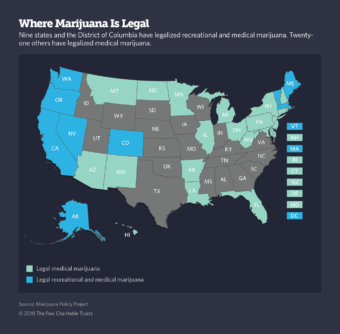
Source: Marijuana Policy Project. (Graphic by Pew Charitable Trusts)

Marijuana legalization at the state level has created a moneymaking opportunity not only for licensed growers and sellers but also for a wide range of ancillary businesses, from publicly traded garden product companies to local print shops.

Now a new Small Business Administration policy could force some entrepreneurs to choose between serving cannabis clients and getting a federally subsidized loan.
In an April policy notice, the federal agency said it won’t approve loans to businesses that derive any portion of their revenue from sales to marijuana clients, because the drug is illegal under federal law.

The policy could hurt local nature centers, architects, designers, attorneys and other businesses that occasionally work with licensed weed industry, legal experts say.

Supporters of cannabis legalization are speaking out against the lending policy.

“This rule would be impossible to implement and wreak havoc across multiple sectors of the economy,” said Oregon Rep. Earl Blumenauer, a Democrat, in a recent letter to the SBA. “For example, would just one order from a cannabis business for soil preclude a locally-owned garden center from receiving federal government loan support in the future?”

Nine states and Washington, D.C., allow marijuana to be sold for recreational and medical use and 21 others allow it to be sold for medical use.

Nationwide, sales of the plant and its products hit an estimated $8.6 billion in 2017 and supported over 121,000 jobs, according to a report from the Arcview Group and BDS Analytics, cannabis industry research firms. That’s almost double the sales Arcview estimated for 2014.

Even more jobs have been created at non-marijuana businesses. In states where marijuana is legal, it’s easy to find marketing agencies that create campaigns for cannabis brands, greenhouse manufacturers that sell products just for marijuana growers and commercial printers that offer new services for marijuana clients.

The SBA has backed over 300,000 loans nationwide since fiscal 2013, and some loan recipients are currently serving cannabis clients, according to a cursory Stateline review of federal loan data and company websites. The agency’s new policy could make them ineligible for future loan assistance.

Take the Green Sunshine Company, a Portland, Oregon-based business that makes lighting systems for growing plants and has used social media to promote its success with cannabis growers. A company representative said the lighting technology is made for anyone who wants to grow indoor plants, and that he may not know what customers intend to grow.

The Green Sunshine representative didn’t want to disclose his name – a reticence shared by several other SBA loan recipients whose websites boast of pot-related clients, but who declined to comment on the new policy.

The SBA isn’t answering questions, either. “Please be aware that the Small Business Administration is not making any comments at this time,” Cecelia Taylor, an agency spokeswoman, said in an emailed statement.

It may be too soon to assess the impact of the policy, said Barbara Vohryzek, president and CEO of the National Association of Development Companies, a trade association for lenders that provide SBA-backed loans.

She said she’s not sure why the agency made the new policy but it may be because the licensed marijuana industry has grown too big to ignore. “It’s becoming an issue that they’re having to address,” she said.

The latest federal crackdown

The SBA’s move to restrict loans to companies that touch marijuana money is the latest example of a federal agency obeying federal law and hurting pot entrepreneurs in the process, said Michael Correia, director of government relations for the National Cannabis Industry Association.

“It doesn’t shock me or surprise me in any way,” he said. Government agencies are risk averse, and would rather say no to the cannabis industry than get into trouble with the Justice Department, he said. Federal law classifies marijuana as a Schedule I controlled substance, on par with heroin and ecstasy. U.S. Attorney General Jeff Sessions is also a prominent opponent of legalizing the plant.

The SBA doesn’t make loans directly. Instead, it guarantees loans, allowing banks to lend money to businesses on better terms. Businesses are eligible for the loans based on the size of their revenues and number of employees, among other factors. Under longstanding federal law, businesses can’t get government-backed loans if they engage in illegal activity.

The agency issued updated guidance last October that said borrowers are ineligible for federally-subsidized loans if they lease space to businesses that violate federal law, including marijuana dispensaries. In April, the agency issued clarification on the marijuana issue – among others – in response to feedback from lenders.

“Because federal law prohibits the distribution and sale of marijuana, financial transactions involving a marijuana-related business would generally involve funds derived from illegal activity. Therefore, businesses that derive revenue from marijuana-related activities or that support the end-use of marijuana may be ineligible for SBA financial assistance,” the notice said.

Ineligible businesses include both those that directly touch cannabis plants, such as growers, processors, distributors and retailers, and businesses that derive any gross revenue from sales to growers, sellers and the like, the notice said.

It cited businesses that sell bongs, grow lights and hydroponic equipment as examples of potentially ineligible borrowers, and said some hemp businesses also may be ineligible for loans.

The new SBA policy could hurt non-white entrepreneurs who have been pushed to the fringes of the cannabis boom, said Kayvan Khalatbari, who chairs the board of the Minority Cannabis Business Association, a business group that advocates for equal access to the industry.

“We’ve see a lot of people of color move to ancillary businesses in this space,” he said, in part because they tend not to have the capital to start a licensed dispensary or grow operation. Khalatbari said it’s “really unfortunate” that such businesspeople will lose the opportunity to get a low-cost loan.

A challenge to enforce

SBA staff may not be commenting publicly, but they’re privately telling banks to increase their due diligence to make sure potential borrowers have no ties to the marijuana trade.

Mark Abell, senior vice president and SBA division director at NBH Bank, said SBA officials have told him that banks should carefully review borrowers’ websites to make sure they’re not marketing to the pot industry. If banks see any red flags, they should submit the prospective borrower’s file to the federal agency for legal review.

He said his bank also has started requiring all prospective borrowers to certify, to the best of their knowledge, that they have no connections to the marijuana industry. No loan applications have been denied yet, he said.

“When you’re in a market like Colorado, cannabis is pretty pervasive,” Abell said, and it’s hard to figure out if non-marijuana businesses are profiting from cannabis. “A business that sells online may not know if it’s selling to the cannabis industry,” he said. NBH Bank has branches in five states, including Colorado, where Abell is based.

Steve Schain, an attorney at the Denver-based Hoban Law Group who focuses on banking and cannabis law, says he doesn’t think the new lending policy will work. “I think it’s almost impossible to implement,” he said, because it’s impossible to police every business transaction.

The policy may create unreasonable due diligence requirements for companies, too, said Andrew Freedman, Colorado’s former “pot czar” and now a consultant working on marijuana legalization. “Making sure that you’re not doing it is much harder than a regulatory system for doing it,” he said.

Freedman gave the hypothetical example of a small electrical services business that occasionally works with indoor marijuana growers. Does the owner now need to train his electricians to identify marijuana businesses? “That’s the part where I’m like, ‘This could be real trouble,’” Freedman said.

Abell said it makes sense that companies that exist for the sole purpose of serving the marijuana industry—such as some businesses that sell grow lights—shouldn’t be getting federal loan aid.  “I think we should all agree that that isn’t a business that should get SBA financing,” he said. But businesses that just happen to serve cannabis clients operating legally in the state – such as garden supply centers – are a different matter, he said.

The SBA may rethink its policy in the future, Abell said. “I’m optimistic that ultimately, we’ll get to a more reasonable place.”

Why this state thinks engineers can save pedestrians’ lives

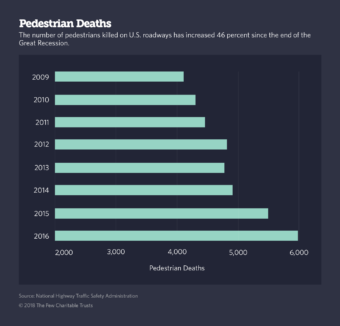
Source: National Highway Traffic Safety Administration (Graphic by Pew Charitable Trusts)

In August 2017, Alexis Dale moved from San Diego to South Florida to attend Florida International University, trading one coastal paradise for another.

Two months later, while crossing an eight-lane road near campus at 3 a.m., she was struck by a car and thrown to the side of the road. Paramedics pronounced her dead at the scene.

Friends and family knew Dale as one of a kind — an ambitious young woman who was eager to pursue a degree in information technology and who loved her dog, Bella. But Dale was one of hundreds of pedestrians who died in Florida that year.

The number of pedestrians killed on U.S. roadways is up — by a lot. Nearly 6,000 pedestrians were killed in 2016, up from 4,100 in 2009 and the highest toll since 1990, according to the Governors Highway Safety Administration. The number of deaths held steady between 2016 and 2017 — but that was cold comfort.

“It leveled off at a 25-year high,” said GHSA’s executive director, Jonathan Adkins. “It’s nothing to celebrate.”

The problem is increasingly concentrated in certain states — and Florida is one of them. Between 2009 and 2016, pedestrian deaths in the state rose by 40 percent, to 652 from 466. To stem the tide, Florida officials increasingly are placing their faith in engineers.

In analyzing trouble spots, the state transportation department now uses mapping software that can identify risk factors such as construction sites, which can divert pedestrian traffic to unsafe routes; land-use patterns, which can then dictate the location of signaled crosswalks; and lighting, which affects pedestrian visibility.

Last month, several of these factors tracked by the agency played a role in a pedestrian fatality in Putnam County. Around 9:30 p.m., a pickup truck struck a man crossing State Road 20 at an intersection with no crosswalk. The state road has minimal lighting, and the Florida Highway Patrol noted visibility was low at the time of the crash. The nearest crosswalk on the high-speed state road was about a mile away.

“Engineering is a proven way to improve safety outcomes,” said Richard Retting, general manager of the firm Sam Schwartz Engineering and author of the pedestrian fatality report released by the Governors Highway Safety Administration. “Florida has some of the best professional planners and engineers working on solving these pedestrian safety problems.”

Safety through engineering?

There is no single cause of the national spike in fatalities, but there are clear patterns.

For example, alcohol consumption by drivers and pedestrians has contributed to about half of pedestrian deaths in recent years, according to federal data.

Another factor is distraction. In 2016, an estimated 562 pedestrians and bicyclists were killed in “distraction-affected” traffic accidents, according to the National Highway Traffic Safety Administration. “Distracted walking” injuries resulting from cellphone use by pedestrians increased by more than a third between 2010 and 2014.

To help address its rising pedestrian fatality rate, Florida is relying on the engineers who design and build roadways and walkways.

“We just have to make sure we identify the right problem for them to solve,” said DeWayne Carver, manager of the state Department of Transportation’s Complete Streets program.

For many years, the department instructed engineers to design roads to handle as much traffic as possible, according to Carver. In recent years, however, it has directed them to prioritize pedestrian safety.

Some of the changes have been subtle, such as changing the standard lane-width on state roads, which had long been 12 feet. Florida narrowed its standard lane width to 11 feet, and to 10 feet in some urban areas.

“Research has shown that narrower roads are more effective for traffic management and safety,” Carver said.

Roads with narrower lanes had lower fatality rates, despite many cities assuming wider lanes are safer, according to an analysis of roadways in cities around the world by the World Resources Institute.

In Florida, Carver said, “If you need a wider lane, you can still ask for it — but you need to show why you need it.”

“Flip-flop” parking, on-street parking that alternates from one side of the road to the other on different blocks, can also improve safety by keeping drivers alert, Carver said. He cites Centre Street in Fernandina Beach, a coastal town near the Georgia border, as a successful example. On Centre Street, stretches of parking spaces alternate from one side to both sides of the street, punctuated by red brick crosswalks.

“It does a great job of using parking to create a chicane effect and keep traffic speeds low,” Carver said.

Engineers are also encouraged to employ “terminated vistas,” in which a large structure is located at the end of a roadway within view of the driver, to “send a message to the driver that they need to be driving slower.”

Florida pedestrian bridge

The year before Alexis Dale died, construction had started on a nearby pedestrian bridge spanning the busy roadway near Florida International University.

Nine months from its completion, the 950-ton bridge collapsed, and the concrete rubble crushed drivers and workers, killing six.

The scope of the project was ambitious: Connecting the FIU campus with the nearby town of Sweetwater, the bridge was designed to serve as a floating public space, with benches, tables, viewing platforms and Wi-Fi.

The bridge was a multifaceted effort: Tallahassee-based FIGG Bridge Engineers designed the bridge, Miami-based Munilla Construction Management was responsible for construction, and the state Department of Transportation provided oversight.

The project reflected the state’s “progressive” engineering strategy, said Retting, the author of the highway safety report.

But the project was not the first of its kind. The engineers behind the pedestrian bridge at FIU used a method called “accelerated bridge construction.” The ABC method is intended to minimize construction time and traffic delays by completing much of the construction off-site and assembling the prefabricated bridge components in a shorter time span.

The ABC method has been implemented in states across the country — one member of the American Society of Civil Engineers estimates that 5 to 10 percent of U.S. bridges are now built using the ABC method. In 2011, Massachusetts replaced 14 bridges in just 10 weeks using the ABC method.

But Retting does not believe the collapse of the FIU pedestrian bridge will dissuade engineers in Florida — or around the country — from pursuing these kinds of ambitious and innovative projects to solve pedestrian safety issues.

“There can be setbacks with progressive infrastructure” projects, Retting said. “But I think setbacks like this are specific to individual projects. This was a one-off.”

Why most states are struggling to regulate Airbnb

Baltimore resident Jeannette Belliveau, who rents a couple of rooms in her historic townhouse to short-term guests, sits with her dog, Copper, in one of the guest suites. States are having a hard time regulating the short-term rental industry. (Photo by Pew Charitable Trusts)

Jeannette Belliveau lives with her dog and two cats in a 19th century house in the Upper Fells Point section of Baltimore, not far from Johns Hopkins Hospital, and rents out a couple of rooms for short-term stays to make a living.

In other parts of the city, Al Hallivis, a real estate investor and single dad, owns a half-dozen houses that he also rents by the night.

A few miles toward the city’s picturesque harbor, a variety of hotels offer traditional overnight stays.

All three models cater to Baltimore visitors, but that’s where the similarity ends.

Belliveau, Hallivis, and hotels have different business models, different perspectives and different agendas. These competing constituencies help account for the difficulty states have had in regulating and taxing the short-term rental industry, even as some cities have taken action to regulate short-term rentals.

“One-size-fits-all state regulation may not always be the most appropriate policy response, and states may therefore choose to allow local governments to regulate,” said Kellen Zale, a law professor at the University of Houston who has done research on the short-term rental market.

Some big cities, such as New York, saw the short-term rentals as a threat to the rental market based on long-term leases, as well as to traditional hotels. New York last year allocated extra funding to enforce a state law restricting rentals for fewer than 30 days unless the host is present and there are no more than two guests.

Other cities saw the short-term rentals as a potential source of income and sought to expand tourist or hotel taxes to the new schemes, with varying success.

The view of downtown Baltimore from the roof of Jeannette Belliveau’s historic townhouse, which she rents to short-term guests. (Photo by Pew Charitable Trusts)

San Francisco this year began limiting the number of nights a year absentee owners can rent their properties through Airbnb or similar platforms.

Owners who live in their residence can rent it out without limit. Owners also must pay a $250 registration fee to the city.

Short-term rentals in San Francisco dropped by 55 percent after the limitations took effect, according to the San Francisco Chronicle and Host Compliance, a company that helps cities keep track of short-term rentals.

In Montgomery County, Maryland, a suburb of Washington, D.C., regulations go into effect in July that will limit the short-term rentals to the homeowner’s primary residence.

Rentals where the homeowner is not present will be limited to 120 nights in a calendar year.

Were Baltimore County to adopt that type of rule, Hallivis said it would kill his business model.

Montgomery County also is collecting hotel taxes on the short-term rental properties. That model, Belliveau said, would make her profit margin, already slim, even tighter.

“I’m opposed to taxing rooms in my house. I’m just Mrs. Murphy,” Belliveau said, referring to the hypothetical elderly widow who has converted a portion of her home into a rental apartment. Under federal housing law, the “Mrs. Murphy’s exemption” provides that if a dwelling has four or fewer units and the owner lives in one of them, that home is exempt from the Fair Housing Act.

Troy Flanagan, vice president of government affairs and industry relations for the American Hotel and Lodging Association, said his group doesn’t oppose “true home sharing” like Belliveau’s — it objects to people who have rental property that they use exclusively for short stays. The industry group has mounted a coordinated attackagainst those multi-dwelling short-term rental owners.

Al Hallivis in a Baltimore property of his, one of half a dozen short-term rental houses he owns. (Photo by Pew Charitable Trusts)
Al Hallivis in a Baltimore property of his, one of half a dozen short-term rental houses he owns. (Photo by Pew Charitable Trusts)

“Increasingly what’s taking place on those platforms is hosts that have dozens of units that are available every day of the year, and that’s a hotel,” Flanagan said. “Home sharing is sharing your home, not sharing your second, third or fourth home.”

Hallivis insists that his houses are not hotels, and that he helps neighborhoods by fixing up vacant houses and turning them into nice-looking properties. By bringing in people with money to spend, he said, he also gives a boost to neighborhood restaurants, mom-and-pop stores and taverns.

Private residences generally are not held to the same safety standards, such as requirements for sprinkler systems or handicapped access, as commercial rentals. Hotels in general must have those, as well as emergency exit directions, emergency lighting and fire doors. Hallivis said his homes have fire extinguishers and smoke detectors.

He noted that in fiscal 2017, about $17 billion was spent in Maryland on hotels and the rest of the tourism industry, and $42 million was spent on short-term rentals from Airbnb. “We don’t hurt the hotel industry at all,” he said. “They want a monopoly.”

In addition to Maryland, about 15 states debated bills to regulate the short-term rental industry this year. Only one, Indiana’s, was signed into law. Nebraska’s governor vetoed a bill approved by that state’s Legislature. A bill to regulate the industry also died in Hawaii.

The Indiana bill protects the ability of homeowners to offer short-term rentals, and prohibits cities from banning rentals of a primary residence, while allowing them to impose fees or taxes. The bill vetoed in Nebraska was similar.

In New Albany, Indiana, just across the Ohio River from Louisville, Ruth Ann Floyd rents out one room in her 1880s-era house. Reached just days before the Kentucky Derby, she said she’s booked solid for Derby week. A 69-year-old retiree from General Electric’s refrigerator manufacturing plant, Floyd is pleased that the state protected her little rental business but concerned about the fees that the city might impose.

“Every bit of money I take in I put back into the house,” she said as grandchildren shrieked in the background. “If the city comes up with a big fee, I’m not going to keep doing it.”

New Albany’s city council president, Al Knable, said he is not in favor of large fees, but collecting the current 4 percent tourist tax — now just assessed on a couple of hotels in the county — might be appropriate. He’d like to see Airbnb and the other platforms collect and remit the tax, not the local homeowners.

The proposal that passed the Indiana Legislature and was signed by Republican Gov. Eric Holcomb in March would not restrict owner-occupied rentals. But it would limit how many days absentee owners can rent their properties and allow for rules on which amenities, such as parking, they must provide. The law also allows for local permitting and taxing.

Maryland state Sen. John Astle, who authored the bill to regulate and tax short-term rentals in his state, said there was stiff resistance to a statewide bill, particularly the part about collecting hotel taxes. Astle is ready to concede that regulations should be left to local jurisdictions. But the tax issue is dependent on the state Legislature.

The Anne Arundel County Democrat said he plans to meet with city officials in his hometown of Annapolis to press his case for local regulation. He said short-term rentals have detracted from his city’s neighborhood feel, and that “if you are going to rent something, you ought to have the health and safety issues that are required in any kind of commercial rental.”

But Matt Kiessling, a vice president at the Travel Technology Association, which represents online platforms, says the travel industry is big enough for a variety of accommodations.

“Hotels are ripping and roaring from a business standpoint, with the highest occupancy rate ever,” he said. “Short-term rentals are exploding. … One isn’t taking away from the other; the pie is just getting bigger. All the internet has done is make that market more efficient by allowing travelers to find a home and homeowners to rent a home.”

Companies in foreign trade zones await more details on Trump tariffs

A crane moves an aluminum replacement cabin made by Homer's Bay Weld Boats. The company is one of a number of Alaska businesses already affected by President Trump's imported metals tariffs.
A crane moves an aluminum replacement cabin made by Homer’s Bay Weld Boats. The company is one of a number of Alaska businesses already affected by President Trump’s imported metals tariffs. (Photo courtesy Bay Weld Boats)

Manufacturers that operate in foreign trade zones may be able to evade President Donald Trump’s new tariffs on steel and aluminum imports, trade experts say. But there are a lot of unanswered questions about how the tariffs — which were justified on rarely-used national security grounds — will be applied in zones.

“This issue is so new and unprecedented that even Customs has not finalized how they are going to handle these transactions,” Tom Gould, senior director for customs and trade at Miami-based law firm Sandler, Travis & Rosenberg, said in an email.

There are close to 200 foreign trade zones in the United States, from the Port of Long Beach to a five-county area in Colorado’s rural Eastern Plains. The federal government created the FTZ program during the Great Depression to help domestic and foreign companies delay or reduce customs duties and fees.

Under most circumstances, manufacturers in foreign trade zones can choose to pay duties on a final product or on its components. For some companies, such as automobile manufacturers, flipping the duty rate can lead to big savings.

But Trump’s tariffs are unusual. They are authorized under a 1962 law that allows the government to limit imports that threaten national security. There’s little to no guidance on how such tariffs will play out in foreign trade zones, Gould said.

Trump has authorized a 25 percent tariff on the value of imported steel articles — such as beams, tubes and wire — and a 10 percent tariff on the value of imported aluminum articles. The tariffs don’t apply to imports from Canada and Mexico and the Trump administration has left the door open to other exceptions.

The federal government has adjusted imports on national security grounds on two other occasions since 1979, according to a 2001 Commerce Department investigationinto iron ore and semi-finished steel imports. The report found no evidence of a national security threat from such imports at the time. Trump’s tariffs are the first national security tariffs imposed since the report was published.

Companies can’t typically use foreign trade zones to avoid other special tariffs, such as antidumping duties. Trump’s tariffs may be applied in a similar way, Erik Autor, president of the National Association of Foreign Trade Zones, an industry association, said in an email.

“Special tariffs imposed through a trade remedy action are subject to different rules,” Autor said. “As a general rule, zone operators may be able to delay, but not avoid payment of these special duties.”

The new steel and aluminum tariffs will apply to products that enter the United States beginning this Friday, March 23.

Site notifications
Update notification options
Subscribe to notifications