Quinton Chandler, KTOO

Seismologists count over 100 aftershocks since morning earthquakes

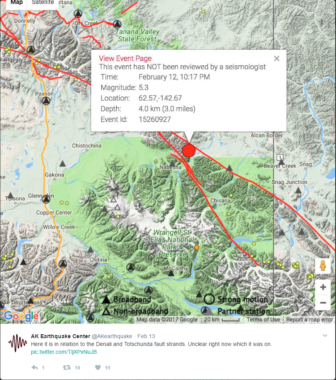
Seismologists with the Alaska Earthquake Center said they’ve recorded over 100 aftershocks since two major earthquakes shook Canada and Southeast Alaska early this morning.

Seismologist Natalia Ruppert warned that more aftershocks are expected over the next few days.

“Some aftershocks could really be pretty strong,” Ruppert said. “If you have any breakable valuables on display or items that you care about, and they’re standing on the shelves unsecured, maybe it’s a good idea right now to box them or put them on the lower shelf so that you don’t lose your valuables.”

Ruppert said the biggest aftershock recorded so far was a magnitude 4.7. The aftershocks won’t travel as wide an area as the earthquakes that triggered them, but she said Southeast communities could still feel them.

“We’ve got reports from Haines that they felt quite a few aftershocks after the 4:30 a.m. earthquake,” Ruppert said. “They’re definitely close enough to experience continuing shaking.”

This morning’s two earthquakes were magnitude 6.2 and 6.3, according to the Alaska Earthquake Center. The first was at 4:30 a.m. and the second was at 6:18 a.m. Ruppert put the quakes’ epicenters in British Columbia, about 130 miles northwest of Juneau. She said there are reports of minor damage to homes in Whitehorse, and she has more damage reports to review.

Michael West, another seismologist with the Alaska Earthquake Center said earlier this morning that it’s important to remember the Denali Fault spans all the way from mainland Alaska to Southeast.

Capital City Fire/Rescue Assistant Chief Chad Cameron said he hasn’t heard any reports of earthquake damage in Juneau.

Newscast – Monday, May 1, 2017

In this newscast:

  • Seismologists warn they’ve recorded 100 aftershocks since two major earthquakes rocked Southeast Alaska and Canada Monday morning.
  • The Supreme Court refused to hear Alaska and oil and gas industry groups’ appeal protesting a U.S. Fish and Wildlife Service decision to set 187,000 square miles in Alaska aside as critical habitat for threatened polar bears.
Juneau Juvenile Justice staff workload up since Ketchikan closure

(Photo by Heather Bryant/KTOO)

Ten kids have come to Johnson Youth Center from Ketchikan since the fall of last year. Ketchikan kids detained by the Division of Juvenile Justice used to be housed in the Ketchikan Regional Youth Facility, but the division closed the facility in September.

Recent Juvenile Justice Director Rob Wood had said the facility was underutilized and state budget cuts made it too expensive to operate. So now, Ketchikan kids go to Juneau.

Juneau Juvenile Justice workers say they’re in good shape now, but transporting and housing the additional kids hasn’t been a completely smooth ride.

“Work-wise it has increased the work of my Ketchikan office in a huge way,” said Chief Probation Officer Joe Adelmeyer.

Adelmeyer is sitting in a conference room outside the detention unit. He is responsible for kids across Southeast Alaska. He says the biggest challenge from losing Ketchikan has been getting the kids to Juneau.

“We’ve got to detain the kid. I’ve got POs on the ground over there that have to bring the kid over. Flights being what they are, that means the POs (have) got to overnight,” Adelmeyer said.

He adds that money isn’t a problem. The flights and accommodations are still cheaper than running the Ketchikan youth center, but it does cost a lot of time.

“If it’s a local kid, we’ve got to get in front of a judge. It could be as long as 16 hours, it could be as short as a couple hours,” Adelmeyer said.

He explains that kids who aren’t from Ketchikan can just be taken on a plane to Juneau and then they can call into the right court, but kids from Ketchikan have to go to court there.

The other challenges are capacity and staffing. The number of kids detained in Juneau can change daily. Adelmeyer is struggling to remember how many kids Johnson has now.

“There’s six kids in the back and there are four Juneau kids and there’s two Ketchikan kids,” Adelmeyer remembered with help from Johnson Youth Center Superintendent Jess Lujan.

The kids in the detention unit weren’t actually visible during my visit. Superintendent Lujan says the state doesn’t allow kids in detention to be interviewed or photographed. It’s a way to protect their identities.

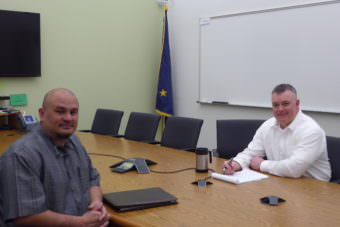
Johnson Youth Center Superintendent Jess Lujan, left, and Chief Probation Officer, Southeast Region Joe Adelmeyer in the Johnson Youth Center conference room.
Johnson Youth Center Superintendent Jess Lujan, left, and Southeast Region Chief Probation Officer Joe Adelmeyer in the Johnson Youth Center conference room on April 26. (Photo by Quinton Chandler/KTOO)

Lujan says since the Ketchikan facility closed, Johnson’s population has ranged between 15 kids and four. He says those numbers were standard before the closure, but Johnson’s detention unit only has eight beds.

“So what that means is we have eight rooms — eight secured rooms, and then we have two observation rooms,” Lujan explained. “So those rooms, we can comfortably house 10 kids, each getting their own room.”

A typical room in the Johnson Youth Center detention unit.
A typical room in the Johnson Youth Center detention unit. (Photo by Quinton Chandler/KTOO)

Lujan says when the population is high, they can put two kids in a room.

“We’ve been very lucky to see numbers where we haven’t had to double up on rooms much. We have done it,” he said.

He says he was already hiring to fill a staff shortage before the Ketchikan closure. After the closure, when they were shorthanded in detention he would borrow staff from Johnson’s long-term treatment unit to help.

Right now, he thinks the ratio of kids to staff is good and he just wants to hire three more people for the treatment and detention units.

Adelmeyer doesn’t think uprooting the Ketchikan kids has had a huge impact on most of them.

“Overall, I think it’s ideal to have kids in the same community as their parents,” he said. “I think that you could make a real general kind of assumption that it’s a better deal. I mean the parents are right there. They can be involved if you’ve got any family work that’s going on therapeutically speaking.”

For some kids who have a very stressful or dysfunctional family environment, Adelmeyer thinks it’s actually better for them to be away.

“I think it could be a double-edged sword. I think for the right kid, it could be a good or bad thing. It just depends on the kid and the family,” Adelmeyer said.

Adelmeyer says parents are calling their kids by phone, and the center can set up a video link, but none of the parents have tried it yet. Lujan says one father has come from Ketchikan to visit his son.

Clarification: A reference to Rob Wood has been updated to clarify that he is no longer the current director of the Division of Juvenile Justice.

Assembly funds schools to full legal amount again

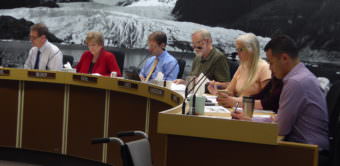
The Juneau Assembly holds a special meeting on Wednesday, April 26, 2017.
The Juneau Assembly holds a special meeting on Wednesday, April 26, 2017. (Photo by Quinton Chandler/KTOO)

The CBJ Assembly voted five to four Wednesday night to appropriate $26,935,900 to the Juneau School District’s budget – more than $1 million above last year’s level.

The appropriation meets the full amount state law allows the CBJ to give the school district plus provides $925,700 for other programs and activities not tied to the state funding cap.
Juneau School District Superintendent Mark Miller, left, and Director of Administrative Services David Means at the Juneau Assembly special meeting on Wednesday, April 26, 2017.
Juneau School District Superintendent Mark Miller, left, and Director of Administrative Services David Means at the Juneau Assembly special meeting on Wednesday, April 26, 2017. (Photo by Quinton Chandler/KTOO)

District budget documents show the appropriation does not include $213,000 the school district asked for to replace a projected shortfall in state funding for student transportation.

David Means, Juneau School District’s director of administrative services said the CBJ amount is decided, but the district’s total budget is still uncertain.

The school district relies on multiple funding sources including local, state and federal government. In late March, district officials sent the CBJ a total projected budget over $87,267,000.

Juneau’s charter requires the assembly to finalize the district’s budget by May 31.

‘It’s really sad’: Juneau kids sorry to see playground burn

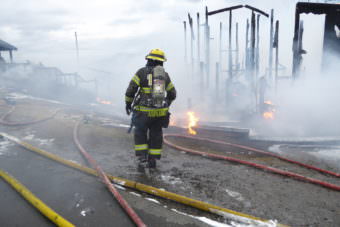
Foam clung to the charred remains of castle steeples and playhouses while firefighters swept the Twin Lakes playground with high-pressure hoses.

(Read more: Two teenagers charged in fire at Twin Lakes playground)

The smoke was thick but through the gaps, it didn’t look like much was left of the popular playground located in a park north of downtown Juneau.
The playground caught fire Monday evening. Bystanders watching from the sidelines said it was a huge loss.

Kala and Kaleb Burras with their parents Latroy, left, and Donny, right. Photo by Quinton Chandler/KTOO
Kala and Kaleb Burras with their parents Latroy, left, and Donny, right. (Photo by Quinton Chandler/KTOO)

Eleven-year-old Kala Burras was watching the fire crews with her parents and brother. She said she feels a strong connection to this park.

“It was really important because I liked to play on it everyday and it was just really fun to play on it and now that it’s gone, it’s really sad,” Burras said.

Kala said she especially used the park in the summer months, something she was looking forward to doing this year.

“I’m probably just going to go see if there’s any other thing I can do, like play at another park, but it’s probably not going to be as good as this one,” she said

Kala’s 10-year-old brother, Kaleb said he loves the park, too, and he and his friends usually play here during the summer.

“I’m probably going to stay home and play video games now,” he said.

But, he said video games won’t make up for it completely.

Nerio Bernaldo said that his kids hadn’t even seen the fire damage in person yet. He showed them a picture on Facebook before coming out to the scene.

“When I got wind of it, I told them about it and immediately they started crying, so I could see the effect that it had on them and that was just by word of mouth,” Bernaldo said. “So, I think by a lot of kids actually seeing it would cause a lot of emotional trauma and they’d be upset about what’s going on.”

Nerio Bernaldo on Monday.
Nerio Bernaldo on Monday. (Photo by Quinton Chandler/KTOO)

Bernaldo was sad and angry. He wants to know how the fire started. He said this playground was a go-to destination for a lot of families, including his. He said it was like a safe haven for his kids in a community where he is increasingly worried about his kids having a safe place to go.

A Facebook group called Rebuild Castle Park popped up Monday and within three hours of the fire, there were nearly 1,800 members.

Capital City Fire/Rescue is looking for information about the fire from the public. Contact the Juneau Police Department at 586-0600 with information. 

Juneau funnels March for Science energy into an Earth Day fair

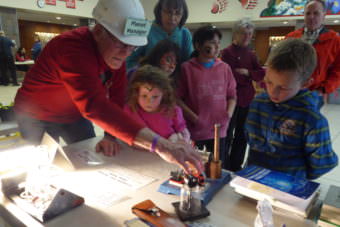
Bill Leighty, the Planet Manager shows a group of kids his model steam engine at the Juneau Renewable Fair in the JDHS commons on Earth Day.
Bill Leighty, the Planet Manager, shows a group of kids his model steam engine at the Juneau Renewable Fair in the Juneau-Douglas High School commons on Earth Day. (Photo by Quinton Chandler/KTOO)

Inside the Juneau-Douglas High School commons, several face painted kids and a couple of adults are engrossed watching electrical engineer Bill Leighty explain the mysteries behind his model energy systems.

Right now, he’s showing off the steam engine.

“OK, flick that big wheel with your fingers,” Leighty directed a boy. “More, flick it harder, harder. Flick it the other direction. Ooh, almost had it go again.”

It takes the boy a few more tries.

“Ooh, try it again,” Leighty encouraged. “There it goes! It’s running!”

This Earth Day, Juneau residents wrapped up their first March for Science with a stop at a fair promoting renewable energy and environmental consciousness.

About 30 different organizations and individuals put the fair together, including environmentalists and wildlife advocates.

Bill Leighty is a director of the Leighty foundation, a local charitable organization.

He has been on a mission for 15 years exploring how to make the jump from fossil fuel to renewable energy without carbon dioxide emissions.

“That’s what I’m demonstrating with the little hydrogen demonstrator here,” he said. “That’s an electrochemical energy system.”

Next, he compared the electrochemical system with the heat engine.

“Heat engines like we have in our cars now and boilers are very inefficient compared to electrochemistry, so that’s why we have the hydrogen system, which is not hot at all,” Leighty said. “There’s no heat in there, except a little byproduct heat. Whenever you convert from one energy form to another, you lose a little energy in inefficiency and it appears as heat.”

Leighty said he wants the kids to think about complete energy systems and how they work, from the source all the way to “turning the wheels on their cars.”

Phillip Moser, left, and Bryn Fluharty are with Southeast Alaska Conservation Council.
Phillip Moser, left, and Bryn Fluharty are with Southeast Alaska Conservation Council. (Photo by Quinton Chandler/KTOO)

A few booths down from Leighty, The Juneau chapter of the Alaska Wildlife Alliance, is handing out flyers against predator control and supporting a buffer zone near Denali National Park and Preserve where wolves would be safe from trapping and hunting.

The Southeast Alaska Conservation Council is promoting their desire for a new baseline study on Hawk Inlet, an Admiralty Island watershed.

SEACC representatives say they want to know whether mining operations in the area are polluting the water and in turn hurting marine life and the people who eat it.

Other organizations at the Renewable Juneau fair include the Alaska Clean Harbors Project, the U.S. Forest Service, Juneau Compost and Juneau District Heating.

Thirty-one groups are sitting behind tables at the fair, according to Danielle Redmond, coordinator for Renewable Juneau.

“They represent all different kinds of things from local food to climate organizing to local schools and school groups, as well as advocacy organizations so it’s been a really good mix,” Redmond said.

Danielle Redmond, left, is the coordinator for Renewable Juneau. David Abad, right, is one of the organization's volunteers.
Danielle Redmond, left, is the coordinator for Renewable Juneau. David Abad is one of the organization’s volunteers. (Photo by Quinton Chandler/KTOO)

Renewable Juneau is a nonprofit that, like their name suggests, promotes renewable energy and utility regulation in Alaska.

Redmond is sitting cross-legged and holding her baby boy.

She said this is the organization’s first fair and they’re holding it on the same day as Juneau’s March for Science.

“Oftentimes we have these marches, and we build up all this great energy, and we get excited, and we whoop and holler, and it’s important to show that energy and to show that publicly,” she said. “But, it’s just as important to keep that energy going and channel it into productive avenues of both policy and concrete solutions on the day to day level.”

Redmond has no idea how many people cycled through the fair, but she estimates they saw at least a couple of hundred, with a big boost in attendance coming from the protesters who finished their March for Science right outside the fair’s door.

Editor’s Note: Bill Leighty sits on the board of the Leighty Foundation which has helped pay for KTOO’s internship program.

Correction: An earlier version of a photo caption in this story misspelled Renewable Juneau volunteer David Abad’s name. 

Site notifications
Update notification options
Subscribe to notifications