Quinton Chandler, KTOO

Native groups install totem pole at Gastineau Elementary, lost cemetery

The T’aaku Kwáan of Douglas Island raised a totem pole in front of an elementary school Saturday to mark the site of a disturbed graveyard. The pole symbolizes the pain of historical trauma and a need to heal.

A couple dozen volunteers prepared to bend their knees and backs to grab wooden beams underneath a 26-foot, solid wood, Raven totem pole laying on its back. Like pallbearers, they lifted the pole and slowly carried it toward a crane waiting to lift and place it on a metal base sitting in front of Gastineau Elementary School.

Event organizers warned them to call for help if they felt like the weight was too much.

“For those of you on the sides, we’re going to need you to switch out if somebody says help. We don’t want anybody getting hurt trying to move this,” one man ordered.

Sixty-one years ago, Gastineau Elementary School was built on top of a graveyard for the Tlingit T’aaku Kwáan.

Goldbelt Heritage Foundation, the Douglas Indian Association and the Juneau School District organized the totem pole raising and a ceremony to reflect on “social injustices” inflicted on the T’aaku Kwáan.

Andrea Cadiente -- Laiti speaks at the totem pole raising ceremony on Saturday.
Andrea Cadiente-Laiti speaks at the totem pole raising ceremony on Saturday. (Photo by Quinton Chandler/KTOO)

Andrea Cadiente-Laiti was the keynote speaker at the ceremony. She sits on the Goldbelt Heritage Foundation’s board and she’s also the tribal administrator for the Douglas Indian Association.

She said construction workers accidentally unearthed three burial sites on the school property in 2012. Five people were in the graves.

“One was a young woman and it was determined by the archaeologist that she died in childbirth,” Cadiente-Laiti said. “So, that leads us to assume that the remains were not just that of the young mom, but that of her infant.”

She said another man was buried with what might have been his prized gun collection.

Cadiente-Laiti likened building Gastineau Elementary over the cemetery to someone building “an office building over Evergreen Cemetery,” a 9-acre memorial in Juneau that the city estimates over 8,000 Juneau residents have been buried in.

Cadiente-Laiti and other speakers also recalled the impacts of the city of Douglas’ intentional burning of Douglas Indian Village in 1962, decisions to build roads over graveyards, property loss, the loss of fishing rights and the suppression of the Tlingit language.

Cadiente-Laiti said those actions had powerful effects that were passed down to today’s generations.

“We don’t necessarily feel it, or see it, or taste it, but somehow through our parents we know it’s there. We see their sadness,” Cadiente-Laiti said.

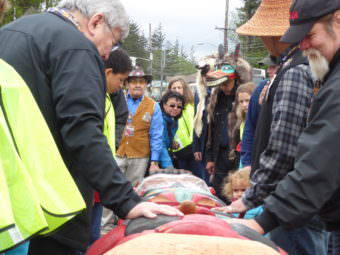
The Raven totem pole after being placed on its base on Saturday.
The Raven totem pole after being placed on its base on Saturday. (Photo by Quinton Chandler/KTOO)

It is hoped that raising the Raven totem pole will pay respect to the grievances of the past, restore the T’aaku Kwáan’s ancestral connection to the land, and signal their desire to heal and move forward, culture intact.

The organizers plan to raise a second totem pole at Savikko Park next spring. The second pole will recognize the Yanyeidì clan and the 1962 burning of Douglas Indian Village.

Correction: A previous version of this story misstated that five construction workers unearthed the burial sites discovered in 2012. The orthography of “T’aaku Kwáan” has also been corrected. 

Amtrak Engineer Charged In Deadly 2015 Philadelphia Train Crash

Emergency personnel work at the scene of a deadly Amtrak derailment in Philadelphia in 2015. The engineer has been charged with crimes including involuntary manslaughter.
Patrick Semansky/AP

Pennsylvania Attorney General Josh Shapiro has brought criminal charges against the engineer who was operating Amtrak 188 when it derailed, killing eight people and injuring over 200 two years ago.

Brandon Bostian faces eight counts of involuntary manslaughter and other crimes including causing a catastrophe and reckless endangerment. Federal investigators determined that Bostian allowed the train to speed up to 106 mph in a curve suitable for only half of that speed.

The National Transportation Board determined that the derailment was caused by human error and that Bostian was distracted and had lost situational awareness.

The charges come after a dramatic turn of legal events. Earlier this week, Philadelphia District Attorney Seth Williams announced that he would not press charges against Bostian because there was no evidence of criminal intent or responsibility.

But Philadelphia Municipal Court President Judge Marsha Neifield ordered the district attorney to charge Bostian at the urging of attorneys representing dozens of the victims. The DA’s office issued a statement saying since it had already decided not to charge Bostian it wanted to avoid “any apparent conflict of interest.” So the DA referred the case to the state attorney general who filed charges.

Amtrak 188, originating in Washington, D.C., was bound for New York. Bostian was an experienced engineer. The investigation found no evidence that alcohol or drugs were involved. The engineer told investigators that he recalled very little about the crash.

The charges against him were filed just a few hours before the statute of limitations was set to expire.

Copyright 2017 NPR. To see more, visit http://www.npr.org/.

School board recognizes retiring Juneau educators

The Juneau School Board took a moment on Tuesday night to honor teachers and staff members who are retiring and moving on to new endeavors.

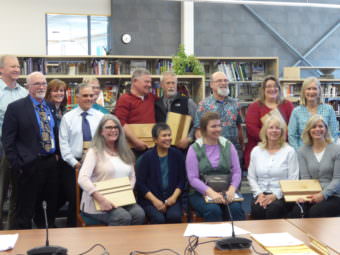
The board called each retiree to the front of the Thunder Mountain High School library to get a pat on the back, or a tight hug, a lifetime pass to all future Juneau School District events and a cutting board made by Thunder Mountain High School students.

Lori Hoover, principal of Auke Bay Elementary School is recognized by the Juneau School Board in the Thunder Mountain High School library on Tuesday, May 9, 2017.
Lori Hoover, principal of Auke Bay Elementary School is recognized by the Juneau School Board in the Thunder Mountain High School library on Tuesday. (Photo by Quinton Chandler/KTOO)

Lori Hoover, the outgoing principal of Auke Bay Elementary School, says she is finishing a 33-year run with the district.

“Well it’s kind of … you know it’s bittersweet. I enjoy going to work every day,” Hoover said. “I enjoy the kids. But sometimes it’s just the right time to look for new adventures and see what else is around the corner and let new people come in and lead the way.”

Hoover also was recognized at the board meeting for being awarded the title: 2017 Champion of the Arts by the Alaska Arts Education Consortium. She says she doesn’t have any big plans for retirement yet.

“I’m just going to wait and see what happens and enjoy every day,” she said.

Like Hoover, Annie Janes, an English teacher with Thunder Mountain, doesn’t have any solid plans.

“We’re 14 days away from summer. I’m going to rest first. That’s the first thing teachers do,” Janes said.

After that, she says she’ll do anything she wants.

Valorie Ringle won’t be able to relax quite as soon.

“I’m teaching summer school so I don’t start resting until August,” Ringle said.

Ringle is also an English teacher. She will be leaving Yaakoosge Daakahidi High School. She and Janes have a little advice for future teachers.

Janes says they need to know one thing more than anything else.

“To go into this business, you better make sure you really enjoy being with kids. That’s the first thing. Really take a look at that I think,” Janes said.

Ringle added, “you have to not just really care about kids. You have to be willing to put aside your own experience and get in the trenches with where they are. I’m older now and I didn’t experience half the things these kids … the kids that I teach have experienced.”

Ringle says when teachers can’t recognize those differences anymore, value them and learn from them, they should probably stop teaching.

Janes, Ringle and Hoover all say they aren’t going anywhere anytime soon and they still plan to contribute to education — just in new ways.

Six names added to fishermen’s memorial at 27th Blessing of the Fleet

The Alaska Commercial Fishermen's Memorial in Juneau on Saturday, May 6, 2017.
The Alaska Commercial Fishermen’s Memorial in Juneau on Saturday. (Photo by Quinton Chandler/KTOO)

It was a warm, sunny Saturday in downtown Juneau. Dozens gathered for the 27th annual Blessing of the Fleet and to honor the commercial fishing fleet and also to remember the lives of six commercial fishermen whose names will soon be engraved in the Alaska Commercial Fishermen’s Memorial.

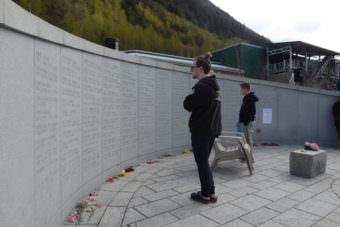
The memorial is a curved, smooth granite wall engraved with over 200 names. Some have small stars next to them, indicating fishermen who died at sea.

Paul Dayton Fredrick’s name is one waiting to be engraved. His name will have a star next to it. Kyle Moselle is Fredrick’s son-in-law. He said Fredrick passed away last June.

Kyle Moselle, left, and Alex Dayton Fredrick point to Paul Dayton Fredrick's name on the Alaska Commercial Fishermen's Memorial in Juneau on May 6, 2017.
Kyle Moselle

“He’s one of those Southeast commercial fishermen that (was) a one-off mold. He’s spirited and sometimes crass and sometimes hilariously funny and (a) hard worker,” Moselle said. “He went out to the ocean and provided for his family and when the fish weren’t running, he worked other jobs to provide for his family. That’s who he was and who he is.”

Moselle said Fredrick mostly fished from a 24-foot Bayliner named the Cathy Jean.

“He was never on the biggest boat. He was always on the smallest boat fishing with the big boats out in the open water too,” he said. “But, he earned the respect of other fishermen that were out there on much bigger vessels than he was and he brought in the catch.”

Paul Fredrick's grandson Hunter Dayton Fredrick, left, and his son Alex Dayton Fredrick.
Paul Fredrick’s grandson Hunter Dayton Fredrick, left, and his son Alex Dayton Fredrick point to his name on Saturday. (Photo by Quinton Chandler/KTOO)

Moselle and Fredrick’s son, Alex, said Fredrick was a fisherman for over 30 years. Moselle said he mostly fished out of Sitka, but went all over Southeast.

Lt. Gov. Byron Mallott was invited to speak at the ceremony. He attended alongside Gov. Bill Walker.

Lt. Governor Byron Mallott, right, and Governor Bill Walker after the Blessing of the Fleet ceremony on Saturday.
Lt. Gov. Byron Mallott, left, and Gov. Bill Walker after the Blessing of the Fleet ceremony on Saturday. (Photo by Quinton Chandler/KTOO)

Asked why the community should continue holding the remembrance, Mallott said it’s an important chance to pause from day to day business and remember fishermen who have died whether they’re on the wall or not. He said it’s especially important for families like Kyle Moselle’s.

“Well you see families come to the wall, who have loved ones placed there just in the past year and you see their grief and you see the support that is given them by the entire community, and to me that’s enough,” Mallott said.

Kyle Moselle said commercial fishing is like “the fabric of a community” because it’s an industry that benefits everyone in Southeast Alaska and the state.

“It’s our family members and other family members that put their love, blood, sweat and tears into that industry and … this memorial recognizes that perfectly,” he said.

The other five fishermen whose names will be added to the memorial wall are Maurice Nelson, Lester Henkins, Rocky Reed, Mark Burger and Steve Erickson. A board member with the nonprofit Alaska Commercial Fishermen’s Memorial in Juneau said the names will be engraved in June.

Correction: An earlier version of this story and its headline omitted one of the fishermen added to the wall. Mark Burger’s name will also be added for a total of six names.

Local adult ed center outperforms national GED graduation rate

Joyanne Bloom teaches the What's Up? class at The Learning Connection on on Tuesday, April 25, 2017.
Joyanne Bloom teaches the What’s Up? class at The Learning Connection on on Tuesday, April 25, 2017. (Photo by Quinton Chandler/KTOO)

It’s time for What’s Up? a social studies class that focuses on current events. When teacher Joyanne Bloom asks what’s up around Juneau, Kristina Arnold brings up a playground that burned down.

“It was saying last night on the Empire page that it was over $250,000 worth of damage done,” Arnold said.

She is in this free class because she is studying for GED or General Education Development tests.

“I did independent science and language arts. I did those tests already and passed them. I just got two more tests to do and I’ll be done,” Arnold said.

The Learning Connection reports 86 percent of their students who complete all four of the GED tests pass. That’s a passage rate nine points higher than the national rate. The staff believes the higher rate is a result of their relationships with their students.

Kristina Arnold at The Learning Connection on Tuesday, April 25, 2017.
Kristina Arnold at The Learning Connection on Tuesday, April 25. (Photo by Quinton Chandler/KTOO)

Arnold is 34 and her goal is to go to college once she has her diploma. She says she was on her own working two jobs 15 years ago. She says she was in “survival mode” and in the second semester of her senior year, she decided to drop out of high school.

“And I’ve kicked my butt the whole entire time. Fifteen years without my high school diploma is 15 years too long in my eyes,” Arnold said.

Eventually, she got married and she has two boys and two

girls. She says setting a good example for them is probably her biggest motivation to pass the GED tests.

The four GED tests cover language arts, science, social studies and math.

Jeff Smith, a teacher at the Learning Connection, believes a combination of things contributes to the higher rate.

He is walking his students through some algebra today. They’re simplifying and solving polynomial equations.

Smith, who is in a Juneau classroom with five other students including Arnold, is also working with students calling in from learning centers around the state.

Some students are just brushing up on their math skills. Most, like Arnold, are preparing for the math test.

I didn’t realize I knew Smith personally until I started this story but we both agreed it wouldn’t be a problem.

“No, I think we can … we can turn on the professionalism,” he laughed.

Smith predicts there will be about 30 Learning Connection graduates by this summer.

He says as soon as a student walks through the door, the staff assesses their strengths. From then on, he says they offer a lot of one-on-one help and he says that one-on-one time contributes to the passage rate.

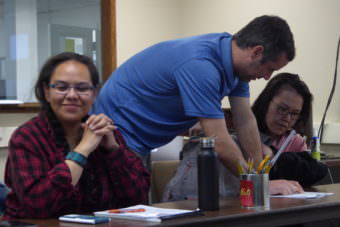
Jeff Smith, middle, helps a student during his math class on Tuesday, May 2, 2017.
Learning Connection teacher Jeff Smith helps a student during a math class on Tuesday. (Photo by Quinton Chandler/KTOO)

The next thing he points to is the activities built around learning subject material.

“When we come back tomorrow, we’re going to look at different application problems,” Smith said. “How does this relate to the workforce? What kind of job out there do you maybe have to use some of these things that we learned today right?”

He says they’ll solve problems with polynomial functions to design their own roller coasters.

The last piece of the equation that Smith says leads to the high passage rate is The Learning Connection’s culture. He says the students are extremely comfortable with their instructors and each other.

“There’s somebody at the center that’s relying on them, that wants them to be here, that’s going to be wondering where they are if they’re not here,” Smith said. “That sense of community that’s built here really keeps people coming back and working towards their goals because they’re not in it alone.”

He stresses that the center is not just for GED testing, they also have a jobs program for ages 16-24, a construction academy, a training program for seniors and there’s an English as a Second Language program. The programs are supported by grants from nonprofits and the state and federal governments.

At the end of the year, students from all these programs are welcomed to a “Celebration of Success.” If Arnold passes her last two tests this month, she will be joining as a graduate.

Site notifications
Update notification options
Subscribe to notifications