Rosemarie Alexander

Auke Bay children celebrate their new school

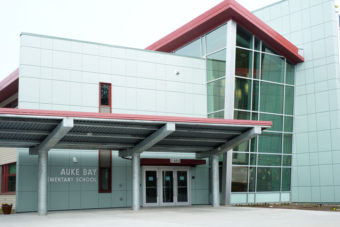
The students of Auke Bay Elementary School on Thursday formally thanked the community of Auke Bay, state and local officials, and the City and Borough of Juneau for their new school.

The old school has been completely gutted and renovated, with much of the work done while school was in session.

The celebration

Auke Bay Elementary School sits on Aak’w Kw’aan land.  The Tlingit were the first people of Auke Bay.

Elders Rosa Miller and Albert McKinley offered the Aak’w Kw’aan welcome to the ceremony in Tlingit and English.

“Our land will be yours,”  McKinley said.

In Tlingit regalia, groups from Harborview and Glacier Valley elementary schools danced the response.

Auke Bay fourth graders sang their school song in Tlingit and kindergartners counted in Tlingit.

Each Auke Bay grade made gifts for the elders and other guests —  necklaces, medallions, bookmarks, tea, even devils club salve.  Before the program began, fifth graders gave each arriving guest a jar of blueberry jam made by teachers and staff.

Lori Hoover has been principal at the school for seven years.

“We are privileged to be here on the land of the Aak’w Kw’aan. As the first peoples of this beautiful land, we honor that you have given it to us, and we hope to do good with our kids and honor you through them.”

Auke Bay school has been on Aak’w Kw’aan land since 1968. The renovation was a complete rebuild.

“We wanted to appreciate the people who envisioned and built our school: Architects, engineers, plumbers, carpenters, roofers, all the people that worked here for 15 months and really gave us a beautiful school,” Hoover said.

The project

While the celebration was confined to the school building, it reflects a thank you to Juneau voters, who in 2010 approved $18.7 million in general obligation bonds for the renovation. A year later, voters approved $1.4 million for a ground source heat system for the school.

CBJ architect Catherine Wilkins managed the three-phase project, which began in 2012.

“School got out May 31st and we started June 1st,” she said.  

The kids came back to school that August in a construction zone. Work continued for the entire 2012 -2013 school year.

Hoover said every construction day held another surprise, from fire alarms to blown circuit breakers. Some days there was no heat, and most days there was dust, dirt and noise.

“The building was literally cut in three pieces and demolished,” she said. “Our mantra was we’ll love it when it’s finished.”

The first phase of the renovation was done in January 2013.

“One side of the building was occupied while the other was torn down and rebuilt, and then we swapped sides,” Wilkins said.

Hoover said the kids used it as a learning experience.

“They watched the construction going up and they would peer through the fence. The construction workers kind of became part of our school family,” she said.

Auke Bay teachers and staff were really good sports, Wilkins said, and the children made it a more cheerful project than most.

“They saw this as one big fun adventure, and that really contributed to sort of a happier construction site,” Wilkins said.

Three-hundred thirty-five children are enrolled this year in kindergarten through fifth grade at Auke Bay. Like Lucas Erickson, many of the fifth graders started kindergarten in the old building, spent fourth grade in modular classrooms while their wing of the building was under construction, and are enjoying their final year of grade school in the new building.

Lucas likes the new technology in each classroom.

“Every room has flat screen. We have iPads, and really nice projectors that aren’t all fuzzy,” he said.

About the only resemblance to the old school now is the location. Though all the major work was done when school started last fall, the building still smells new.

“We’ve been poking along picking up some little items that weren’t quite complete at the beginning of the school year and now we are looking at the art acquisition,” Wilkins said.

City law requires that 1 percent of school construction costs be reserved for art work.  Wilkins says artists are invited to submit proposals by May 23.

Auke Bay was the last of a decade of major renovations to Juneau’s oldest elementary schools.  Mendenhall River Community School and Marie Drake are the next buildings for renewal, but there is no time frame for the projects.

Update: U.S. Bank apologizes for banking error that delayed state payroll

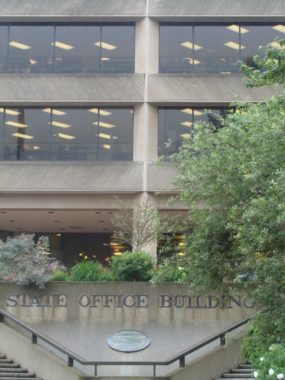
State Office Building
State Office Building in Juneau. (Photo by Casey Kelly/KTOO)

Update: Tuesday, May 13, 2014

U.S. Bank has apologized to state of Alaska employees whose paychecks were delayed due to a company error.

Department of Administration Commissioner Curtis Thayer forwarded a letter of apology Tuesday to the 15,000 employees affected by the glitch. The letter said it was an “isolated incident, and that U.S. Bank has taken proper steps to ensure this will not recur in the future.”

Thayer also said the department will assist any state workers that “experienced hardship” due to the delay. U.S. Bank said it would cover any banking fees or penalties resulting from the late deposits.

Thayer said the administration department has received numerous confirmations that the direct deposits were made Tuesday morning to employees’ personal accounts.

Original story: Monday, May 12, 2014

About 15,000 state of Alaska employees will wait another day for their paychecks, due to a banking glitch.

Direct deposits were not processed as expected by U.S. Bank on Monday, according to the Administration Department. Spokesman Andy Mills says the deposits are expected to be complete by Tuesday morning.

He says the state transmitted the payroll information to U.S. Bank on Friday, and the error was made by the bank.

U.S. Bank is a new vendor for the state and this is first time the company has processed the direct deposits. Wells Fargo was the previous vendor.

Mills calls it a big disappointment that U.S. Bank couldn’t get it right the first time.

“While our folks processed and did their portion of this payroll transmittal information, U.S. Bank did not complete their part and we’re looking to  make sure this doesn’t happen again,” Mills says.

State workers may end up with fees on their personal bank accounts due to the problem, he says, which will be U.S. Bank’s responsibility.

“U.S. Bank has confirmed that they will be covering employee banking fees that are incurred from this error that they created and we’re going to hold them to that.”

Employees in every agency of the executive, legislative and the judicial branches of government statewide are affected.

Update: Forest Service concerns fade as waterfalls disappear

Waterfalls had disappeared by 5 p.m. Saturday. (Photo courtesy U.S. Forest Service)

Update: Saturday, May 10:

It’s still unknown what caused three large waterfalls to emerge Friday evening near the west flank of the Mendenhall Glacier, but by Saturday evening all had disappeared.

The waterfalls prompted warnings Friday night from the U.S. Forest Service to expect increased calving and higher lake levels.

But by Saturday, Mendenhall Lake had risen only three inches and no new ice calves were reported.

Naturalist Laurie Craig says she issued the alert because “we don’t know how this affected the ice cave, the west glacier trail, any of the margins of the glacier where people are likely to hike or be putting kayaks in.”

The flow could have existed for days, instead it was only hours. She says it’s typical for warm spring weather.

“We have such warm temperatures, the water will just melt into a pool, a natural pool on the ice, and then something will give way and it lets loose and just goes away,” she says.

“In this case, it went “from a gusher to a goner,” she says.

Original story, Friday, May 9:

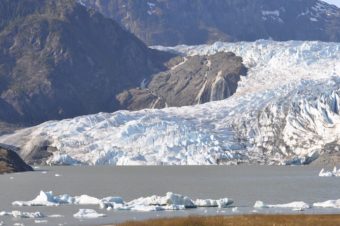
New waterfalls appeared Friday at the Mendenhall Glacier. Forest Service officials say expect rising lake levels. (Photo courtesy U.S. Forest Service)

U.S. Forest Service officials are warning Mendenhall Glacier visitors to expect increased calving, which will result in waves on Mendenhall Lake, colder lake temperatures and higher water levels. Hikers and  kayakers should be especially cautious.

The alert was issued at 8 p.m. Friday. In a news release, naturalist Laurie Craig said an unusual event about 5 p.m. resulted in three large waterfalls discharging sediment-laden glacial water onto bare rock near the west flank of the glacier.  The site is near the ice cave.

Craig said waterfalls are cascading down a deglaciated ridge of Mount McGinnis adjacent to the glacier.

While the water appears to be flowing under the glacier, that may not be the case, and the effect on the glacier, lake and trails is unknown.  Craig said the glacier and ice cave may become unstable due to the flow of water.

Craig said a cause could be discharge from meltwater lakes that form along the margins of the glacier, increasing water volume.

City urges water conservation

Gold Creek
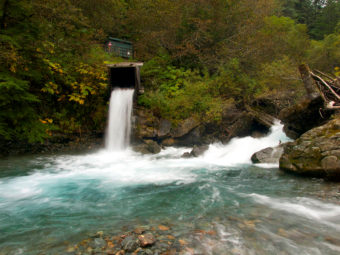
Gold Creek in Last Chance Basin is Juneau’s primary source of drinking water. (Photo by Gillfoto/Wikimedia Commons)

Update, Monday, May 12, 2014:

Despite cooler weekend temperatures and some rain, Juneau residents should continue to conserve water, especially in the Mendenhall Valley.

Last week’s warm, dry weather has taxed the city’s sources of drinking water.

As KTOO reported on Friday, Public Works Director Kirk Duncan was urging water conservation, with Juneau’s reservoirs at 30 percent capacity.

As of Sunday evening, reservoirs were about 42 percent of capacity, but Salmon Creek has been off-line for a week, due to turbidity in the water.

Salmon Creek reservoir is Juneau’s secondary water source and is often unusable for drinking water this time of year. But the water level in Lemon Creek reservoir is also low, and Duncan says that could be a problem for the Mendenhall Valley. Lemon Creek is a 31-foot reservoir and was down to 8 feet on Sunday.

He says he gets nervous when reservoirs are that low.

“We’re at 42 percent, normally we’d be at 100 percent,” he says. “We’re  not asking anybody not to use their washing machine, or not do domestic water uses, but if you could water your lawn for 10 minutes instead of 20 that would be good. If you could wash your boat down in 5 minutes instead of a half hour, that would be good.  Just be aware of the water use.”

Juneau’s primary water source is Last Chance Basin, in the mountains above downtown. He says downtown and Douglas have plenty of domestic water and fire protection, but the basin has been “pumping for all it’s worth” in recent days.

Duncan says CBJ is not selling water to cruise ships.

The city has plans and funds to build a Salmon Creek filtration plant and expand Last Chance Basin, but both projects are two years away.

Original story, Friday, may 9, 2014:

The City and Borough of Juneau is asking residents to temporarily conserve water. The warm, dry weather is taxing the city’s sources of drinking water.

While there is water in storage, Juneau reservoirs are about 30 percent below normal capacity and Salmon Creek is completely offline, says Public Works Director Kirk Duncan.

The Salmon Creek reservoir is Juneau’s secondary water source.

“When the reservoir replenishes from all the rain and snowmelt it brings dirt into the reservoir, or turbidity in the water, so it’s been offline for a week,” Duncan says.

Normally that’s not a problem, but Lemon Creek reservoir also is down and Juneau is using a lot of water right now.

“Lemon Creek reservoir, which is a 31-foot reservoir, is down to 6 feet,” he says.

Juneau’s primary water source is Last Chance Basin, in the mountains above downtown.

The draw on Last Chance Basin late Friday afternoon was about 2,100 gallons a minute.

“It’s putting out almost 3-million gallons a day right now, so it’s pumping for all it’s worth.”

The city is not selling water to cruise ships, he says.

The city plans to build a Salmon Creek filtration plant and Last Chance Basin will be expanded in the future, but right now is the time to conserve.

Don’t wash cars or boats, water lawns and gardens until the rains come.  Duncan says the conservation measures will remain in place until the weather changes.

(Full disclosure: Kirk Duncan is a member of the KTOO Board of Directors.)

Denali climber dies in fall

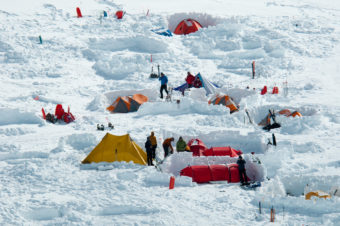
2010 Denali base camp. (NPS Photo/Kent Miller)
A 2010 Denali base camp. (NPS Photo/Kent Miller)

A 39-year-old Washington state woman is the first victim of the Denali climbing season.

Sylvia Montag, of Tacoma, fell earlier this week while descending Denali Pass on Alaska’s highest mountain, officially known as Mount McKinley.

National Park Service mountaineering rangers say Montag and Michael Fuchs, 34, of Berlin, Germany, were climbing near the pass on Saturday, May 3. They were about 18,000 feet when poor weather forced them to turn back from the summit and set up camp to shelter from high winds.

Two days later, on Monday, Montag and Fuchs began their descent down Denali’s West Buttress, but became separated.  Fuchs told the Park Service via satellite phone that each had limited supplies and he’d taken shelter in a storage locker at High Camp, around 17,200 feet.  On Tuesday, Fuchs requested rescue. He told park rangers that he’d heard nothing from Montag.

High winds and poor visibility prevented the Park Service from launching a rescue helicopter until Wednesday.

Montag’s remains were spotted nearly 1,000 feet below Denali Pass.

Fuchs was found near his camp and airlifted to base camp.  After a medical assessment, he was flown to Talkeetna State Airport.

Cell tower proposal before Planning Commission

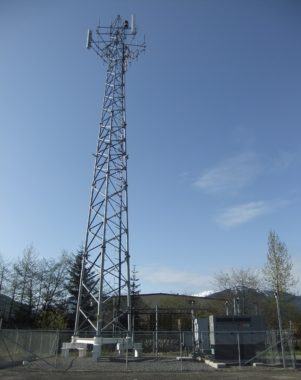
Communications tower in the Mendenhall Valley. (Photo by Rosemarie Alexander)
Communications tower in the Mendenhall Valley. (Photo by Rosemarie Alexander/KTOO)

The city is proposing regulations to require cellphone companies to locate new antennas on existing towers, or conceal them.

The Juneau Planning Commission considers the ordinance Thursday in a special work session. On Monday the Assembly took an initial look at the bill.

It comes after several recent public hearings and lots of citizen angst over cellphone towers this year.

Many of the public comments are based on complaints about how towers look as well as continuous flashing lights – like the infamous one on Spuhn Island.

A number of telecommunication providers are atop that 155-foot pole, including Verizon.

The company is the latest to enter the Alaska wireless market, currently offering data packages in Juneau, Anchorage, the MatSu and Fairbanks. Voice will be available within the year, according to Demian Voiles, vice president of Verizon Wireless in Alaska.

Verizon has 13 sites in Juneau and Voiles doesn’t expect anymore.

“A majority of those sites are what are called co-locations, meaning they were cell sites that were already here, structures that were already here” Voiles said. “We just simply added our antennas to those sites. That includes two rooftop sites.”

Verizon leases space on the roof of the KTOO building for a cell site.

The CBJ draft ordinance requires a new antenna be installed on an existing structure and if it can’t the company must give the city a detailed justification.

Under the ordinance, antennas and towers could be concealed, though it’s silent on methods.

City Attorney Amy Mead told the Assembly Monday that details would be left mainly to the communications company.

“They can conceal them in structures that make them look like steeples, or make them look like trees. There’s only a certain world of possibilities with respect to concealment techniques and so the recommendation was not to limit the concealment techniques, but to make clear what the objective was so that the providers can use whatever methods are available to them to meet the goals,” she said.

Wireless facilities should not “significantly affect scenic corridors or view sheds,” according to the proposed law, but “significant” isn’t defined.

Mead said that would be left up to the CBJ Community Development Department, which would issue the permit for the tower.

“It’s the director’s determination as to what substantially impacts, not the wireless communication providers,” she said. 

Travis Goddard is the planning manager for Community Development and has been working on the master plan and proposed ordinance, which will implement the long-term policies.

Goddard called it a work in progress, but a good ordinance.

“I would not be surprised if it ends up being the best ordinance in Alaska for wireless communication facilities.”

A consulting firm has been involved with the project for several years and helped draft the various versions of the master plan and proposed regulations. The city also used cell tower laws from other communities as models. Goddard said that helped planners present the complicated issues in a well-organized ordinance.

He said the city also worked with providers and believes the plan is business-friendly while addressing the Planning Commission’s and assembly’s concerns.

Earlier this year, the city imposed a moratorium on cell tower permits until the master plan and regulations are adopted.

Site notifications
Update notification options
Subscribe to notifications