Vandalism at Juneau-Douglas High School Thursday morning left a nasty mess in the entryway of the school and required the commons be closed for a while.
While officials say there was no threat to student or staff health, the prank included urine and feces, and doors cemented shut. There was a better side to it – lots of balloons.
Principal Paula Casperson says the school was cleaned up before classes began.
She described the vandalism as a senior prank, but confidentiality policies won’t allow her to release much information. It’s not clear if the students involved were all seniors. Casperson says Juneau School District policies prescribe the punishment.
“We are concerned. Certainly there are consequences and those consequences could in fact include not being allowed to participate in the commencement ceremonies,” she says.
Graduation is Sunday.
“And we certainly want to celebrate all of that. We don’t want to be mired in the negativity of the decisions of one or two kids. We want to celebrate the Class of 2014,” she says.
JDHS graduation is at 4 p.m. on Sunday in the gymnasium. TMHS is at 7 p.m. in the TMHS gym. Yaakoosge Daakahidi ceremony is at 1 p.m. at Centennial Hall.
A burglary at a Mendenhall Valley home netted the thief about $14,000 worth of firearms and electronics.
Juneau police want some help with the case.
A Gee Street resident was working out of town when his house was burglarized earlier this month. Police report 10 guns were stolen, including rifles, shotguns, and handguns.
Lt. Kris Sell says the theft fits the profile of a person who may be stealing to support their drug habit.
She says anyone approached to buy a gun should be immediately suspicious, especially if the guns are being sold for less than market value, or if the seller wants to meet the potential buyer in an unusual place.
“We’re asking people who buy guns and who might be approached to buy these guns to be suspicious if any of the makes and models match what we’ve put out from this burglary.”
It’s unclear how the burglar got into the house, Sell says, because there was no sign of forced entry. She says finding some of the guns will help police trace the perpetrator.
The firearms taken include one DPMS AR-10, a Palmetto Arms AR-15, and a Windham Weaponry AR-15 with Trijicon Optics and bi-pod. A Mossberg 12- gauge shotgun, a Browning 375 H&H with a Leupold scope, and a Browning 300 Winmag also were stolen.
The handguns taken were a .22 caliber Ruger with Leupold Optics, a .45 Glock with Surefire tactical light, and a Walther P22 with laser sights. A .44 magnum Smith and Wesson also was stolen.
It’s not known how many people were involved in the burglary. The homeowner told police that a black Apple iPad with case, and GoPro camera with accessories also were taken in the burglary.
Lt. Sell says anyone with information about the guns, the electronics, or the burglary should go to Juneau Crime Line.
Last summer a ribbon-cutting opened three more miles of Glacier Highway and construction continued to improve existing stretches. (Photo by Heather Bryant/KTOO)
The draft supplemental environmental impact statement for a road out of Juneau is now under review by the Federal Highway Administration. That’s the last step in the process before federal highways names a preferred route and issues a Record of Decision.
State transportation department spokesman Jeremy Woodrow said the final SEIS, as it’s called, is expected sometime in the next six weeks.
“If it gets the blessing and we don’t need to do anymore revisions on it, we’ll stamp ‘draft’ on it and we can release it for public review.”
Once that happens, DOT would hold hearings in Juneau, Haines and Skagway.
Federal highways issued a Record of Decision in 2006 to build a road between Juneau and Katzehin, where motorists would board a state ferry for the rest of the trip north.
Conservation groups immediately filed suit. In 2009, the U.S. District Court ruled the environmental impact statement was invalid, because it didn’t consider improved ferry service in Lynn Canal. That decision was upheld in 2011 by the Ninth U.S. Circuit Court of Appeals, requiring the supplemental study.
Little by little, however, the road north has grown, completed last summer to Cascade Point. This year $35 million is in the state’s budget for another extension. Woodrow said federal funds account for $30 million dollars and $5 million comes from the state.
“The talking point was that that would help us begin constructing the road toward Kensington (mine),” Woodrow said. “And really how this road’s going to be built, no matter what, is it’s going to be constructed in phases. It’s just such a large project.”
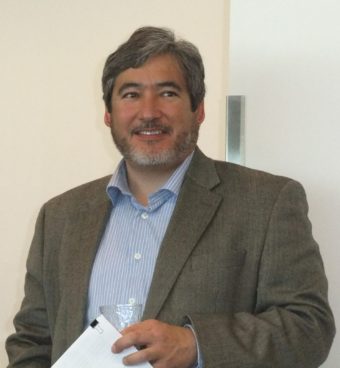
Rep. Sam Kito III at Juneau Chamber of Commerce on Thursday. (Photo by Rosemarie Alexander/KTOO)
It’s one of those mega projects the state may not be able to afford, according to Juneau Rep. Sam Kito III. He told the Juneau Chamber of Commerce Thursday that Juneau Access has a lot of competition for funds statewide.
Kito is a civil engineer and said he likes big projects. But he wondered about the return on the estimated $500 million investment.
“Do we receive 500 million dollars’ worth of commerce or revenue back to the state or the city? I think that’s a tough one to support.”
Kito didn’t curry much favor with the chamber audience. The business organization and most of its members have long been road advocates.
He said he didn’t have strong personal feelings on building or not building the proposed road, which would not replace ferry use for the trip to Haines or Skagway.
“There may be some savings because the ferry is operating as a day boat as opposed to a 24-hour ferry, but there’s still ferry costs. Which means you still have 12-hours’ worth of fuel, you’re not going to be running full all the time, there may be ferries that are running mostly empty, and then you’re going to have an additional 65 miles of road to maintain,” he said.
Kito’s questions and concerns should be answered when federal highways releases the final SEIS and Record of Decision sometime this summer.
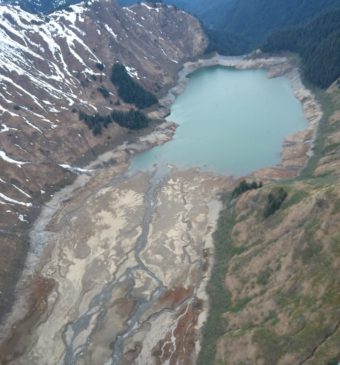
Channels at the upper end of Salmon Creek may be the source of much of the turbidity in the lake during spring runoff. (Photo courtesy Scott Willis/Alaska Electric Light and Power)
Spring cleaning is underway in Juneau this week: Streets and sidewalks are being swept, storm drains flushed and flowers planted. The water required to do the work is being drawn from Gold Creek and not from the city water supply.
That’s because the level of water throughout the system remains lower than usual and Salmon Creek reservoir is still too turbid to be used for drinking water.
Turbidity is cloudiness in the water. It can hide germs such as giardia and make people sick. Every spring, turbidity becomes a problem in Salmon Creek.
The reservoir belongs to Alaska Electric Light and Power and is used by the city and borough as a drinking water source. The water is not filtered and has to meet stringent standards.
Turbidity is measured by an instrument called a nephelometer. When cloudiness reaches 1.49, Salmon Creek is shut off.
“So the system will automatically turn itself off to take water out of Salmon Creek if the turbidity is above 1.49 for three days. Or if it goes above 4 NTU at any point,” says Cindy Christian, compliance and engineering manager for the state’s drinking water program. She knows municipal systems well.
NTU is a nephelometric turbidity unit.
“The higher the turbidity, the higher the potential there could be pathogenic organisms in the water,” Christian says.
Runoff produces turbidity. Over Salmon Creek dam’s 100 years, sandy gravel has formed a delta around the lake. AELP’s Scott Willis flew over the lake last week and describes “little stream channels” running through a large flat area.
“That silty material is easily eroded and we think that’s where it picks up some silt and sediment and causes the higher turbidity in the spring time during run off,” he says.
Nearly every spring Salmon Creek is taken out of the city water system until the cloudiness settles and turbidity units fall.
“It’s not just that delta, it’s as the snow melts there’s water flowing down the hillsides and picking up debris and things like that,” Willis says.
Turbidity only affects drinking water. It has nothing to do with power generation.
“We keep Salmon Creek running all year long and it’s online right now,” Willis says.
Salmon Creek generates 5 percent to 7 percent of Juneau’s hydroelectricity. About 45 miles south, AELP’s Snettisham hydroelectric project produces about 70 percent.
Willis says the water levels in Snettisham’s Long Lake and Crater Lake are above normal for this time of year.
“There’s more water in those lakes now than there was in the last five years,” he says.
Lake Dorothy is smaller than the Snettisham lakes. Willis, who is vice president of generation for the power company, says Lake Dorothy is right where he wants it.
“I like to pull it down a little bit harder, so it’s in a good spot right now. It’s at its low point, but it’s not unreasonably low by any means,” he says.
Until it’s needed in town, Lake Dorothy sells electricity to Juneau’s interruptible customers, including Hecla Greens Creek Mine on Admiralty Island and some cruise ships.
Salmon Creek reservoir, May 26, 2009. Water level is within a foot or two of the current elevation, but there’s more ice on the lake and snow on the hillsides. (Photo courtesy Scott Willis/ AELP)
Willis watches water levels every day. He says January’s warm and wet weather brought those levels up.
“The precipitation that was stored as snow on the hillsides, at least at the lower elevations, melted off and ran into the lakes,” he says. “The lakes actually jumped up in January.”
But there’s not much snow pack left.
“I’m looking real good now when I look at the chart on the wall and see where the lake is. If we have a wonderful, glorious, beautiful summer in July and August, I’ll be worried,” he says.
When levels are low in AELP lakes, the company must supplement its hydroelectricity with diesel fuel.
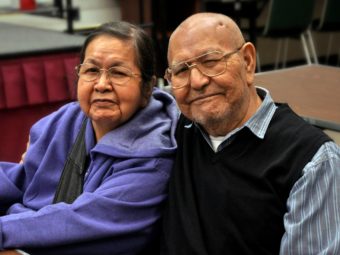
Lillian & Harvey Marvin at a Tlingit-Haida Central Council Native Forum luncheon. (Photo courtesy of Jodi Garrison)
Tlingit elder Harvey B. Marvin, of Juneau, has died at the age of 81.
Marvin grew up in Hoonah, worked for the public health service in Sitka and was the state of Alaska’s first Native auditor.
He was born in 1933 in Excursion Inlet to Lillian Pratt Marvin Smith, who was of the Kaagwaantaan clan, and John Marvin, of the T’ak Dein Taan clan, and a grandchild of the Chookaneidi. He was one of their 12 children.
He went to Mt. Edgecumbe High School, business school in Chicago and served in the U.S. Marine Corps in the Korean War.
Native land claims
Marlene Johnson grew up with Marvin in Hoonah.
“We were of opposite clans. He was an Eagle and I was a Raven, but we were good friends,” she says with a chuckle.
That friendship came in handy during the years they would work together on the Alaska Native Claims Settlement Act.
Marvin and Johnson were among the five members of the Tlingit-Haida Central Council Executive Committee to lobby Congress. When ANCSA passed in 1971, Huna-Totem was created as the Hoonah village corporation.
Marvin was appointed corporation treasurer. Johnson was a board member.
“He was at every meeting and worked with us as we looked at the history, and doing the land claims and other important things for the corporation,” she says.
These were complicated issues. Johnson says Marvin was just the guy to explain them.
“He was very fluent in Tlingit, so he could explain it in Tlingit to the elders that didn’t understand English that well,” Johnson says.
As they met with new shareholders in Hoonah and other parts of Southeast, she says Marvin also listened well, so he could tell the board what Huna-Totem members wanted in their corporation.
Marvin later transitioned from treasurer to board member, serving 19 years. He was a member of the Alaska Native Brotherhood and active with Tlingit and Haida. In 2005, he was named Citizen of the Year by the Central Council for what the organization called his “extreme dedication” to the Alaska Native community.
“He was with and very loyal to Tlingit-Haida Central Council since the ’60s,” says Edward Thomas, who was Central Council president at the time.
Super voters
Lisa Worl keeps the family tree for her large family. She always called Harvey Marvin great grandfather, though he was actually her great uncle.
Worl is on the Juneau School Board. Marvin and his late wife Lillian were there when she was sworn into office.
She can recite the work Marvin has done for his people through Native organizations, as a Sitka Assembly member, and other political involvement.
Harvey and Lillian Marvin were Democrats and “super voters,” she says.
“It was more a matter of civic duty and always making sure the family was aware of the issues and make sure they voted. They never pushed any people but obviously they had their people they were supporting,” Worl says.
Former Juneau Rep. Beth Kerttula was one of them. Kerttula got to know Marvin when her father, Jay Kerttula, was a state senator and chairman of the Legislative Budget and Audit Committee. Marvin was the auditor.
Years later, when Beth Kerttula ran for Juneau’s downtown seat in the state House, Marvin sat her down for a tutorial on the nuts and bolts of Juneau politics.
“He had almost every twist and turn and nuance, and knew the groups I needed to reach out to and knew the people I needed to go talk to,” she recalls.
But it didn’t stop there. Both Marvins worked hard on all five of her campaigns and were in the gallery at the state capitol when she took the oath of office.
Kerttula calls him an astute politician.
“You know I think Harvey would have been governor or U.S. Senator in a different day,” she says. “He just had that kind of talent and ability.”
More importantly, she says, the Marvins set a great example of how to be good human beings.
Lillian Marvin passed away in February, just after the couple celebrated their 59th wedding anniversary.
“The two love birds are back together,” Worl says.
A memorial service for Harvey Marvin is Saturday at 3 p.m. at Alaska Memorial Park on Riverside Drive. A private family viewing is 1 p.m.
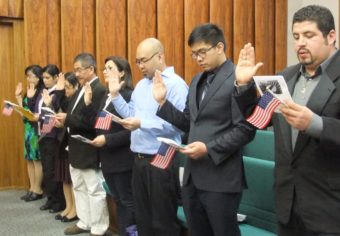
Juneau residents from other countries take the Oath of Allegiance to the U.S. to become American citizens at a ceremony on May 14, 2014. (Photo composite by Rosemarie Alexander/KTOO)
Juneau has 11 new American citizens. Immigrants from the Philippines, Mexico, Spain and South Korea took the oath of citizenship Thursday in U.S. District Court in Juneau. More than half were from the Philippines.
U.S. Magistrate Leslie Longenbaugh was the presiding judge. She said she looks forward to each naturalization ceremony.
“It’s completely inspiring to see people born in different nations raise their hands and swear an oath to become citizens of the United States of America,” she said. “Each generation of immigrants renews our national character and revitalizes our culture.”
For some, the journey to U.S. citizenship has been years and many said it had been a personal goal.
Maria Rosales has been in Juneau since 1998. She said she was happy to become a citizen, but one of her sons remains in Mexico. She said she has petitioned U.S. Immigration Services, but he has been denied entrance to the U.S. for ten years.
“I am so sad with this law. That’s why I want to be a citizen, to work and (do) whatever I can to review the laws, because the laws affected (sic) a lot of people,” Rosales said.
The next steps
Immigration officer Gary Johnson is based in Anchorage and comes to Juneau for naturalization ceremonies several times a year. He told the new citizens they should apply for their U.S. passport, social security card, and register to vote.
The new American citizens registered to vote before leaving the courthouse. (Photo by Rosemarie Alexander/KTOO)
But he told them not to put a picture of their naturalization certificate on Facebook.
“What we found is that with social media people would zoom in on the information that’s on the certificate and take over that individual’s identify. They’ve got their name, they got their alien registration number, and they have their certificate number. It can cause a lot of problems for the new citizen,” he said.
Before they left the courthouse, most of the new Americans registered to vote, with the assistance of the Juneau League of Women Voters.
(Full disclosure: Magistrate Longenbaugh is on the KTOO Board of Directors)
Close
Update notification options
Subscribe to notifications
Subscribe
Get notifications about news related to the topics you care about. You can unsubscribe anytime.