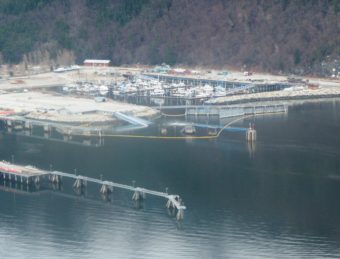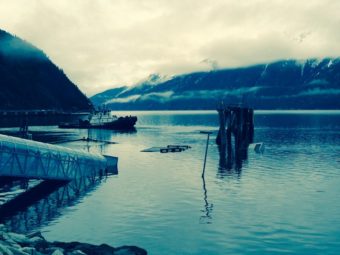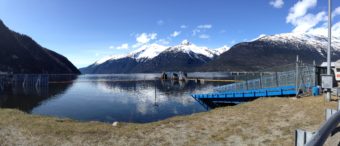
Clear weather reveals the full extent of the submerged Skagway ferry terminal dock. (Photo by Doug Smith/KHNS)
Skagway remains cut off from ferry service as the state figures out why the ferry terminal dock sank last Thursday.
The state transportation department has contracted with Western Marine Construction to begin salvaging and repairing the dock. The company moved two barges to the town over the weekend and will try refloating the dock on Tuesday or Wednesday. However, repairs will still be needed before Alaska Marine Highway ships can tie up again, according to DOT spokesman Jeremy Woodrow.
“We’ll know a lot more once we get the dock floated again and will be able to access the damage,” Woodrow says. “Then we’ll be able to devise a plan from there.”
Why the dock sank is a mystery, though Skagway Mayor Mark Schaefer says some of the individual concrete chambers that float the structure may have flooded.
Skagway’s potable water system’s 3-inch pipe runs from the terminal to the dock and part-way underneath, making it easy for state ferries to resupply with water.
Schaefer says Skagway uses an average of 300,000 gallons of water every 24 hours from the municipal supply, but between Wednesday evening and Thursday morning the city registered 800,000 gallons of water used. That leads city officials to think the potable water pipe under the dock may have burst, filling the floats and causing it to sink.
Essentially we think we flooded the float and sank it that way. But we’re not sure yet. We know we used a whole bunch of water and it’s not bubbling up in the street somewhere. It’s a significant amount of water,” Schaefer says.
The dock is a 120-foot by 160-foot platform that sits on 24 hollow concrete chambers. Mayor Schaefer compares the floating mechanism to a concrete ice cube tray. The potable water line runs through several of those compartments, hence the theory about the burst pipe flooding the floats, he says.
Woodrow says the state is aware of the theory, but is investigating all possibilities at this point.
Due to the urgency of the situation, the state was able to bypass the bidding process and established a sole source contract with Western Marine, Woodrow says.
The state has suspended ferry service to the town until at least May 9. A Haines-based ferry company, the Fjordland, has tentatively scheduled service between Haines and Skagway on days the state ferry sails the Lynn Canal.
Alaska Seaplanes and Air Excursions have added flights to Skagway while ferry service is suspended.
Oil containment boom remains in place around the sunken Skagway ferry terminal dock. (Photo courtesy Kirk Miller/Alaska DOT&PF)
The Skagway ferry dock is still resting on the seafloor, after sinking on Thursday.
State Department of Transportation officials say they’re working on a salvage and repair plan, but don’t know the extent of damage to the dock used by the Alaska Marine Highway System.
The dock started sinking overnight Wednesday and by early Thursday was totally submerged at high tide. DOT engineers have been on-site and have not yet determined a cause.
DOT spokesman Jeremy Woodrow says once a plan is set, the department will issue a request for proposals so work can begin immediately to recover and repair the dock. He says a diver will inspect for damage after the dock has been refloated.
Oil absorbent boom was deployed around the area Thursday and remains in place.
“We’ve removed all the fuel that was to the fuel lines that ran onto the dock. And we’ve removed the hydraulic oil that was in the mechanism that raises and lowers the ramp, so we basically have removed all contaminants from the dock,” Woodrow says. “But we still have an oil boom deployed just as a precautionary measure.”
AMHS vehicle and pedestrian ramps in Skagway plunge into the water. (Photo courtesy Kirk Miller/Alaska DOT&PF)
The 160-foot by 120-foot dock is comprised of 24 individual concrete chambers that have all been inspected within the last year, with no indication of wear, Woodrow says.
All state ferries to Skagway have been cancelled for two weeks. Woodrow says marine highway system officials have determined that a ferry traffic alternative is not available in Skagway.
Ferry updates will be posted at FerryAlaska.com, or toll-free at 800-642-0066. The Juneau ferry terminal number is (907) 465-3941.
The search began at the end of the 2013 symphony season, when musicians and board members gathered to answer three questions:
What are you looking for in the next conductor? What role does the symphony play in your life? What role do you think the symphony plays in the Juneau community?”
Search committee chairwoman and violinist Kristin Garot says the questions were asked again in the summer and fall. The answers helped the 15-member committee come up with traits the orchestra wants in a new conductor.
Garot says lessons learned from the last recruitment, in 1999, and the Music Director’s Search Handbook from the League of American Orchestras morphed into a blueprint for the current search.
Nearly 70 applications rolled in. Only 28 made the first cut. That list was reduced to 13 conductors, who were interviewed over Skype, resulting in a list of nine. Committee members voted on each person to get to the remaining three.
Though the job pays only about $35,000 a year, Garot says the volunteer Juneau orchestra demands a lot of its conductor.
“Not only are they there to lead the musicians but they’re also kind of the face of the orchestra to the community,” she says. “We want someone who’s dynamic, who can energize an audience and speak to them about what they’re listening to. We also want someone who can connect with our youth audience and our youth organizations and help build that part of our program.”
That means music director, long-range planner, fundraiser, and grand communicator.
Troy Quinn lives in Los Angeles, where he commutes to the East Coast to conduct the Portsmouth Institute Orchestra in Rhode Island, a gig he would keep if hired in Juneau.
“Conductors nowadays never stay in one place. They’re doing multiple gigs and flying from town to town,” he says.
Quinn has not been to Juneau, but already has a vision for making the symphony more accessible to the community.
“Being an ambassador for the symphony and being out in the public, in the school system, in businesses, reaching people through different medias,” Quinn says. “And I think providing a balanced repertoire so we’ve got something for everybody to come listen to.”
Quinn will conduct the Juneau Symphony in November.
Wesley SchulzWesley Schulz in rehearsal with Bainbridge Symphony Orchestra. (Photo courtesy Dominique Cantwell)
Wesley Schulz is the Juneau Symphony’s February conductor. He lives in Seattle and leads the Bainbridge Symphony Orchestra on Bainbridge Island as well as the Seattle Festival Orchestra and two youth symphonies.
He has directed both professional and volunteer orchestras, and says he finds a joy of discovery working with volunteers.
“You get to discover along with them some of the elements of the music that the professionals, you know, might think of as old hat,” Schulz says.
He also has not been to Juneau, and sees it as something to add to his current conducting jobs.
“When this position opened up, it’s like what a perfect way to have a relationship with that area that I’m just fascinated by,” he says.
JeremyBriggs RobertsSymphony candidate Jeremy Briggs Roberts. (Photo courtesy Washington Idaho Symphony)
The final conductor candidate for next year’s season is Jeremy Briggs Roberts. He is musical director, conductor and executive director of the Washington Idaho Symphony, which performs in the Moscow, Idaho and Pullman, Washington area.
Roberts calls himself a Pacific Northwesterner and says Juneau would be a natural extension of his current work.
“I think one of the major things I’ve enjoyed here is we’ve taken the orchestra and really grown it into a community cultural asset,” he says.
Roberts says he would like to take on another orchestra to “build culture and the sense of community awareness that art is valuable in our communities and it makes a difference in our lives.”
He says Juneau already seems to have done a very good job of that.
Roberts would commute to Juneau from his home in Moscow, Idaho.
Outgoing Juneau director Kyle Pickett has been commuting to Juneau from Northern California for the past 14 years, where he’s conducted other orchestras. He says he will live in California and fly to his new conducting jobs in Kansas and Missouri.
Pickett will continue as music director for the Juneau Symphony next season, working with each candidate on music choice for the concerts they conduct.
Symphony musicians and the audience will play a role in selecting the new conductor. The winner of the competition will be announced in June.
The AMHS dock in Skagway sank overnight. (Photo courtesy Alaska Department of Transportation and Public Facilities)
The state ferry dock in Skagway remains underwater and is closed indefinitely. The dock was completely submerged by about 9:30 a.m. Thursday.
Alaska transportation department officials say oil booms were laid around the area to collect contamination.
Marine engineers have been onsite and are still assessing the damage. Agency spokesman Jeremy Woodrow says the dock is resting on the seafloor and is fully submerged at high tide and partially submerged during low tide.
Boom has been deployed around the dock area. (Photo by Doug Smith/KHNS)
Skagway resident Gary Heger was one of the first to see it early Thursday morning. He says the tugboat Anna T was tied up on the east side of the dock and the west side was underwater. When the tug untied from the dock, the rest of the dock sunk.
“Last night (Wednesday) about 5:30 they had a fork lift on the dock and everything was fine,” he says. “Nobody’s really sure what happened this morning, but it was a surprise.”
DOT engineers were surprised, too. Woodrow says the 160-foot by 120-foot dock is made of 24 individual concrete chambers.
“The words that the engineer used is he’s perplexed. We actually have inspected every one of those individual chambers in the last year and there was no indication of any wear,” Woodrow says.
No ferries were scheduled into Skagway on Thursday. The Alaska Marine Highway System has canceled all sailings for the next two weeks. Woodrow says if the dock can be salvaged, it will take some time before it will be ready to accept ferry traffic.
The Skagway Alaska Marine Highway floating dock seen from the MV Malaspina on May 5, 2013 (Mikko Wilson/360 North)
Original story:
The Skagway ferry terminal dock is fully submerged, according to state transportation officials.
DOT spokesman Jeremy Woodrow says an engineer is on his way to Skagway to find out what happened. Apparently the dock started to sink overnight and by early this morning it was totally underwater. The 160 foot by 120 foot dock is about 12-feet deep. It is made of 24 individual concrete chambers.
“The words that the engineer used is he’s perplexed,” Woodrow says. “We actually have inspected everyone of those individual chambers in the last year and there was no indication of any wear.”
Woodrow says the cause of the collapse remains a mystery until an engineer gets on site and a diver gets an underwater look. No ferries are scheduled into Skagway today (Thursday), but the LeConte is to sail there tomorrow. Woodrow says marine highway officials are working out a plan.
This is a breaking story. Check back for details.
Note: Also previous reports indicated the dock had collapsed. That connotes structural failure and DOT’s Woodrow says the extent of the damage is still unknown.
Gov. Sean Parnell signed SB 159 at the Airlift Northwest hangar in Juneau. Rep. Cathy Munoz is left. Airlift Northwest director Chris Martin is on the right. (Photo by Rosemarie Alexander/KTOO)
Gov. Sean Parnell on Wednesday signed a bill allowing medevac membership programs to continue operating in Alaska.
Surrounded by Airlift Northwest pilots and nurses, Parnell signed Senate Bill 159 at the Juneau hangar the company shares with Guardian Flight, another emergency medical flight service.
Airlift Northwest had been legally selling memberships to Alaskans since the AirCare program started in 2008. The state insurance division suspended it last year when the Washington company reorganized under the University of Washington Medical School and Alaska regulators interpreted memberships as insurance.
But the programs are not insurance. Rather, they are a supplement to health care insurance that covers the patient’s out-of-pocket costs, or co-pay. An emergency medical flight from a Southeast town to Seattle or Anchorage can cost $100,000 or more.
Airlift Northwest’s AirCare membership costs $99 a year and covers everyone in a household.
The program has more than 3,200 members in Alaska and Washington state. Director Chris Martin said most members live in Southeast Alaska.
It’s huge peace of mind to people to know that if they are in an extreme situation and need to go either down to Seattle or up to Anchorage for more definitive care that they don’t have to worry about a gigantic co-pay,” she said.
Pilot Randy Aspelund looked on as Gov. Parnell signed SB 159. Aspelund has flown medevacs for about 30 years. (Photo by Rosemarie Alexander/KTOO)
Pilot Randy Aspelund has been flying medevac flights for about 30 years. He told Gov. Parnell that local communities come together at the airport when an emergency medical flight is needed.
“It’s not just us involved as pilots and flight nurses, but entire communities will come out and support,” beginning with transportation department crews who ensure runways are clear.
Aspelund said volunteer firefighters and others help with loading and unloading the patient, and transporting family members and luggage to the airport.
“It’s everybody on the ground at the community that we’re going to that are helping and assisting in that transportation endeavor,” Aspelund said.
When the state halted the AirCare and similar programs, Rep. Cathy Munoz, R-Juneau, and other Southeast legislators heard from lots of concerned constituents. Munoz started working on legislation to correct the problem and shared it with her colleagues. Sen. Bert Stedman introduced it in the Senate, and it passed in February. The House passed SB 159 last week. The bill goes into effect at 12:01 a.m. Thursday.
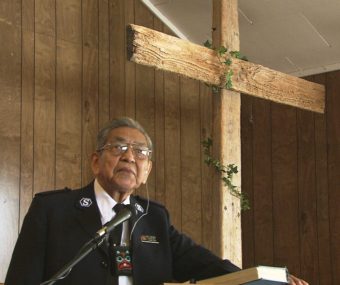
Cyril George Sr. in 2007, speaking at Angoon Presbyterian Church, where his son Joey George is pastor. (Photo by Skip Gray/KTOO)
A memorial service for Cyril George Sr. is Wednesday, 6 p.m., at Elizabeth Peratrovich Hall in Juneau. The Tlingit elder died April 15 at the age of 92.
Over his life, he was a fisherman, boat builder, master storyteller, and man of great faith.
George was of the Deisheetan clan (Raven/Beaver) of Angoon and lived in the Admiralty Island community most of his life. He moved to Juneau in 1975.
One of his five sons, Richard George, recalls his father to be a successful seiner, halibut and herring fisherman.
He also served his community. He was elected to the Angoon City Council and was mayor. He was on the first board of directors of Sealaska, the regional Native corporation for Southeast, from 1972 to 1974, and served as a member of the board for Kootsnoowoo Inc., Angoon’s village corporation.
Richard George remembers his father as a strong man.
He made decisions which always seemed to be the proper decision. That’s what I was impressed with when I was young,” he says.
Cyril George attended Sheldon Jackson high school and college in Sitka in the late 1930s, where he became a machinist and learned to build boats. The Presbyterian school was tasked with helping Tlingit shipwright Andrew Hope build the Princeton Hall, a replacement vessel for the church mission fleet.
“I wasn’t the only one that had this feeling of an enormous undertaking when he started to build this boat,” Cyril George recalled in a 2007 interview with KTOO.
“I could weld, I did everything in the machine shop. I was with him all the way from lining up the motor, the shaft, setting up the electrical,” he said. George also built the shaft.
It took a year to complete the Princeton Hall. Then in 1941, just a few days after the Japanese attack on Pearl Harbor, the boat was to be launched. It had already been conscripted by the U.S. Navy.
George said all the Sheldon Jackson students trooped down to the harbor to watch the launch.
“When the Navy started to tow it away all the kids were crying. I was crying. I don’t think there was anybody that wasn’t crying,” he said.
After the war, the Princeton Hall was returned to the Presbyterians and it traveled Southeast Alaska waters for years, going village to village.
While George helped build it, he had never been on the boat. Many years later, he had a number of cruises on the Princeton Hall after it was purchased by the late Bill Ruddy. Bill and Kathy Ruddy became close friends with Cyril George, the boat builder, the musician, and the Tlingit storyteller.
George gradually began to lose his hearing. For several years, Kathy Ruddy took on the role of stenographer – typing out conversations for him.
“It really helped him to have things written down so he could look over your shoulder and know what people were saying,” she says.
The hearing loss didn’t slow him down. He continued to play his guitar and sing, visit classrooms, churches, and be involved in the community. He was a delegate to the Juneau chapter of Central Council of Tlingit and Haida Indian Tribes of Alaska, which provided a transcriber for George, so he could be actively involved.
“You know for a guitarist and a really excellent musician, hearing loss is a really poignant thing,” Ruddy says. “The fact that he maintained this constant sense of gratitude even as hearing was failing is just a tribute to his character.”
As a fluent Tlingit speaker, George liked to teach his language and often went to Tlingit language classes at the University of Alaska Southeast, taught by Lance Twitchell.
“In Tlingit he’d tell us: ‘I just feel wonderful whenever I’m looking upon your faces and you guys are learning your language.’ He said he felt that it (Tlingit language) was drifting away from us but then just seeing us fills him with hope.”
Son Richard George calls his father a Godly man. In the 2007 interview, Cyril George talked about a battle with alcohol, which he said he finally won through prayer and his faith.
He was a member of the Salvation Army and was a local commissioned officer known as a sergeant major. He often wore his uniform and always wore it to church, says Lt. Lance Walters of the Salvation Army in Juneau.
He explained one day that he put it on to remind him of what he came from and that he wasn’t going back,” Walters says.
George will be buried on Killisnoo Island near Angoon.
Close
Update notification options
Subscribe to notifications
Subscribe
Get notifications about news related to the topics you care about. You can unsubscribe anytime.