Rosemarie Alexander

Assembly nixes boat size limits on Auke Lake

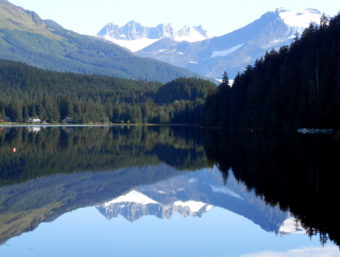
Auke Lake boating season usually begins with the first warm weather in May. For the second year, the CBJ Parks and Recreation will collect data on lake activities. (Photo by Alaskan Librarian/Flickr CC)
Auke Lake boating season begins with the first warm weather in May. For the second year, CBJ Parks and Recreation will collect data on lake activities. (Photo by Alaskan Librarian/Flickr CC)

Size restrictions on motor boats using Auke Lake have been lifted.

The Juneau Assembly Monday night eliminated a 16-foot limit on boats that has been in place since the 1990s. At the same time, members voted to prohibit the flushing or rinsing of boat engines in the fresh water lake.

Like so many Assembly votes, the panel voted five to four on the ordinance to amend Auke Lake regulations – and voted against a recommendation of its own Lands Committee.

The committee last month opposed doing away with the boat size limit, but agreed with the engine flushing ban.

Assembly members voting to relax boat size restrictions were Jerry Nankervis, Randy Wanamaker, Carlton Smith, Mary Becker, and Mayor Merrill Sanford. Both Smith and Becker are on the Lands Committee. Jesse Kiehl and Loren Jones are also on that committee, but on Monday they stuck to their original vote to retain the size limit. They were joined by Karen Crane and Kate Troll.

Auke Lake is owned by the state of Alaska and managed by the city. Following a fatal accident two years ago, the Assembly asked the Parks and Recreation Department to re-evaluate the management plan.

The Parks and Recreation Advisory Committee last year recommended a new plan that would replace vessel size regulations with a 10-horse power limit, and restrict towing. The Assembly refused to consider the proposal, asking instead for more information on lake activities.

CBJ Parks Superintendent George Schaaf told the Assembly that last summer’s  data showed jet skis violated regulations more often than bigger boats.

“We broke it down by personal watercraft as defined by the National Personal Watercraft Association, so jet skis, and then anything other than a jet ski that was a powered vessel,” Schaaf said. “And the personal watercraft were responsible for more observed violations last summer than the other vessels were.”

The study will continue through the upcoming summer, according to Parks and Recreation Director Brent Fischer. That will give the department two boating seasons of data.

“We’re going to continue collecting what type of vessels, numbers, days of high population, just general usage, whether it’s a summer day, rainy day; any violations of the ordinance, whether it has to do with no wake zones, or no vessel zones or anything like that,” Fischer said.

He said once the data is analyzed, the information will be presented to the Assembly, and members will be asked to review the proposed management plan again.

The last run: Remembering Bob Janes & Ron Dippold

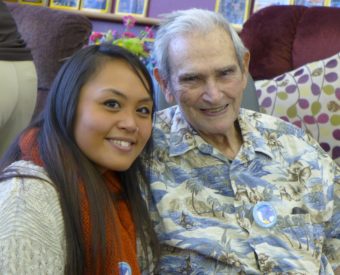
Bob Janes and Marina Rae Caparas, a Certified Nurse Aide at the Juneau Pioneers’ Home, during the 25th anniversary party for the home on Nov. 16, 2013. (Photo courtesy of Dick Isett).

Longtime Juneau resident Robert C. Janes, well-known for his love of skiing and the mountains, has died at the age of 92.

Always known as Bob, he passed away on March 21 at the Juneau Pioneers’ Home.

Janes came to Alaska in 1965 with the U.S. Forest Service, in what he thought would be another three-year stint with the agency. Instead, he chose to stay in Juneau and raise his family, all of whom still call the capital city their home.

His family writes in his obituary that Janes grew up on the beaches of California, but embraced the forests and snow of the mountains. When he came to Juneau, he worked to maintain  the 3rd Cabin rope tow and the snowcat  “Oola,” access to the Douglas Ski Bowl.  Janes was then deeply involved in the siting and planning of Eaglecrest, Juneau’s city-owned ski area.

He was a member and historian for the Juneau Ski Club, which supports and promotes ski racing. For decades he was a member of the Juneau Ski Patrol.

It’s only fitting, says son Bill Janes, that his father and another longtime ski patrol member Ron Dippold, who died in January, will be remembered by the Eaglecrest Ski Patrol on April 13, the last day of the season.

“They’re going to pull two empty sleds down, the symbolic last run.  It definitely has to recognize both of them, because they were such institutions with the Juneau Ski Patrol,” Bill Janes says.

He says the ceremonial run will be open to all skiers who want to remember Bob Janes and Ron Dippold.  It will begin at 3 p.m. at the top of Easy Bowl.

Bob Janes will be remembered in a celebration of life on April 20 at 5:30 p.m. at the Juneau Arts and Culture Center.

City to provide hazardous waste disposal three days a week

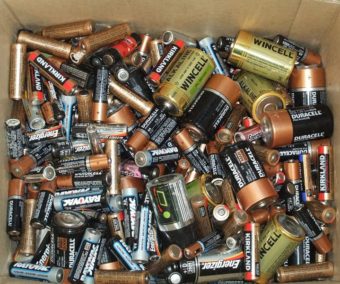
Dead batteries will be collected at the CBJ  hazardous waste collection center to be open to residents two days a week. (Photo by Rosemarie Alexander/KTOO)
Dead batteries will be collected at the CBJ hazardous waste collection center to be open to residents two days a week. (Photo by Rosemarie Alexander/KTOO)

Household hazardous waste collection will no longer be a once in a while event in Juneau; instead it will happen more than once a week.

Beginning April 11, residents will be able to drop off everything from dead batteries to old computers to paint every Friday and Saturday, from 8 a.m. to 4:30 p.m. The collection center will be open on Mondays for businesses, by appointment only.

Until now, the center has been open once a month for only seven months a year.

“So on that Sunday we get 550 people lined up wanting to get rid of their household hazardous waste,” said CBJ Public Works Director Kirk Duncan. He told the Juneau Chamber of Commerce Thursday that hazardous waste will be collected 156 times a year.

“We’ll take your TVs, we’ll take your radios, we’ll take our toasters. Bring them on. E-waste (computers), we’ll take those as well,” Duncan said.

In the past, hazardous products such as paint, new antifreeze and engine oils were shipped south to be destroyed, costing the city about $400,000 a year.  Now the liquids will stay in Juneau to be used.

“So that gallon of antifreeze is not going to be shipped to Seattle, it’s just going to be sitting there and you can come, sign a release and you can take that,” he said. “And what we found out with paint is that you can take all the paint, say five gallons of blue and 8 gallons of black and 4 gallons of green, and it comes out beige.  Don’t know how it does it, but it does it, and it is great primer material.”

Don’t put your kitchen grease down the drain or in the landfill. Bring it to the hazardous waste center to be shipped south.

“You can bring your oils, chicken fats, whatever, to household hazardous waste and we’ve created a contract with General Biodiesel in Seattle and they create biodiesel out of it.  And we’ve been working with restaurants in the same way,” Duncan said.

The collection center is at 5436 Commercial Boulevard, just off Anka Street in the Lemon Creek area. Duncan said vehicles will not be allowed to block the road during the hazardous waste drop off.

City wants citizen input on cell tower master plan

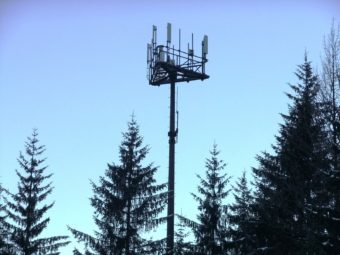
Wireless communication tower in the Mendenhall Valley. (Photo by Rosemarie Alexander/KTOO)

Only 12 Juneau residents showed up for the first neighborhood meeting Thursday night on the CBJ wireless tower master plan. Many of them have been intimately involved in the issue for years.

The city and borough’s Community Development Department has two months to finish the policies that will guide cell tower regulations. That’s when a moratorium on tower permits will expire.

After lots of citizen angst over towers in certain neighborhoods, city officials have said they want to hear from the public.

The process includes a survey that asks for the most to least-preferred tower design, including type of tower, co-location, camouflage and screening, lights, and other ways to harmonize towers within neighborhoods.

Take for example, co-location. City planner Eric Feldt says the city master plan and ordinance will encourage companies to locate their antennas on existing towers.

“So you could have AT&T, Verizon and ACS, instead of a tower for AT&T, a tower for Verizon and a tower for ACS in one location,” Feldt says.

Collocation does have some drawbacks, says Planning Manager Travis Goddard. It requires a certain distance between the antennas so towers are taller.

“Say a 140-foot tower could have an antenna array at 140 feet, 130 feet,  120 feet, 110 feet. So it depends on the type of antenna and the type of structure,” Goddard explains. “If it is the roof of a building, say the federal building, you could have two antennas right next to each other and they won’t change the height of the building.”

The tallest wireless tower in Juneau is 300 feet on North Douglas Highway.

Goddard says the surveys and comments from last night’s meeting will be synthesized and sent to the Planning Commission and Assembly, which will hold several work sessions and public hearings on the master plan and ordinance.

The Spuhn Island cell tower has a constant flashing red light at night and a white strobe during the day. (Photo courtesy Jon Lyman)

North Douglas resident Doug Mertz has been battling the 150-foot Spuhn Island cell tower for more than a year.

Like many residents who see the flashing lights every few seconds, 24-hours a day, Mertz feels they haven’t been heard.  So he’s glad for the survey process, which he calls awkward, but necessary.

“Democracy is messy. The only thing I could ask for in the whole process that would be better is a more open attitude by the city manager’s office. So far, every time we’ve interacted with them on cell tower issues, we’ve gotten animosity and negativism,” he said.

But Mertz says CBJ Community  Development is working hard to reconcile citizens’ various concerns on cell towers.

Patricia Wherry says she’s affected by any tower that goes up in Juneau, no matter where it’s located. She was disappointed so few people came to the meeting. She says she likes the process city planners are using for citizen input.

“I like that they’re trying to explain to us the specifics.  They’re asking us for a gradated opinion. They’re here to answer questions. They’re doing a good job of that; they’re trying,” Wherry says.

 CBJ community planners will hold another neighborhood meeting on March 27th at the University of Alaska Southeast.  Later today (Friday), Goddard says, the survey will be on the city website.

Neighborhood meeting tonight on cell phone tower master plan

Wireless communication tower in the Mendenhall Valley. (Photo by Rosemarie Alexander/KTOO)
Wireless communications tower in the Mendenhall Valley. (Photo by Rosemarie Alexander/KTOO)

Like your cellphone, but don’t want a tower in your view?

That’s the dilemma facing Juneau and other communities across the U. S., with the rapid expansion of wireless technology.

The City and Borough of Juneau is working on a master plan for the placement, design and permitting of future towers. Much of the 75-page document is an inventory of  the towers and antennas already installed.

“By looking at that then you can see where’s there’s holes,” says City Manager Kim Kiefer.  “Where do we need to put some more antennas, more towers to get the coverage that we need?”

The master plan will be implemented by a city ordinance that will spell out wireless tower regulations.

“The ordinance actually puts in the place how you go through the process. It is more specific,” Kiefer says. “You can in the ordinance encourage towers to be co-located.  Really we want to push as many antennas on one tower rather than a bunch of single towers.”

She says the ordinance would spell out other details, including how towers would be sited.

Kiefer says city planners will consider public comments as they write the wireless tower regulations.

The first of two neighborhood meetings is Thursday from 6 p.m. to 8:30 p.m. in Assembly chambers at City Hall.  The second hearing is scheduled at the same time on March 27 in the Glacierview Room at the University of Alaska Southeast.

Until the master plan is done, no tower permits will be granted by the city. The plan and ordinance will go through several Planning Commission and Assembly work sessions and public hearings before both are finalized and adopted in mid-May.

Interviews scheduled for Bartlett CEO finalists

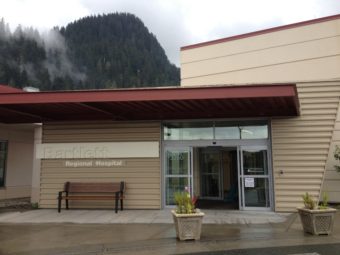
Bartlett Regional Hospital entryway
Bartlett Regional Hospital. (Photo by Lisa Phu/KTOO)

The search for a new Bartlett Regional Hospital Chief Executive Officer has been narrowed to five candidates, who will be in Juneau next week for interviews with the hospital board, staff and city officials.

City Human Resources Director Mila Cosgrove says the public will have a chance to meet the finalists during a reception on March 26, from 5 p.m. to 6:30 p.m. in the hospital cafeteria.

The city-owned hospital received 78 applications for the  job. Twenty people were initially interviewed and nine chosen for interviews by a selection committee.

Cosgrove says all five finalists have strong administrative experience.

“One of the candidates is a medical doctor, others have primarily been on the administrative side. We have a candidate here from the community who’s not been in hospital administration but has strong CEO experience,” Cosgrove says. “So we’re really looking forward to meeting them, interacting with them and having some fairly in-depth conversations to sees who’s going to be the best fit for the hospital.”

The finalists are Dr. Paul Franke, Alaska Native Medical Center interim administrator; David Abercrombie, CEO of Madison County Memorial Hospital in Madison, Fla.; Charles Bill, assistant administrator of Physician Development with Centura Health Physician Group in Durango,  Colo.; Joe Cladouhos, CEO of Syringa Hospital and Clinics in Grangeville, Idaho, and formerly of Juneau; and Alaska Pacific Bank CEO Craig Dahl, of Juneau.

Cosgrove hopes the new CEO will be selected by mid-April and on board sometime in May to work with the interim chief executive officer.

“Our current interim CEO Jeff Egbert has been doing a fabulous job in that position and he has committed to staying until the new CEO is here on the ground and transitioned,” Cosgrove says.

Former Bartlett CEO Chris Harff resigned in September, after a personnel investigation into senior management and staff complaints of a hostile work environment.

Site notifications
Update notification options
Subscribe to notifications