Rosemarie Alexander

Update: Ski guide Aaron Karitis dies following Haines avalanche

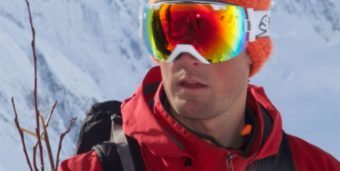
Aaron Karitis was evaluating snow conditions on a popular ski run west of Haines when the avalanche occurred about 11 a.m. Saturday. (Photo courtesy SEABA website)

Updated March 18, 2014 | 11:45 a.m.

Aaron Karitis died late Monday, according to a statement posted online by his family.

Karitis was guiding a group of skiers with Haines heliskiing company Southeast Alaska Backcountry Adventures, or SEABA, on Saturday.

According to the statement, which was corroborated by SEABA, he had dug a snow pit to test snow conditions and sample stability,  and had determined conditions were safe. Then Karitis skied down a slope to set a track, while his clients waited on top.  An avalanche was triggered, carrying him about approximately 700 feet and burying him in several feet of snow.

Fellow guides found Karitis within 15 minutes thanks to the  locator beacon he was wearing. He was unresponsive and CPR was started. He was transported to the Haines clinic then flown to Providence Medical Center in Anchorage.

The statement from his family and medical team says Karitis’ core body temperature was critically low when he arrived at Providence. He had inhaled snow, compromising oxygen flow to his brain.

Karitis is originally from Bend, Oregon and has been active in heliskiing for more than a decade. His experience includes extensive avalanche education, according to SEABA and his family.

Updated March 17, 2014 | 6:00 a.m.

A heliskiing guide was critically injured in an avalanche near Haines over the weekend, the third avalanche in as many years to injure or kill extreme mountain skiers in the area.

Alaska State Troopers say thirty-one year old Aaron Karitis was evaluating snow conditions on a popular ski run west of Haines when the avalanche occurred about 11 a.m. Saturday. Karitis was carried about 800 feet and buried at least seven feet deep, according to trooper spokesperson Beth Ipsen.

Karitis was acting as a guide on a heliski tour with Haines company Southeast Alaska Backcountry Adventures, known as SEABA. Four clients were waiting on the top of slope and not caught in the avalanche. Other SEABA staff immediately began searching for Karitis and called in another helicopter and more guides to assist. Ipsen says Karitis was located within 20 minutes.

“If you’re going to survive an avalanche, it’s because the people you are with are going to find you in time,” Ipsen said.

Karitis was wearing a locator beacon that helped rescuers locate him quickly, Ipsen said.

“What you have is you have locator beacons on you and you have to turn it on. You have to turn it on so it receives a signal and that’s why it kind of like a metal detector where you’re trying to receive that signal the other beacon is sending out.”

Ipsen said Karitis was unresponsive when located and CPR was started. He was flown by a SEABA helicopter to the Haines Airport and transported by ambulance to the local clinic where CPR continued. He was stabilized and medevaced to Providence Medical Center in Anchorage where he was listed in critical condition on Sunday. There was no other information about his injuries.

SEABA owners did not want to speak about the incident but issued a statement Sunday saying normal response procedures were followed. The statement also says while avalanches are inherent risks of heliskiing, the company has offered its assistance and encouragement to the guide’s family.

Ipsen said a trooper visited the scene of the avalanche Saturday and interview SEABA staff and responders about the incident. Troopers also revised a previous press release that said Karitis had determined the area unsafe to ski. Ipsen said Sunday the guide wasn’t planning on moving his clients from the area. Instead, based on the conditions, he was showing them how to ski that slope. The clients hadn’t yet descended the slope when the avalanche broke loose and took Karitis down the mountain known to skiers as Tele 2.5 near the Kicking Horse Valley west of Haines.

Ipsen said the trooper investigation is complete because they found no sign of criminal intent or negligence.

According to the SEABA website, Karitis grew up in Bend, Oregon. He graduated from the University of Utah and has been working in the heliski industry for about a decade. He joined SEABA in 2013. Karitis has international guide and avalanche certifications, according to the website, and an excellent safety record.

Just over a year ago, another SEABA guide was killed in a cornice collapsed on a mountain near Haines. That incident also injured two skiers. And in 2012 a guide and client with another heliski company were killed in an avalanche, also outside Haines.

Original Post March 15, 2014 | 4:34 p.m.

Alaska State Troopers say an avalanche near Haines on Saturday morning  injured a helicopter ski guide.

Troopers say Southeast Alaska Backcountry Adventures guide Aaron Karitis was testing snow conditions about 11 a.m. He had just deemed it unsafe for clients when the avalanche struck.

Karitis was buried for about 30 minutes before he was located by his emergency beacon. Troopers say CPR was started and he was flown to Haines by a SEABA helicopter then transported to the clinic. He was flown to Providence Hospital in Anchorage. On Sunday afternoon, he was listed in critical condition.

According to the SEABA website, Karitis is 31 years old and grew up in Bend, Oregon. He graduated from the University of Utah and has been working in the heli-ski industry for about a decade.  He joined SEABA in 2013. Karitis has international guide and avalanche certifications, according to the website, and an excellent safety record.

Juneau Peace Corps volunteer evacuated from Ukraine

Mary Miller, of Juneau, spoke Thursday to Juneau World Affairs Council about her recent experience in Ukraine.

Longtime Juneau resident and Peace Corps volunteer Mary Miller had several months to go on her two-year tour in Ukraine when the organization pulled out volunteers late last month.

Miller was teaching English to what she calls “technically elite students” at Odessa National Academy of Telecommunications.

With a population of about a million people, Odessa is the third largest city in Ukraine and a major shipping port on the Black Sea. It’s about 275 miles south of Kiev, the capital.

Miller said most of the people she met were fluent in Russian and Ukrainian, and many spoke English.

“They may have grown up speaking one language but they know the other, and for the most part I would say the vast majority of the population is bilingual,” she said.

As demonstrations in Kiev grew violent, the Peace Corps volunteers found themselves in a tenuous position.

“We’ve followed it, you know, every day for the last three months, everything that was happening, just as an observer,” she said. “I would have students that would ask me ‘what do think about what is going on up there’ and I would say it’s not important what I think, it’s what do you think. But I would say that I did believe it was a human right for people to be able to express their opinions in a peaceful manner without fear of persecution.”

On Feb. 22 , Peace Corps volunteers in Ukraine were sent home. Miller doesn’t know if or when she will return.

Miller spoke to the Juneau World Affairs Council on Thursday night and to KTOO News earlier this week .

You can watch Miller’s talk to the Juneau World Affairs Council Friday at 8 p.m. on 360 North television.

Juneau faces declining revenues

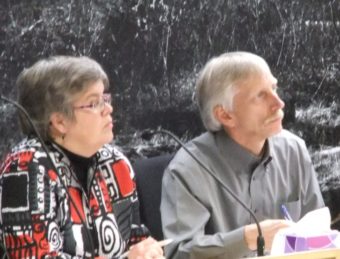
Juneau City Manager Kim Kiefer and Finance Director Bob Bartholomew
City Manager Kim Kiefer and Finance Director Bob Bartholomew deliver bad revenue news to the Juneau Assembly Committee of the Whole. (Photo by Rosemarie Alexander/KTOO)

The City and Borough of Juneau needs nearly $5 million to balance its budget over the next two years.

Finance Director Bob Bartholomew says federal, state and local revenue sources are down. He told the Assembly Monday night the figures are still preliminary, but members should be prepared for more fiscal challenges as they start their budget work next week.

Bartholomew said the city will lose two federal grants, and a projected 2 percent to 3 percent increase in property and sales taxes did not materialize.

“We’re still seeing slight increases in property tax and sales tax is projected to be flat year to year,” Bartholomew said. “So we backed  off our projections for (fiscal years) ’15 and ’16, and that’s why there’s not a lot of new revenue from our existing programs.”

Bartholomew said CBJ also forecast $800,000 a year in ambulance billings, but federal and local reimbursements have declined.

Despite the flat revenues, he said Juneau is coming out of the economic downturn that had a big impact in the Lower 48.

“We’ve gone through a 3 to 4-year period where a lot of pressure has been kept on the operating budget to hold the line, keep positions vacant, only essential services,” he said. “I think that was a successful approach to helping us get through that national economic downturn that affected Alaska in (fiscal years) ’09, ’10, ’11.”

Since several funding sources will be off the mark, City Manager Kim Kiefer said the city will be looking for ways to enhance revenue and reduce spending.

Bartholomew and Kiefer will present the proposed budget to Assembly members on March 19.  During the budget process, the Assembly will work as a Finance Committee of the Whole to determine the spending plan for fiscal years 2015 and 2016.

Assembly drops Spuhn Island cell tower study

The Spuhn Island cell tower has a constant flashing red light at night and a white strobe during the day. (Photo courtesy Jon Lyman)

The case of the Spuhn Island cellphone tower is closed.

The Juneau Assembly Monday night called off a search for a solution to the 155-foot tower and the flashing lights that have disturbed area residents for more than a year.

The Assembly in January asked city staff to look for ways to mitigate the visual impact of the cell tower lights. At the time, Deputy City Manager Rob Steedle said there were no options. But when pressed, he found six.

“I was wrong. I should have said that CBJ has no good options,” he told the Assembly Committee of the Whole.

He admitted none of his assumptions had been tested. He called the cost of each option “very rough.”

The price tags range from a high of more than $500,000 to relocate the tower, to a low of $175,000 for a dialogue with the Federal Aviation Administration about less intense lighting. Steedle said that could take ten years and he rated the actual chance of conversation very low.

But that was the type of alternative Assembly members seemed to be looking for when they called for the study. Kate Troll said it clearly is time for conversation.

“Have a discussion with the regulatory agencies or the tower and property owners, realizing we can’t compel them to a solution,” Troll said.  “But maybe out of their desire to be a good neighbor, they would modify the blinking light.”

The Spuhn Island tower is within the airport flight path. It has a flashing red light at the top and two lower, but steady red lights at night; a white strobe flashes throughout the day. The tower was properly permitted in 2012.

Atlas Tower LLC, of Colorado, owns the tower. It sits on land leased from Spuhn Island Development, a Juneau company. Atlas Tower is in the midst of its first five-year lease, with five, five-year renewals remaining. Verizon is the cellphone carrier.

CBJ Community Development Planning Manager Travis Goddard said the flashing red warning light provides significant information to pilots.

“And the purpose of that flashing light is to help them figure out the three-dimensional aspect of that tower and where those lights are,” Goddard said.

Mayor Merrill Sanford said the FAA regulations are clear and the city should just drop its study.

“This isn’t just for Juneau, this is across the nation,” he said.

City staff assigned to the project did not talk to the FAA, the tower company, or property owners. They’d been asked to consider community mediation – getting all the parties in the same room to talk through the issues and possible solutions. In a memo to the Assembly, Steedle said the approach made no sense in the case of the Spuhn Island tower; he doubted Atlas would be interested in coming to the table.

That annoyed Assembly member Jesse Kiehl.

“I have never heard a response to, for instance, a request that the Assembly try and start a conversation, or that management start a conversation, like the one in this memo, which simply says, ‘well, we don’t have a hammer, so there’s no point in having the conversation. There’s no point in inviting them to talk. The tone and the approach remain an issue of great concern for me.”

For more than a year, Gene and Sue Ann Randall have been asking the city to help broker a solution. Their North Douglas home faces the flashing tower. They were in Assembly chambers for Monday’s discussion and asked to make a statement, but public testimony is never taken at Committee of the Whole meetings.

After the meeting, Randall said Steedle’s options were shortsighted.

“He suggests that community mediation would be of no value, and this is just shameful to dismiss the value of open discussion on an issue that affects the community this much,” Randall said.

While the case of the Spuhn Island cell tower seems to be closed, the city is in the midst of developing a master plan to regulate the placement, design and permitting process of future  towers. That process promises neighborhood meetings and public hearings before the plan is adopted.

Tompkins, Kurka injured in training at Sochi Paralympics

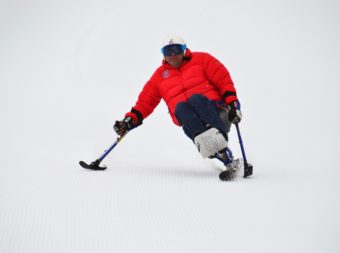
Joe Tompkins skiing at Eaglecrest Ski Area in February. (Photo courtesy Sarah Cannard, Eaglecrest)

Alaska’s Paralympic alpine skiers were both injured in training runs in the Paralympic Winter Games in Sochi, Russia.

Joe Tompkins, of Juneau, is awaiting surgery in a hospital in Germany, after a crash in a Thursday training run for the men’s sit-ski downhill race.

It was the same training run that took out Andrew Kurka, of Palmer, who broke his back. Kurka has already returned to  Alaska. The 21-year-old wrote on Facebook that he was “excited to get the chance to represent” his country. “Perhaps a bit too excited,” he said.

Kurka has been partially paralyzed since he was 13, the result of an accident with a four-wheeler. Tompkins is paralyzed from the waist down due to an automobile crash in 1988.

According to Kurka’s Facebook entries, Tompkins, age 45, broke his femur in the training run.

News reports indicate that warm weather and soft snow at Sochi’s Rosa Khotur Alpine Center resulted in a number of crashes both in training and in the race.

Another U.S. teammate, Tyler Walker, crashed during the Saturday race and was taken off the mountain by helicopter. He is reportedly in stable condition.

Twenty-two competitors were entered in the men’s downhill; nine failed to complete the run.

Japan’s Akira Kano won the gold. Josh Dueck of Canada is the silver medalist and the bronze went to Takeski Suzuki, also of Japan.

The sit-skiers use a molded bucket-style seat on a suspension system and shock absorber mounted to a single ski.

Juneau Access project begs question of ferries versus roads

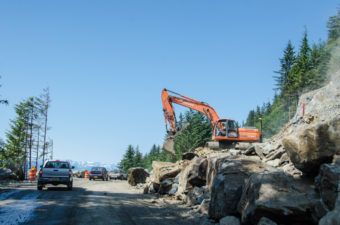
Construction has extended Glacier Highway to Cascade Point. Here crews are shown working on widening parts of the existing road in June of 2013. (Photo by Heather Bryant/KTOO)
Construction has extended Glacier Highway to Cascade Point. Here crews are shown widening parts of the existing road in June of 2013. (Photo by Heather Bryant/KTOO)

Why should the state of Alaska consider extending roads to take over the function served by ferries?

The question was recently put to Department of Transportation officials at a joint hearing of the legislature’s House and Senate Transportation committees.

From a DOT perspective, the answer is simple:  cost.

“One thing about a road is that first investment is retained over decades and decades and decades. It doesn’t wear out,” said Jeff Ottesen, division director of program development for DOT. “In the 50-year life of a ferry we replace it piece by piece.”

Capacity is the other part of the equation. Ottesen said roads give travelers greater opportunity and flexibility.

DOT forecasts indicate 1,484 vehicles a day could travel by road between Juneau, Haines and Skagway in the summer by the year 2020. Current ferry capacity is 154 vehicles a day in summer.

An old argument

A map of the favored proposed route to Katzehin. (Map courtesy Alaska DOT)

A highway out of the capital city has been debated for decades. It’s slowly grown to Echo Cove and the latest proposal would extend it about 50 miles to the Katzehin River valley, east of Haines, where a ferry terminal would have to be built for the final leg to Haines and Skagway. Those ferries would operate in “a three directional mode,” Ottesen said.

“There’d be ferries from Katzehin over to Haines. Other ferries from Katzehin up to Skagway and then a smaller ferry up to Skagway and Haines directly,” he said.

In the summer, he said, the Katzehin ferry to Haines would run 10 times a day; six times to Skagway. Mainline ferries would no longer operate in Lynn Canal; they’d turn around at Auke Bay.

The latest estimate for the road to Katzehin is $500 million. Ottesen said the initial cost ultimately becomes savings.

“Roads will greatly increase the capacity of the corridor by almost a factor of ten.  And we believe that capacity will be filled.”

Testimony at the transportation hearing was by invitation. Though the committee received some letters, Juneau-Douglas High School teacher Clay Good was the only person testifying who was not affiliated with the state transportation department.

“As a student growing up in Juneau and now as a teacher, I’ve taken students on field trips throughout Southeast Alaska, and the ferries were and are the safest, most affordable transportation option,” Good said.

Good has read the reports that describe a road periodically closed in winter due to avalanches and rock slides. He sees no utility in what he called an “expensive and dangerous road.”

“Imagine 40 students on a winter ferry to Haines. I can see it, a bunch of kids having fun, running around. Now imagine those 40 students in a bus in the winter driving to a very remote ferry terminal to catch another ferry,” he said. “What would parents choose if they could?”

The next segment

Next year’s DOT proposed capital budget includes $35 million for the Juneau Access project. Just what the money would cover did not come up during the hearing.

At this point, there is no detailed plan, because the Juneau Access Supplemental Environmental Impact Statement isn’t done. DOT spokesman Jeremy Woodrow says a draft document could be released within a couple of months then public meetings would be held in Juneau, Skagway and Haines. The final SEIS must be approved before the next segment gets underway, and Woodrow hopes that would be as soon as next fall.

The SEIS has been delayed to include the costs of building and operating two day boats in Lynn Canal, called Alaska Class ferries. If a highway is ever built to Katzehin, the proposed day boats would be used on the route to Haines and  Skagway.

Site notifications
Update notification options
Subscribe to notifications