Rosemarie Alexander

Juneau’s Joe Tompkins to ski in Sochi Paralympics

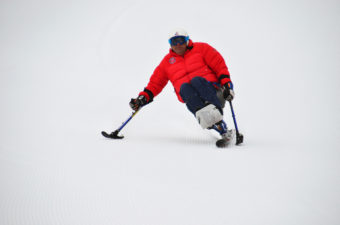
Paralympian Joe Tompkins takes a warm-up run at Eaglecrest Ski Area. (Photo courtesy Sarah Cannard/Eaglecrest.)

Juneau’s Joe Tompkins will represent the United States in the Paralympic Winter Games in Sochi, Russia.

Tompkins and Andrew Kurka, of Palmer, are among 26 athletes named to the U.S. Paralympic Alpine Ski Team.

Tompkins has been racing since 1999, when he qualified for the U.S. Disabled Alpine Men’s Ski Team.  He’s had a successful World Cup race career, but has never won a medal in the Paralympics.

Sochi will be Tompkins’ fourth Paralympic Winter Games.

“Four and done.”

Tompkins admits he’s said that every four years since the Salt Lake City Paralympics in 2002.

When he gets to Sochi, he will be skiing a single downhill race.  To get ready, he’s been bombing the trails at Eaglecrest Ski Area.

Coming out of retirement

Tompkins is paralyzed from the waist down. He sits in what he calls a bucket atop a single ski.  His gear looks like it’s held together with duct tape.

Joe Tompkins heads to Hooter lift at Eaglecrest.  (Photo by Rosemarie Alexander/KTOO.)
Joe Tompkins heads to Hooter lift at Eaglecrest. (Photo by Rosemarie Alexander/KTOO.)

Now age 45, he’d decided it was time to retire from racing.

Then he got a call from the Paralympic alpine team coach who said Tompkins should join the team in Sochi.  First he needed to get back on his mono ski and prove he could still compete, so he went to Aspen for the U.S. National Championships in early February.  He came in sixth.

“After  three days of skiing — for the season,” he says with a laugh.

The Paralympic downhill course at Sochi is similar to the Olympic downhill, with some of the same jumps.

“There’s going to be some air in there.  You just have to have the confidence, the balance to land it and keep going,” he says.

Tompkins says mono-skiers can get a lot of air.

“If you watch the able-body coming up to a jump, they suck up their knees so it’s less, but we’re going with a solid shock.  You have to be pretty quiet in the air to land it because you’re on one ski,” he says.  “The two outriggers that people see in your arms, those are just for balance, those aren’t for skiing at all.”

Tompkins says he wasn’t convinced he should go to the Paralympics.  Sochi is a big commitment; baseball training is getting underway and he’s assistant baseball coach at Thunder Mountain High School.

“I told my mom I didn’t think that I should go over there, and she goes ‘what  would tell your boys?’  That pretty much stuck in my head.  Of course I would tell ’em to go for it.  Swing the bat, swing it like you mean it.”

Tompkins was paralyzed in a 1988 alcohol-related car accident near Auke Bay.  He wasn’t driving, but he and three other young men in the car were drunk.  One died.

A few years later it hit him.  That’s when he decided he needed to help kids stay away from alcohol and drugs.  His message is blunt.

“If you get into drugs and alcohol, it’s going to be harder to get out of that and come back to where your dreams and goals are.  I’m a constant reminder because they ask me what happened to me.  And I tell them.  I don’t lie to them, I don’t sugar coat it,” he says. “It’s about motivation.  It’s about never giving up.”

To compete  in the Paralympics, Tompkins says he’s been training to build confidence and balance as well as speed.

“I’m just  thinking I’ve got to ski smart, ski fast and let it go.  I would hope that the fourth is my lucky charm.”

Mighty Mites take over the mountain

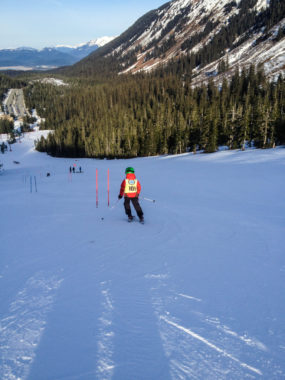
Every Saturday at Eaglecrest Ski Area young racers work on mastering slalom gates on a trail known as Sourdough.

They are the Mighty Mites.

Thirty skiers ages 7 to 12 are in the ten-week race program this season. It’s sponsored by the Juneau Ski Club, which coordinates youth ski race programs at Eaglecrest.

Even former downhill Olympian Hilary Lindh, whose daughter is a Mighty Mite, got her start in the program.

“Bib 188 is on the course. Bib 119, Mikayla Neal, is in the start,” Lindh says by two-way radio to the timers, gate judges and referees working the course.

A multitude of parents volunteer for each of the three Mighty Mite races of the season.

“Go Mikayla,” cheers Mike Goldstein, an Eaglecrest ski instructor and father of three racers. He says the youngsters develop good fundamentals for a lifelong sport.

“They become fantastic all-mountain skiers. But it’s really also about camaraderie and team work and it’s about the social interaction that they generate out here on the mountain. Lots of people can attest to it. It’s lifelong friends as well.”

For boys ages 10 to 12, Goldstein’s son Koby came in first. Twelve-year-old Kaelin Quigley was second. They’ve moved up this year from Mighty Mites to Devo, short for development team.  Nine Devos are still eligible by age to race with the Mighty Mites.

Kaelin says they spend every weekend during ski season in a race class.

“We do a lot of drills to get better, so we can get better times on our races,” he says.

In the giant slalom, each racer had two runs that were averaged for the total time.

“I think I went pretty fast,” Kaelin says.  “It felt pretty comfortable.” His total time was one-minute, five-tenths of a second.  Koby’s was 56.88.

Ski fast, have fun

Look all over Eaglecrest on weekends, and you’ll see a lot of seemingly fearless kids on skis and snowboards.

To join Mighty Mites, kids must be 7 years old, able to get on and off the lifts by themselves and ski independently, says coach Mike Satre. He and his wife Sarah grew up racing at Eaglecrest and have coached Mighty Mites for about six years.

Most importantly, Mike says, kids need to be comfortable skiing the whole mountain and “ready to have some fun.” After all, the Mighty Mite motto is “ski fast, have fun.”

“The more laps they get on the mountain, the better they are. We work on edging and balance skills, and we enforce that as we work in all terrain on the mountain, then we do some race specific drills,” Mike says. “And then we have a beautiful day like today and we get to show it off on the race course.”

Sarah Satre teaches second grade at Auke Bay Elementary School and knows the Mighty Mite age group pretty well.

“Going to have some fun today?” she asks 10-year-old Sadie Jenkins as she pushes into the start gate.  “Ready? Go.”

As each young racer slides into the start, Sarah delivers a very clear message:

“Smile and have a lot of fun.”

Juneau hires new harbormaster

David Borg has been hired as Juneau harbormaster.

A civilian in the U.S. Coast Guard has been hired as Juneau Harbormaster.

David Borg begins his new job in late March, according to Port Director Carl Uchytil.
Borg is currently Recreational Boating Safety Analyst for the Coast Guard. He has lived in Juneau for seven years, and is originally from Florida, where he worked in maritime operations for 28 years.

Juneau’s Harbormaster job has been vacant since November when Dwight Tajon resigned.

The city received 20 applications for the job. After telephone interviews with ten, the hiring committee selected five for personal interviews in Juneau.

Uchytil says the selection committee interviewed two candidates from Washington State and three from Alaska. They were evaluated on writing samples, a face-to-face interview and a 15-minute oral presentation to the full Docks & Harbors Board last month.

Capitol flag presented to Munoz

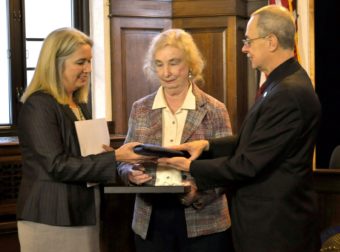
Rep. Cathy Munoz and her mother, Sally Engstrom, are given the flag that flew above the capitol in November when her father died. Rep. Mike Hawker organized the presentation. (Photo by Skip Gray / Gavel Alaska.)

The flag that flew above Alaska’s state capitol at the funeral of former lawmaker Elton Engstrom Jr. was presented Wednesday to his daughter, Juneau Rep. Cathy Munoz.
Anchorage Rep. Mike Hawker organized the ceremony and memorial for Engstrom, who passed away Nov.  6, 2013. By coincidence, the presentation was made on what would have been Engstrom’s 79th birthday.

He represented Juneau as a Republican in the legislature from 1965 to 1971.

Munoz is from a long line of Alaska politicians. Her grandmother, Thelma Engstrom, and grandfather, Elton Engstrom Sr., were both elected to the Alaska Territorial Legislature. Then Engstrom Sr. served in the Senate just after statehood. His son was elected to the House in 1965 and to the Senate in 1967.

Munoz was only about a year old when her father ran for office, but she’s heard the stories for years. During a speech yesterday on the floor of the House, she related some of the history of those early years after statehood.

When he was elected in 1965, the budget for the entire state was $100 million. 

Munoz said her father was 30 when he was first elected to the legislature. He served among lawmakers who made legislative history as they helped build the new state, including Ted Stevens, Jay Hammond, Jay Kerttula, Clem Tillion, and Nick Begich. John Butrovich was Senate President at the time.

They were developing the Alaska Marine Highway system, the infrastructure; they were putting together the payroll system for the state, all of the nuts and bolts.  They were building the infrastructure of the communities.

At the same time, they were rebuilding much of Southcentral Alaska after the 1964 earthquake, and Fairbanks, after the 1967 flood.

And then in 1968, the political landscape completely turned upside down with the discovery of oil and an infusion of $900 million into the coffers overnight.  It was quite a change and my father was right in the middle of all of that change.

Munoz called Engstrom her mentor. After she was elected to the House in 2008, she said her father often slipped into the gallery of the House to watch special votes, but would never allow her to introduce him.

Kito gets to work as legislature’s newest member

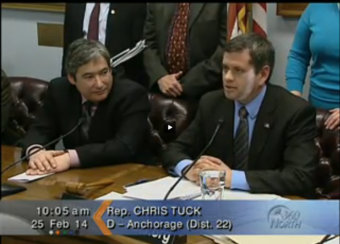
Chris Tuck and Sam Kito III during the February 25, 2014 House Minority Press Availability. Screenshot courtesy of Gavel Alaska.
Sam Kito III looks on while House Minority Leader Chris Tuck announces Kito’s confirmation. (Photo courtesy of Gavel Alaska.)

(Story was updated Feb. 26 at 6:00 a.m.)

Sam Kito III is at work today as the newest member of the Alaska Legislature.

House Democrats Tuesday morning confirmed Sam Kito III to the legislative seat vacated last month by Juneau Rep. Beth Kerttula.

Minority Leader Chris Tuck said Democrats were unanimous in their decision.

“He had to answer some very tough questions both in the public and with the governor and with us, and all through that he was consistent and he spoke from the heart. And I think that speaks a lot for a person.”

Gov. Sean Parnell on Friday appointed Kito to the seat.

The governor asked Democrats to take their vote on the House floor.  But the minority met Monday night in closed caucus then Tuck announced the decision Tuesday on Gavel Alaska, statewide television coverage of the legislature.

With pen in hand, Tuck said party confirmations have been announced by letter for the past 25 years.

“And with that right now I’d like to sign a letter to both the governor and to the Speaker of the House announcing Sam’s replacing Beth Kerttula in the House Democratic 32 seat,” Tuck said.

Kito will fill in for Rep. Harriet Drummond on the Education as well as Community and Regional Affairs committees. Drummond is absent from the capitol for a family medical emergency.  Tuck said Kito will continue on Community and Regional Affairs when Drummond returns.

He inherits Kerttula’s longtime staff members, Ken Alper and Hannah McCarty. Alper was one of nine Juneau Democrats to apply for the seat. Tongass Democrats nominated Kito, Jesse Kiehl and Catherine Reardon.

Kerttula left the job on Jan. 24 for a Stanford University fellowship. It took a  month to fill the seat, but Tuck said the small House Minority did not lose any strength while down a member.

House District 32 encompasses downtown Juneau and Douglas, Petersburg, Gustavus, Skagway, and Tenakee Springs. Kito said he would have been a candidate for the seat if it had been open.

(Editor’s Note: Updated Monday afternoon with additional information.)

Previous Coverage:
Tongass Democrats nominate Kiehl, Kito, and Reardon for Kerttula’s vacant seat
Sam Kito III named as new Juneau representative
Next step: House Democrats to confirm Kito appointment

New Capital Transit plan boosts Mendenhall Valley bus service

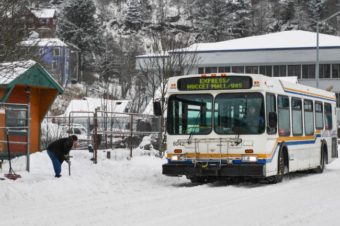
Capital Transit provides between 4,000-4,500 passenger rides each week day. (Photo by Kelli Burkinshaw/KTOO)
Capital Transit provides between 4,000-4,500 passenger rides each week day. (Photo by Kelli Burkinshaw.)

Bus service on Riverside Drive in Juneau’s Mendenhall Valley could start by midsummer, if city officials adopt a new Capital Transit plan.

Valley buses also would be rolling 30 minutes earlier each day.

The bus system has been under review for nearly a year and the 2014 Transit Development Plan is now complete.  The CBJ Planning Commission is expected to adopt it Tuesday night.  The Assembly will take it up next month.

Passengers have been asking for earlier and additional service in the Mendenhall Valley since Thunder Mountain High School was built.

Capital Transit Superintendent John Kern says continued growth along Riverside Drive is the impetus behind the proposal for expanded service.

“We did evaluate bus service for the school, again for the pool, and now we’ve got a library going in there,” Kern says. “I think it’s just a matter of the sheer magnitude of facilities on that location, requiring better service.”  

Due to budget constraints, there are tradeoffs. If Riverside Drive is added to the system, bus service on Back Loop Road and North Douglas Highway would be reduced.  Ridership is lower along those routes.

Kern says bus fares would not increase with the new service.

The Capital Transit study began last spring and included a number of public meetings.  Kern says it’s not too late to take public comments on the final proposal.

Site notifications
Update notification options
Subscribe to notifications