Rosemarie Alexander

Remembering Bob Janes

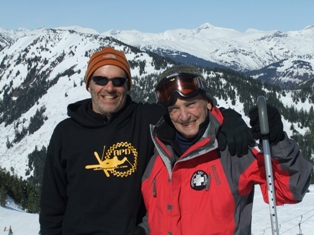
Bob Janes St. and son Bill at the top of Black Bear chair in 2010.
Bob Janes Sr. and son Bill at the top of Black Bear chair in 2010.

A three-year Forest Service assignment to the Tongass National Forest became 49 years in the capital city for the late Robert C. Janes Sr., whose life will be celebrated on Sunday.

He passed away at the Juneau Pioneers’ Home in March at the age of 92.

Ski area reconnaissance

Bob Janes arrived in Juneau in 1965 with the U.S. Forest Service.  Used to moving with the agency, he thought it would be another short stint.

At the time, Douglas Ski Bowl – also known as Third Cabin — had a rope tow and snowcat to get Juneau skiers to the top.

Janes had been working in the Sierra Nevada Mountains in California and was soon assigned to help come up with another location for a ski area.

“The regional forester put me to work. (He) said go out with Craig Lindh and find a new ski area.  That’s what we tried to do,” Janes said in an interview a few years ago.

Lindh was also with the Forest Service. He had transferred to Juneau to work on the ski area project.

“He was pretty enthusiastic when I first came to Juneau and met him and we chatted about skiing,” Lindh said.

So the two foresters and avid skiers hooked up to find a place with better access than Third Cabin. Lindh said they had lots of input from Juneau skiers and finally settled on the Fish Creek area.

“From the top of Third Cabin area you could look down into the Fish Creek drainage and that’s what got people interested,” he recalled.

The land was taken out of federal ownership and in 1975, Eaglecrest opened with the Ptarmigan lift up the west side. The ski area is owned by the city and borough of Juneau.

By the 2009 / ’10 season, Eaglecrest had grown to four lifts. Black Bear was installed on the east side with the help of gifts from Eaglecrest users.  Bob Janes sponsored tower 21, which reads:

Supporting Eaglecrest’s past and future.”

Black Bear chairlift Tower 21
Tower 21 of the Black Bear chairlift at Eaglecrest is sponsored by Bob Janes Sr. (Mikko Wilson / KTOO)

He was 88 that year and no longer skiing. An Eaglecrest employee took him by snowmobile to Black Bear, so he could ride the lift and see the sign in place.

“It’s nice looking I think. I kind of am proud of that sign,” Janes said later.”There are many other nice signs and people that have contributed. It shows the community spirit.”

He juxtaposed the first Eaglecrest logo with the current logo. The sign reflects Janes’ early reconnaissance work and subsequent years as a skier and a ski patrol volunteer.


A love of snow

Janes grew up in California. His family writes that he could have been a beach bum, but after earning a degree at the University of California Berkeley, he joined the Forest Service and eventually started working in snow.

In the 1950s he trained in avalanche control with Monty Atwater, who was considered the father of avalanche science in the U.S. In 1960, he was  part of Atwater’s team of Forest Service snow rangers for the 1960 Winter Olympics at Squaw Valley, Calif.

When Tom Mattice was hired as Juneau’s emergency program manager a few years ago, Janes was on the board of directors for the Southeast Alaska Avalanche Center.

“You know, he was one of the first avalanche mitigation specialists in the nation,” Mattice said. “It’s neat to have that kind of experience in our region.”

Janes brought his expertise to Juneau, and in the 1980s worked to create a statewide avalanche forecasting system, which ended when the state dropped out. He advocated for Juneau’s avalanche advisory program and often shared his knowledge of how certain weather events in Juneau contribute to slides, Mattice said.

“How Taku wind events tend to be some of the events that lead to some of our instabilities in the urban environment, but also some of the dangers that loom in the back country up Douglas and other places,” Mattice said. “He wanted to make sure the public had the information they needed to make educated decisions.”

Lion Bob

Searching the KTOO archives produced tape of Bob Janes, the Lions Club member, selling tickets at the 55th Gold Medal Basketball Tournament.

“What do you see for the future of Gold Medal?” the reporter asked.

“Well, after 55 years, I think it’s going to go on forever, don’t you?” Janes quipped.

He missed Gold Medal this year, which was the 68th annual competition that brings Southeast communities together on the basketball court in Juneau.  It’s a major fundraiser for the Juneau Lions Club, part of the international service organization.

“That’s our motto, ‘we serve,’ and that’s where our resources come from. Somebody that wants to join the club and do something for somebody else,” Janes told the reporter.

When Ted Burke joined the Lions Club in 1987, Janes became his mentor. Burke said the education in all things “Lionism” never stopped, even when Janes moved into the Pioneers’ Home.

“That’s when he called me up and told me I had to become the historian of the Juneau Lions Club to relieve him of those duties,” he said, laughing.

Janes took on the job of historian for many of the organizations he joined.

Burke said Janes was always clued into the needs of the community.

“It was Lion Bob that started us in a quest to make sure that whatever we were able to do for our community that youth came first,” he said.

In 1980, Janes was elected as District Governor for Alaska Lions Clubs. That same year, he founded the Lions Club adaptive ski program, which continues today at Eaglecrest, under Southeast Alaska Independent Living, or SAIL.  Janes brought Joe Tompkins into the program, who went on to compete in four Winter Paralympic Games with Lions Club support.

The definition of a gentleman

Burke and Mattice and just about everyone you talk to about Bob Janes called him a gentleman. The definition in this case: A man whose conduct conforms to a high standard.

A celebration of life for Bob Janes Sr. will be held Sunday, April 20, at the Juneau Arts and Culture Center at 5:30 p.m.

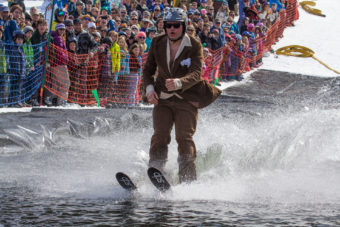
Sounds from down under the Slush Cup

Does a snowboard crashing into a slushy pond sound different than a pair of skis? How does the sound differ above and under the water?

Our report is far from scientific, but this year KTOO used a hydrophone to record the sounds of last weekend’s Eaglecrest Slush Cup. Our thanks to Joseph Reeves for the loan of the special underwater microphone.

[icon name=”icon-file”]Results


Aquatic facilities board to take public comments on closing Augustus Brown pool

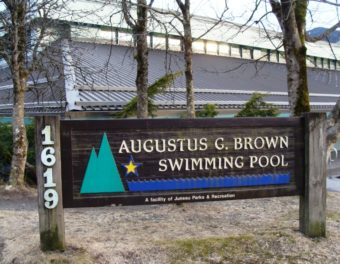
Augustus Brown Swimming Pool is adjacent to Juneau-Douglas High School on Glacier Avenue in downtown Juneau. (Photo by Casey Kelly/KTOO)

The Juneau Aquatic Facilities Advisory Board wants to hear from the public on a proposal to close the downtown Augustus Brown Swimming Pool for a year, possibly two.

City Manager Kim Kiefer says it could save the city $775,000 over the next two years and would be a good time to assess pool renovation costs.

The aquatic facilities board is a citizen advisory group to the city. Members have already said closing the pool is not the right approach to the city deficit.  They recommend the city work with a citizen group to find ways to reduce costs, increase pool revenue, and identify funding sources for deferred maintenance at the pool.

The board is holding a meeting Tuesday to take public comments. Board chairman Bob Storer says the group also has asked the city assembly for copies of mail received on the proposed pool closure.

Glacier Swim Club is one of the largest users of the pool.  Swim club board member Max Mertz says the Juneau swimming community has grown significantly since the Dimond Park Aquatic Center opened in 2011 in the Mendenhall Valley.

“We now operate, for example, a 50-person master’s program, Glacier Swim Club does, that didn’t exist before Dimond Park,” he says. “Glacier Swim Club has approximately 250 total members. Before the opening of Dimond Park we were around 120 or 130, so we’ve just about doubled in size.”

Mertz says closing Augustus Brown pool would create scheduling problems at Dimond Park and limit access to the pool.

In a three-page letter to the assembly, Glacier Swim Club offers nine recommendations to save money, including staff reductions at both pools, covering the pools for heat loss when the facilities are closed, and increased user fees.

Mertz believes both pools as well as other city recreational facilities could operate more efficiently.

“A decision to close Augustus Brown is hasty and it doesn’t answer a more important underlying question, which is how can we do these things better? What can we do to make sure our recreational facilities are top notch and operating most effectively? We need to do A — that – before we do B, which is starting to close facilities,” Mertz says.

The Juneau Community Foundation also urges the city to come up with other ways to meet the budget deficit. In December, the foundation gave the city $20,000 for climbing walls at Augustus Brown pool. That money would have to be returned if the pool closes.

The Aquatic Facilities Advisory Board will take public comment and consider options Tuesday at 4:45 p.m. in room 224 of city hall.

Eaglecrest season ends with memorial run

The Eaglecrest ski and snowboard season ended Sunday with a memorial run for long-time ski patrolmen Ron Dippold and Bob Janes.

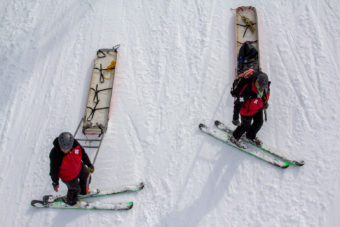
“The symbolic empty sleds for Janes and Dippold will go first, followed by today’s patrollers and the alumni patrollers,” said Bob Janes’ son Bill, as skiers of all ages came from Ptarmigan and Black Bear lifts to join the crowd at the top of Easy Bowl on Eaglecrest’s east side.

Empty Sleds - Gathering
Current and past Juneau Ski Patrollers gather with family and friends at the top of “Easy Bowl” for a memorial run at Eaglecrest Ski Area on Sunday. (Photo by Mikko Wilson/KTOO)

Bill Janes used a bull horn to address them.

“Both were patrollers, one for over 50 years, one for just under 50 years,” he said.

Dippold died in January at the age of 78; Janes passed away in March at age 92. They started volunteering with the National Ski Patrol at the old Douglas Ski Bowl called Third cabin near Dan Moller trail. It was replaced by Eaglecrest in 1975, which is now owned by the city and borough of Juneau.  A lot of community toil has gone into the ski area, and Janes reminded the crowd of several others who had been part of building it.

“Think about all the old timers, the Pittmans, the Tom Stewarts, Sig Olson, many others that I have not thought of that have left us already,” Janes said.

Pittman’s Ridge at Eaglecrest is named for Tom Pittman, who skied at Third Cabin along with Tom Stewart and Sig Olson. Stewart was secretary of Alaska’s constitutional convention and a superior court judge; Olson, a wildlife biologist. In World War II, Stewart and Olson were members of the skiing infantry of the 10th Mountain Division of the U.S. Army. Both died in 2008.

“And think about, too,” Janes said, “those that have left us far too early, the Bill Tugmans, the Helen Davies, Peter Barretts and Matt Brakels.  They also deserve our attention on this run.”

Bill Tugman taught skiing at Eaglecrest in the 1980s and died in a boating accident in 1987. Snowboarder and professional photographer Peter Barrett died in 2005 in a kayaking accident off North Douglas.  Skier, snowboarder and ski race coach Matt Brakel died in 1999 in an avalanche on Mt. McGinnis. Avid skier and CBJ accountant Helen Davies died of cancer in 2011.

Empty Sleds - Sourdough
Ski Patrollers lead a group of about 200 down “Sourdough” on Sunday. (Photo by Mikko Wilson/KTOO)

Davies’ husband and Eaglecrest Director of Snow Safety Brian Davies started the procession with the two empty sleds, followed by current and former patrol members. More than 200 other skiers followed, including members of the Janes’ and Dippold families.

Most of the skiers were friends who had known these gentlemen for decades, some for just a few years; all were a part of the community ski area that fosters loyal users.

The slow procession seemed a fitting end to the 38th season at Eaglecrest.

Janes came to Alaska with the US. Forest Service. A celebration of his life will be held on April 20th. Dippold worked for the Forest Service and was a Southeast Region Director for the American Red Cross. A celebration of his life is May 31.

Fire at Chapel by the Lake could have been much worse

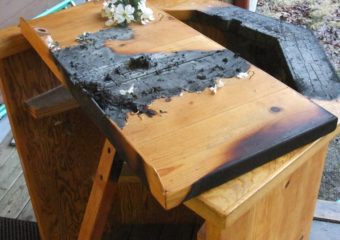
remains of the charred pulpit from Tuesday's suspicious fire at Chapel by the Lake. (Photo by Rosemarie Alexander/KTOO)
Remains of the charred pulpit from Tuesday’s suspicious fire at Chapel by the Lake. (Photo by Rosemarie Alexander/KTOO)

The church still smells a bit smoky, but thanks to members, Cub Scouts and the Boy Scouts, the result of a fire at Chapel by the Lake has been mostly cleaned up.

“It could have been much, much, much worse,” says the Rev. Matt Royston.

He’s thankful the fire didn’t spread beyond the pulpit and a liturgical cloth. The pulpit was built by church members Elwood Reddekopp and Martin Johnson in the early 1970s for the main sanctuary.

Damage is estimated between $3,000 and $5,000. Royston says much of that cost will be cleanup.

“We sponsor the Boy Scout Troop 6 and Cub Scout Pack 6 here at the church and they showed up in force to help us clean up the sanctuary.  It was just wonderful that they did that,” he says.

Royston credits a Goldbelt Security officer for finding the fire at the Auke Lake church.  About 3 a.m. Tuesday, he saw lights on and entered the building. The heavy smell of smoke led him to the sanctuary and the smoldering pulpit. He called the fire department and put out the fire with an extinguisher.

Then he went next door to the parsonage and woke up Royston. Neither the family nor their dogs had heard anything. No fire alarm went off and the smoke did not reach the detectors in the high-ceilinged sanctuary.

“The fire appeared to be burning itself out.  It didn’t get hot enough to consume the pulpit,” Royston says.

Fire Marshal Dan Jager says the fire is suspicious, because investigators have not been able to find a heat source, or where the fire started. But he says it’s too early to call it arson.

“When you label it arson that’s a very specific case, that’s a very specific crime, and we don’t have anything right now saying absolutely it was an arson,” Jager says. “Not to minimize the incident, but to kind of emphasize that we don’t want to go mislabeling things, which could have an impact down the road with court proceedings or other legal issues.”

The building was locked at the time of the fire and the point of entry is not clear.

Juneau police investigators also consider the fire suspicious, but Lt. Dave Campbell says they have no suspects.

“There’s things that we look at. Obviously we do a premises check. We canvass the area inside and outside.  We look for things that are odd.  You know, ways we might be able to tie people to the incident. You talk to the people that found it, try to determine the window of when it occurred,” Campbell says.

Fire Marshal Jager says investigators hope the public might be able to fill in some of the gaps in information about the fire.

The public has been a huge help on fires in the past and we would really hope they would step forward if they have anything.

Church activities have not been interrupted since the small fire.

As for a pulpit for Sunday’s services?  Pastor Royston says a music stand will work just fine.

Alaska Dispatch buys Anchorage Daily News

The homepage of the Alaska Dispatch after the sale was announced.

The owner and publisher of the online news organization  Alaska Dispatch is purchasing the Anchorage Daily News for $34 million.

The ADN is Alaska’s largest daily newspaper and owned by The McClatchy Company, which publishes 29 other daily newspapers in 28 U.S. cities.

In a website release, McClatchy president and CEO Pat Talamante said the company was not looking to sell the Daily News, “but after Alaska Dispatch Publishing approached us, we saw advantages to local ownership in this case and opportunities for consolidation that would strengthen both news organizations.”

The Alaska Dispatch was formed in 2008 by former Anchorage Daily News reporters, including Tony Hopfinger. The next year, Alice Rogoff, former U.S. News and World Report chief financial officer, became majority owner.

Hopfinger is Alaska Dispatch executive editor and president.

“We’ve always been looking for ways to improve and expand journalism in Alaska and so this is an opportunity to produce a more comprehensive news product and to hopefully reach all corners of Alaska,” he said in an interview with KTOO.

While the two companies are merging, Hopfinger said the current focus will be on a smooth transition.

The Anchorage Daily News distinguished itself in Alaska journalism as the winner of a long-fought newspaper war with the Anchorage Times.  The Times was published by Robert Atwood, known for his efforts to move the state capital from Juneau.

In 1974, the two companies entered into a joint operating agreement in order to reduce costs.  Then in 1980, McClatchy purchased 80 percent of the ADN from editor and publisher Kay Fanning.

The Daily News was struggling financially at the time and the California-based company invested significant resources into its northernmost newspaper, constructing a new headquarters in Anchorage in 1986.  The Anchorage Times went out of business in 1992.

The Daily News won a Pulitzer Prize for public service reporting  in 1976 for its series on the influence of the Teamsters union in Alaska. In 1989, it won another Pulitzer for a series on alcohol and suicide in Alaska Native villages.

Hopfinger says the ADN will continue to be sold on the newsstand and by home delivery.

“We’re looking forward to just working with both teams to produce one journalism product. The paper will still be printed seven days a week,” he said. “You will see the two websites merged at some point.”

The Alaska Dispatch purchase of the Anchorage Daily News is expected to close in May. The deal includes the adn.com website and the newspaper’s building in Anchorage.

Once the merger is complete, the Alaska Dispatch plans to sell the Daily News building to GCI, which already leases space there for its television news operation, Denali Media. GCI Corporate Services Vice President David Morris said the company’s participation will “provide stability for the investment GCI has already made inside the building.”

The Dispatch and ADN will rent from GCI.

Site notifications
Update notification options
Subscribe to notifications