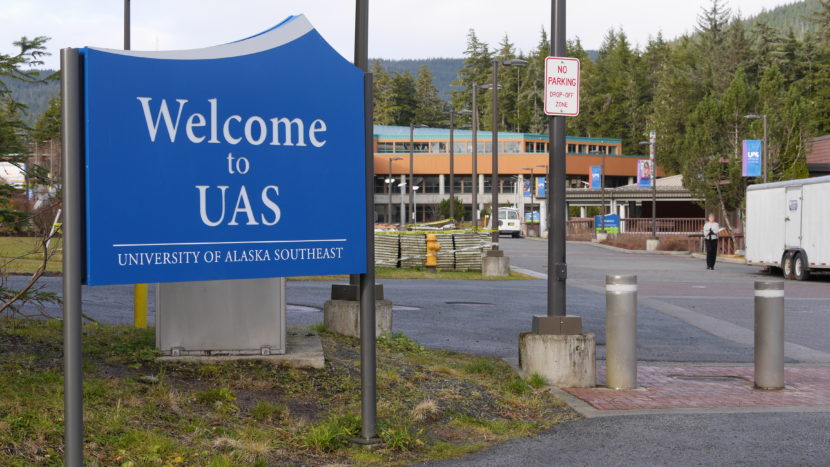
University of Alaska President Jim Johnsen delivers the State of the University Address at a Juneau Chamber of Commerce luncheon in Juneau on Feb. 16, 2017. (Photo by Skip Gray/360 North)
The head of Alaska’s public university system is potentially leaving the state to take over the helm of the University of Wisconsin System.
The UW system announced Tuesday that Johnsen was the sole finalist to become its president. Johnsen will go through multiple interviews next week for the job.
Johnsen’s possible departure from the University of Alaska system comes at a tumultuous time for UA. The university system is wrestling with another series of deep budget gaps driven by cuts to state funding, declining enrollment and the coronavirus pandemic.
In an email to UA students and employees on Tuesday, Johnsen wrote that he wasn’t looking for another job when he was nominated for the position in Wisconsin, “but the position aligns with my experience and skills as a university leader.”
“The opportunity to lead a larger university is an exciting prospect, and Madison is in very close proximity to our family,” Johnsen wrote.
Johnsen was named UA president in 2015. Under his leadership, he spearheaded efforts to consolidate the university system amid declining state funding. That effort was met with widespread pushback, and the UA Board of Regents tabled the idea last year after the governor walked back his budget veto. The governing body is expected to discuss a controversial option later this week to merge the University of Alaska Southeast into the system’s other universities.
The University of Wisconsin System is a constellation of 26 campuses. It’s one of the country’s largest systems of public higher education.
In its announcement Tuesday, the Wisconsin system said its presidential search committee unanimously agreed on Johnsen as its first choice as a finalist, describing him as a strong, qualified and collaborative leader. It also said the pandemic posed “unanticipated and unprecedented circumstances and obstacles” to the search.
“Several candidates removed their names from consideration near the end of the process, with some expressing concern over being named publicly as a finalist during the pandemic,” the announcement said.
Johnsen wrote that he will be in discussions next week with the Wisconsin committee and the university community, and expects the outcome of those talks by mid-June.
The Providence Transitional Care Center shares a campus with Providence Extended Care in East Anchorage. It was quiet outside of the campus on Monday, June 1, 2020, with a security vehicle staged at the entrance. (Tegan Hanlon/Alaska Public Media)
Update, 9:00 a.m. Tuesday:
The number of coronavirus cases at the Providence Transitional Care Center in Anchorage climbed by five on Monday, to 17, as test results continue to come back.
It’s the largest reported cluster of coronavirus cases at a single facility in Alaska, according to the state health department.
The Providence cases are part of a weekend spike of positive tests.
How the virus entered the transitional care center is under investigation, said Dr. Michael Bernstein, chief medical officer for Providence Health & Services Alaska, the operator of the facility.
“We became aware of the infection when, last Thursday, one of the residents there developed a fever and cough and was tested for COVID,” Bernstein said in a call with reporters on Monday. “The test returned on Friday as positive.”
Bernstein said the patient likely acquired the coronavirus at the transitional care center based on how long the individual was staying there.
“At this point,” he said, “we don’t have information about how that resident may have acquired the virus.”
The transitional center can serve up to 49 patients. As of Friday, it had 48. They range in age and stay there as a midway point between hospitalization and going home or to an assisted-living facility, Bernstein said. Some may be recovering from surgeries or serious illness. They often stay for 40 to 50 days.
Friday’s positive case prompted Providence to have all of the transitional center’s patients and staff tested for the virus. It’s also testing all of the residents and employees at Providence Extended Care, a long-term care facility that serves about 100 people, mostly seniors.
The facilities share the same campus in East Anchorage. But there are “very, very few” employees who travel between the two operations, Bernstein said.
“We’re testing the whole campus because the population is all one that we would consider as susceptible or vulnerable,” he said.
By Monday afternoon, more than 400 patients, residents and employees were tested for the virus, with “a relatively small number” of results still pending, Bernstein said.
None of the tests from Providence Extended Care had come back positive, he said.
The 17 positive tests from the transitional center include both patients and employees. Bernstein declined to break down the number further citing privacy concerns.
He said one person has required hospitalization so far.
On Monday afternoon, it was quiet outside of the campus — a group of buildings off Boniface Parkway. A security vehicle was parked near the entrance.
Bernstein said the transitional center enacted strict procedures in March in an effort to keep the virus out, including universal masking and closing to visitors. That ban will remain in place on the campus.
“The one exception would be in an end-of-life situation,” he said.
He noted that in various surveys the transitional center has been “exemplary in their infection prevention techniques.” But, he added: “This virus is really tough.”
The coronavirus has been shown to spread in similar settings, where people live in a confined space, and the virus is particularly deadly among older people and those with underlying medical conditions. The New York Times reported last month that one-third of all U.S. coronavirus deaths were tied to long-term care facilities for older adults.
On the Anchorage campus, patients who have tested positive for the virus are staying in their rooms, Bernstein said, and the workers who test positive are staying home.
“We do everything we can to avoid having staff care for both a COVID and non-COVID patient during the same working shift,” he said.
There will be a second round of testing completed later this week, Bernstein said.
The new coronavirus cases at the transitional center will likely be reported in the state’s data on Tuesday. The state reports positive cases daily based on the prior day’s numbers.
On Monday, the state reported seven new coronavirus cases among Alaskans. Three are from Anchorage and four are from the Kenai Peninsula Borough. None are linked to the transitional center, according to the health department.
A day earlier, the state announced Alaska’s largest daily case increase: 27, with 11 of them tied to Providence.
The latest coronavirus counts come just over a week after the state ended capacity restrictions on businesses, and days before the state plans to lift its 14-day requirement for travelers and require testing instead.
Update, 2:15 p.m.Monday:
The number of coronavirus cases at the Providence Transitional Care Center has climbed to 17 as more test results come back, according to Dr. Michael Bernstein, the regional chief medical officer for Providence Health & Services Alaska, the operator of the center.
Bernstein said all patients and workers are being tested for the virus, both at the transitional care center and at the long-term facility it shares a campus in East Anchorage with, Providence Extended Care.
It’s not clear how many of the seven new cases announced by the state on Monday are tied to the transitional care center. Alaska Public Media has asked the state health department, and will update this story as more information becomes available.
The latest coronavirus counts come just over a week after the state ended capacity restrictions on businesses, and days before the state plans to lift its 14-day quarantine requirement for travelers, and require testing instead.
The Providence Transitional Care Center said Monday it’s still waiting for test results to come back for some of its caregivers. The facility remains closed to visitors, “but exceptions will be made for people who are coming to visit a loved one at the end of life,” according to a message on the website for Providence Health & Services Alaska.
Of the seven new cases reported Monday, the state says four of the Alaskans are from the Kenai Peninsula Borough and three are from the Municipality of Anchorage. The total number of Alaskans who have tested positive for the virus is now 467, with 368 of them considered recovered.
The state on Monday reported no new hospitalizations or deaths, and the number of nonresident cases in Alaska remained 21. More than 54,000 tests have been completed.
This is a developing story and will be updated when new information becomes available.
Hilcorp’s Innovation drilling rig on the North Slope. (Photo courtesy of Hilcorp)
State regulators have fined Hilcorp Alaska $30,000 for meter-related violations at an oil and gas field on the Kenai Peninsula. They cited the company’s history of violations as a factor behind the penalty.
The Alaska Oil and Gas Conservation Commission wrote in its May 14 order that Hilcorp failed to submit required meter performance reports for the Beaver Creek unit in the Kenai National Wildlife Refuge. Those reports detail how accurately a meter measures the volume of oil or gas leaving a field. The state uses those volumes to calculate royalties that Hilcorp pays to the government.
Hilcorp’s violation stems from an agreement with the commission in October. The commission allowed for new metering equipment, but required the monthly performance reports.
“Oil custody transfer meters are essentially the state’s cash register,” Jeremy Price, chair of the commission, said in a statement. “AOGCC strives to ensure the till is always accurate.”
In setting the penalty, the commission said, it considered Hilcorp’s “lack of good faith in its attempts to comply with the imposed conditions, its history of regulatory noncompliance and need to deter similar behavior.”
“While improvements in Hilcorp’s compliance can be shown in the past 2 years, the recurrence of failing to account for approval conditions imposed by AOGCC calls into question the effectiveness of corrective actions implemented in responses to past enforcement actions,” the commission’s order said.
The commission said Hilcorp had similar, recent violations in Alaska at the Granite Point and Trading Bay units in Cook Inlet.
It provided Hilcorp with notice of the proposed fine in March.
Hilcorp Alaska spokesman Luke Miller said that when the company received the notice, it took corrective steps and provided the required reports. Hilcorp has not disputed the commission’s findings.
“We also took measures to ensure the quality control of our recordkeeping related to this issue,” Miller said in a statement. “We will continue to work closely with AOGCC to ensure compliant, safe and responsible operations.”
The commission says it has received the data and a corrective action report from Hilcorp. The information indicates the oil metering equipment is giving accurate readings.
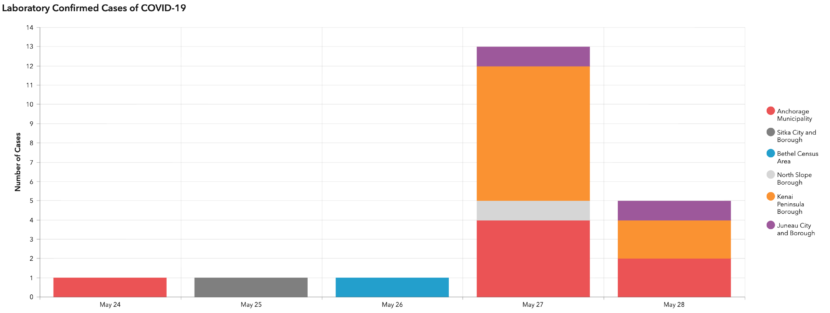
Screenshot from the Alaska Department of Health and Social Services COVID-19 dashboard, showing this week’s cases, taken on May 29, 2020. (Data from https://coronavirus-response-alaska-dhss.hub.arcgis.com/)
There are six new coronavirus cases in Alaska from Thursday, following a spike in positive tests the day before, according to the state Department of Health and Social Services.
The latest cases include two Alaskans from Anchorage, one from Juneau, one from Homer and one from Soldotna. The sixth case is a nonresident described as a visitor in the Kenai Peninsula Borough, according to state data.
Gov. Mike Dunleavy lifted restrictions on businesses last week, and is expected to make an announcement Friday evening about the required two-week quarantine for people traveling into Alaska. The requirement is set to expire on Tuesday.
In total, 430 Alaskans have tested positive for the virus so far, and 367 have recovered. There have been 47 hospitalizations and 10 deaths.
The number of nonresidents who have tested positive in Alaska now totals 18. A dozen of them work for the seafood industry and one works in mining. Two are pilots and three are visitors, the state reports.
Nearly 50,000 coronavirus tests have been administered in the state, according to the health department.
The department reports new coronavirus cases by noon daily based on the prior day’s data.
The state reported 13 new coronavirus cases from Wednesday. It was the highest daily increase in more than a month and prompted Alaska’s chief medical officer, Dr. Anne Zink, to caution Alaskans to keep their social circles small.
“#Alaska our risk is going up,” she posted on Twitter on Thursday.
After more than month of single digits or no cases- we hit double digits today with 13 cases, no clear link. These are concerning for on going community transmission. #Alaska our risk is going up. Keep your circles small and keep the lid on #COVID19
University of Alaska Southeast’s Juneau campus on Tuesday, Nov. 15, 2016. (Photo by Quinton Chandler/KTOO)
The University of Alaska Board of Regents will meet next week to consider how to close a gaping budget hole driven by cuts to state funding, declining student enrollment and the coronavirus pandemic.
Options on the table include deploying savings to fill part of the gap, and deleting or reducing about 50 degree and certificate programs. Plus, there’s a controversial proposal to merge the University of Alaska Southeast into one, or both, of the system’s other two universities.
“The university is facing immediate and significant financial headwinds,” UA President Jim Johnsen said in a call with reporters Thursday.
For years, UA has grappled with reduced state funding and lost tuition dollars as enrollment declines. Then came the coronavirus pandemic. It cut into the finances of the already-strained university system.
Across the country, universities are wrestling with plunging revenues and rising expenses linked to the pandemic. The virus forced campuses to quickly move classes online. Events were canceled, and housing and dining fees returned. In some cases, universities helped pay for students to move home.
At UA, the coronavirus is projected to cause a nearly $25 million budget shortfall in the fiscal year that starts July 1, Johnsen said. He’s proposing that regents use one-time funds to fill it.
“These are funds that have been saved through belt-tightening over the last year,” he said.
Apart from the pandemic, UA was already preparing for a $25 million cut to its state funding in the upcoming fiscal year. It’s restructuring its debt, planning for furloughs, laying off staff, suspending pay increases and cutting administrative costs, Johnsen said. There’s also the proposal to reduce or eliminate the dozens of academic programs to save about $4.5 million.
Still, Johnsen said, that’s not enough to eliminate mounting budget issues.
UA is expecting another budget shortfall in the fiscal year that starts in July 2021. The budget gap could range from about $11 million to about $36 million, Johnsen said. The total depends, in part, on enrollment and what costs are eliminated this year.
That’s where the proposed merger comes in.
It’s the largest of the cost-cutting options for regents to consider next week.
“We’ve exhausted the little stuff,” Johnsen said. “We need to start looking at larger reductions.”
It would mean merging UAS into the University of Alaska Anchorage or the University of Alaska Fairbanks or both. UAS includes campuses in Juneau, Ketchikan and Sitka. It’s the smallest of the three universities. And, about about half of the credits from UAS are delivered online, Johnsen said.
“They’re already not on the campus every day, so they’ve made the transition,” he said.
Johnsen said a merger could potentially save $15 million or more. He said it would not mean closing campuses.
But the proposal faces opposition.
Heather Batchelder is a professor at UAS and the chair of the system-wide Faculty Alliance. She said faculty members were blindsided by the proposed merger, and the alliance does not support it.
“In order to meet the diverse needs of our state, we need to keep our university in our capital city,” she said.
Batchelder said talk of a merger has created another layer of instability for students and employees, some who are still reeling from last summer’s chaotic budget battle.
Facing an unprecedented, $135 million veto from Gov. Mike Dunleavy last year, regents considered consolidating the entire university system. The faculty alliance and others opposed the proposal, and it was later tabled after regents entered into a compact with Dunleavy, reducing the veto to a $70 million cut over three years.
Batchelder said it feels like “déjà vu” to confront another proposal to move away from a three-university system.
“There’s been so much uncertainty, and then the pandemic on top of that. So we are exhausted,” she said. “But we are not defeated. And we will not give up and we will never stop fighting for our three separately-accredited universities.”
UA regents are taking public comment on the options by email at ua-bor@alaska.edu. Starting at 4 p.m. next Tuesday, June 2, people can also call in to provide comment. The regents will meet the following Thursday and Friday. They’re expected to approve a budget for the upcoming fiscal year, deciding whether to cut the academic programs and tap reserve funds to cover this year’s deficit. They’re also expected to weigh-in on the proposed merger.
Editor’s note: An earlier version of this story said that public comments would be taken by phone starting at 3 p.m. on June 2. The correct time is 4 p.m. The last paragraph of this story has been corrected.
BP’s office building in Anchorage. (Photo by Elizabeth Harball/Alaska’s Energy Desk)
Oil and gas company BP is using a new online platform to track its out-of-state workers’ health. And now, it’s offering the code to the program to other organizations for free.
“It could be applicable to any other industry,” said Jerome Leveque, a data manager at BP Alaska. “It’s not really limited to oil and gas. So, you know, fisheries or tourism or anybody who’s traveling in state or coming from out of state could use this.”
The coronavirus pandemic has forced companies to do business differently and, in some cases, monitor their employees’ health closer than ever.
BP brings hundreds of workers from out of state to Alaska’s North Slope for their shifts at the remote oil fields. But first, the workers must quarantine for two weeks at Anchorage hotels, said BP Alaska spokeswoman Megan Baldino.
That started about two months ago, and prompted the question: What’s the best way to monitor those workers for illness?
Jeremy Zidek, a spokesman for the state Department of Homeland Security and Emergency Management, said companies bringing out-of-state workers to Alaska need to document their plan for screening employees, but they’re given latitude about what measures to use.
BP’s process started with a lot of paper. At first, Leveque said, “everybody was using paper and our medical provider, Beacon, was going door-to-door and filling out papers and taking temperatures twice a day.”
Leveque said BP wanted to find a more efficient way that included less human interaction. So it hired a software company called Resource Data to create a digital hub for its workers. The new platform launched earlier this month.
Now, Leveque said, workers can log in to the program on their cell phones, computers or tablets. Twice a day, while in quarantine, they take their temperatures and type in the results. They check the boxes of any symptoms they’re experiencing.
The platform relies on honesty and the Internet. Leveque said it has sped up the workflow. The program also automatically alerts the company’s medical provider of fevers and other health concerns like a cough or muscle aches.
“We send an immediate text message and alert emails to the medical support teams,” Leveque said. “So we can really deal with any symptoms as rapidly as one can.”
Using the program, BP workers also record their quarantine locations and contact information. The company posts coronavirus-related messages and news. There’s another portal for the screening questions they have to answer before they fly to Prudhoe Bay.
According to Baldino, roughly 50 BP workers are in quarantine on any given day before flying north. BP’s Prudhoe Bay workforce totals about 1,000 employees, and nearly 40% live out of state. So far, BP has reported one of its employees at Prudhoe Bay testing positive for the coronavirus. That happened in late March.
Baldino said employees can still opt to use paper forms to fill out their health information instead of the software. As of last week, workers had filled out more than 700 online quarantine logs, Leveque said.
Baldino said BP expects to use the new program “for the foreseeable future.” BP, however, is also in the process of selling its entire Alaska business to Hilcorp and exiting the state. The company has said it plans to close the deal by the end of next month.
Leveque said he hopes other companies, big and small, can adapt the online program to monitor for illness as the pandemic continues.
Close
Update notification options
Subscribe to notifications
Subscribe
Get notifications about news related to the topics you care about. You can unsubscribe anytime.