Tegan Hanlon, Alaska Public Media

Most travelers to Alaska are choosing COVID-19 testing over quarantine

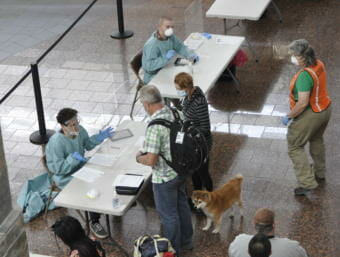
A health screening for travelers at Anchorage's airport
Travelers arriving from out of state go through the health screening process at Ted Stevens Anchorage International Airport on June 22, 2020. (Liz Ruskin/Alaska Public Media)

Update — On July 28, 2020, Alaska Gov. Mike Dunleavy announced that starting August 11th, nonresident travelers to the state will be required to have a negative COVID-19 test.

Most people who took a flight to Alaska from out of state last week opted to bypass the two-week quarantine and undergo COVID-19 testing instead, according to state health officials.

A total of 12,044 people got screened at eight airports during the second week of the state’s revised travel rules, said Tessa Walker Linderman, the state’s port of entry coordinator for its COVID-19 response.

Here’s how many chose to test vs. quarantine, she said:

  • 4,894 people opted to get swabbed for the virus at the airport and quarantine themselves until their test results arrived.
  • 4,237 brought proof of a negative test result with them. (Travelers must take the test within 72 hours of departure to avoid testing at the airport.)
  • 1,953 said they would quarantine for two weeks in Alaska.
  • The rest either were outside of Alaska for less than 24 hours, are critical infrastructure workers following their companies’ plans or had proof that they’ve recovered from the virus.
  • Walker Linderman said 13 passengers who got swabbed for the virus at the airport tested positive for the disease.

She said the turnaround time for results from airport tests is improving.

In the first week of the state’s new set-up, some travelers reported waiting five days or more to get their results back. That meant they had to quarantine longer in Alaska — an unexpected delay for tourists and some Alaskans who said they couldn’t return to their jobs when they expected to.

Now, Walker Linderman said, “We really are seeing turnaround time within that 72-hour window.”

Walker Linderman said the state will keep working with its contractors at airports to smooth the screening and testing process. They expect the number of travelers to continue to rise this summer as word of the new policy spreads, and as other states continue to reopen.

University of Alaska president will resign amid blowback from Wisconsin job search

University of Alaska President Jim Johnsen appears on an episode of Forum@360 in Juneau on April 3, 2018.
University of Alaska President Jim Johnsen appears on an episode of Forum@360 in Juneau on April 3, 2018. (Photo by Rashah McChesney/Alaska’s Energy Desk)

The leader of Alaska’s public university system is resigning from his job.

The announcement from the University of Alaska’s board of regents follows blowback around President Jim Johnsen’s unsuccessful effort to get a new job leading Wisconsin’s university system.

Sheri Buretta, the chair of the board, announced Johnsen’s resignation during an emergency meeting, following a 45-minute executive session.
“The decision regarding a change in leadership was mutual and was made after considerable reflection by the board,” she said.

Johnsen was selected as president of Alaska’s public university system in 2015. He led it through years of budget cuts imposed by state lawmakers as Alaska experienced a sharp decline in oil revenue.

Earlier this month, Johnsen had been named as the only finalist for the University of Wisconsin system’s presidency. But he withdrew from consideration following pushback from Wisconsin faculty and students.

This is a breaking news story and will be updated as new information becomes available. 

Fixes underway to COVID-19 testing at Alaska’s airports, after long waits for results

Travelers disembark a plane from Seattle at Ted Stevens Anchorage International Airport
Travelers disembark a plane from Seattle at Ted Stevens Anchorage International Airport on Friday, June 5, 2020. The airport was preparing for major changes to the state’s travel policy starting Saturday, June 6. (Tegan Hanlon/Alaska Public Media)

Dale Reid and his wife, Janice, got tested for COVID-19 at Ted Stevens Anchorage International Airport on June 6, the first day it became an option for travelers.

Reid, 75, had surgery in Arizona. And they were on their way home to Juneau. Reid said the testing process went well. But then, days passed and they didn’t receive their results.

“We never heard,” he said. “So we started calling. And for a while it was a full mailbox.”

Reid said it took about a week for his wife to get her result back. It was negative. By Thursday, Reid said he still hadn’t gotten his result. He tested again in Juneau.

Reid isn’t alone. Some travelers who tested at the airport within the first week of the new system reported waiting at least six or seven days for their results. By Thursday, 60-year-old Lynn Carter, from Oregon, said she still hadn’t gotten the result from her test on June 8. She had quickly booked a flight to Alaska after her teenage grandson died in a car accident, and she had no time to test in Oregon.

Alaska health officials acknowledge that the testing system had issues in the beginning that led to some delays and confusion. But they say fixes are underway, and the process should be smoother and faster now.
“Ideally, we would like for all travelers to have their results within 72 hours. And, in most cases, that is what we’re seeing,” said Tessa Walker Linderman, a nurse consultant at Alaska’s Division of Public Health and the state’s port of entry coordinator for its COVID-19 response.

Signs at the Ted Stevens Anchorage International Airport direct travelers where to go
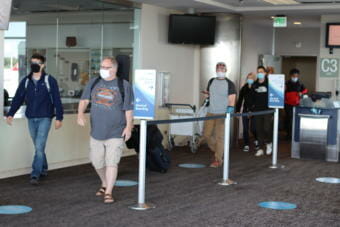
Signs at the Ted Stevens Anchorage International Airport direct travelers where to go depending whether they have their declaration form filled out and whether they have proof of a negative result from a test for COVID-19. (Tegan Hanlon/Alaska Public Media)

“However, there are exceptions where we’re seeing three to five to seven days for the result’s turnaround,” Walker Linderman said in an interview Wednesday. “A lot of that, I would just say, is just the growing pains of standing up a process really fast and having thousands of people coming in and trying to get everything going really quickly.”

Gov. Mike Dunleavy announced on May 29 that the state would provide alternatives to the mandatory, two-week quarantine for travelers arriving in Alaska. The changes went into place about a week later.

“Since June 2, I have been working around-the-clock to get all the airports up and running,” Walker Linderman said.

People traveling to Alaska from out of state can now bring proof of a negative result from a test taken within 72 hours of their departure. Or, they can get tested at the airport and quarantine until they get their results.

Setting up the system involved hiring contractors and, some of them, then had to hire dozens of new employees. It also involved creating paper forms for travelers to fill out.

The testing process includes transferring a lot of data, and some issues sparked there.

“Sometimes it’s just a matter of, there’s somebody whose handwriting wasn’t very good,” Walker Linderman said. “And so we input their email address wrong or we couldn’t read something on their form.”

The contractors have to send the tests to a lab. And then the results are sent back to the contractors who notify the travelers.

“We are working on adding more people to be able to process things at the lab on our end and then also equipping our contractors with enough resources,” Walker Linderman said.

Also, the testing site at the Anchorage airport — the busiest location — has moved to online forms, according to Micky Boyer, the operations manager for Capstone Family Medicine, the company running the health screenings there.

Boyer said he expects results to come back quicker as the online forms are used more often, coordination improves and employees settle into their new jobs. Capstone recently had to hire about 160 new workers to staff the airport.

“Getting all those people trained up and settled in and focused was part of the challenge,” he said. “We’ve made tremendous progress in the last week and a half.”

During the first week of testing, Walker Linderman said, about 13,000 travelers went through the new health screenings. And, about 30% of them opted for airport testing.

Walker Linderman said Thursday she did not have the number of passengers who decided to quarantine or the number who brought a negative test result with them. She said the state will have those totals from the second week of testing soon.

Boyer said, generally, Capstone is now telling travelers testing at the Anchorage airport to expect their results in three to five days.

“I think that we’re getting them out sooner now,” he said on Thursday. “So we will probably be able to tell them something different shortly. But I don’t want to give them false expectations.”

Both Boyer and Walker Linderman advised travelers to try to get tested before their flights. They said it’s still the fastest way to move through Alaska’s new process.

Alaska’s active COVID-19 case count hits new high

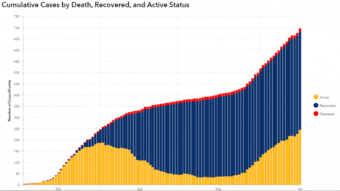
The number of recovered and active COVID-19 cases among Alaskans, as well as the number of deaths. (Screenshot taken June 17, 2020, of a COVID-19 chart the Alaska Department of Health and Social Services)

Another 20 Alaskans and five nonresidents have tested positive for COVID-19, the state health department reported Wednesday.

There’s now a total of 246 Alaskans who have been diagnosed with the disease and haven’t recovered yet — the highest number since the pandemic began. The data is based on numbers through the end of the day Tuesday.
The latest case count for Alaska follows a series of double-digit, daily increases in positive tests since late last month. Gov. Mike Dunleavy has said a higher number of cases is expected as Alaska reopens. He said the state is tracking an array of data including hospital capacity.

Some healthcare workers, however, have raised concerns that some Alaskans have developed “coronavirus fatigue” and are not social distancing or taking other precautions. And they worry that if behavior doesn’t change, the disease’s spread will only get worse.


The 20 newly-diagnosed Alaskans are from communities across the state, according to the health department’s data. Six are from the Fairbanks area, two are from Anchorage and two are from Palmer. There is also one Alaskan each from Homer, Soldotna, Chugiak, Eagle River, Wrangell, the North Slope Borough, Sitka, Kodiak, Juneau and Ketchikan.

The Fairbanks cases are the first COVID-19 cases reported for Fort Wainwright, said the state health department. A family tested positive who live on base, according to military leaders.

Ketchikan emergency officials on Wednesday also alerted the public about potential “wide community spread” after a person reportedly broke quarantine after their arrival to town.


More Pogo mine workers test positive

The new nonresident cases include one seafood worker in the Ketchikan Gateway Borough and one person in the Nome Census area, who the state lists as visiting Alaska for “other” purposes. The other three work at the Pogo gold mine, about 40 miles northeast of Delta Junction, confirmed owner Northern Star Resources in a statement Wednesday.

The company said two employees tested positive three days after beginning their shift at the mine. Seven close contacts were identified and transported offsite. Two of them also tested positive for the virus.

Of the four employees infected, three are from out of sate, according to the company’s statement. But the infection isn’t related to travel, it said.

“To help minimize the spread of COVID-19, Northern Star has provided non-residents incentives to remain in the state during their rostered leave,” the statement said. “Affected employees have not left the state in more than 12 weeks.”

The employees are isolating offsite and have mild symptoms. In April, another positive case at Pogo was announced.


Fourth round of testing begins at Providence

Meanwhile, Providence Health & Services Alaska will complete a fourth round of testing at its East Anchorage campus, the site of the state’s largest COVID-19 outbreak.

Providence spokesman Mikal Canfield said testing would begin Wednesday or Thursday.

By Wednesday afternoon, a total of 19 residents and 27 caregivers at the Providence Transitional Care Center had tested positive for the virus. Four residents were hospitalized. Two have died.

Also, one caregiver is infected at the facility the center shares a campus with, Providence Extended Care.

Statewide, the number of positive COVID-19 tests has reached 82 among nonresidents and 696 among Alaskans, about two-thirds of whom are considered recovered.

The state also reported one new hospitalization tied to COVID-19. Since March, 55 Alaskans have been hospitalized with the disease, with 12 deaths. No new deaths were reported from Tuesday.

The state says 77,709 tests have now been administered in Alaska —  up about 1,500 from the day before. The average percentage of positive tests for the previous three days is 0.48%, according to the state’s data.

A total of 29 of the state’s 350 ventilators are in use, along with 1,000 of its 1,800 inpatient hospital beds.


This story has been updated with more information about individual cases. 

Health officials worry Alaskans have ‘coronavirus fatigue’ as active cases reach new high


This is not the time to let your guard down, public health officials say.

The number of active COVID-19 cases in Alaska reached a new high this week since the state recorded its first infection in mid-March. Public health officials say they worry that some residents have developed fatigue about the contagious disease and are not social distancing or taking other precautions.

“If you look at the graph of cases, it looks a lot like it did in March, so that’s quite concerning,” said Dr. Tom Hennessy, an infectious disease epidemiologist and affiliate faculty member at the University of Alaska Anchorage.

Following an initial spike in cases, the state and local governments put restrictions in place to slow the spread of the disease. And the number of new COVID-19 cases began dropping in April and stayed low for most of May, as businesses closed, many people shifted to working from home and school went online. Then, in late May, the number of cases in Alaska started to climb again.

Gov. Mike Dunleavy says the rising cases are no surprise with Alaska reopening and boosting its testing. He said the state is closely watching hospital capacity and the availability of medical supplies.

“The more we open up and mix, it’s just the way it is,” Dunleavy said on Wednesday. “So far, nothing unusual is occurring.”

Alaska is among more than a dozen states that, since the start of June, have recorded their highest seven-day average of new coronavirus cases, The Washington Post reported.

The increase in cases in Alaska is partly driven by several significant outbreaks: A long-term care facility in Anchorage, a seafood plant in Whittier, the Tustumena state ferry. Meanwhile, the Kenai Peninsula — marketed as Alaska’s playground — has become a new virus hotspot. And the disease continues to creep into remote Alaska communities, with the first cases recently recorded in Kotzebue, Wrangell, Haines and King Cove. The number of nonresidents testing positive in Alaska also continues to grow.

Dr. Keri Gardner, chief medical officer at Alaska Regional Hospital, said the recent holiday weekend also likely contributed to the increase in cases. The timing matches up, she said. Most people who are going to show symptoms have developed them by about a week after exposure to the virus.

“We’re seeing an increase in a positive number of cases consistent with what you would expect after Memorial Day weekend,” Gardner said. “Which is a big gathering time.”

Still, Gardner said, she feels like “Alaska is one of the safest places to be right now.” That’s because Alaska continues to have one of the country’s lowest rates of cases per capita, she said.

Gardner said she’s also watching the percent of tests that are coming back positive and the number of hospital beds and ventilators in Alaska. The state reported Thursday that more than 800 hospital beds and 320 ventilators were available.

“The number of hospitalizations and deaths within the state are still really low, and that’s a great thing,” Gardner said.

But that doesn’t mean it’s time to become complacent, she said. She worries that some Alaskans have developed “coronavirus fatigue.”

“People are mingling more and probably being less strict with masking, social distancing and possibly even with sanitization,” she said. “We are not out of the woods.”

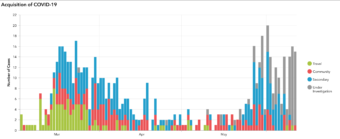
Natasha Pineda, director of the Anchorage Health Department, said there’s a worrisome shift in how Alaskans are becoming infected. Back in March, it was often because of travel. Now, it’s more often what epidemiologists call “community spread.”

Screenshot from the Department of Health and Social Services dashboard, taken June 12, 2020, showing how cases of COVID-19 in Alaska were acquired.

“That means we can’t tie the acquisition of the case to travel or some specific location,” she said. “And that’s concerning because it means that the virus itself is present in the community and no one is going to know where it’s present because a lot of people may be asymptomatic carriers.”

While Pineda is also tracking hospital capacity, she calls it more of a “lagging indicator.”

“You’re not going to see stress on that system until we’re farther along down the line of increasing cases,” she said. “What I’m seeing as pressure on the system already is being able to interview all cases.”

Teams of “contact tracers” are tasked with finding the close contacts of people infected with COVID-19, and alerting them of their exposure. This week, the team in Anchorage couldn’t get to all of the new cases, and had to call in back-up from the state and the federal Arctic Investigations Program, Pineda said.

The Kenai Peninsula also needed help. In recent weeks, state health authorities have enlisted workers from other parts of Alaska to track and monitor the close contacts of sick people on the peninsula.

That could become a problem, Pineda said.

“That starts to be concerning if we exceed our capacity and then the state exceeds their capacity,” she said. “The strategy of using contact tracing, monitoring and investigation and testing to maintain control over virus spread in the community goes away. That would be problematic.”

Pineda reiterated that Alaskans should keep their social circle small, keep their distance from others and wear masks in public, even without government-level restrictions. She said she worries about the disease becoming out of control if people don’t follow those recommendations.

“I’m absolutely concerned about exponential growth,” she said.

Hennessy, from UAA, said he’d like to see a more messaging about the continued presence of COVID-19. When he worked in Africa during the Ebola outbreak, he said, warning signs about the disease were posted everywhere. They described the symptoms and who to call for medical care.

“And I’m not seeing that in Alaska. I’m not seeing that in Anchorage,” he said. “We’re in the middle of a pandemic and people are dying and we run the risk of blowing up our healthcare system. And I just feel we need more urgency and messaging and people taking it more seriously.”

Hennessy said it would also help if more people wore masks, and if doing so was more normalized. More than 150 Alaska health workers recently signed a letter to Dunleavy encouraging him to mandate the use of masks in businesses where 6-foot distancing isn’t realistic.

Dunleavy said Wednesday that he had no plans to require face coverings.

“I think we do best when we give Alaskans information, ask them to use their best judgement in the situations that we’re in and I think we’re going to get better outcomes there,” he said.

In March, he said, the state had to quickly implement restrictions to keep the virus at bay because of projections of hundreds of thousands of infections. The mandates kept the virus under control, he said, but also had a big impact on the economy.

Now, as the state learns more about COVID-19, it has changed its approach, Dunleavy said.

“We can’t run away from this forever. It’s here. It’s on this planet. It’s circling the globe,” he said.

Dunleavy said the state will start having a “different conversation” if intensive-care beds fill up or if more and more clusters of cases appear.

Alaska superior court judge orders state to correct its summary of the oil-tax initiative

Anchorage attorney Robin Brena sits at a meeting of the citizens initiative campaign to raise taxes on Alaska’s largest oil producers on Thursday, January 16, 2020. (Photo by Nat Herz / Alaska’s Energy Desk)

An Alaska superior court judge has ruled this week that the state must correct part of its summary for a ballot initiative that would raise taxes on the state’s largest oil fields.

Judge William Morse sided with the backers of the initiative and wrote in an 18-page order that the summary provided by Lt. Gov. Kevin Meyer was not impartial, as required by state law. Morse ordered that Meyer delete the problematic sentence from the summary.

That sentence had to do with oil producers’ tax filings for the state’s three largest oil fields: Prudhoe Bay, Kuparuk and Alpine.

The group backing the initiative, often referred to as Ballot Measure 1, says it wants tax filings made public so Alaskans can see producers’ profits, revenues and costs for the fields.

Meyer’s summary of the initiative says — if it became law — the filings would be subject to the state’s normal public records act process. The initiative’s backers objected to that description. They say it’s not the same because the state could decide to keep some of the information confidential through the process.

In his order, Morse said that for now the most important goal is to allow the initiative’s backers to present their vision of transparency and taxation to the voters. He said Meyer placed “his finger on the scales” when he stated the provision did not mean what its backers say they intended.

“By siding with the possibility of confidentiality Meyer has engaged in partisan suasion,” Morse said. “That is improper.”

In a statement Wednesday, the Alaska Department of Law said it was disappointed the court “failed to see the straightforward accuracy” of the sentence.

“It is the State’s position that whether any information would ultimately be withheld under another existing exception or under the privacy clause of the Alaska Constitution are questions for implementation and not addressed in the summary one way or the other,” the statement said.

Initiative chair Robin Brena said in a statement that it was unfortunate the group had to bring a lawsuit to get Meyer “to fulfill his duty to provide a true and impartial summary” of the initiative.

The initiative will appear on the Nov. 3 general election ballot. The initiative group is also facing a lawsuit from industry trade groups.

Site notifications
Update notification options
Subscribe to notifications