Tegan Hanlon, Alaska Public Media

Alaska judge dismisses lawsuit against backers of oil tax initiative

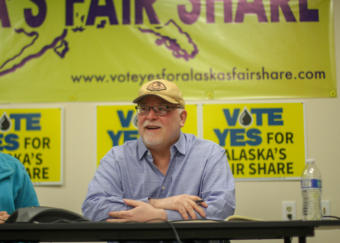
Anchorage attorney Robin Brena sits at a meeting of the citizens initiative campaign to raise taxes on Alaska’s largest oil producers on Thursday, January 16, 2020. (Photo by Nat Herz / Alaska’s Energy Desk)

An Alaska judge on Thursday dismissed a lawsuit against the backers of a ballot initiative that would raise taxes on the state’s three largest oil fields.

The Resource Development Council for Alaska and five other industry trade groups filed the lawsuit in April. They argued that people gathering signatures to get the initiative on the ballot were paid more than $1 per name, a violation of state law. They wanted those signatures tossed out.

The group backing the initiative, Vote Yes for Alaska’s Fair Share, denied the claim, and called on the court to dismiss the lawsuit.

On Thursday, Superior Court Judge Thomas Matthews did just that.

In a 30-page order, he said the state law that prohibits payment greater than $1 per signature is a “unconstitutional restriction on free speech” and could hinder signature gathering. He said disregarding the “technical violation” of the law would promote First Amendment rights by allowing voters to weigh-in on the initiative.

“By contrast, disregard of thousands of otherwise valid signatures operates like a sledgehammer on a mosquito,” he said. “It may do the job, but it wreaks havoc in the process.”

He asked: “Why should voters be disenfranchised because a circulator fails to meet technical statutory requirements?”

Initiative sponsor Robin Brena, an oil and gas attorney from Anchorage, applauded the judge’s decision in a statement on Thursday.

“Clearly our opposition decided they can’t win at the polls so they tried to get the courts to strip Alaskans of their right to vote for Alaska’s Fair Share,” he said.

Matt Singer, an attorney for the industry groups, said they would likely appeal the decision.

“We respectfully disagree with some of what the judge found,” he said.

The oil tax initiative is headed to Alaska’s statewide ballot in November. It would raise the minimum tax and eliminate oil tax credits for Alaska’s largest oil fields. It would also require oil companies to publicly report their revenues and costs from those fields.

So far, Brena’s group has reported raising about $660,000 in support of the initiative — a chunk of it from Brena himself with dozens of smaller donations from individuals.

The group OneAlaska — formed last year to oppose the initiative — has raised nearly $9.9 million, much of it from ExxonMobil, BP, ConocoPhillips and Hilcorp.

Legislative finance director named University of Alaska interim president

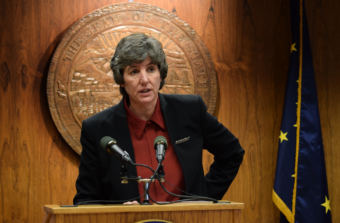
Pat Pitney, director of the Office of Management & Budget, fields questions from reporters at a press conference called by Gov. Bill Walker, Feb. 5, 2015. (Photo by Skip Gray/360 North)

The University of Alaska system has a new interim president: Pat Pitney, the director of the state Legislative Finance Division.

UA regents announced Tuesday that Pitney will serve as interim president as they search for someone to permanently fill the position left vacant when Jim Johnsen abruptly resigned last month.
Regents selected Pitney from a group of five finalists. They unanimously appointed her to lead the UA system during a meeting broadcast online late Tuesday afternoon.

“We have a lot of work ahead of us,” Pitney said during the meeting. “I will hit the ground running and very much look forward to working with all of you and addressing the challenges we have ahead. But we also have tremendous opportunity.”

Pitney previously worked as a vice chancellor of the University of Alaska Fairbanks, and as the state budget director under former Gov. Bill Walker.

Pitney will take over as UA interim president on Aug. 1, weeks before the start of fall semester.

Pitney acknowledged that budget challenges await, but “there’s a very positive way forward,” she said.

In recent years, UA has struggled with a series of cuts to its state funding and declining enrollment. It was dealt another financial blow by costs and revenue loss tied to the coronavirus pandemic. The universities also continue to discuss what classes will look like this fall as the number of COVID-19 cases in Alaska continues to rise.

Pitney has agreed to serve as interim president for at least one year and up to 18 months, according to UA.

The prior UA president, Jim Johnsen, resigned in late June amid escalating calls for him to step down following his interviews for a job in Wisconsin where he made controversial comments about diversity and the PFD.

COVID-19 infections in Alaska are on the rise among younger adults

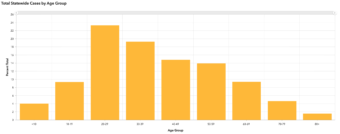
Graph showing that 23% of COVID-19 cases in Alaska are people in their 20s -- the largest share of any age group
Graph showing that 23% of COVID-19 cases in Alaska are people in their 20s — the largest share of any age group. (Data from Alaska Department of Health and Human Services)

The number of younger Alaskans infected with COVID-19 is on the rise, and it’s driving an increase in case numbers in the state, say public health officials.

“We are seeing many more young adults get COVID-19,” State Epidemiologist Joe McLaughlin said at a news conference Monday.

The trend is apparent in other states too where cases are rapidly rising, and public health officials are pleading with younger people to wear masks and social distance.

In Alaska, the number of known infections is highest among residents in their 20s, followed by those in their 30s and then 40s, according to state data.

Dr. McLaughlin said the concentration of cases in younger people likely explains the state’s low number of hospitalizations and deaths as infections increase. That’s the good news, he said.

But the bad news: The more pervasive COVID-19 becomes, the more likely it is to spread to more vulnerable Alaskans, such as those in long-term care facilities who are more likely to become critically ill or die from the virus.

McLaughlin said the state doesn’t know for sure what’s behind the increase in cases among younger Alaskans. It could be, he said, that they’re more likely to gather in groups, like at parties or other social venues, and less likely to wear masks or practice social distancing. State and Anchorage health officials have recently implicated bars as the center of some of the spread.

Also, McLaughlin said, younger people may be more likely to have jobs that require them to go into work, instead of doing their jobs from home.

“There’s an opportunity for transmission there,” he said.

McLaughlin renewed his calls for Alaskans to wear face masks when they’re around people they don’t live with, to practice social distancing and to wash their hands.

Also, he said, everyone needs to monitor for COVID-19 symptoms, and get tested even if they don’t feel especially sick.

“Because one of the things we’re seeing with COVID is many, many people just present with very mild symptoms,” he said. “They may have a mild sore throat or just feel a little bit achy. They may have a slight cough, and they may have a fever, but remember that only half of people with COVID actually develop a fever.”

On Tuesday, the state reported another 54 coronavirus cases: 40 of them Alaskans and 14 nonresidents. Of the newly-diagnosed Alaska residents, 70% are age 39 or younger.

Number of active COVID-19 infections among Alaskans tops 900 as case count again grows by dozens


The number of active COVID-19 infections among Alaskans now tops 900.

On Monday, the state reported another 60 Alaska residents have tested positive for the virus, plus 11 nonresidents.
One more person has become sick enough to require hospitalization. The state reported no new deaths.

Alaska’s latest COVID-19 case count follows Sunday’s report of more than 100 new infections — a daily record for the state.

The total number of COVID-19 cases among Alaskans since March now totals 1,539. That includes 620 considered recovered, 902 still active and 17 deaths. In addition, there have been 306 cases among nonresidents.

State officials have said they expected cases to rise as the economy reopens. But, the Anchorage Health Department is warning that employees tasked with investigating the infections are overwhelmed.

“We are in the middle of a significant COVID-19 case spike,” Anchorage Mayor Ethan Berkowitz said in a statement Monday. “Our contact tracing capacity has been overwhelmed, and we must defend our hospital capacity.”

Contact tracing is critical, Berkowtiz said, because it allows the city to track who has the virus so it can better contain it.

A majority of the new cases reported Monday were tied to Anchorage.

The new cases reported Monday among Alaskans are:

  • 34 residents from the Municipality of Anchorage
  • 11 from the Fairbanks North Star Borough
  • 5 from the Matanuska-Susitna Borough
  • 3 from the Kenai Peninsula Borough
  • 2 from the Bethel area
  • 2 from Bristol Bay and the Lake and Peninsula area
  • 1 each from the Kodiak Island Borough, the Northwest Arctic Borough and the North Slope Borough

Of the nonresident cases, eight tested positive in Anchorage. Two are tourists. The reasons the others are visiting Anchorage are not listed in the state database.

Another two nonresident cases are in Fairbanks. One is a visitor and the reason for the second person’s visit is listed as “other.”

One non-Alaskan tested positive in the Kenai Peninsula Borough. The visit purpose is also listed as “other.”

Meanwhile, the state is reporting 690 hospital beds are available and 261 ventilators. There are 22 people in the hospital in Alaska with COVID-19 or suspected to have the disease.

A total of 146,590 COVID-19 tests have been conducted in the state, up about 1,100 from Sunday’s report.

Elsewhere in the country, surging case counts are driving a second round of restrictions in some cities and states, including California. Alaska is among more than 30 other states where new cases are increasing, The New York Times reports.

This story has been updated.

Here are the five finalists named for University of Alaska interim president job

The University of Alaska Fairbanks campus
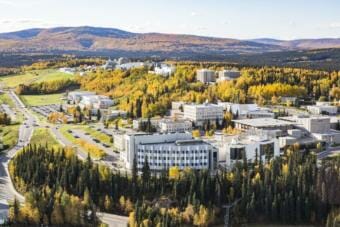
The University of Alaska Fairbanks campus. (University of Alaska photo)

The University of Alaska Regents on Friday named five finalists for the job of interim president at the state’s public university system. They include two current university chancellors and the director of the state’s Division of Legislative Finance.

The announcement comes about three weeks after Jim Johnsen suddenly resigned from his role as UA president amid blowback from his Wisconsin job search.

The regents say they expect to announce the interim president on Tuesday after interviews in executive session — meetings closed to the public.
Here are the five candidates they’re choosing from:

  • Pat Pitney, director of the Division of Legislative Finance and former vice chancellor of administration at the University of Alaska Fairbanks
  • Michelle Rizk, the acting UA president who is also UA’s vice president of university relations and chief budget and strategy officer
  • Cathy Sandeen, chancellor of the University of Alaska Anchorage
  • Dana Thomas, former interim chancellor of UAF and UA vice president of academic affairs and research
  • Daniel White, UAF chancellor

The interim president will lead the UA system while regents search for someone to permanently fill the position.

State gives Italian oil giant six more months to make $2.7M rent payment on Alaska leases

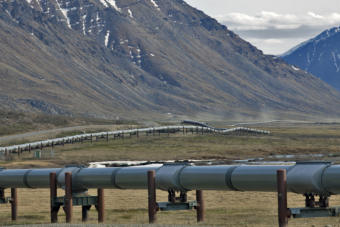
An above-ground section of the Trans-Alaska Pipeline System near the Toolik Lake Research Station in the North Slope Borough. (Photo by Rashah McChesney/Alaska's Energy Desk)
An above-ground section of the Trans-Alaska Pipeline System near the Toolik Field Station in the North Slope Borough. (Photo by Rashah McChesney/Alaska’s Energy Desk)

The state Department of Natural Resources is giving Italian oil giant ENI a six-month break on a nearly $3 million rent payment for oil and gas leases on the North Slope.

It’s the third time DNR has granted such an extension in the past three months, citing the coronavirus pandemic’s impact on the oil industry.

Sean Clifton, a policy and program specialist with the state Division of Oil and Gas, said he’s not aware of the department ever allowing similar extensions for oil and gas leases before this year.

“But,” he said, “these are pretty extraordinary times.”

Falling demand driven the pandemic, paired with an oil-price war earlier this year, led to a glut of oil on the market. Crude prices tanked, and oil companies cut spending and suspended drilling across the globe, including in Alaska. Hundreds of oil field service workers lost their jobs in the state.

In a letter on May 21 to Natural Resources Commissioner Corri Feige, ENI asked for a one-year extension on its payments for 110 exploration leases encompassing about 275,000 acres southeast of Prudhoe Bay. ENI said the economic impact of the pandemic and the unforeseen drop in crude prices “significantly curtailed” its cash reserves. The company said it needed time to budget and reevaluate its business plans for the leases.

Oil companies must make annual rent payments to the state on their oil and gas leases. Under state law, Feige has authority to grant extensions if she finds “reason of war, riots, or acts of God” have prevented them from paying.

ENI’s bill for the exploration leases was originally due by Aug. 1. Now, the company has until Feb. 1 to pay about $2.7 million, Division of Oil and Gas Director Tom Stokes said in a response to ENI in early June.

Stokes said President Donald Trump and Gov. Mike Dunleavy have declared states of emergency over the pandemic. The restrictions, he said, “have placed an unanticipated burden on Alaskan businesses that justifies an extension of time within which to make payments.”

In May, DNR also granted months-long extensions to Accumulate Energy Alaska and Burgundy Xploration for about $4.6 million in rent payments on leases. And, in late April, it granted an extension for nearly $90,000 in lease payments for the struggling Mustang oil project.

At the federal level, the Trump administration has cut the amount oil and natural gas companies must pay for access to US-government-owned land.

Clifton underscored that, in Alaska, the state will still collect the companies’ lease payments in the current fiscal year — it’s not lost revenue — and “has the upside of keeping our North Slope oil producers in business during these unprecedented times.”

Site notifications
Update notification options
Subscribe to notifications