Tegan Hanlon, Alaska Public Media

State reports another death as active COVID-19 infections again reach new high


Another Alaskan has died with COVID-19 as the number of active cases among residents again reaches a new high, state health officials reported Tuesday.

Additional details about the person who died were not immediately available. Alaska Public Media has reached out to the state health department and will update this story when it has more information.

The report of another death follows a recent spike in Alaska’s number of new COVID-19 infections, and warnings from Anchorage city officials that its system for investigating cases has maxed out. The state health department is also continuing to call on Alaskans to wear masks, wash their hands and social distance.

“Alaska is seeing a surge in cases with the number of infected Alaskans now outpacing recovered ones, plus a new high in COVID-positive hospitalizations yesterday,” the department posted on Facebook Tuesday morning.

The state on Tuesday reported 19 new COVID-19 cases among Alaska residents. A dozen of them are from Anchorage, two are from Wasilla and there is one each from Eagle River, Kenai, Cordova, the Yukon-Koyukuk area and Ketchikan.

The state is also reporting four new infections among nonresidents. One is listed as a tourist in Seward. There are two in Anchorage and their reasons for visiting are not listed in the state’s database. A fourth person’s location is listed as unknown.

Another four Alaskans have been hospitalized with the disease, according to the state. And there are 25 people in the hospital with COVID-19 or who are suspected to have the disease.

By the end of the day Monday, the state tallied 1,184 infections among Alaskans since March, and 560 of them have recovered. About 20% of those infections were in Alaskans in their 20s and another 20% were in Alaskans in their 30s — the two age groups with the most infections.

“The COVID-19 outbreak is far from over,” Gov. Mike Dunleavy wrote in a Facebook post Monday night.

The latest death brings the total number of Alaskans who have died with COVID-19 to 17, according to the state’s data. At least four of them died out of state. One of the out-of-state deaths may have been misattributed to Alaska because of incorrect information on a death certificate, The Juneau Empire reported.

A total of 131,420 COVID-19 tests have been administered in Alaska — up about 3,000 from Monday’s report.

Across the country, the total number of confirmed coronavirus cases is again on the rise. Alaska continues to have one of the country’s lowest case counts per capita.

How Providence workers fought to contain ‘lightning speed’ coronavirus at site of Alaska’s largest outbreak

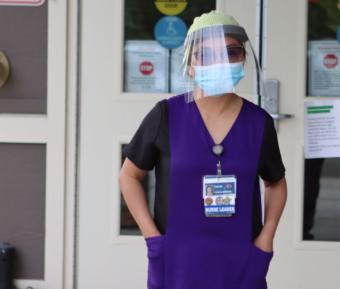
A nurse with a face shield standing outside Providence Transitional Care Center in Anchorage
Connie Mast is the director of nursing at the Providence Transitional Care Center, the site of Alaska’s largest coronavirus outbreak. Mast has worked for Providence for 18 years. Photographed outside of her workplace on Tuesday, June 30, 2020. (Tegan Hanlon/Alaska Public Media)

A phone call at 4:45 one morning in late May woke up Connie Mast, the director of nursing at the Providence Transitional Care Center.

“They said that we have a positive patient,” Mast recalled. “The first positive patient.”

The coronavirus had gotten into the Anchorage transitional center, a place where patients often live for weeks as they recover from surgery, injury or serious illness. Mast said she knew if one patient had become infected, others must have too.

“It’s impossible that it’s only one,” she said. “So I was worried, I’m like, ‘Oh my God. So I know we have one, and there will be more.’”

Suddenly, Mast and her colleagues found themselves on the front line, fighting the infectious disease as one case grew into dozens more. The center quickly became the site of Alaska’s largest coronavirus outbreak.

“It’s a virus you can’t see and it’s so fast moving,” said Hashi Price, a certified nursing assistant at the center. “It’s lightning speed.”

A nursing assistant wearing a mask and face shield outside the Providence Transitional Care Center in Anchorage.
Hashi Price is a certified nursing assistant at the Providence Transitional Care Center. Price has worked for Providence for 10 years. Photographed outside of her workplace on Tuesday, June 30, 2020. (Tegan Hanlon/Alaska Public Media)

Price, a mom of three, had only been back on the job for a few months when the virus found its way inside.

She returned from maternity leave in March. She said she remembers following the news about the coronavirus tearing through long-term care facilities in Washington state — settings so similar to her workplace here.

“I was scared watching it,” she said. “How fast it was spreading, it scared me.”

Still, she said, she felt good about the precautions the transitional center had put into place early on. Starting in March, staff told visitors they had to stay on the other side of a window if they wanted to see patients. Caregivers went through health screenings. Masks became mandatory for all employees.

“I feel like we did a really good job because we kept it out of our facility — even though it was all over — until the end of May,” Price said.

Meanwhile, outside of the center, Alaska was reopening its economy in May and, by the end of the month, the number of COVID-19 infections started to grow again.

Mast said after the first case turned up at the transitional center, staff locked down the area even more. The center shares a campus with Providence Extended Care, which mostly serves older adults.

Patients had to stay in their rooms. Staff started wearing face shields. Everyone got tested, and then they got tested again and again and again.

Mast said she prayed before each nasal swab that her result would come back negative.

“I can’t afford to be sick. I know that I will be needed,” she said. “My staff needs me and the patients need me as well.”

Mast and Price never did test positive. But tests over several weeks revealed 47 coronavirus cases among the center’s patients and caregivers — about one in four. Two patients died.
And, one caregiver at the extended care facility on campus also tested positive.

Mast said it’s emotional to talk about.

Price said she tries to stay focused and do her job, and do it well. She said some of those infected showed no symptoms.

“Then we had the ones that got really sick and it’s hard to see,” she said. “They can’t get comfortable and their body hurts all the time.”

Price said she is sure her patients were scared, but they often didn’t show it. Everyone cooperated, she said, and seemed to understand the reasons for the stricter rules. But, she said, she wishes they could see her trying to give them a reassuring smile behind her face mask and shield.

“That part kind of sucks,” she said.

Price described the center’s employees as close-knit. It’s the type of place, she said, where they would bring in their kids to visit with patients, to talk with them and play games.

Now, Price said, she’s busy checking in with her colleagues who are at home with COVID-19 infections.

“I make sure that they’re doing okay and if they need anything, like if they need me to drop them off anything, I can leave it at their door and then run,” she said.

Mast’s and Price’s lives at home have changed too. Mast started staying in a separate room at her house, and stopped hugging and kissing her two kids. Price said she immediately takes a shower when she gets home.

“My kids already know and my husband already knows that they can’t touch me or anything until I’ve already showered and put on fresh, clean clothes,” she said.

After weeks of a rising case count, Providence staff recently said they’re hopeful the virus may finally be contained — or at least close it. A fifth round of testing at the end of June identified no new cases at the center.

Providence staff say they’re still unsure how the virus first got in.

Price said after working and living through Alaska’s largest coronavirus outbreak, the advice she’d like to share is: Wear a mask and wash your hands to help protect the community, including some of the city’s most vulnerable — her patients.

Alaska reports 50 new COVID-19 cases, breaking record for state’s biggest one-day increase


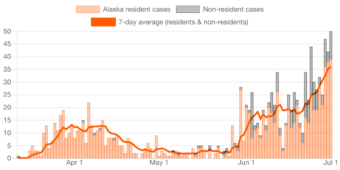
Alaska recorded 50 new coronavirus cases from Wednesday, but no new deaths or hospitalizations. It’s the biggest one-day increase in infections in Alaska since the pandemic began, breaking the prior record set earlier this week.

The latest COVID-19 cases include 39 Alaskans and 11 nonresidents, according to the latest data update Thursday from the Alaska Department of Health and Social Services.

The jump follows a series of double-digit, one-day case increases in Alaska for much of June. And it comes as case numbers surge throughout much of the country, in the days leading up to the Fourth of July weekend.

By the end of Wednesday, the total number of COVID-19 infections among Alaskans topped 1,000. Of 1,017 cases, 535 are considered recovered and 468 are active. There have been 14 deaths.

The newly-diagnosed Alaskans are mostly from Southcentral Alaska. They include 13 from Anchorage, nine from Wasilla, four from Palmer and three from Seward.

The newly-diagnosed nonresidents tested positive across the state, from Unalaska to Petersburg to Seward to Anchorage. At least four work in the seafood industry. But the state has not yet listed the reason most of them are in Alaska.

By the end of Wednesday, 18 people were in the hospital in Alaska with COVID-19 or suspected to have the disease.

Also, the state reported that nearly 116,000 COVID-19 tests have been conducted — up roughly 1,500 from a day before.

Despite the rising COVID-19 infections in Alaska, the state continues to have one of the country’s lowest case counts per capita.

In preparation for the upcoming holiday weekend, the city of Seward is limiting capacity for campgrounds and for businesses with indoor seating. Earlier this week, Anchorage Mayor Ethan Berkowitz began requiring face masks in indoor, public spaces.

Hilcorp to quietly take over BP’s stakes in Prudhoe Bay and other oil field assets

Point Thomson is approximately 60 miles east of Prudhoe Bay. (Photo courtesy Exxon)

A big piece of one of Alaska’s largest oil industry deals is set to quietly close by the end of the day Tuesday.

Hilcorp Energy Company will take over BP Alaska’s oil and gas leases within Point Thomson, Milne Point and the massive Prudhoe Bay oil field. The transfer is expected to happen around midnight, and marks the close of a major part of the $5.6 billion deal first announced by the oil companies last August.
It follows an announcement from state commissioners late Monday afternoon that they’d approved the sale of BP’s oil field assets to Hilcorp after a months-long analysis of the transaction and after stress testing Hilcorp’s finances.

“Today’s announcement represents a major milestone in the BP-Hilcorp review process,” Gov. Mike Dunleavy said in a statement Monday about the commissioners’ approval.

The sale will launch Hilcorp into the position of Alaska’s second largest oil producer, and the privately-owned company will become the operator of Prudhoe, the largest oil field on the North Slope and one of North America’s most productive. It will also move BP one big step closer to exiting the state after more than 60 years.

Meanwhile, the second key piece of the sale remains under review.

The Regulatory Commission of Alaska is still assessing BP’s sale of its pipeline assets, including its interest in the 800-mile trans-Alaska pipeline. The RCA has said it will reach a final decision by the end of September.

Sean Clifton, with the Alaska Division of Oil and Gas, said the two companies alerted the state in April about plans to split the deal into two parts. The companies also publicly announced several other changes to the transaction as an oil-price war and the coronavirus pandemic sent crude prices plummeting.

“This is not something DNR needed to approve, being a business decision among private parties,” Clifton said about the decision to divide the deal.

BP and Hilcorp said little publicly Tuesday about closing the first chunk of that deal. There didn’t appear to be any large events planned by the companies to mark the transfer.

A BP spokeswoman confirmed Tuesday that the company anticipated closing the first part of the sale by the end of the day. She declined to comment further. A Hilcorp spokesman also declined to comment.

Mark Myers is a geologist and energy consultant, who has served as a DNR commissioner in Alaska and as the national director of the U.S. Geological Survey. He said one of the biggest changes some Alaskans may first notice is Hilcorp’s smaller workforce.

“They’re a leaner company,” he said in a phone interview Tuesday. “So they’re going to do it with less people.”

Over the nearly year-long review of the sale, Hilcorp has faced criticism for its safety and environmental record and received praise for its innovation and ability to revive aging infrastructure, including at Milne Point.

Myers said he didn’t expect any immediate changes to oil production out of Prudhoe Bay.

Hilcorp, he said, will be working with two other main partners: ExxonMobil and ConocoPhillips, which each own a roughly one-third stake in the field.

Myers said he anticipated Hilcorp will first focus on training its employees, transitioning the hundreds of BP workers it has hired and learning more about the complexities of the oil field.

“There are a lot of opportunities, but they’re going to have to compare them within that field and run the economics on them as well,” he said.

BP has said up to 50 of its employees who planned for early retirement will help with Prudhoe Bay operations for 90 days after the sale closes.

Trump administration wants to open millions of more acres to oil development on Alaska’s North Slope

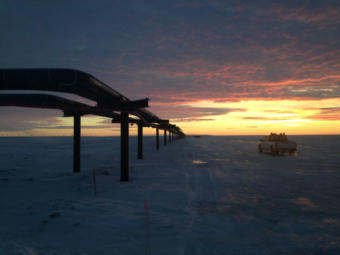
Pipelines stretch toward the horizon in the National Petroleum Reserve-Alaska. (Photo by Elizabeth Harball/Alaska’s Energy Desk)


The Trump administration is proposing to open millions of additional acres to oil and gas development in the National Petroleum Reserve-Alaska, a move blasted by environmental groups and praised by Alaska’s governor and other state and federal officials.

The Interior Department’s Bureau of Land Management released its final environmental impact statement Thursday for a new management plan for the 23-million-acre reserve, which sits west of Prudhoe Bay.

The plan would make 82% of the area available for drilling, up from the 52% that’s open under an Obama-era document. The Trump proposal would expand leasing into another 7 million acres that’s currently protected from development — an area just larger than the state of Vermont.

The reserve is estimated to hold about 8.7 billion barrels of oil, according to the U.S. Geological Survey.

But it’s also home to important habitat for birds and caribou, including the Teshekpuk Lake area in the reserve’s northeastern corner. And conservation groups point to the 1976 Naval Petroleum Reserves Production Act, which directs the interior secretary to uphold environmental and subsistence values in NPR-A.

Those groups decried the new plan Thursday, describing it as reckless, rushed and shameful, as well as a threat to the Teshekpuk Lake area, subsistence and the climate.  The area was off-limits to drilling in the Obama-era document, and would become completely open under the Trump administration plan — though there would be limits on when and how development could occur.

“This is really giving away vital habitat for caribou and migratory birds and will only exacerbate the climate crisis,” Nicole Whittington-Evans, Alaska program director for Defenders of Wildlife said in a phone interview. “So, we feel this is bad for the Western Arctic and it’s bad for the planet.”

In a statement, the Interior Department described the reserve as critical for “American energy dominance and national security.” And it said the plan has stipulations to protect the Teshekpuk Lake area, including “timing limitations” for major construction.

“We’ve looked to open up some additional areas to leasing based on new information while also using management prescriptions to protect important wildlife, habitat and subsistence uses,” Bureau of Land Management Alaska State Director Chad Padgett said in the statement.

The BLM released its draft environmental impact statement last fall.

But the preferred alternative announced Thursday was not part of it. Some conservation groups criticized the agency Thursday for not allowing communities to provide input on the option.

In its statement, the Interior Department said public comment led to the creation of the new and preferred alternative.

Gov. Mike Dunleavy thanked Trump’s administration for proposing to open more land to development, calling it a better balance than the Obama-era plan. Alaska’s congressional delegation also praised the decision.

The BLM will next prepare a final Record of Decision, which could be published as early as late July and will guide future lease sales in the reserve.

Alaska’s Energy Desk reporter Nathaniel Herz contributed to this report.

Correction: This story has been corrected to show that the Bureau of Land Management will produce a final record of decision in at least not next 30 days, not within the next 30 days. 


Anchorage mayor says he may issue mask mandate soon if increase in COVID-19 cases continues

Anchorage Mayor Ethan Berkowitz in March 2020. (Photo by Alaska Public Media)

Mayor Ethan Berkowitz says he may require masks in indoor, public areas in Anchorage soon if the increase in COVID-19 cases continues.

“That order is ready and could be implemented at any time,” Berkowitz said at Tuesday’s Anchorage Assembly meeting.

“If the number of cases and the type of cases that we see continue over the next two or three days we’re going to implement that order.”

The announcement comes as the number of COVID-19 infections in Alaska continues to climb, and as people clash over wearing masks. Some businesses are requiring face coverings, but there’s currently no city-wide or statewide mandate.

About two dozen people protested outside of Assembly chambers Tuesday, opposing a mask mandate. Meanwhile, more than 200 Alaska health care workers have called on the governor to implement one for the entire state.

Berkowitz did not provide specifics about what exactly his drafted emergency order says or how it would be enforced. He said it would require the wearing of masks “under certain circumstances,” and would not apply to the outdoors.

Berkowitz said there is increased community spread of COVID-19, a strain on the ability to track people who come in contact with the virus and a “disregard of some of the public health precautions that have kept us safe up to this point.”

Business owners who are requiring masks have reported that they’re struggling to enforce their rules, and getting pushback that there’s no city-wide order, Berkowitz said.

“That puts frontline workers in an untenable position of having to be law enforcement,” he said. “I think the presence of an order is an indicator of what social norms are and should be and consequently I’m prepared to implement that order within the next few days.”

On Tuesday, the governor of Washington announced a statewide mandate requiring facial coverings in any indoor public space, as well as any outdoor public area if social distancing isn’t possible. Several other states are also requiring face coverings.

The federal Centers for Disease Control and Prevention recommends people wear cloth face coverings in public settings where social distancing measures are difficult to maintain such as grocery stores. It says the use of masks can help slow the spread of COVID-19 and may help keep those who have the virus but aren’t showing symptoms from transmitting it to others.

Site notifications
Update notification options
Subscribe to notifications