Tegan Hanlon, Alaska Public Media

Feds to study impacts of potential Cook Inlet oil and gas lease sale

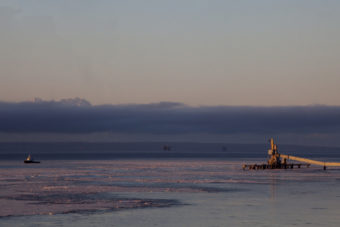
Cook Inlet oil platforms are visible from shore near Kenai, Alaska. (Photo by Rashah McChesney/Alaska’s Energy Desk)
Cook Inlet oil platforms visible from shore near Kenai, Alaska. There are oil and gas production platforms in state waters of the inlet, but none in its federal waters. (Photo by Rashah McChesney/Alaska’s Energy Desk)

The Bureau of Ocean Energy Management announced Wednesday that it plans to study the environmental impacts of a potential lease sale in Alaska’s Cook Inlet.

It would be the first federal oil and gas lease sale in the inlet since 2017. While there are oil and gas production platforms in state waters in the inlet off Alaska’s southcentral coast, there are none in its federal waters right now.

The proposed lease sale area in Alaska’s Cook Inlet. The Bureau of Ocean Energy Management is studying the environmental impacts any oil and gas drilling in the area could have on the area. (Bureau of Ocean Energy Management)

The potential lease sale would cover about one million acres of the inlet and would be held next year.

Before any lease sale occurs, the bureau says, it will analyze the impacts of leasing, exploration, development and production in the area. It’s also asking the public to weigh in on the proposed sale. It says it especially wants to hear from residents in communities along the inlet.

“We especially need to hear from residents of the communities along Cook Inlet as to how the proposed leasing area is currently being used and what specific areas need extra attention,” James Kendall, regional director of the bureau’s Alaska office, said in a statement.

The Center for Biological Diversity, an environmental group, criticized the proposed lease sale in a statement Wednesday. It says the government should protect the beluga whales in the inlet and do more to combat climate change instead of offering more federal waters to the oil industry.

The bureau said 13 exploration wells have been drilled in the inlet’s federal waters between 1978 and 1985, and all have since been plugged and abandoned. During the last federal lease sale in the inlet, in 2017, Hilcorp acquired 14 leases.

Before that, a lease sale in December 2010 was canceled due to lack of industry interest.

The bureau said it estimates the federal waters of Cook Inlet contain 810 million barrels of oil and 330 billion cubic feet of natural gas that can be produced, based on economic conditions and technology.

‘We will give you one heck of a fight’: Lawsuits filed against drilling plan for Alaska’s Arctic Refuge

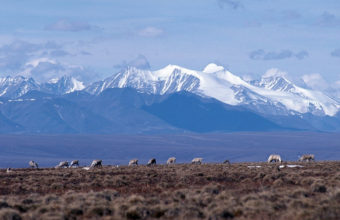
Caribou graze on the coastal plain of the Arctic National Wildlife Refuge, with the Brooks Range as a backdrop. (USFWS)

The Gwich’in Steering Committee and more than a dozen environmental groups are suing the Trump administration over its controversial plan to open up part of the Arctic National Wildlife Refuge to oil and gas development.

The two lawsuits filed Monday argue that the Bureau of Land Management’s environmental review process failed to follow numerous laws meant to protect wildlife, land, water and people.
“The remedy that we’re seeking is to throw out this illegal decision as well as any lease sale or leases that rely on it,” said Victoria Clark, executive director of Trustees for Alaska, the Anchorage-based firm representing the Gwich’in Steering Committee and other groups.

The lawsuits come a week after the BLM finalized its plans for development in the Arctic Refuge’s 1.6-million-acre coastal plain — an area roughly the size of Delaware that makes up about 8% of the vast refuge. It’s a place where caribou migrate, polar bears den and migratory birds feed. It’s also an area believed to hold billions of barrels of untapped oil.

Interior Secretary David Bernhardt has said the federal government could auction off drilling rights in the coastal plain by the end of the year.

That’s why the groups had to quickly move forward with their lawsuits, Clark said. Once leases are issued, it could be more difficult to reverse course.

“We have an administration that is just steamrolling along trying to get these decisions made,” she said.

The BLM’s development plan stems from legislation approved by Congress in 2017 that called for two lease sales in a coastal section of the Arctic Refuge within seven years.

In response to the lawsuits, the BLM released a statement Monday saying that its plan for where and when development can take place “includes extensive protections for wildlife, including caribou and polar bears.”

“This is a congressionally mandated energy development program that leaves 92% of the refuge completely off-limits to development,” it said.

But the lawsuits argue that the BLM is downplaying the impacts of drilling and that oil and gas development will cause irreparable harm to wildlife, the tundra and the climate.

“Developing Alaska’s last wild places would be a death sentence for polar bears and other threatened Arctic species. The oil industry just doesn’t belong in the Arctic National Wildlife Refuge,” said a statement from Kristen Monsell, a senior attorney at the Center for Biological Diversity, a group behind the second lawsuit.

On a call with reporters Monday, Gwich’in Steering Committee’s executive director Bernadette Demientieff said the Gwich’in people feel attacked by the government.

“We are not asking for anything but the ability to continue to live and thrive off the land that has sustained us for thousands and thousands of years,” she said.

Demientieff is from the Yukon River community of Fort Yukon, and she’s one of the highest profile leaders among the Gwich’in, an indigenous group spread between Alaska and Canada whose members harvest caribou that give birth in the Arctic Refuge.

Demientieff described the coastal plain as pristine and sacred and vowed to protect it.

“We will give you one heck of a fight,” she said.

State forecasts decline in new coronavirus infections after July surge

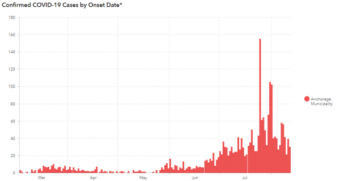
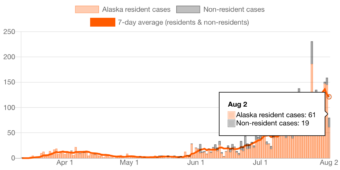
A screenshot of a chart from the Alaska Department of Health and Social Services showing the number of COVID-19 infections among Municipality of Anchorage residents since March. State health officials say case counts are generally trending downward.

State health officials say they’re predicting a decline in coronavirus infections in Alaska after cases surged last month.

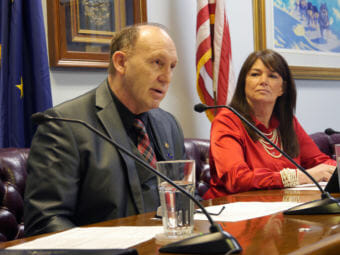
In a call with reporters Thursday, State Epidemiologist Dr. Joe McLaughlin said the forecast is driven by a drop in COVID-19 outbreaks and fewer new infections in the state’s largest city.

“The case counts are really on the decline or have been on the decline in Anchorage,” McLaughlin said. “And so this is a real positive sign that things are improving right now in Anchorage, and may well be an indication that the mandates that are in place in Anchorage are working. So that’s really encouraging.”

The Municipality of Anchorage put new capacity restrictions in place at businesses in late July, and then cracked down even further earlier this month. It closed indoor dining at restaurants and bars, and further limited the size of gatherings.

The state reported Wednesday that COVID-19 cases in Alaska are now predicted to decline by half every 38 days. That’s a sharp reversal from last week’s prediction that cases would double every three weeks.

But Alaska chief medical officer Dr. Anne Zink cautioned that the number of COVID-19 cases will continue to rise and fall. She said the future of the virus in the state will depend on how well Alaskans continue to follow preventative measures like wearing face masks and social distancing.
“You can see that our fate with COVID is not fixed,” she said on Thursday’s call. “Our fate with COVID is directed by what we’re all doing as individuals collectively, together to minimize the spread of COVID.”

The state reported 95 new coronavirus infections on Thursday, with 30 of them tied to the Municipality of Anchorage. The number of people hospitalized with the virus in Alaska also hit a new high at 39.

Meanwhile, the state is tracking at least two significant outbreaks. At the Anchorage Pioneer Home, 10 residents and two employees have tested positive for the virus, and there are 19 known cases among workers at a Southeast Alaska mine.

Alaska reports another COVID-19 death and 80 new infections


Another Alaskan has died with COVID-19.

The Anchorage man was in his 70s, according to the Alaska Department of Health and Social Services. He’s the 25th Alaskan whose death is linked to the infectious disease.
A spokeswoman with the state health department said Monday that it’s unknown if the man had any underlying medical conditions. Based on the information the state has, COVID-19 was a factor in the death.

The state reported about a dozen of its total deaths in June and July as the number of infections in Alaska also climbed.

On Monday, Alaska’s number of known COVID-19 cases rose by 80. Sixty-one of them are residents who tested positive, most from Anchorage.

The rest are nonresidents. Nearly all of them work in the seafood industry. Plus, two are oil field workers on the North Slope.

Of Alaska’s 4,064 COVID-19 cases since March, about 70% — nearly 3,000 — are still considered active. That includes cases among residents and visitors.

The average percentage of daily positive tests for the past three days is 2.27%.

The City and Borough of Juneau reported one new individual with COVID-19 in Juneau on Monday. Since March, Juneau has had 91 residents and 63 nonresidents test positive for COVID-19.

Kenai legislator and local pilot among 7 killed in midair plane crash

Rep. Gary Knopp, R-Soldotna, speaks during a House Minority press availability, April 6, 2017. (Photo by Skip Gray/360 North)
Rep. Gary Knopp, R-Soldotna, speaks during a House Minority press availability in April 2017. Knopp has left the Republican caucus. (Photo by Skip Gray/360 North)

Update: Saturday, Aug. 1

An Alaska state legislator and local pilot were among seven killed in a midair plane crash Friday morning on the Kenai Peninsula.

Rep. Gary Knopp, 63, was alone in his Piper PA-12. He took off from Soldotna’s airport, according to a preliminary investigation, said Clint Johnson, the National Transportation Safety Board’s Alaska chief.

Just to the northeast, 57-year-old Greg Bell, owner of a Soldotna-based air charter business, left in a de Havilland DHC-2 Beaver from Longmere Lake, according to Johnson. Bell had five others aboard: A fishing guide and four people in their 20s from South Carolina.

The two planes collided around 8:30 a.m., roughly two miles northeast of Soldotna’s airport, according to the Federal Aviation Administration.

Six of those aboard were confirmed dead at the scene, and one died on the way to the hospital, troopers said.

Troopers identified Bell’s five passengers as a 40-year-old guide, David Rogers, from Kansas and four South Carolina residents: 26-year-old Caleb Hulsey, 25-year-old Heather Hulsey, 24-year-old Mackay Hulsey and 23-year-old Kirstin Wright.

South Carolina television station reported that Caleb Hulsey and Mackay Hulsey were siblings, and their partners were Heather Hulsey and Kirstin Wright. They were in Alaska on vacation.

“This is an unfathomable tragedy for multiple families today,” Alaska’s Department of Public Safety Commissioner Amanda Price said in a statement.

What caused the midair crash remains under investigation, Johnson said Friday evening. He said it’s “highly unlikely” that weather was a factor. He said NTSB will piece together the plane wreckage, analyze radar and talk to witnesses to help determine what happened Friday morning.

Rita Geller, a shop attendant at the Birch Ridge Golf Course, was among those who heard the crash.

She described it as a “really loud, metallic sounding bang.” She looked up. A plane fell from the sky.

“I saw it explode, pieces flying off,” she said. “It was just so shocking to see.”

Wreckage from the plane near the Sterling Highway led to the temporary closure of the roadway.

News of the fatal crash also led to statements from many public officials who offered their condolences, and expressed shock at the sudden deaths.

Gov. Mike Dunleavy said he and his wife, Rose, are heartbroken. He ordered the United States flag and Alaska state flag to be flown at half-staff in honor of Knopp for three days.

Knopp, a Republican from Kenai, was elected to the state House in 2016 after serving on the Kenai Peninsula Borough Assembly.

He worked for many years as a general contractor and enjoyed flying, diving, hunting and golfing, according to his bio on the Legislature’s website.

Sen. Peter Micciche, R-Soldotna, said he knew both Knopp and Bell for most of his life.

“Gary has served the Kenai Peninsula community to the best of his ability for decades,” he said in a post on Facebook. “Greg Bell was a dedicated Christian, family man and community member. I have flown with Greg and never felt to be in better, more safety-focused hands while in the air. We are reeling from the loss in our community. Please keep the Knopp and Bell families in your prayers.”

Bell is listed as an owner of High Adventure Air Charter. The business offers fishing, hunting and sightseeing trips. The company declined to comment Friday, but said it’s cooperating with the investigation.

Lawmakers mourned Knopp’s death. They described him as a hard worker, a one-of-a-kind leader and a true Alaskan who will be missed by many.

“More than a legislator, Gary Knopp was a husband, father, son, brother, grandfather, and friend. He will be tremendously missed,” said Senate President Cathy Giessel, R-Anchorage.

House Speaker Bryce Edgmon, I-Dillingham, said he was devastated and shocked to learn about the crash and Knopp’s death.

Rep. Steve Thompson, R-Fairbanks, described Knopp as “one of the nicest guys I’ve ever met.”

This story has been updated.

Correction: Pilot Greg Bell was 57 and Gary Knopp was 63, not 67 as initially reported by troopers.

Alaska Psychiatric Institute has its first COVID-19 case

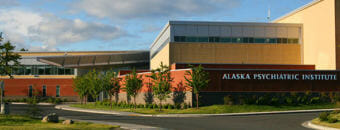
The Alaska Psychiatric Institute in Anchorage. (Photo courtesy of the Alaska Department of Health and Social Services)
The Alaska Psychiatric Institute in Anchorage. (Alaska Department of Health and Social Services)

An employee at the Alaska Psychiatric Institute has tested positive for COVID-19. It’s the first case that the state has publicly tied to the Anchorage psychiatric hospital.

The Alaska Department of Health and Social Services announced the case in a statement Thursday. It said the employee became sick last Wednesday, took a COVID-19 test and hasn’t returned to the hospital since.

“No other staff or patients have shown symptoms of the disease,” the statement said. “The employee took excellent precautions to minimize the risk of exposure.”

New patient admissions to API will be on hold for at least the next 72 hours, according to the statement. API is the state’s only inpatient psychiatric hospital.

The health department counted the case in its report Thursday of 75 new COVID-19 infections: 65 Alaskans and 10 nonresidents. The number of infections reported daily has continued to surge in Alaska in recent days, and hospitals say they’re seeing an increase in patients with coronavirus symptoms in emergency rooms.

At API, leadership found out about the positive COVID-19 case Wednesday afternoon and began notifying their colleagues and contractors, said the health department. API is also working with the state to trace the person’s recent contacts to try to contain the disease’s spread.

The state says API has had additional safety measures in place for months to try to keep COVID-19 out including mask requirements and health screenings.

Site notifications
Update notification options
Subscribe to notifications