Tegan Hanlon, Alaska Public Media

Trump administration to auction oil drilling rights in all federal lands of ANWR coastal plain

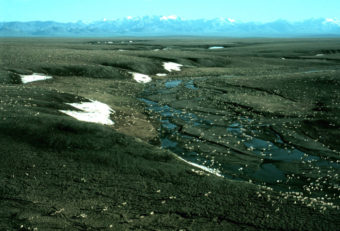
The Arctic Coastal Plain (Department of Interior Photo)

The Trump administration intends to auction off drilling rights in all federal lands of the Arctic National Wildlife Refuge’s coastal plain in its upcoming oil and gas lease sale. That’s according to the government’s 83-page document released Monday that details the terms of the first-ever lease sale in the northeast Alaska refuge, which is scheduled for Jan. 6.

The controversial sale will follow decades of fighting over whether to drill for oil and gas in the coastal plain.

Monday’s document says oil companies and other interested parties will be able to bid on tracts that cover the coastal plain’s nearly 1.6-million federal acres, an area about the size of Delaware that makes up about 8% of the refuge.

Supporters of the sale, including Alaska’s Congressional delegation, say it’s good for jobs and the economy. But those opposed, including conservation and some tribal groups, raise concerns about impacts to wildlife, the climate and Indigenous people. They also continue to blast the Trump administration for rushing to lock in oil drilling in the refuge before the swearing-in of President-elect Joe Biden, who opposes development there.

“What you see is agencies rushing, disregarding science, disregarding human rights in an effort to turn over the entire coastal plain of the Arctic refuge to oil and gas companies,” said Brook Brisson, senior staff attorney at Trustees for Alaska, an Anchorage-based environmental law firm that has filed one of the lawsuits that aims to block oil and gas development in the coastal plain.

Brisson and others opposed to drilling in the refuge point out that Monday’s sale announcement comes with 10 days still left in the “call for nominations” process. That’s a 30-day window when oil companies and other interested parties can tell the federal Bureau of Land Management which blocks of land within the coastal plain they’re most interested in bidding on — a step designed to guide the government’s decisions about which tracts to include in the auction.

The Arctic National Wildlife Refuge’s coastal plain is shown in orange. The area covers about 1.6 million area, roughly the size of Delaware, and makes up about 8% of the refuge. (USGS map)

Typically, that confidential comment period closes before the date of a sale is announced.

The BLM, which is conducting the lease sale, has defended its timeline, saying it has been working toward a sale since the tax law was passed in late 2017. It said it’s allowing for each step in the process to take place, and it says it will still consider the comments received after Monday.

“What’s important to note there is we reserve the right to amend that detailed statement of sale,” Kevin Pendergast, BLM’s deputy state director for resources in Alaska, said in an interview last week. “It may change, it may not.”

The agency will not accept bids until after the comment period closes, said Lesli Ellis-Wouters, a spokeswoman for BLM Alaska.

According to the statement of sale posted online Monday, the minimum bid will be $25 per acre. Companies can submit their sealed bids to BLM between Dec. 21 and Dec. 31. Those bids will be unsealed at the 10 a.m. auction on Jan. 6, which will be broadcast online.

It’s unclear which companies will show up to a drilling rights auction for the refuge. So far, oil companies aren’t talking publicly about it.

Conservation groups have vowed to keep up the pressure to try to deter companies from bidding. Already, multiple lawsuits have been filed challenging the government’s environmental reviews of drilling in the coastal plain, and an array of big banks have said they won’t finance oil development in the refuge.

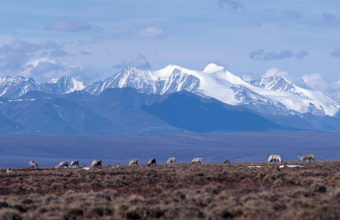
Caribou from the Porcupine Caribou Herd in 2007. The herd often calves on the Arctic Coastal Plain. (Andrew Ramey/USGS)

In a letter to Interior Secretary David Bernhardt on Monday, three Democrats in the U.S. House of Representatives pledged to work with Biden, to “undo any illegal steps the Trump administration is taking to rush these leases out the door.” They also said they’d fight to repeal the move to open the coastal plain to leasing that Congress included in a 2017 tax bill.

That massive bill — the Tax Cuts and Jobs Act — opened the area to drilling after decades of protections. It also required two lease sales within seven years, with the first to include at least 400,000 acres of the coastal plain and to be scheduled by the end of 2021.

Asked why the government decided to offer all roughly 1.5 million acres of federal land in the January sale, BLM Alaska spokeswoman Lesli Ellis-Wouters said, “Currently, there is no reason to exclude tracts from this lease sale.”

“The BLM has the right to withdraw tracts from leasing after nominations and comments are received and bids will not be accepted until after the nomination and comment period closes,” she wrote in an email.

Alaska’s Congressional delegation strongly supports opening the refuge to drilling, saying it will provide jobs and benefit the economy.

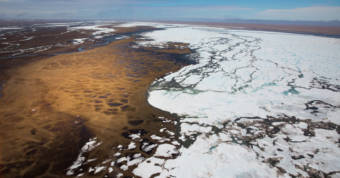
A line visible from seismic testing conducted in the mid-1980s pictured here in 2007 (Image from U.S. Fish and Wildlife Service)

Also on Monday, the federal government said it’s considering a request from the Kaktovik Iñupiat Corporation to conduct seismic testing in the coastal plain as early as Jan. 21, the day after Biden takes office.

The proposal would allow for the “harassment” of up to three polar bears that could occur during the seismic exploration program, including possible disruption to “migration, breathing, nursing, breeding, feeding, or sheltering.”

That move was swiftly criticized by environmental groups.

This is a developing story. Check back for updates.

In last-minute push, Trump administration announces ANWR lease sale for Jan. 6

porcupine_caribou_herd
The Porcupine Caribou herd in the Arctic National Wildlife Refuge’s coastal plain. (Photo courtesy U.S. Fish and Wildlife Service)

In a last-minute push, the Trump administration announced Thursday that it plans to auction off drilling rights in the Arctic National Wildlife Refuge in just over a month, setting up a final showdown with opponents before President-elect Joe Biden takes office.
The sale, which is set for Jan. 6, could cap a bitter, decades-long battle over whether to drill in the refuge’s coastal plain, and it would seal the administration’s efforts to open the land to development.

“We’ve followed a very logical and fairly lengthy, certainly very involved and public-oriented process to get us to this point. And this is the next logical step,” said Kevin Pendergast, deputy state director for resources with the Bureau of Land Management in Alaska.

But conservation and tribal groups who oppose oil and gas development in the coastal plain strongly disagree. And they blasted the administration on Thursday, saying it’s cutting corners so it can hand over leases to oil companies before Biden, who opposes drilling in the refuge, is sworn in and can block it.

“You’re one mile from the finish line and you decide to take a shortcut is what this screams to me, and you hope you don’t get caught,” said Matt Newman, a senior staff attorney at the Native American Rights Fund in Anchorage. He represents three Gwich’in tribes who live near the refuge and oppose drilling on the coastal plain.

“This just smacks in the face of a normal procedure,” he said.

BLM’s announcement of a sale date Thursday came just about two weeks into its “call for nominations,” a 30-day window when oil companies and others can tell the government which tracts of land they’re interested in bidding on.

Typically, once that period ends, confidential comments are analyzed to inform which pieces of land will be offered in a lease sale — and then the date of a sale is announced, said Athan Manuel, a lobbyist for the Sierra Club, which is opposed to drilling.

“The oil and gas program is usually more scheduled and systematic and by the book,” Manuel said. “That’s not happening with this case.”

Pendergast countered that the government is following regulations, including providing a 30-day notice of a lease sale.

A statement about the sale will be posted online Monday, detailing which areas the government will offer for leasing. The call for nominations ends 10 days later, on Dec. 17.

“We’re allowing for the various steps of the process to take place,” Pendergast said. “We can put those together in different ways at different times.”

Matt Lee-Ashley, a former deputy interior secretary under President Barack Obama, described the Trump administration as “hell-bent on selling off the Arctic Refuge on its way out the door, rules and laws be damned.”

“This whole boondoggle can and should be tossed in the trash by the courts or the next administration,” Lee-Ashley, who’s now a senior fellow at the Center for American Progress, a left-leaning think tank, said in a prepared statement.

Already, conservation and tribal groups, as well as a coalition of 15 states, have filed lawsuits challenging the Trump administration’s environmental reviews. Opponents have also secured pledges from an array of banks that say they won’t finance oil development in the refuge.

“Today we put the oil industry on notice,” said a statement Thursday from Jamie Rappaport Clark, head of Defenders of Wildlife. “Any oil companies that bid on lease sales for the coastal plain of Arctic National Wildlife Refuge should brace themselves for an uphill legal battle fraught with high costs and reputational risks.”

The coastal plain, also known as the 1002 Area, covers about 1.6 million acres; it’s roughly the size of Delaware.

It represents about 8% of the vast refuge. And while it’s home to polar bears, caribou and other wildlife, it’s also thought to hold billions of barrels of oil.

The Arctic National Wildlife Refuge’s coastal plain is shown in orange. The area covers about 1.6 million area, roughly the size of Delaware, and makes up about 8% of the refuge. (USGS map)

In a dramatic shift after nearly four decades of protections, a Republican-led Congress approved legislation in 2017 that opened up the coastal plain to oil development. It required two lease sales within seven years, the first scheduled for no later than the end of 2021.

In Kaktovik, the only community inside the coastal plain, some residents greeted Thursday’s news with enthusiasm. Matthew Rexford, Kaktovik’s tribal administrator, said drilling could boost the local economy.

“We have watched oil and gas development on the North Slope for almost 50 years,” he said in a phone interview. “And we believe that through the stringent regulatory environment and the oversight of our home rule borough, the North Slope Borough, all impacts from exploration and development can be mitigated to preserve the area.”

Alaska’s Congressional delegation, which has pushed to open the coastal plain to drilling, also praised Thursday’s announcement, saying development will create jobs. Kara Moriarty, head of the Alaska Oil and Gas Association, said it’s also good for the industry.

“Having a lease sale is the first step of getting access to responsibly developing resources that are needed to meet global demand,” Moriarty said.

Moriarty said she would not call the administration’s process rushed, since drilling in the refuge has been debated for decades. But she did say oil companies will have less time to prepare their bids than they normally do.

It remains unclear who might participate in a coastal plain lease sale. Oil and gas companies aren’t talking publicly about whether they plan to bid.

BLM says the sale will be conducted by video livestream.

Alaska Public Media’s Nat Herz contributed to this story.

This story has been updated.

This Anchorage ER nurse is out sick with COVID-19. And she’s not the only one.

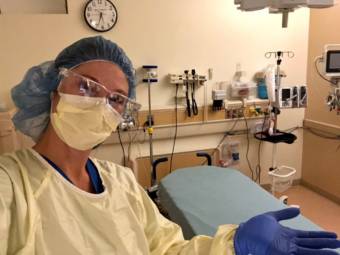
Greer Gehler, an Anchorage emergency room nurse, in full personal protective equipment
Greer Gehler is an Anchorage emergency room nurse who, in Nov. 2020, tested positive for the coronavirus. (Photo courtesy Greer Gehler)

It started last Friday with a tickle in her throat. Greer Gehler, an emergency room nurse in Anchorage, was on her way home from work.

“I chalked that up to sometimes, after wearing a respirator for 12 or 13 hours straight, you get kind of a sort of irritated cough from just breathing in all that moisture for so long,” Gehler said.

But, by the next day, a scratchy throat turned into a stuffy nose, a cough and swollen lymph nodes. She cried. She got a rapid COVD-19 test. The result came back as she suspected: positive.

She’s 20 weeks pregnant.

“I was pretty emotional,” she said. “I’m 37 years old and pregnant, with my first pregnancy, so I’m already high risk, so it’s just a pretty profound fear about complications.”

By Wednesday, Gehler’s partner, a firefighter, had tested positive too. And Gehler’s symptoms had progressed to body aches and chills.

Gehler will be out of work for at least 10 days. She’s among a growing number of Alaska health care workers who are out sick, either because they’ve tested positive for the virus or need to quarantine because of close contact with someone who’s infected. Hospital administrators continue to sound the alarm that the increasing absences are leading to serious staffing challenges in an already-strained health care system.

Gehler has witnessed it firsthand.

“With more nurses and doctors, and everyone down to our housekeepers, out sick, that just puts additional strain on the system,” she said. “And not just in my hospital, but kind of all over the state. There’s beds that are open that we can’t put patients in because we don’t have the healthy staff to help those patients.”

The whole situation makes her so angry.

Even though the number of coronavirus cases in Alaska is rising rapidly, she still sees people not taking the pandemic seriously.

“People are making personal choices about what they want to do. But then some of us are going to work and doing what we have to do. And we’re getting sick because of their choices,” she said.

She said she tried to make her own safe choices outside of work to avoid the virus.

“I don’t see my family. I don’t see my friends,” she said. “I’ve even stopped doing outdoor activities with friends in case we happen to get too close or are breathing too heavily.”

But she still had to go to the hospital.

At work, in recent weeks, she said she’s been treating more and more coronavirus patients.

“We’re just kind of swimming in it at work,” she said. “So it does feel like it’s Russian roulette.”

Even after carefully dressing in protective gear each day — a surgical cap, gown, respirator, gloves, a face shield — she knew her risk of becoming infected was increasing because so many more of her patients had the coronavirus, compared to earlier in the pandemic. And she’s treating some of the state’s sickest Alaskans.

“I’m in these small rooms with these patients where the virus is now aerosolized because of these medical procedures we’re doing to try to save their lives,” she said. “And they’re very contagious already. And, you know, so did something get around my mask? Did some droplets fall on my surgical mask then I touched that later? Or did it fall on my neck?”

She can’t say for sure.

Gehler said she’s sharing her story about becoming infected because she wants more people to follow health guidelines: To wear face masks, to avoid crowds, to keep their distance from people they don’t live with.

She sees the impacts of cavalier behavior at work every day: The younger, fit Alaskans who have gotten the virus and are coming in with heart issues. The older Alaskans who have the coronavirus and are so sick they’re delirious.

“When we see one or two deaths reported, what’s not being reported is all the people that we are keeping from dying,” she said, “that are literally dying when they walk through our doors regardless of age and, without serious intensive medical intervention, they would die.”

Gehler said she wants people to remember that their choices have downstream impacts, and could lead to the virus spreading to Alaskans who become so sick they need to be hospitalized or to health care workers, like herself.

The Trump administration is moving to sell leases in ANWR, but will anyone show up for a sale?

Caribou graze on the coastal plain of the Arctic National Wildlife Refuge, with the Brooks Range as a backdrop in October 2010. (Public domain photo by U.S. Fish and Wildlife Service)
Caribou graze on the coastal plain of the Arctic National Wildlife Refuge, with the Brooks Range as a backdrop. (USFWS)

The battle over oil drilling in the Arctic National Wildlife Refuge’s coastal plain has dragged on for decades.

And now, the Trump administration is close to auctioning off drilling rights for the land in northeast Alaska — potentially just days before President-elect Joe Biden takes office in January.

But there’s a big, unanswered question looming over the idea of a sale: To what degree will the industry actually participate?

Oil and gas companies aren’t talking publicly about whether they’d bid. And Kara Moriarty, head of the Alaska Oil and Gas Association, said that’s not surprising.

“Participation in lease sales is one of the most competitive and secretive things between companies,” she said. “So I don’t know who is interested in participating in a state lease sale, any more than I know who is interested in participating in the next NPR-A lease sale, or in the coastal plain of ANWR.”

ANWR-USGS
The Arctic National Wildlife Refuge’s coastal plain is shown in orange. The area covers about 1.6 million area, roughly the size of Delaware, and makes up about 8% of the refuge. (USGS map)

Moriarty said the public likely won’t have the full picture of industry interest until the federal government unseals the bids on the day of a sale. A sale date has not been announced yet, but the way the government’s timelines work, one could be held just before Inauguration Day.

And while oil and gas companies are mum, industry experts and analysts do have a read on what a lease sale might look like.

“My view is that any response will be fairly lukewarm,” said Rowena Gunn, an analyst for the energy research firm Wood Mackenzie.

Alaska politicians and industry groups have long fought to get drill rigs on the coastal plain, which is thought to hold billions of barrels of oil, but Gunn and others say there’s currently a layer of uncertainty and risk that could lead to limited interest in a lease sale if one happens within the next couple months.

“They’ll probably get some bids,” said Larry Persily, an oil industry observer and former federal coordinator for Alaska gas line projects under President Barack Obama. “But even at fire-sale prices, there probably won’t be a rush of interest.”

That’s for a number of reasons, he said.

One of them is money.

The coronavirus pandemic and an oil price war have both hit the oil industry hard. Oil prices are still low, and it’s expensive and difficult to explore for oil in the Arctic, said Mark Myers, a geologist and former natural resources commissioner in Alaska.

“The prices have fallen down to a level that leaves very little capital for exploration in these companies,” Myers said. “So that’s one of the biggest negatives.”

Also, there’s the opposition, Gunn said, which may weigh more heavily on publicly-traded companies.

“There’s a certain amount of public opinion that it wouldn’t necessarily be good PR for them to be seen as drilling in the Arctic or drilling in environmentally-sensitive areas,” she said.

While some, including Alaska’s congressional delegation, have celebrated the prospect of a lease sale as a way to create more jobs and revenue for the state, others are fighting to keep oil and gas companies out of the refuge, citing concerns about impacts on ecosystems, Indigenous people and the climate.

Indigenous and conservation groups have already filed multiple lawsuits that aim to block drilling in the coastal plain. They’re asking major insurers to not support any oil and gas projects in the refuge. And an array of big banks have already said they won’t fund new oil and gas projects in the Arctic.

There’s a list of other reasons too why some analysts say they wouldn’t expect a deluge of bids.

That includes future demand for oil.

Colorado-based energy economist Philip Verleger said he thinks a lease sale in the refuge 15 years ago would have been “terrifically successful,” but, he said, he thinks the time to develop the coastal plain has passed.

“I do not think ANWR is ever going to be produced,” he said. “The cost of going there and developing and putting the resources in is too high, particularly since the production would last a long time, and we don’t know if demand would last as long.”

Gunn also said some of the larger oil companies operating in Alaska are busy with other projects, such as ConocoPhillips’ work in the NPR-A and Hilcorp taking over oil fields at Prudhoe Bay.

Both companies declined to say whether they had plans to participate in a lease sale in the refuge, if one is held. ExxonMobil also declined to comment for this article.

Chevron said it would consider it “in the context of its global exploration portfolio.” Oil Search said it is “focused on developing the Pikka project and exploring our current leases.”

Perhaps the biggest uncertainty of all that the industry is facing is the changing administration.

Biden has said he opposes drilling in the refuge.

Andy Mack, another former Alaska natural resources commissioner, said even if the Trump administration issues leases before leaving office, Biden’s administration could delay the permits that companies need to search for oil and build their infrastructure.

“What they would try to do is make it so difficult, so onerous, to get the array of permits that the companies just kind of say, ‘Well, we’re not going to spend 10 years just trying to get a simple permit, we’re going to put our money and our investment elsewhere,’” Mack said.

However, Mack said, it’s also possible companies could secure leases and just wait for the administration to change again.

He and Myers underscored that the flip side of all this is that the refuge is still thought to hold a whole lot of oil. And, for some companies, that payoff could outweigh any risk or uncertainty.

Trump administration rushes to sell oil rights in Arctic National Wildlife Refuge

Caribou graze on the coastal plain of the Arctic National Wildlife Refuge, with the Brooks Range as a backdrop. (USFWS)

Starting Tuesday, oil and gas companies can pick which parts of the Arctic National Wildlife Refuge’s coastal plain they’re interested in drilling. It’s the latest push by the Trump administration to auction off development rights in the northeast Alaska refuge before President-elect Joe Biden takes office.
The official “call for nominations” launches a 30-day comment period. It will also allow the Bureau of Land Management to move forward with a lease sale, which it must announce 30 days in advance. The exact timing is not clear, but it raises the possibility that a sale might happen just days before Biden’s inauguration.

“It’s been quite a lot of work to get to this point,” said Kevin Pendergast, Deputy State Director for Resources with the BLM in Alaska. In a separate statement, the agency said the lease sale will be a historic move “advancing this administration’s policy of energy independence.”

In a dramatic shift after nearly four decades of protections, a Republican-led Congress in 2017 approved legislation that opened up part of the refuge to oil development. It called for two lease sales in the coastal section of the Arctic Refuge within seven years, with the first one to be held by the end of 2021.

But conservation groups are blasting the Trump administration’s decision to move forward with the first lease sale now, just a couple months before Inauguration Day, saying it’s rushing the process “to open one of the nation’s most iconic and sacred landscapes to oil drilling.”

The Arctic Refuge’s coastal plain is about 1.6 million acres — an area roughly the size of Delaware that makes up about 8% of the vast refuge. It’s a place where caribou migrate, polar bears den and migratory birds feed. It’s also an area believed to hold billions of barrels of untapped oil.

“This timeline indicates that they’re trying to cram this through in a way that would cut out consideration for public concern,” said Brook Brisson, senior staff attorney at Trustees for Alaska, an Anchorage-based environmental law firm.

Trustees for Alaska is among several groups, and a coalition of 15 states, that filed lawsuits earlier this year aimed at derailing drilling plans for the Arctic refuge. The suits are still winding their way through the court system.

The American Petroleum Institute, a national trade association, welcomed the call for nominations on Monday, saying in a statement that development in the Arctic refuge is long overdue, will create good-paying jobs and provide more revenue for Alaska. It said the industry will work with wildlife organizations and local communities, and use new technology “to safely and responsibly develop these important energy resources.”

Alaska’s all-Republican congressional delegation is also celebrating the news of the government taking another step closer to a lease sale. U.S. Sen. Lisa Murkowski said a sale could be held as soon as January.

“While we face headwinds, from global economic conditions to an organized effort to prevent leasing, the Department’s rigorous environmental review has provided a solid framework to ensure responsible exploration and development,” Murkowski said in a statement. “We are now within sight of the first-ever lease sale on the Coastal Plain, and I appreciate the continued good work of (Interior) Secretary Bernhardt and his team to help us reach this point.”

Residents of the villages closest to the coastal plain are split on the development issue, with some seeing opportunity from drilling while others decry the impact on wildlife, most notably the Gwich’in, whose culture and diet revolve around migrating caribou.

“Any company thinking about participating in this corrupt process should know that they will have to answer to the Gwich’in people and the millions of Americans who stand with us,” said Bernadette Demientieff, executive director of the Gwich’in Steering Committee, in a statement.

But it’s not clear how much interest there will be in drilling. For one thing, it’s expensive in such a remote area.

“There’s a lot of potential oil there that could be harvested,” said Andy Mack, a former Alaska commissioner of natural resources who’s pushed for the refuge’s opening.

“The real trick,” he said, “is doing the math around the marginal cost of producing a barrel of oil in that area of the world.”

Other challenges are low oil prices, the coming change in administration, and the risk of more litigation over environmental concerns. Some investors have also said they won’t fund new oil and gas projects in the Arctic.

Meanwhile, Biden says he plans to permanently protect the Arctic refuge and ban new oil and gas permitting on all public lands and waters.

If drilling leases are finalized before Biden takes office, they could be difficult to revoke, said Mack. But even if not, Biden would still face that federal law that mandates a lease sale by the end of 2021.

Still, Mack said, the next administration could impose restrictions.

“What they would try to do is make it so difficult and so onerous to get the array of permits,” he said, “that the companies just say, ‘Well, we’re not going to spend 10 years just trying to get a simple permit, we’re going to put our money and our investment elsewhere.’”

Across Alaska, as the pandemic sends more staff home, hospitals prepare for the worst

A healthcare provider, wearing several types of personal protective equipment that is being tracked by the State of Alaska, provides care on April 7, 2020, for a woman hospitalized in an isolation room in the critical care unit of Bartlett Hospital, in Juneau, Alaska. on (Photo by Rashah McChesney/KTOO)
A healthcare provider provides care on April 7, 2020, for a woman hospitalized in an isolation room in the critical care unit of Bartlett Hospital, in Juneau, Alaska. on (Photo by Rashah McChesney/KTOO)

As coronavirus cases continue to skyrocket in the state, cracks are appearing in Alaska’s fragile health care system, officials from seven hospitals said this week.

The problem repeats itself across the state: More and more workers are out sick or quarantining. At the same time, more patients with coronavirus are filling hospital beds.

“This feels very serious right now,” said Jared Kosin, head of the Alaska State Hospital and Nursing Home Association. “It’s all coming together at the same time and we’ve said, since day one, if this all coalesces into a single event, it’s going to overwhelm the health care system.”

What’s particularly worrisome, health officials say, is that Alaska continues to report record-high numbers of coronavirus infections, with no signs of cases slowing down. And they expect that a portion of those infected will end up seriously ill, needing care in the state’s already strained hospital system.

They have asked for the state to take additional measures, including a statewide mask mandate, to slow the spread. The governor’s office continues to encourage individuals and local communities to take their own measures instead.

Already, 1 in 10 patients in Alaska hospitals have COVID-19.

On Thursday, Alaska’s Chief Medical Officer Dr. Anne Zink said the state has gotten to a point of “really limited capacity for ICU beds.” It’s uncertain whether there will be enough staffed beds to keep up with the coronavirus surge, she said.

Hospital officials are bracing for the worst. They say it’s already harder to shift patients, share resources and manage hospital capacity — a complicated calculation of space, equipment and staff that is constantly changing.

Here’s what providers say they’re up against:

ANCHORAGE

At Alaska’s largest hospital, Providence Alaska Medical Center, staffing is the biggest challenge, according to chief medical officer Dr. Michael Bernstein.

“We have a significant portion of our staff that need to be out,” he said. “And there’s more competition for finding people from other parts of the country to help.”

Providence Alaska Medical Center in Anchorage. (Joey Mendolia/Alaska Public Media)

The number of employees absent at Providence has grown with community spread of the virus, Bernstein said. The hospital has tallied anywhere from 80 to 100 workers out on recent days, with a majority of the absences tied to the coronavirus. That’s about double the number of staff typically out.

“Most days, we are able to absorb everything that we wanted,” Bernstein said. Some days, employees have to work extra shifts.

The Alaska Hospitalist Group, a private group of doctors that serve hospitals in Southcentral, also recently added another internist in Providence’s ICU to provide additional support, said Dr. Tim Bateman, the group’s president.

“So we are, you know, starting to have to utilize our surge planning capacity,” he said. “We expect it to get worse on a physician front, and we have plans in place.”

Bernstein said Providence is also “aggressively looking to bring in temporary workers from Outside,” but it’s in tough competition with hospitals across the country. Coronavirus hospitalizations in the United States hit an all-time high this week.

If the number of coronavirus cases in Alaska continues to rise at the same rate as they are now, Bernstein said, the hospital will not be able to continue all of the services it currently provides.

It’s also preparing for the possibility of many more sick patients and deaths.

The hospital said it has acquired a refrigerated trailer to be used as a temporary morgue, if needed. It added the trailer in response to the recent rise in cases, hospitalizations and deaths.

At Alaska Regional Hospital, staffing is a top concern.

The percent of employees testing positive for the coronavirus has risen rapidly over the past two weeks, according to Kjerstin Lastufka, the hospital’s director of public relations.

“Staffing-wise, we are doing fine right now, but the impact of the virus spreading within our caregiver community is definitely something that’s keeping our leadership team awake at night,” she wrote in an email Thursday.

Alaska Regional has not stopped providing any services, she wrote, but has “on occasion delayed a surgery for a day or two until we have ICU bed capacity.”

The Alaska Native Medical Center in Anchorage is already using new space for care.

It has converted one wing of a housing unit into an alternate care site, and routinely has five to 10 patients there, to help ease pressure in the hospital, said Dr. Bob Onders, ANMC interim chief executive.

Onders said he expects the hospital to convert a second wing, too, “because we anticipate the need for even more beds.” The Indian Health Service is also sending about 14 health care workers to help with staffing.

The additional support, paired with the medical center’s current staff, who Onders praised as working hard, will still not be able to handle a big surge in patients. Administrators are trying to recruit more employees.

But, Onders said, the math doesn’t work when he accounts for the infections he knows are in the pipeline — on their way to hospitals — and models of how quickly cases will multiply if Alaskans’ behaviors don’t change.

“We will do the best we can, but if spread continues at this rate there’s no way we’ll be able to staff enough hospital beds,” he said.

Already, limited ICU bed capacity is having impacts.

YUKON-KUSKOKWIM REGION

The Yukon-Kuskokwim Health Corp. serves the region with the state’s highest rate of coronavirus infections. It does not have an intensive care unit at its Bethel hospital.

So when patients need that level of care, an employee starts calling hospitals in Anchorage to see if they have room, and a flight is arranged.

Volunteer Lucas Salzbrun hands out swabs and gives directions on how to do a self-swab at the airport coronavirus test site in Bethel, Alaska on April 29, 2020. (Photo courtesy Katie Basile/KYUK)

Earlier this week, it had four patients it could not find ICU beds for in the city, said Dan Winkelman, president and chief executive of YKHC. It had to send them somewhere else.

They were not all coronavirus patients, Winkelman said, but he believes the virus is making it harder for the health corporation to find hospital beds in Anchorage.

“That’s incredibly concerning,” he said. “As the COVID crisis increases throughout the state, we’re running into having less options in Anchorage where we normally medevac our patients.”

While it’s not unusual for Anchorage hospitals to temporarily divert patients away now and then, YKHC Chief of Staff Dr. Ellen Hodges said, “this is certainly much earlier than we’ve experienced and a higher volume of patients.”

Also, she said, she’s expecting hospitalizations to increase as the region sees more COVID-19 infections among older residents, who are more likely to develop serious symptoms from the virus.

“It’s like the arc of the pandemic in every other part of the country. The difference, of course, is that our resources are a little more limited,” she said. “And to transfer, it’s not a helicopter or an ambulance ride, it takes a lot more time.”

Winkelman said he wants more action from the state government before hospitals reach a crisis point.

“What is the plan to strengthen health strategies across the state of Alaska,” he asked. “I’m waiting to find out when universal masking is going to be mandated throughout the state.”

FAIRBANKS 

At the Fairbanks Memorial Hospital, like in Anchorage, exposure to COVID-19 in the community is causing problems for staffing.

”You have employees, you know, that they have to go to the grocery store,” said Foundation Health Partners Incident Commander Clint Brooks.

“They have to go get gas for their vehicles,” he said. “All the things that you’re trying to do. And of course our employees are trying to stay socially distanced and do the handwashing and the mask wearing. But, when you’re out in public when you have widespread community transmission it’s — you know — you can pick up the virus.”

Since the beginning of the pandemic, the hospital has had 60 employees test positive for the coronavirus, Brooks said.

It’s hard to recruit enough additional staff to fill in. Normally, many Alaska hospitals rely on traveling health care workers, including nurses and specialists, who come into the state to fill short-term gaps.

That’s more challenging now.

At the beginning of the pandemic, when hospitals in Alaska thought they could be overrun with coronavirus, Brooks said, they had those traveling employees. But hospitals weren’t overwhelmed then, and with the state’s ban on elective procedures and tanking budgets, hospitals across the state let those travelers go.

Now demand for those roving nurses and other health staff has surged along with cases all over the U.S.

“A lot of the hot spots were paying an exorbitant amount of money to get people to come to help them during their crisis times like in New York City and Seattle,” Brooks said.

“And so a lot of the travelers that were willing to take chances went to those locations because the amount of money they were paying with like hazard pay and bonuses and things of that nature was attractive to them.”

Dr. David Scordino is a medical director of Alaska Regional Hospital in Anchorage and treasurer of the Alaska Chapter of the American College of Emergency Physicians. He described the market for traveling health care workers as “extremely competitive right now.”

Alaska also faces added staffing challenges because of its geography, he said.

Hospitals in other states can quickly move staff between hospitals from nearby towns or states. If Alaska has a large number of health care workers out sick because of a coronavirus outbreak, there’s not much backup.

“Obviously, when we start having health care workers get sick, the hospital capacity is just going to go down,” Scordino said. “And we don’t have a good way of building that back up. And I think that’s one of the biggest concerns as we look at capacity.”

KENAI

On the Kenai Peninsula, health care workers getting exposed to COVID-19 are making it difficult for some hospital departments to operate normally.

This week, Central Peninsula Hospital had 63 staff members across 23 departments either sick with COVID-19 or quarantining because of exposure.

Through a special-need ballot system, Central Peninsula and South Peninsula hospitals are helping patients and staff vote without leaving the premises. (Sabine Poux/KDLL)

“That’s the highest number we’ve had,” said Bruce Richards, the hospital’s external affairs manager.

As more staff are absent, normal hospital operations like cardiac ultrasounds become trickier to manage.

Richards said the hospital uses the ultrasounds for a variety of reasons, including to determine whether a patient with a heart condition needs to be medevaced.

It has just three staff members who can perform the ultrasounds, and on a busy day, they’ll do about a dozen of them.

But recently one of those staffers was on extended leave. One went on vacation. Then, the third had to quarantine because of exposure to the coronavirus.

“That left us with nobody,” Richards said.

Luckily, he said, the tech who was on vacation came back early to help.

“But you can see how fragile this gets,” he said. “You can have that in multiple different departments throughout a hospital where there’s not many people.”

In recent weeks, the hospital’s wound care clinic ended up with several specialized nurses in quarantine. One nurse had to cover for the three who were out. Similar outbreaks are happening with cleaning staff, with certified nursing assistants and with the hospital’s nursing home.

But the work hasn’t slowed down. On Tuesday, Richards said the hospital was full.

“It’s been full the last few days,” he said.

A few days earlier, he said, the hospital had eight COVID-19 patients, its highest total yet.

“It’s not good,” Richards said. “Are we making it? Yes, we are. But we are so close to it not being made.”

JUNEAU

In Juneau, Bartlett Regional Hospital Chief Nursing Officer Rose Lawhorne said things are relatively stable. The hospital generally has just a few COVID-19 patients at a time.

But there are indicators that things could become challenging if there is a new wave of patients locally and the hospital has to transfer some of them out.

Lawhorne said they’ve sent a few patients to Anchorage without trouble, but now they’re getting reports that patient volumes are surging. 

“A couple of hospitals are full and they’re boarding patients in the ER,” she said.

The critical care unit at Bartlett Hospital in Juneau, Alaska, nearly empty on April 7, 2020. (Photo by Rashah McChesney/KTOO)

Still, Lawhorne said, she wants to avoid the perception that all hospitals are too full to accept new patients and risk people dying at home because they don’t seek medical care when they really need it.

Across the hospitals, health care officials called on Alaskans to help get the spread of the coronavirus under control and to help prevent more cracks in the health care system by following health precautions, including wearing a face mask and staying at least six feet apart from non-household members.


Site notifications
Update notification options
Subscribe to notifications