Tegan Hanlon, Alaska Public Media

Trump administration approves Conoco’s Willow project in National Petroleum Reserve-Alaska

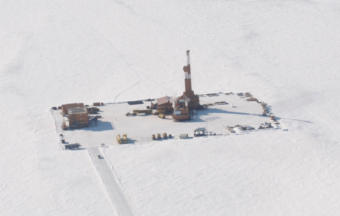
ConocoPhillips’ undeveloped Willow prospect, pictured here, is still being explored. The company announced this week that it’s selling a one-fourth stake in Willow and other projects in Alaska. (Photo courtesy ConocoPhillips)

The Trump administration has approved ConocoPhillips’ development plans for its massive oil project in the remote National Petroleum Reserve-Alaska, on the western North Slope.

Interior Secretary David Bernhardt signed the record of decision for the Willow project on Monday, earning praise from Alaska’s Republican Congressional delegation and governor, and condemnation from environmental groups.

The decision allows Conoco to construct up to three drill sites, plus an oil processing facility, pipelines, roads and other infrastructure.

The Willow project would be the North Slope’s westernmost oil field, and the Department of the Interior says the project could produce up to 160,000 barrels of oil a day, over 30 years.

U.S. Sen. Dan Sullivan said in a statement celebrating Willow’s approval that “the NRP-A is slated to be among the hottest energy prospects in the world.” Bernhardt said in a statement that the project will help keep oil flowing down the trans-Alaska pipeline, and will lead to hundreds of jobs.

“President Trump made his administration focus on American energy independence and the freedom it provides from day one of his term,” Bernhardt said.

But environmental groups are blasting the project, and say it poses significant risks to wildlife, including caribou and polar bears, and is a threat to the Teshekpuk Lake area, one of the Arctic’s most important habitats. Also, they say, it will further contribute to climate change in an already rapidly-warming region.

“The world remains mired in a global pandemic and the oil markets are experiencing continued volatility, yet this administration has once again opted to barrel forward with unnecessarily aggressive oil and gas development,” said a statement from Kristen Miller, conservation director at Alaska Wilderness League.

Conoco described the federal government’s approval of the Willow project as a “key milestone” and says construction could begin as early as next year. The company says it’s planning for oil production to begin in 2026, though it has also said the project could be delayed if Ballot Measure 1 passes, which supporters of the measure say they don’t believe.

More drill sites could be later added at Willow. The Interior Department says it will decide later on whether Conoco can add two additional drill sites. The oil and gas company requested the deferral on that piece of its proposal so it could do more community outreach, according to the federal agency.

Listen to Midnight Oil bonus episode: How a small, Arctic village found itself in the middle of Alaska’s new oil boom

As coronavirus infections surge across the state, Alaska finds itself at ‘a tipping point’

A health care worker with purple gloves handling a COVID-19 test swab
SEARHC personnel test a colleague for COVID-19 at the employee screening tent behind the hospital in April 2020. (Photo by Berett Wilber / KCAW)

Alaska is in the grips of its highest number of coronavirus infections yet, and some health experts say the state has again reached “a tipping point” in the pandemic.

Either Alaskans get the spread of the virus under control, they say, or infections will continue to multiply and could overwhelm the state’s health care system.

“If anyone needs to know, ‘Should I be worried? Are the alarm bells going off?’ The answer is yes,” said Jared Kosin, president and chief executive of the Alaska State Hospital and Nursing Home Association. “We need to control the spread.”

Alaska recorded a record-high 526 new coronavirus infections on Sunday, followed by 348 cases on Monday and 381 on Tuesday. For more than a month, the state has reported 100 or more new cases a day, with the daily tally hitting at least 200 new infections for almost two weeks straight.

The surge has prompted pleas from health officials that Alaskans avoid all activities with people outside of their households and, if they must be around others, to wear a mask and stay at least 6 feet apart.

During the last spike, in July, the state and its largest city either had stricter measures in place or put them in place in response to rising cases. While some have suggested that tighter rules, including a statewide mask mandate, may help now, Gov. Mike Dunleavy maintains that he supports a more localized approach. Anchorage just seated a new acting mayor.

Meanwhile, the virus has exploded in parts of rural Alaska, and in more urban areas too. A top Anchorage health official said last week that “there’s virus everywhere in the community.” Efforts to trace the close contacts of those infected are strained. Some villages have gone into lockdown. Infections are also rapidly rising in other parts of the country. And, due to a national shortage, health care workers in Western Alaska say they’ve been forced to reuse gloves.

“We’re clearly into our third wave,” said Dr. Tom Hennessy, an Anchorage physician and infectious disease epidemiologist who used to work for the federal Centers for Disease Control and Prevention. “We probably have more people with COVID walking around in Alaska than we ever have.”

By Tuesday, the state was reporting more than 7,500 known active coronavirus cases, and nearly every region in Alaska was in a “high-alert level,” meaning there’s widespread community transmission “with many undetected cases and frequent discrete outbreaks.” The state health department said cases are expected to continue to accelerate, and more testing is needed.
Graph showing regional alert levels for Alaska
Pandemic alert levels on Wednesday, Oct. 28, 2020, according to data from Alaska DHSS (Chart by David Purdy/KTOO)

According to The New York Times, Alaska on Tuesday had the eighth highest number of new coronavirus infections per 100,000 residents over the past seven days, compared to other U.S. states. It still had one of the country’s lowest death rates from the virus.

Kosin said what he’s most concerned about now is the degree of community spread in Alaska, and also the impact that’s having on hospitals, and will continue to have.

“This weekend, when we had over 500 positive cases statewide, the brunt of that is not going to hit our doors for a couple weeks,” he said. “So right now, we’re already strapped. I mean, definitely noticeable stress, in terms of staffing, in terms of just hospitalizations increasing, and the worst is yet to hit our doors.”


Increasing case numbers are not only linked to more hospitalizations, Kosin said, but also to more hospital staff not coming into work, either because they have the virus or because they’ve been in contact with someone who does. That’s exacerbating existing staffing shortages, he said. Fewer staff means fewer available hospital beds.

Also, capacity is further stressed as the virus infiltrates other health care facilities, and those buildings push pause on accepting new patients, Kosin said. That includes assisted-living homes and the Alaska Psychiatric Institute, which announced Friday that it won’t take new patients for two weeks.

“That means any patients that otherwise would go to API essentially sit in a hospital emergency room, and it creates a backup and when we have a backup, you start creating basically choke points within the system,” Kosin said.

The unpredictability of staffing shortages, facility closures and other variables makes it difficult to project precisely when the virus could overwhelm hospitals if the spread doesn’t slow, said Hennessy. One model, he said, shows Anchorage ICU beds filling up in about two months. The city has plans for surges, but concerns persist about staffing.

“We, with increased transmission, could threaten our hospital care system in December. Or we could, with a 10% decrease in transmission, get this under control,” Hennessy said. “We’re kind of in a fragile tipping point position right now.”

The state health department reported that that the number of new coronavirus cases in Alaska last week was 56% higher than the week prior. And, it said, that many Alaskans diagnosed with the coronavirus said they went to social gatherings, community events, church services or other social venues while they were contagious, but before they knew they had the virus.

Hennessy and Kosin questioned whether more should be done to try to control the spread of the virus, especially as temperatures drop and more Alaskans gather indoors.

“The methods that we’re using to try to convince people to change their behaviors do not appear to be working,” Hennessy said. “State public health is having a hard time keeping up with case contact investigations, data entry, even the simple things of reaching each positive case and giving them instructions about isolation.”

While some local communities, including Anchorage and Juneau, have mandatory mask orders, Hennessy said, a statewide rule would help.

“I think it would give enough coverage to enough communities that are suffering, and don’t have a mask order in place,” he said. “It would be cheap, it wouldn’t put anybody out of work, and it could have a huge impact on case numbers, hospitalizations, and it could save lives.”

Kosin said he’d support a statewide mask mandate too.

“It sure seems like something more is necessary than what we’ve been doing, given the results we’re seeing right now,” he said.

In an email Monday, Lauren Giliam, deputy press secretary for Gov. Dunleavy, said when it comes to implementing new measures to reduce the spread of the virus, the governor “stands by his support of local control.” Dunleavy will continue to “assess and respond as needed,” she wrote.

Alaska’s chief medical officer Dr. Anne Zink said last week that “many communities have their own restrictions based on different case levels and alert levels.”

“Mandates or no mandates, COVID really is determined by what we do individually,” she said.

In Anchorage, the city is recently under new leadership after Ethan Berkowitz announced on Oct. 13 that he would resign from his job as mayor. Austin Quinn-Davidson was sworn in as acting mayor Friday evening.

A city spokeswoman wrote in an email Monday that Quinn-Davidson was not available for an interview early this week about whether she was considering new measures in response to the rise in cases, and said the administration was “prioritizing getting her acclimated with the status of many policy items – COVID-19 included.”

At Tuesday night’s Anchorage Assembly meeting, Quinn-Davidson said the economy will not fully recover as long as there’s widespread coronavirus transmission, and Alaskans “must flatten the curve.”

“Gatherings are not safe,” she said. “If you’re feeling even mild symptoms, please get tested, please stay home and wear a mask and stay at least 6 feet from others outside your home.”

At the Providence Alaska Medical Center in Anchorage, the hospital has had plans in place for months to handle a surge in coronavirus patients, said chief medical officer Dr. Michael Bernstein. In the most dire case, he said, the hospital could fill the operating and recovery rooms with more beds. The Alaska Airlines Center could also be used.

The biggest challenge, Bernstein said, will be staffing. But the goal is to not get to a point where there’s that many Alaskans sick enough with the virus to get hospitalized.

To help bring the current rate of transmission down, Bernstein said, he’d support additional, government-led efforts, including a more sweeping requirement that people wear masks indoors, and an order limiting gatherings to about 10 people.

“That’s not a popular answer,” he said. “But if we flatten this again, and we start going down, I think you can relax it.”

Alaska records another 348 coronavirus infections on Monday

Juneau Airport COVID-19 test
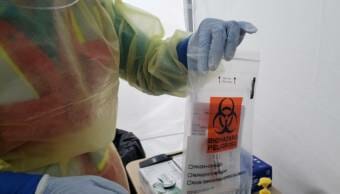
A public health worker in a tent outside Juneau International Airport bags a freshly collected nasal swab for COVID-19 testing on Sept. 1, 2020. (Photo by Jeremy Hsieh/KTOO)

The Alaska Department of Health and Social Services on Monday reported another 348 new coronavirus infections and no new deaths.

It’s the third-highest daily case count in Alaska since the pandemic began.

The state’s first and second highest case counts came over the weekend, with 526 new cases reported on Sunday and 355 new cases on Saturday.

State health officials are warning that the virus is in an acceleration phase, with widespread community transmission throughout much of Alaska.
All of the 348 cases reported Monday are in Alaska residents except one. The nonresident tested positive in Anchorage, the state reported.

Of the resident cases, 155 are from the Municipality of Anchorage. The case tally also included 59 newly-diagnosed Wasilla residents, 19 Palmer residents, 22 Fairbanks residents and another 10 residents in the broader Fairbanks North Star Borough. The rest of the residents who recently tested positive are spread from Utqiaġvik to the Bethel area to Kodiak to Homer to Ketchikan.

A total of 50 patients diagnosed with COVID-19 were hospitalized on Monday.

The City and Borough of Juneau reported 34 new cases of COVID-19 among residents on Monday. That includes cases that came in over the weekend. Four of the new cases are linked to the outbreak among Juneau’s unsheltered population, which includes 77 people so far.

Related: Sleeping options more limited as COVID-19 outbreak among Juneau’s unsheltered population grows

Conflicting claims, big money at heart of debate on Alaska’s oil taxes

Alpine
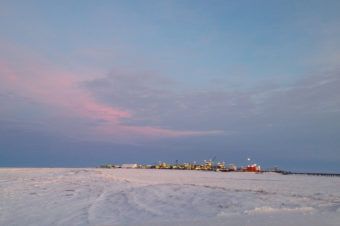
ConocoPhillips’ Alpine facility on the North Slope. (Photo by Elizabeth Harball/AED)

Alaska voters will decide next month whether to raise taxes on Alaska’s largest oil fields.

Ballot Measure 1 — dubbed the “Fair Share Act” by its sponsors — is an initiative that supporters say would fix Alaska’s oil tax law and fill the state’s deficit. But those opposed argue it would lead to less investment in Alaska and jeopardize the state’s economy.
In short: The two-page ballot measure is contentious and complicated, with each side citing its own set of facts.

As the Nov. 3 election approaches, here’s some of what we do know about the ballot measure and, if it’s approved, how it could impact Alaska.

What would Ballot Measure 1 actually do?

It would amend some of Alaska’s oil tax law.

Ballot Measure 1 would apply solely to North Slope oil fields that have pumped more than 400 million barrels and that are still producing more than 40,000 barrels a day.

Right now those are Prudhoe Bay, Kuparuk and Alpine. The main oil producers at those fields are ConocoPhillips, ExxonMobil and Hilcorp, which bought BP’s North Slope assets.

If voters approve the ballot measure:

  • The oil companies at those three fields would pay the state more in production taxes. That’s in part because the ballot measure would eliminate a per-barrel tax credit for those three larger fields.
  • The documents that companies submit to the state to calculate those production taxes would become “a matter of public record.” Right now, those documents are confidential.
  • A so-called “ring fence” would be created around the three oil fields, which would bar the companies from reducing their taxes on those larger fields using deductions earned at smaller fields.

(Read the entire two-page ballot measure here. And the state’s summary here.)

Who’s backing the ballot measure?

A group called Vote Yes for Alaska’s Fair Share that’s chaired by Robin Brena, an Anchorage attorney.

Anchorage attorney Robin Brena and other supporters of the initiative to raise oil taxes pose for a photo on January 16, 2020. Supporters of the initiative to raise oil taxes pose for a photo on Jan. 16, 2020. From left to right: Les Gara, Jane Angvik, Robin Brena, David Carter and Harry Crawford. (Nat Herz/Alaska’s Energy Desk)

Others listed as officers of the group include: Jane Angvik, a former Anchorage Assembly chair and former member of the commission that wrote the charter for the Municipality of Anchorage. Former state Rep. Les Gara, an Anchorage Democrat, is also supporting the ballot measure alongside Anchorage Democratic Sen. Bill Wielechowski and Ken Alper, who worked as director of the state’s tax division under former Gov. Bill Walker, an independent.

The group recently reported raising about $1.4 million from about 700 donors. The largest chunk of that money has come from Brena himself.

And who’s fighting Ballot Measure 1?

OneAlaska—Vote No on One, a group that’s getting almost all of its money from oil companies. The group is chaired by Chantal Walsh, former director of the state’s Division of Oil and Gas under Walker.

OneAlaska chairwoman Chantal Walsh, a petroleum engineer and former director of the state’s Division of Oil and Gas, addresses the crowd at a OneAlaska rally on Thursday, Feb. 13, 2020 at Delta Constructors in Anchorage. (Tegan Hanlon/Alaska Public Media)

Its other leaders include former state Rep. Jason Grenn, an Anchorage independent, Crawford Patkotak, chairman of the board for Arctic Slope Regional Corp., Kara Moriarty, head of the Alaska Oil and Gas Association and Bill Popp, head of the Anchorage Economic Development Corp.

The group has raised a ton of money so far: about $18.5 million. It’s major contributors are Conoco, Exxon, BP and Hilcorp. The Alaska Chamber is also running attack ads against the measure and has raised about $2 million more from Conoco and Hilcorp.

Why did initiative backers bring forward this ballot measure now?

Because of Alaska’s budget crisis, says Vote Yes for Alaska’s Fair Share. “Ballot Measure 1 is the only revenue option that can be implemented in time to save Alaskan jobs,” the group says.

Meanwhile, OneAlaska counters that the ballot measure would lead to fewer oil jobs, jeopardize new projects and only fill a small slice of the state’s budget hole. It says the measure goes too far.

How much additional revenue would Ballot Measure 1 bring into the State of Alaska?

It’s hard to say for sure, said Mouhcine Guettabi, an associate professor of economics at the University of Alaska Anchorage. That’s because calculating new revenue requires assumptions about both the price of oil and the amount of oil produced in the future, he said.

“Uncertainty around price, uncertainty around the production response and, obviously, uncertainty around future investments — all three of those things make it difficult to know exactly what the amount is,” he said.

The state Department of Revenue has provided a window into what revenue might look like if oil production stays the same next fiscal year, and if companies’ investment doesn’t change. With prices at $45 a barrel, production taxes would total $191 million under the current law and nearly triple under Ballot Measure 1, growing to $564 million.

That’s a little more than half of Alaska’s current deficit, which is roughly $1 billion, but less than a fourth of the deficit if lawmakers decide to pay a larger Permanent Fund dividend under the historical legal formula.

The state Department of Revenue has provided estimates on Ballot Measure 1’s on oil taxes. It says the estimates in the chart are based on the Spring 2020 revenue forecast for Fiscal Year 2022 and “assumes no changes in produced oil volume or company investment because of the tax change.” (Screenshot of Oct. 2, 2020 presentation)

How would the ballot measure, if approved, impact oil and gas companies’ investment in Alaska?

It depends on who you ask.

Moriarty, the campaign manager for OneAlaska, said there’s no question that higher taxes would lead to less investment and less drilling in Alaska and have dire impacts on the industry that underpins the state’s economy. Conoco has threatened that if the ballot measure passes, projects like the Willow discovery on Alaska’s western North Slope would be delayed.

“Oil companies have a hundred other places that they can invest their money. And they won’t leave Alaska right away, but they just won’t spend more,” Moriarty said. “Things will start to die off here. And they’ll go move somewhere else, and they’ll take their employees with them.”

At Vote Yes For Alaska’s Fair Share, campaign manager David Dunsmore said the state cannot subsidize the oil and gas industry any longer. Senate Bill 21 — a controversial piece of legislation passed in 2013 that cut oil taxes — is not working, he said. Oil companies will still make money in Alaska even if they pay more taxes, he said.

“It’s still going to be a very profitable place for them to continue doing business,” he said.

Guettabi, the economist, is less sure. He said the question of how sensitive oil production is to tax changes is one of the most studied questions in economics, “and we don’t really have a definitive answer.” It’s especially hard to study the potential impacts of Ballot Measure 1 in the middle of a pandemic, with multiple business sectors struggling and with low oil prices, he said.

“It just makes a messy situation even messier,” he said.

And what about making more documents public and ring fencing? What do the two sides say about those?

Dunsmore, with Vote Yes For Alaska’s Fair Share, said Alaskans deserve to see the information in the documents so they can make informed decisions about managing the state’s natural resources. That includes details about how much in profit oil companies are making, he said. He said ring fencing will eliminate a tax loophole in SB21, and companies shouldn’t be able to take expenses from other fields to lower their taxes at the “three large, incredibly profitable fields.”

On the other side, Moriarty, with OneAlaska, said oil companies and the smaller companies they do business with will lose their competitive advantage by making expenses and pricing public. She said it’s unprecedented. And, she said, ring fencing eliminates incentives for companies to expand into an area that’s not yet producing oil because companies are more likely to invest money when they know they can deduct their expenses from taxes on fields that are currently active.

If voters do pass Ballot Measure 1, can the state Legislature later change the language in it?

According to Alaska’s constitution, the Legislature could amend it at any time, but couldn’t entirely repeal it for two years.

Have Alaska voters weighed in on oil taxes before?

Yes. Most recently, in 2014, Alaska voters narrowly rejected the repeal of SB21.

Former SAExploration executive arrested on charges of wire fraud, securities fraud

Jeff Hastings, Chairman and and Chief Executive Officer of SAE Exploration, answers questions after his testimony before the House Resources Committee in Juneau. (Rashah McChesney/Alaska’s Energy Desk)

The former chief executive of a company that proposed conducting a seismic survey in Alaska’s Arctic Refuge was arrested in Anchorage on Friday on charges of wire fraud and securities fraud.

The federal charges are tied to Jeffrey Hastings’ work as CEO and board chairman of SAExploration, a Texas-based company that provides seismic data to the oil-and-gas industry. The company also has offices in Anchorage.

A complaint written by an FBI agent investigating the case — and unsealed on Monday — alleges that, between 2015 and August 2019, Hastings engaged in a multi-million-dollar scheme to deceive investors and artificially inflate the company’s revenue.

Hastings’ lawyer, Michael Dry, did not respond on Tuesday to requests for comment on the charges.

The 14-page complaint from the FBI details numerous allegations of financial wrongdoing.

Among them: It says Hastings made “false and misleading statements” to the U.S. Securities and Exchange Commission. It says he created a second company, Alaskan Seismic Ventures, as a way for SAExploration to take advantage of certain Alaska oil tax credits that it wasn’t eligible for. And, it says, he set up shell organizations to move money between the two companies so Alaskan Seismic Ventures could appear “independent and financially healthy.”

The complaint does not say whether the State of Alaska was defrauded, but according to SAExploration’s most-recent annual report, Alaskan Seismic Ventures collected millions of dollars in tax credits.
The report says the Securities Exchange Commission, Department of Justice and state Department of Revenue were investigating the company’s financial statements.

Colleen Glover, Alaska’s tax director, said the state considers tax matters confidential, so the department could not comment on any potential investigations. Reports from 2016 through 2019 show that SAExploration and Alaskan Seismic Ventures did not receive any cash from the state for oil and gas tax credits during those years.

Also, according to the FBI complaint, Hastings didn’t work alone.

The complaint says he conspired with three other now-former company executives who aren’t named in the complaint. At least one agreed to help law enforcement with the investigation.

The complaint says the four of them “misappropriated” more than $6 million of SAExploration funds for “their own personal use.”

In a brief written statement Tuesday, SAExploration spokeswoman Sarah Marshall said the company is now under new management and continues “to work hard to provide the same operational excellence that our customers have come to expect.”

Marshall said Hastings was put on administrative leave more than a year ago and then resigned.

SAExploration announced in 2019 that it was under investigation by the Securities and Exchange Commission for “certain accounting matters that arose in 2015-2016.” This August, the company filed for bankruptcy and said it reached an agreement with most of its creditors to restructure its debt, the Wall Street Journal reported.

Meanwhile, Hastings had his initial appearance in federal court in Anchorage on Tuesday. He had been jailed at the Anchorage Correctional Complex since Friday.

“We just don’t want him locked up for another night,” Hastings’ lawyer told the judge.

The judge said Hastings could be released on a $500,000 bond secured by $100,000 cash. Hastings’ next court date was set for October.

A flurry of lawsuits aim to stop drilling plans in Alaska’s Arctic. So what’s next?

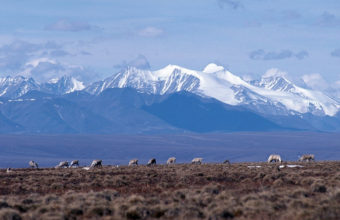
Caribou graze on the coastal plain of the Arctic National Wildlife Refuge, with the Brooks Range as a backdrop in October 2010.
Caribou graze on the coastal plain of the Arctic National Wildlife Refuge, with the Brooks Range as a backdrop. (Public domain photo by U.S. Fish and Wildlife Service)

Alaska Native groups, environmental groups and, most recently, a coalition of 15 states have filed a flurry of lawsuits over the past month that aim to derail drilling plans for Alaska’s Arctic National Wildlife Refuge and National Petroleum Reserve.

These are separate lawsuits over separate pieces of land — a lot of land — and it’s a lot to keep track of.

Listen to the interview or read the transcript of Alaska Public Media’s Tegan Hanlon and Casey Grove trying to sort through it all.

[GROVE]: Well, let’s just get right into it. Can you briefly summarize what triggered these lawsuits?

[HANLON]: Yes. So there have been two big, recent developments when it comes to oil and gas drilling on Alaska’s North Slope.

Number one: The Trump administration announced in August its official plan for opening up part of the Arctic Refuge to oil and gas development. It’s an area called the coastal plain, and it sits to the east of Prudhoe Bay. The coastal plain makes up about 8% of the whole refuge. But the whole refuge is massive, so 8% of it is about the size of the state of Delaware.

It’s a place believed to hold billions of barrels of untapped oil, but it’s also an area where caribou migrate, polar bears den and migratory birds feed. And environmental groups have long fought to keep drilling rigs out.

And so, this official plan for oil and gas development on the land comes out in August, and Interior Secretary David Bernhardt says that the federal government could auction off drilling rights in the coastal plain to oil and gas companies by the end of the year. (Once leases are issued, it will be harder for a future president to reverse course.)

All of it is a very big deal.

[GROVE]: OK. I got that part. So, what’s number two.

Significant development number two: On the other side of Prudhoe Bay, to the west, sits Alaska’s National Petroleum Reserve, also called the NPR-A. There’s already some oil and gas development going on in the NPR-A, but there’s also land that is off-limits to drilling under the current Obama-era plan for the reserve.

But the Trump administration is working on a new management plan for the reserve, and it released its final environmental impact statement for that plan in June. The proposal would make about 80% of the NPR-A open to drilling instead of the current 50% or so. And that includes opening up the Teshekpuk Lake area — in the reserve’s northeastern corner — to drilling.

The next step is the government issuing what it calls a record of decision — or you might hear it referred to as a “ROD” — basically it’s just the final decision.

Again, all of it is also a very big deal.

And, like the Arctic Refuge, the NPR-A is also thought to hold billions of barrels of oil but it’s also an important habitat for birds and caribou and other wildlife. In both areas, there’s also concerns about impacts to subsistence, the climate and the land.

[GROVE]: And then came the lawsuits, right?

[HANLON]: Yes! And then came an avalanche of lawsuits.

Actually, two of the lawsuits related to development in the Arctic Refuge’s coastal plain were filed Wednesday.

One by a tribal government and two village councils and another by a coalition of 15 states including New Jersey and New York and Washington, but not including Alaska.

Taken together, the lawsuits are hundreds of pages.

At the most basic level the claims very broadly boil down to alleging that the federal government glossed over the impacts that oil and gas development could have on the land, wildlife, climate and subsistence. And, they say, the government failed to follow numerous environmental laws when developing the plans.

Here’s how EarthJustice attorney Kate Glover summarized the claims in one of the Arctic Refuge lawsuits:

“The problem is that BLM is pushing prioritizing oil and gas over all other purposes… all of the claims in the lawsuit are targeting their failure to take into account the impacts on Indigenous communities, wildlife, subsistence and recreational wilderness values of the refuge.”

The Bureau of Land Management counters that its actions are lawful and based on the best available science.

[GROVE]: So what’s the status of the lawsuits currently?

Well, they’re all in U.S. District Court in Alaska, so federal court. We’ve got the two just filed. And there are at least four others that are still really early on in the process.

Lawyers say the NPR-A lawsuits will likely start moving through the court process once the federal government issues its final decision on a management plan.

And, lawyers who filed two other Arctic Refuge lawsuits say they’re now waiting on the federal government to answer the complaint. One lawyer I spoke with said a ruling from the judge may not come for a year or so.

[GROVE]: Can the federal government move ahead with a lease sale with lawsuits ongoing?

[HANLON]: The short answer is: Right now, yes.

The Bureau of Land Management says “there is no legal prohibition” right now for it to move forward with a lease sale, in the case of the Arctic Refuge, or a final decision on a management plan, in the case of the NPR-A.

Then if a judge rules in a way that makes the lease sale or the management plan invalid, well, that’s a whole other conversation for us to have.

Also: I was curious if the filing of the lawsuits would have any impact on oil companies’ decisions on where to drill.

Lawyers who filed the lawsuit are hopeful that’s the case.

But Kara Moriarty who leads the Alaska Oil and Gas Association says she doubts it. She says the lawsuits aren’t surprising.

“Lawsuits have just become a way of life. And it was not surprising to us. If the industry was concerned about lawsuits these days, they’d probably never invest in Alaska anymore in the oil and gas industry. Trying to use lawsuits to keep resources in the ground has become a tried and trued page out of a playbook by groups.”

[GROVE]: Well, to close out: Any ETA at this point on a lease sale or official decision on the NPR-A management plan?

[HANLON]: No, no set date announced publicly at this point. That’s the million-dollar question.

Site notifications
Update notification options
Subscribe to notifications