Tegan Hanlon, Alaska Public Media

Site of Alaska’s largest COVID-19 outbreak begins third round of testing, as some patients grow worse

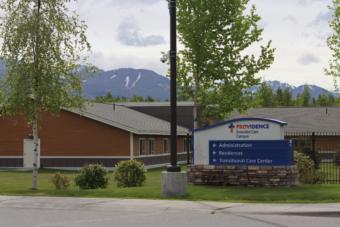
The Providence Transitional Care Center shares a campus with Providence Extended Care in East Anchorage. On Monday, June 1, 2020, it was quiet outside of the campus with a security vehicle parked at the entrance. (Tegan Hanlon/Alaska Public Media)

A third round of testing is expected to start Thursday at the Providence Transitional Care Center in Anchorage as health officials continue to try to contain Alaska’s largest coronavirus outbreak.

More than 40 of the center’s patients and caregivers have tested positive for COVID-19 so far.

One of the patients died on Sunday, Alaska’s 11th coronavirus-related death. Other patients have been hospitalized with the disease, and one was in very serious condition on Wednesday, said Dr. Michael Bernstein, chief medical officer for Providence Health & Services Alaska, the operator of the center.

“It’s humbling how transmissible this virus is,” Bernstein said in a call with reporters late Wednesday afternoon. “People were doing excellent practices.”

Bernstein said the center stopped allowing visitors at the East Anchorage health-care campus in March and enacted strict procedures, including universal masking, to try to keep the virus out after watching COVID-19 tear through long-term care facilities in other states, including Washington.

“At least a third of the deaths in the U.S. from COVID are from residents of long-term care facilities,” Bernstein said. “And particularly following the outbreak at the Life Care in Kirkland, that was really a warning cry to all of us.”

Patients usually spend weeks at the Anchorage transitional center to recover from serious illness, injury or surgery before heading home or to assisted living. The center shares a campus with Providence Extended Care, a long-term care facility that mostly serves older people who live there for years.

The coronavirus has proven particularly deadly among older people and those with underlying medical conditions. And it has shown to spread quickly in settings where people live in close quarters.

That’s why, Bernstein said, Providence locked down the campus quickly.

“Fortunately for the first two and a half months or so of the pandemic, this site was entirely clear of COVID,” he said.

Then the virus got in, he said, as the state started to open back up and record a climbing number of COVID-19 cases.

“After our reopening, with increased community spread that we’ve been seeing now for several weeks, a resident developed a fever on Thursday, May 28, and was tested. And the following day, we had a positive test,” he said.

Bernstein said he believes the patient became infected at the center. But he doesn’t know exactly how. There are about 50 patients at the center and about 145 employees.

“We know that it had to come in from the outside,” he said. “And so the two main ways that would happen would be either: One or more caregivers could have acquired it in the community and brought it in. Or, a new resident that we could have taken, could have brought it in.”

After the first confirmed case, Providence tested hundreds of caregivers, patients and residents on the campus. Bernstein said too many positive cases came back to pinpoint the source of the virus.

A recent round of testing also found a positive case in an employee from Providence Extended Care who had shown no symptoms, Bernstein said. By Wednesday, there were no positive tests among the residents there. Bernstein said thankfully those 96 residents are separated between eight cottages on the site, spreading out the population.

“They’re like individual homes that were built to create more of a family-like atmosphere,” he said. “But it’s kind of a godsend now.”

Patients at the transitional center who have tested positive are now quarantining in their rooms. They’re all in one wing of the center, Bernstein said. All other patients are also under direction to stay in their rooms.

“They’re really confined to the rooms unless there’s something they absolutely need,” Bernstein said, such as medical care.

Employees with the disease are staying at home.

That has created a staffing shortage, and prompted Providence to recently move about a half-dozen patients to its St. Elias Specialty Hospital in Midtown. That wasn’t without complications. One of those patients tested negative, but then received what Bernstein described as a “conflicting” test result that’s under investigation. That patient was moved back to the transitional center.

“They were tested by a very reliable method before being moved, and it said negative,” Bernstein said. “But then a test from the sweep raised the possibility of it being positive.”

Bernstein said Providence will continue to test patients and staff on the campus weekly until no new positive cases occur. Even after that, he said, he hopes to do periodic tests.

Reflecting on the past few weeks, Bernstein said, it’s difficult to say what Providence could have done differently. The only thing he could think of, he said, was regularly testing the campus earlier.

“But,” he said, “we really didn’t have the testing capacity.”

Now, it’s a complicated balancing act to control the virus spread in a state that’s largely reopened.

“We knew we would see more cases when we opened up. We have the capacity to take care of the very ill when those resources are appropriate,” he said.

“But, you know, we’re living within that balance and it’s hard to titrate,” he said. “We really, really want to keep the virus out of these long-term care facilities.”

Also, family of caregivers have tested positive for COVID-19. Alaska’s chief medical officer Dr. Anne Zink said Wednesday that at least nine of Alaska’s coronavirus cases are linked to close contacts of caregivers from the campus.

In a call with medical providers and others Tuesday evening, Zink said the state was in the process of testing everyone in long-term care facilities in the Kenai, Mat-Su and Anchorage areas as a preventative measure.

“As you saw,” she said, “one case quickly led to a whole lot more.”

Patient at Anchorage transitional care center is the latest Alaskan to die of coronavirus


Updated at 7:30 p.m.

Another Alaskan has died from COVID-19 after more than a month of no fatalities linked to the disease.

The person was a patient at the Providence Transitional Care Center in East Anchorage — the site of the state’s largest coronavirus outbreak.

The patient tested positive for the virus and then was hospitalized, said Mikal Canfield, a spokesman for Providence Health & Services Alaska, which operates the transitional center. The patient died at the Providence Alaska Medical Center.

“This resident was a cherished member of the PTCC family, and we are deeply saddened,” Canfield said in a statement. “We extend our sympathies to their family and loved ones in their time of loss.”

Canfield didn’t provide the patient’s age or information on any underlying medical conditions, citing patient privacy.

The patient is the 11th Alaskan to die with the virus. The death comes as Alaska recorded another double-digit, daily increase in coronavirus cases in the state. By the end of the day Monday, 11 more Alaskans had tested positive for the disease. So had two more seafood workers from out of state.

Six of the Alaskans are from the Municipality of Anchorage, two are from the Kenai Peninsula Borough, one is from the Nome census area, one is from the Northwest Arctic Borough and one is from Haines, which the borough reported on Monday. It’s the first case in the Southeast Alaska community.

Also, the health department said Tuesday that it reclassified a previously reported case after further investigation. A case described as an Alaskan on the Kenai Peninsula Borough was actually a nonresident.

It wasn’t immediately clear how many of the new cases are linked to the ongoing outbreak at Providence’s East Anchorage campus.

Health officials confirmed the first case on the campus on May 29. A patient at the transitional care center had developed a cough and fever, and then tested positive for the infectious disease.

By Tuesday, 17 patients and 26 caregivers had tested positive for the disease at the transitional center. Patients typically spend weeks at the transitional center as they recover from injury, surgery or illness before heading home or to assisted living.

Also, a caregiver at Providence Extended Care has tested positive for the disease and is quarantining at home, Canfield said. The extended care facility serves mostly older people and shares a campus with the transitional center.

Providence is on its second round of testing all residents, patients and employees on the campus, Canfield said. It was still waiting for some results on Tuesday, and planned for a third round of testing at the end of the week.

The number of new coronavirus cases in Alaska each day has reached the double-digits several times over the past two weeks, after more than a month of small, daily increases. The state started to lift coronavirus-related limitations on businesses in late April and removed them completely in late May.

By the end of the day Monday, the state had recorded 573 coronavirus cases among Alaskans: 389 of them are considered recovered, 173 of them are active cases and there are 11 deaths. A few of the deaths are Alaskans who died out of state.

The last death was a man from Anchor Point who was older than 80 and had pre-existing conditions.

State health officials say a death is included in its coronavirus data if the person was confirmed to have COVID-19 through a lab result and then died during the course of having the disease or through complications related to the disease. It is also included if the medical examiner conducts a death investigation which results in a positive COVID-19 lab test. COVID-19 is the disease caused by the coronavirus.

The health department on Tuesday also reported another person has been hospitalized with the disease in Alaska, bringing that total to 49 since the state started tracking the coronavirus in March. As of Monday, 12 people were currently in the hospital who either tested positive for the virus or were awaiting results.

The total number of tests administered in the state has reached 66,890, up nearly 1,000 from a day earlier. The total number of nonresidents who have tested positive for the disease is now 49.

Also Tuesday, the state transportation department announced another six Alaska Marine Highway employees from the Tustumena ferry have tested positive for COVID-19, bringing the total number of cases to seven. The seven crewmembers will remain in isolation on the Tustumena. Health-care workers are monitoring them, the department says.

Those six cases will be included in the state’s case count on Wednesday. The state’s daily, data update is based on the prior day’s numbers.


Original story

Alaska’s health department on Tuesday reported an 11th person has died with COVID-19, the disease caused by the coronavirus. There are 14 new cases of the disease.
The person who died was an Anchorage resident, according to Audrey Gray, a spokeswoman for the municipality’s emergency operations center.

Additional details about the death were not immediately available from the city or the state. It’s the first death reported in more than a month.

Of the 14 new cases, three are nonresident seafood workers and the rest are among Alaskans from across the state, according to the department’s data update of cases through the end of the day Monday.

Six of the Alaskans are from the Municipality of Anchorage, two are from the Kenai Peninsula Borough, one is from the Nome census area, one is from the Northwest Arctic Borough and one is from Haines, which the borough reported on Monday. It’s the first case in the Southeast Alaska community.

It wasn’t immediately clear how many of the new cases are linked to an ongoing outbreak at a health-care campus in East Anchorage, where 42 caregivers and patients have tested positive for the disease — 41 of them from the Providence Transitional Care Center and one caregiver from Providence Extended Care.

The number of coronavirus cases in Alaska each day has reached the double-digits several times over the past two weeks, after more than a month of small, daily increases. The state started to lift coronavirus-related limitations on businesses in late April and removed them completely in late May.

By the end of the day Monday, the state had recorded 573 coronavirus cases among Alaskans: 389 of them are considered recovered, 173 of them are active cases and there are 11 deaths. A few of the deaths are Alaskans who died out of state.

The last death was a man from Anchor Point who was older than 80 and had pre-existing conditions.

State health officials say a death is included in its coronavirus data if the person was confirmed to have COVID-19 through a lab result and then died during the course of having the disease or through complications related to the disease. It is also included if the medical examiner conducts a death investigation which results in a positive COVID-19 lab test. COVID-19 is the disease caused by the coronavirus.

The health department on Tuesday also reported another person has been hospitalized with the disease in Alaska, bringing that total to 49 since the state started tracking the coronavirus in March. As of Monday, 12 people were currently in the hospital who either tested positive for the virus or were awaiting results.

The total number of tests administered in the state has reached 66,890, up nearly 1,000 from a day earlier. Also, the total number of nonresidents who have tested positive for the disease is now 49.

Correction: An earlier version of this story incorrectly stated the number of new cases in Alaska reported by the state on Tuesday. There were 13 new cases, not 14. A case the state previously reported and described as an Alaskan on the Kenai Peninsula was re-categorized as a nonresident after further investigation, the health department says. It is a not a new case.

Theater, chemistry, sociology among dozens of academic programs cut at the University of Alaska system

A sign on the campus of the University of Alaska Anchorage. (Photo by Tegan Hanlon/Alaska Public Media)

The state’s public university system is eliminating dozens of degree and certificate programs from theater to chemistry to creative writing to close a budget gap driven by cuts to state funding and declining enrollment, and exacerbated by the coronavirus pandemic.

The University of Alaska Board of Regents on Friday approved cutting about 40 programs and reducing or merging several others. It’s part of an effort by the UA administration to scale-down the university system as revenue sources shrink.

Regent Karen Perdue said it’s the largest number of program reductions at UA in recent memory, and reflects the tough financial times the university system is in.

“The choices are difficult,” Perdue said in a statement. “Hard questions have been asked and refinements have been made.”

The academic cuts stem from a months-long review process. Students, faculty and community members have pushed to save some of the programs — arguing they have healthy enrollments and are unique to UA. Perdue said UA had to make difficult choices.

The program cuts will impact 30 faculty and staff. Also, almost 700 students are enrolled in the programs, according to UA. UA says those students will be able to complete their degree or certificate. That’s a requirement from accreditors.

Faculty say many more students take classes from the programs.

The programs eliminated include:

  • At the University of Alaska Anchorage: Bachelor’s degree programs in sociology, hospitality administration, theater and environment and society, plus master’s degree programs in early childhood special education and creative writing and literary arts.
  • At the University of Alaska Fairbanks: Bachelor’s degree programs in sociology, earth science and geography, plus master’s degree programs in biochemistry and space physics. The bachelor of arts in chemistry was also cut, but UAF still has a bachelor of science in chemistry. Some of the programs were previously suspended.
  • At the University of Alaska Southeast: A bachelor’s degree program in geography and environmental resources.

Read the full list of programs cut, merged and reduced here.

UA says the cuts will save about $4 million.

Regents also agreed on Friday to several other ways to cut spending including restructuring debt, suspending pay increases and furloughs. UA regents tasked administrators to further study a controversial proposal to merge UAS programs into the Fairbanks and Anchorage universities. The proposal has drawn widespread criticism.

Clarification: This story was updated to include that UAF still has a bachelor of science in chemistry.

The state has revised its two-week quarantine requirement. Here’s what we know about the changes.

Signs at the Ted Stevens Anchorage International Airport direct travelers where to go depending whether they have their declaration form filled out and whether they have proof of a negative result from a test for COVID-19. (Tegan Hanlon/Alaska Public Media)

Update — On July 28, 2020, Alaska Gov. Mike Dunleavy announced that starting August 11th, nonresident travelers to the state will be required to have a negative COVID-19 test.

For more than two months, Gov. Mike Dunleavy’s administration has required people traveling to Alaska from out of state to quarantine for two weeks once they get here. But, that changed Saturday.

The state is now allowing visitors to get tested for COVID-19, instead of quarantining, if they’re taking a flight to Alaska.
It’s a complicated new policy, and many questions remain about how exactly it will work. Also, late Friday, the Municipality of Anchorage announced its own rules for travelers that are largely similar to the state’s, but with some extra restrictions, including where travelers can go until they get a follow-up test.

Here is some of what we know so far about the new guidelines:

What are the alternatives to quarantining? 

Let’s start with the options for testing ahead of time, according to the state:

• You can get a PCR test — the swab that goes up your nose — within 72 hours of your flight, and bring proof of the negative result with you. (Yes, that 72-hour clock starts when you get tested, not when you get the result back, confirmed Heidi Hedberg, the state’s director of public health.) In a FAQ document, the state bills it as the “fastest and safest way to ensure your ability to explore Alaska right away.” The state says you need to “minimize your interactions” until you get a negative result from a second test to be taken 7 to 14 days after your arrival.

• If you need just a little more time, the state is accepting results from PCR tests taken up to five days before departure. But, if it’s more than 72 hours, you’ll still have to take a second test when you get to the airport and minimize your interactions until that result comes back. Also, the state says, you should continue to minimize your interactions until 14 days have passed or until you get results from a third test taken at least 7 days after your arrival.

The state says it’s giving out vouchers at airports for the follow-up tests.

What if I don’t get my results back in time for my flight? 

The state says in its FAQ document: “You can quarantine at arrival until the results arrive. Once you provide the results to the state, your quarantine is over.”

And, if I can’t get tested ahead of time? 

You can quarantine for two weeks in Alaska. Or, get tested at the airport when you arrive and quarantine until the result comes back. But the state cautions that test availability is not a guarantee.

On Friday afternoon, Hedberg said she wasn’t concerned about having enough swabs for visitors — at least right now. At a recent news conference, however, Alaska’s chief medical officer said availability could change if coronavirus cases surge in the state.

“We are going to do our absolute best to have testing available,” said Dr. Anne Zink. “But if we have a huge spike in cases and we have to do a bunch of case investigations, Alaskans come first.”

Do people have to pay to get tested at the airport? 

No, Hedberg said.

How long will it take to get results back if I opt to test when I get here? 

It could take anywhere from a few hours to a few days, the state says. Hedberg said Friday that tests sent to the state lab were taking 24 to 48 hours to return, but “those timelines are kind of constantly varying.”

Will the state find me a place to quarantine? 

No, Hedberg said. That’s on you and at your own expense. It could be in a hotel room or a home, but it cannot be in a RV that is moving from place to place.

Is anybody tracking where I quarantine? 

The state has rolled out a new declaration form. (Check it out here.) Hedberg said travelers should print it out and bring it with them. The state is also working with airlines to have it available on planes.

If you are quarantining, you write down the address you’ll be staying at, Hedberg said.

However, as the Anchorage Daily News reported, the quarantine requirement relies on voluntary cooperation and not enforcement.

What does quarantining actually mean? Can I go to the grocery store? 

Hedberg said it means you don’t go out in the public unless it is for medical care.

“Stay at your residence. Stay at that location until you can get your results. Do not go to the grocery store,” she said.

What if my result comes back positive?

If you test positive, you have to quarantine for 14 days or until a health official clears you after a subsequent, negative test result, says the state’s FAQ.

“We strongly encourage travelers to obtain a test prior to travel to reduce the possibility of this occurring,” the document says.

Does my whole family have to get tested? 

Everybody age two and older has to get tested to be released from the 14-day quarantine requirement, says the FAQ document.

Richard Clarke, left, and Namfon Noisai answer screening questions after landing at Juneau International Airport on Saturday, March 21, 2020 in Juneau,
Richard Clarke, left, and Namfon Noisai answer screening questions after landing at Juneau International Airport on Saturday, March 21, 2020 in Juneau. The airport sees multiple daily flights to and from Seattle — one of the epicenters of coronavirus spread in the United States. (Photo by Rashah McChesney/KTOO)

So, what will the airport look like now? 

There will be many more employees at airports in Alaska. The City and Borough of Juneau is hiring temporary workers to meet, greet and screen passengers. At the Ted Stevens Anchorage International Airport, the state has hired Capstone Family Medicine to provide screening.

“We’re going to have 58 people working 12-hour shifts supporting this project,” said Dennis Spencer, Capstone chief executive.

In Anchorage, greeters will direct travelers to areas in the terminal where they hand in their declaration forms, Spencer said. Staff will also review testing results and provide testing and vouchers if needed. Spencer didn’t have an estimate Friday for how long it will take someone to go through the process. It was too soon, he said.

“This is new to all of us. I don’t want to give you bad information,” he said. “But we’re gonna make sure that we do this as quickly as we possibly can.”

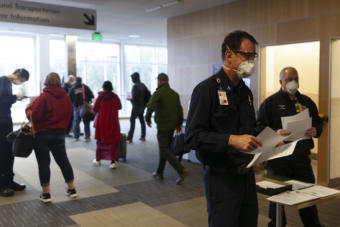
One of the new screening areas at the Ted Stevens Anchorage International Airport. Employees will take travelers’ new declaration forms and any proof of a negative test result. They will also provide testing here. (Tegan Hanlon/Alaska Public Media)

Wait. What if I’m an Alaskan who’s leaving for a trip?

The state says you should check the local rules for where you’re headed.

If you’re an Alaska resident flying back from a trip out of state that was five days or less, you don’t have to get tested out of state. You can either quarantine for 14 days back in Alaska or get the PCR test in the terminal when you return, quarantining until you get the result, according to the state’s mandate. You will also get a voucher for a second test to be taken 7 to 14 days after you return, and you should minimize your interactions until you get that second result.

If your trip is longer, you have the same array of options as visitors.

So does this only apply to me if I’m taking a flight to Alaska?
For now, the testing infrastructure is only at airports, Hedberg said on Friday. She said the state is still asking people driving to Alaska to fill out the declaration forms and to get tested ahead of time.

But there isn’t any testing at border crossings, Hedberg said. At least, not yet. There aren’t that many people driving into Alaska, with Canadian borders closed to non-essential travel. 

“We’re taking this in sort of a staggered, tiered approach,” Hedberg said. “We’re really focusing on air and we’re making sure that we’re hitting the major airports in planning and setting up this infrastructure.”

Next week, she said, the state will focus on smaller communities. Then it will look at border crossings and seaports.

“We’ve got to take small bites,” she said.

Can local governments set their own rules? 

Yes. The state is advising travelers to check with their final destinations to learn about any local restrictions.

Anchorage issued its emergency order for international and interstate travel Friday night. Its rules are tighter than the state’s. Here are two of the main differences:

• The city has defined what minimizing in-person interactions means. In Anchorage, it means you can’t dine-in at restaurants or visit indoor attractions like museums or theaters. You also need to wear face coverings when around non-household members. That applies to travelers who are waiting for their second or third test results.

• The city says people getting to Anchorage within 14 days of arrival in Alaska must inform their hotel or rental lodging of their quarantine status and whether they’re required to minimize in-person interactions. The city says businesses may refuse to serve people who are in quarantine or “minimal-interaction status.”

Do these travel requirements have an expiration date? 

Not right now. Gov. Mike Dunleavy said at a recent news conference that the state will re-evaluate the requirements every day and watch the number of coronavirus cases in Alaska, monitoring for a spike. Anchorage’s rules stay in effect until changed.

Lisa Starr, a visitor from Kansas, talks to Jeremy Zidek, a spokesman for the state Department of Homeland Security and Emergency Management. Starr had questions about what to do with her declaration form and proof that she had tested negative for the coronavirus within the past three days. Starr is visiting her newborn grandson. She said it took her days to find a testing site with a quick-enough turnaround time. Photographed at the Ted Stevens Anchorage International Airport on Friday, June 5, 2020. (Tegan Hanlon/Alaska Public Media)

What do I do if it’s too hard to get testing in my home state?

Know that you are not alone.

Hedberg, the director of public health, said the state has received an overwhelming number of calls from people with similar concerns.

“That’s why we have testing available at the airports,” she said, “to make sure that they are tested.”

What about these vouchers? 

Travelers will get them at the airport and use them for a second or third test to be taken 7 to 14 days after their arrival. The voucher will cover the cost of the test if insurance does not, according to the state’s FAQ.

The FAQ says the follow-up test is strongly recommended, but not required. However, the city and state say that additional negative test is needed to lift restrictions on minimizing interactions.

The state has a testing site locator on its website.

And what about out-of-state workers coming to Alaska? Do these changes impact them?

The state says workers considered essential or critical need to fill out the new declaration forms, but they will continue to follow their employers’ plans.

Read the state’s FAQ here and the state’s mandate here. Also, here’s Anchorage’s emergency order.

Thanks to the readers and listeners who sent in their questions to help inform this story. What did we miss? Email your questions to Tegan Hanlon at thanlon@alaskapublic.org. Check back for updates as we learn more. 

18 more Alaskans, plus another nonresident seafood worker test positive for coronavirus

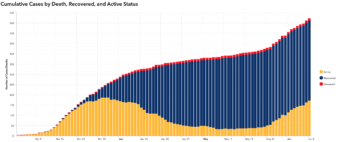
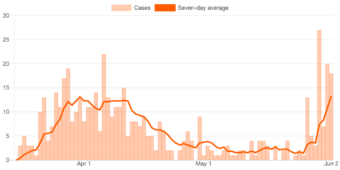
Statewide data from DHSS showing total cases by date reported, not the date disease or symptoms are estimated to have begun (Graphic by David Purdy/KTOO)

Eighteen more Alaskans have tested positive for the coronavirus, as has another nonresident seafood worker in the Anchorage area, according to the updated tallies posted Wednesday by the Alaska Department of Health and Social Services.

It’s the second day in a row of double-digit case increases for Alaska and follows the state’s highest one-day spike of cases: 27 reported Sunday. The higher case counts come in the weeks after Alaska started relaxing its coronavirus-related restrictions on businesses and gatherings.

Nearly all of the cases announced in the last week are in Alaskans from Southcentral.

The state’s daily updates on Alaska’s coronavirus cases reflect data from the day before.

Of the 18 new cases among Alaskans, five of them are from Anchorage, four are from Homer, three are from Wasilla, two are from Eagle River and there is one each from Palmer, Big Lake, Soldotna and a smaller community in the Kenai Peninsula Borough that the state has not named.

Four of the cases Wednesday are tied to the outbreak at the Providence Transitional Care Center in Anchorage. The transitional center reported a total of 25 positive cases among patients and staff by Wednesday afternoon — two more from the day before.

The Kenai Peninsula Borough also announced a cluster of cases Wednesday at the Nikiski Fire Department, prompting an entire shift to quarantine themselves.

Of those 11 people in quarantine, three have tested positive for the virus so far, said Brenda Ahlberg, a spokesperson for the borough.

“What we do know is we had an individual who got testing. I can’t speak to that individual’s motivation, why they felt like they needed to, if they had symptoms,” she said. “I don’t know that. It’s not clear. All I know is that when that individual was tested, it was positive.”

Ahlberg said how that person contracted the virus remains under investigation. It prompted the testing of the entire shift, and then the entire department, and an investigation into recent contacts.

“We know no patient transports were affected,” she said.

The 11 people will remain quarantined for two weeks. Staff from Central Emergency Services and the Kenai Fire Department will help fill in while they’re gone.

The three positive cases have already been counted in the state’s count, Ahlberg said.

The state separates its tallies of coronavirus cases into two main categories: residents and nonresidents.

So far, the state has recorded a total of 505 cases among residents, with 373 recoveries. There are 23 cases among nonresidents, 15 of them are seafood workers from out of state. A total of 58,183 tests have been conducted.

Alaska Chief Medical Officer Dr. Anne Zink reminded people in a Twitter post on Tuesday that the cases reflect what happened a week or more ago.

“We flattened the curve before Alaska – we can do it again,” the post said. “Our individual sacrifices make a collective difference.”

Ahlberg said Alaskans need to remember that the virus is here, and to continue to take precautions.

“We just need to come back to that grassroots efforts that we started in March,” she said. “If you’re not feeling good, stay home.”

This story has been updated with more information about the cases and the Kenai Peninsula Borough’s response to the outbreak at the Nikiski Fire Department.

Providence announces 6 more cases at Anchorage transitional care center; state tally grows by 21

The Providence Transitional Care Center shares a campus with Providence Extended Care in East Anchorage. On Monday, June 1, 2020, it was quiet outside of the campus with a security vehicle parked at the entrance. (Tegan Hanlon/Alaska Public Media)

The number of confirmed coronavirus cases at the Providence Transitional Care Center in Anchorage has grown by six to 23, according to an update Tuesday afternoon from its operator, Providence Health & Services Alaska.

It’s the largest reported cluster of coronavirus cases at a single facility in Alaska since the state started tracking the virus in March. The first case at the center was confirmed on Friday after a patient tested positive.

Since then, Providence has tested all of the patients and employees at the transitional center, as well as the long-term care facility it shares a campus with, Providence Extended Care, according to Providence spokesman Mikal Canfield.

“We’re still waiting for test results back from some caregivers,” Canfield said Tuesday afternoon. “Hopefully we’ll have all the test results back by tomorrow or later today.”

Meanwhile, the state’s tally of coronavirus cases in Alaska continues to spike.

The number of Alaskans diagnosed with the virus increased by 20, to 487, according to Tuesday’s update from the Alaska Department of Health and Social Services. That total includes six cases from the transitional center, five of them that Providence announced on Monday.

Of the 487 Alaskans diagnosed with the disease, 371 have recovered so far.

Also, another nonresident, seafood industry worker has tested positive for the virus in the Valdez-Cordova area, according to the state health department.

The state’s updated tally comes more than a week after Gov. Mike Dunleavy lifted capacity restrictions for businesses and allowed for larger gatherings. Later this week, Dunleavy is expected to end the state’s two-week quarantine for people traveling into Alaska and require testing instead.

The state reported its largest daily spike of coronavirus cases on Sunday, at 27.

Of the 20 new cases among Alaskans announced Tuesday, 15 are from Anchorage and five are from the Kenai Peninsula Borough. One of the new Anchorage cases is a young Alaskan who was recently admitted to the McLaughlin Youth Center, a juvenile justice facility in the city.

By the end of the day Monday, more than 56,000 tests had been administered in the state.

The state updates its count of coronavirus cases daily based on the prior day’s numbers. Meanwhile, other agencies, such as Providence Health & Services Alaska, are announcing them sooner.

Canfield said Providence will do another round of testing at its East Anchorage campus later this week.

He said all of the 23 cases are linked to the transitional care center, which has 48 patients and about 145 employees. There have been no cases yet at the extended care facility that serves about 100 residents, mostly seniors, and has about 190 employees.

The 23 cases include both patients and staff. Providence has declined to break down the number further citing privacy concerns.

Providence’s regional chief medical officer said Monday that patients who tested positive for the virus are staying in their rooms and the employees are staying home. Visitors are not allowed unless it’s an end-of-life visit.

The transitional care center is a midway point for patients moving from hospitalizations to their homes or assisted-living facilities. Its patients range in age and are often recovering from serious illness or surgeries.

Providence and other health officials are investigating how the virus got into the facility. Strict procedures have remained in place since March, including the no-guest policy, Providence says.

The coronavirus has been shown to spread in similar settings, where people live in a confined space, and the virus is particularly deadly among older people and those with underlying medical conditions.

Site notifications
Update notification options
Subscribe to notifications