
Tegan Hanlon, Alaska Public Media

6 tips from Alaska medical experts about minimizing your risk as the state reopens

Anchorage businesses are reopening after coronavirus-related restrictions shut them down for weeks. Polar Bear Gifts in downtown Anchorage welcomed customers on Friday, May, 22, 2020.(Tegan Hanlon/Alaska Public Media)

Alaska is reopening.

Gov. Mike Dunleavy has removed state restrictions for businesses, and is allowing for larger groups. Anchorage Mayor Ethan Berkowitz has also lifted local capacity limits on businesses in the state’s largest city.

Dunleavy and Berkowitz have cited a low number of coronavirus cases and increased healthcare capacity as some of the reasons to open back up.

But, even though the state has one the country’s lowest rates of infection per capita, the virus is still here and Alaskans should make plans for how to re-enter social settings based on their individual circumstances, doctors say.

There are no easy answers. And there’s no playbook. But, medical experts do have tips for what Alaskans should consider as the state reopens:

1. Think of the coronavirus as the bear in the woods  seriously.

Dr. Tom Hennessy has a very Alaska analogy to explain how people can think about the coronavirus:

“It’s like you’re taking a walk in the woods, and just because you don’t see a bear, doesn’t mean the bear isn’t there,” he said. “And the bear, in this case, is the coronavirus, and it’s out there. So we need to be aware of that and take precaution.”

Hennessy is an infectious disease epidemiologist and affiliate faculty member at the University of Alaska Anchorage.

When Alaskans go hiking, he said, they know they may run into a bear, so they prepare: Carrying bear spray or a firearm, making noise and traveling in groups. Now, Alaskans leaving their homes need to be prepared for the lurking coronavirus — which is harder to see than a bear and can spread silently.

“We are not in a risk-free environment. The virus hasn’t gone away. It’s still out there. There are still people walking among us who are infected with it and are transmitting to other people,” Hennessy said. “So it would be foolish for people to assume we could just go back to the way life was before this virus visited us… The bear is still in the woods.”

2. Age and underlying medical conditions are key considerations.

Alaskans should consider their own health risks, plus the risks of those they see often.

“We’re entering a phase where people really need to individually assess their own personal risk and the risk of others they come in close contact with,” said Dr. Michelle Rothoff, a medical epidemiologist at the state Department of Health and Social Services.

People age 65 and over are at a higher risk of developing severe illness from the coronavirus, and of dying from the disease. Those with underlying medical conditions like serious heart problems and lung disease are too.

So, if that’s you or someone you live with or see regularly, then you should be “extremely, extremely careful” about who you’re interacting with, Hennessy said.

“If that healthy person brings the infection home to their vulnerable family member, they could cause a catastrophic illness,” he said.

3. Start small. 

The basic rule is: The more different people that you’re exposed to, the higher your potential risk is, Rothoff said.

As Alaskans start to regrow their social circles, they should consider expanding slowly, she said.

“Start by maybe incorporating a few additional friends or family members outside of the immediate household that are kind of consistent,” she said.

That way, everyone also knows what precautions the others in the group are taking.

And, consider how long you’re around other people and where you are. Outdoors is generally better than indoors. There’s more air flow, Rothoff said. But, if you’re spending all evening outside in a large group, your risk rises.

4. Do your research.

Before you go to a restaurant, bar, hair salon, gym or other business, research what new protocols the owners have put in place in response to the pandemic, Hennessy said.

Look online. Or call ahead. Then, decide if you’re comfortable with the measures.

“If a business decides to take the reopening of the economy and just pack people into their restaurant or bar, without any concern for these social-distancing measures, that would be a really high-risk setting compared to a restaurant where they appropriately space the tables, where the waitstaff are wearing masks, where there’s hand-washing facilities easily available to customers,”  Hennessy said.

Hennessy said he’d feel much more comfortable going to a business following social-distancing guidelines, and where employees are wearing masks.

Other questions to consider: How long are you spending in the business? How many others will be there, and in how big of a space?

5. Masks are still a good idea.

Masks that cover your nose and mouth help keep large droplets from spraying out when you cough or sneeze or even talk loudly, said Dr. Michael Bernstein, regional chief medical officer for Providence Health and Services Alaska.

Wearing a mask is particularly important with the coronavirus because people can be very infectious while not showing symptoms, Bernstein said. While Bernstein doesn’t wear a mask when walking his dog in empty areas, he said, he does generally wear one otherwise.

“It’s not that hard,” he said. “I don’t feel like I’m, you know, being restricted terribly. I think anything I can do to help reduce that transmission, I should.”

Hennessy put it another way: “The masks that we wear in public — at the grocery store or in a crowded location — are really for us to protect other people. And so not wearing a mask is kind of a statement that you don’t really care about other people.”

6. It’s not time to let your guard down: Social distancing and handwashing are still critical.

Rothoff said she really wants to emphasize that even though businesses are opening back up, keeping a distance from others is critical so coronavirus cases don’t spike.

She pointed to a graphic that shows if Alaskans decrease their social exposure by 75%, one infected person leads to about three other infections in 30 days. If no one follows social distancing, that one infection leads to more than 400 others with the virus in the same time period.

“So social distancing is really important,” Rothoff said.

So is washing your hands, she said. And not touching your face.

The goal is to keep the number of coronavirus cases manageable, Hennessy said. With restrictions lifting, he said, it’s now up to Alaskans.

“The governor has turned it back to the people of Alaska and said, ‘It’s up to you. You’ve learned about this. We expect you to act responsibly,’” Hennessy said. “So it will be a test for all of us to see if we just throw caution to the wind… or if Alaskans will take the measures they’ve learned and continue to apply them.”

In the time of social distancing, Alaska holds its first online oil and gas lease sale

Cook Inlet oil platforms are visible from shore near Kenai, Alaska. (Photo by Rashah McChesney/Alaska’s Energy Desk)

The Alaska Department of Natural Resources announced Thursday that it’s holding its first ever online auction of oil and gas leases.

It’s a new way of doing business for the department in the time of social distancing. Since the state started lease sales in the 1960s, DNR said, it has relied on in-person auctions and sealed bids. Now, the department has hired a Texas-based company called EnergyNet Services to use its internet platform.

In a statement, DNR Commissioner Corri Feige said the online sale allows the state to offer the leases to broader markets. Also, she said, the department is working to find new ways to operate more safely and efficiently due to concerns about the coronavirus.

DNR’s plan to move to online bidding started before the pandemic, said department spokesman Dan Saddler. But, he said, the health-care emergency has underscored another advantage of the transition. Saddler said the department plans to continue with the online process in the future.

“Our new relationship with EnergyNet will bring our leasing program into the 21st century, while making our outstanding hydrocarbon opportunities more visible and attractive in a global marketplace,” Feige said.

The inaugural online auction closes June 11. As part of the annual Cook Inlet and Alaska Peninsula lease sales, the state is offering 1,729 tracts of land that cover nearly 8 million acres, an area about the size of Maryland.

Those interested in the leases can register online, select tracts from interactive maps and submit their bids, according to DNR. Then, they receive online invoices.

Mat-Su school board rescinds vote to remove ‘Catch-22’ and 4 other books from English classes

Three of the five books the Mat-Su School Board had voted to remove from a reading list for high school English electives. (Tegan Hanlon/Alaska Public Media)

The school board of the Matanuska-Susitna Borough School District rescinded its vote to remove “Catch-22,” “The Great Gatsby” and three other novels from the reading list for high school English electives following widespread backlash.

But, that doesn’t mean the books — deemed “controversial” — are back on the reading list for the upper-level classes. Instead, the board voted on Wednesday to punt the decision on the reading list and course outline until May 2021 after two hours of, at times, heated debate and a protest outside of district headquarters in Palmer.

Some school board members, including Richard “Ole” Larson, argued that the books were inappropriate for a high school classroom because of graphic content that could upset students. While board member Sarah Welton said educators are trained to teach that material.

“When children read a story of another child who has gone through something similar, they don’t feel like they were the ones at fault, they learn,” she said, “especially when you have teachers who have been given instruction.”

Along with “Catch-22” and “The Great Gatsby,” the school board had originally plucked from the reading list “Invisible Man,” “I Know Why the Caged Bird Sings” and “The Things They Carried.” The board also had removed The New York Times’ section, “The Learning Network,” from writing classes.

The removals sparked outrage, captured national headlines and prompted the Alaska-rooted band Portugal. The Man to offer to send the books to any student in the district who wanted to read them. At the board’s prior meeting in May, more than 50 people testified about the removal of the books, nearly all pushing the board to rescind its vote.

Students and community members gathered outside of the Matanuska-Susitna Borough School District’s headquarters on Wednesday, May 20, 2020, to protest recent school board decisions, including its removal of five books from an English class reading list. (Photo courtesy Denile Ault)

Ultimately, the board did just that — voting 6-1 to throw out its earlier vote. Board member Ryan Ponder cast the only no vote. He criticized reporters and others for describing the removal of the books as a “ban,” and said the novels are still in the library. He raised concerns that some parents feel ignored if they try to object to a book on a class reading lists.

“I believe that there is a process that needs to be put in place,” he said. “There’s definitely some things that need to be looked at.”

Board members were also critical of the content of the books.

Board member Jim Hart told parents tuning into the meeting that they may want to have their young children stop listening. He paused, and then began reading an excerpt of Maya Angelou’s “I Know Why the Caged Bird Sings” where she describes rape.

“I wanted to read that for the record so people could know what we’re talking about,” Hart said. “And, specifically, what we’re talking about has nothing to do with race… We’re talking about propriety for sexual content in front of minors. We have other literature available. I think we can use it.”

A furious Mat-Su Superintendent Monica Goyette jumped in: “I am deeply offended. That is not sexual content. That is rape of a child. A teacher would have prefaced that section.”

A teacher would also teach the entire book, and discuss it, she said.

“I read the text as it came in the book, and I read it heartfelt, ma’am,” Hart responded. “And I also said it was tragic. I did. This is a question of propriety.”

Board president Thomas Bergey led the charge to rescind the prior vote based on concerns about policy. He said the district needed time to improve its systems for involving parents in decisions on controversial materials, and aligning those policies with state law.

“Those need to be corrected before we can even move on,” he said.

The Mat-Su book controversy stems from 2019, when the board requested that the district administration create course outlines and reading lists for the ongoing English electives. A team including teachers and librarians created the reading list, with input from the public. It flagged the five books as controversial, and the board requested more information about them in early April. A district document summarizes the challenges with the books and the rationale to still teach them.

Then, in late April, the board voted to cut the books from the list. Some teachers and communities members said they were blindsided.

The district will now revisit the reading list and curriculum — largely starting the process over. In the meantime, elective courses will continue as they normally have, without the board-approved reading list.

After Wednesday’s vote, Portugal. The Man declared “victory for all of humanity” in a Twitter post. There’s still a long way to go, the band said.


But, Dianne Shibe, the president of the local teacher union, felt less cheery. She doesn’t support the board pushing off its final decision on the reading list.

Shibe also criticized the board for a lack of transparency on the initial book removal, and other district issues. She underscored that a committee has already reviewed and approved the reading list.

“I look at it as political,” she said of the board’s decision. “This all feels very political to me, and that’s not appropriate for a school board.”

More oil can flow from Alaska’s North Slope as global demand creeps back

An above-ground section of the Trans-Alaska Pipeline System near the Toolik Lake Research Station in the North Slope Borough. (Photo by Rashah McChesney/Alaska's Energy Desk)
An above-ground section of the Trans-Alaska Pipeline System near the Toolik Field Station in the North Slope Borough. (Photo by Rashah McChesney/Alaska’s Energy Desk)

The operator of the trans-Alaska pipeline is allowing oil companies to send more crude from the North Slope to Valdez as demand creeps back and economies reopen.

Alyeska Pipeline Service Co. had previously imposed a 15% cut to North Slope production as the coronavirus hammered demand for oil and that, paired with an international oil price war, led to a glut of oil on the market. On Friday, Alyeska trimmed the reduction to 5%, or roughly 25,000 barrels of crude a day spread across all fields.

“It is a big deal to be able to adjust a proration and get back to business, where every barrel that producers intend to move, we can move,” said Michelle Egan, a spokeswoman for Alyeska. “That’s what we’re here for.”

In late April, Alyeska had cut oil flow by 10% to avert a storage crunch in Valdez, the town where tankers pick up the crude and deliver it to West Coast refineries. It raised that to the 15% cut on May 8.

Now, oil prices are crawling back after taking a historic plunge into the negatives last month. That’s as global demand for oil begins to return, the oil price war ends and companies shut down wells.

Larry Persily, who has long tracked oil and gas markets, described the reduced cut from Alyeska as “the first sliver of good news for Alaska North Slope oil producers.” It indicates there’s a place for the crude to go after it’s pumped from the oil fields at the top of Alaska, he said.

“It’s more of an indication that there’s capacity on the West Coast, at the refineries, and in storage,” he said. “So they’re going to up production because there’s a place to put it. There’s someone who wants it. And prices are higher.”

But, Persily said, there’s still a backlog of bad news for Alaska’s oil industry: Oil producers have recently slashed spending and reduced drilling. Oil field service companies have laid off hundreds of workers. The state’s largest oil producer, ConocoPhillips, also still plans to cut its oil production in half in Alaska for the month of June.

“The decision to curtail production by 100,000 barrels a day in June has been made, and that won’t change,” Conoco Alaska spokeswoman Natalie Lowman wrote in an email.

Alyeska operates the pipeline on behalf of its owners: Conoco, BP and ExxonMobil.

Alyeska reported 450,299 barrels of North Slope crude flowing down the pipeline on Monday. The value of a barrel reached almost $30 by last week — a significant climb from a low of -$2.68 on April 20. It’s still far below the $70 value from early January.

Egan said there’s no timeline for when Alyeska will remove the 5% cut. She said that’s the ultimate goal.

“We’ll make every effort to get back to 100%,” she said. “That’s absolutely where we want to be.”

These Alaska couples aren’t letting coronavirus get in the way of their vows

Grace Graham’s bridal bouquet for her upcoming wedding that was transformed by the coronavirus. (Matthew Faubion/Alaska Public Media)

Across Alaska — and the world — the coronavirus pandemic is canceling big celebrations, weddings included. But many couples are still making it work anyway — rushing to the courthouse for last-minute paperwork, trying on wedding dresses by Zoom and moving their first dance from ballrooms to living rooms.
Meet three couples who aren’t letting the coronavirus stop them from saying their vows in Alaska.

‘One thing we knew is we’re going to get married’

When Kendra Kennedy’s dad warned her in early February that the coronavirus — then a new disease that had taken hold in China — could disrupt her wedding in Alaska on March 21, she thought: No way.

Kendra Kennedy and George Faber got married in Girdwood on March 21, 2020, a day before Anchorage went into its “hunker down.” (Photo by AnW Studios, LLC)

“I just had no concept that things would just move so fast and change so dramatically,” Kendra said.

But then, the coronavirus spread across the globe. And Kendra and George Faber, her then-fiancé, now-husband, watched and worried. They live in Los Angeles. But Kendra is from Anchorage. And, for about a year, they had pieced together their plans to marry in Girdwood.

They flew to Alaska about a week before the wedding.

“Each day we would wake up to a new reality about a different state or a different country that has since been locked down,” George said.

“Two weeks before our wedding, we had 110 confirmed guests,” Kendra said. “And, and over the course of eight days, it went down to 12.”

“It was really quite heartbreaking,” George said.

The guest list shrunk to just Kendra’s family and a couple family friends.

Kendra Kennedy created a graph for the couple’s memory book. A plummeting blue line shows their number of wedding guests, and a rising red line is the increasing number of coronavirus cases in the United States. (Image courtesy of Kendra Kennedy.)

But, George and Kendra said, they knew — through all of the fast-paced decisions and hectic cancellations — that they would get married, somehow, on March 21. It would have felt too deflating not to, Kendra said. And, marriage is more than just one day, George added.

“No matter how bad things got, no matter how stressful things became, no matter how many people canceled, the one thing we knew is we’re going to get married,” he said. “We’re not going to let this define, you know, what our marriage is. This is simply one of the first hurdles that we were dealing with as a married couple.”

So they adapted. Kendra’s sister went to the courthouse days before the wedding to fill out paperwork so she could marry them — to substitute for the friend who couldn’t fly in. They live-streamed their wedding on Facebook, from a church in Girdwood, with just a few people in the pews.

Instead of a reception at Hotel Alyeska, they went back to a rental house. They had their first dance to Louis Armstrong’s “What A Wonderful World” played from a cell phone plugged into a speaker system.

“We had practiced that dance for months,” George said, and they both laughed.

They listened to George’s dad’s pre-recorded speech. And their friends, from across the country, sent video messages congratulating them.

“We truly were able to celebrate with everyone,” Kendra said. “But just on a much different platform than we ever imagined.”

The next day, Anchorage started hunkering down.

‘Ironically, this is kind of becoming the wedding we had initially wanted’

Grace Graham and Gus O’Malley got engaged in November 2018, and imagined they’d eventually elope. But then, they told Grace’s mom. And she didn’t love that plan.

“Her response was, ‘Well, that would be selfish,’” Grace said, trailing off into laughter. “And so we took that to mean: Okay, wedding it is!”

So, in December 2018, the couple sketched out a plan to marry on May 30, 2020 at the Crow Creek Gold Mine in Girdwood, the town where Gus grew up and where his parents still live. They invited about 150 people. They shoehorned their wedding date between plans for an early honeymoon — a ski race in Norway and backpacking in Spain — and a move from Anchorage in early June to wherever Gus got placed for his medical residency.

Grace Graham and Gus O’Malley at the home in Anchorage’s Airport Heights neighborhood on May, 8, 2020. The pandemic forced the couple to redo their wedding plans. (Matthew Faubion/Alaska Public Media)

“So just like all the big life events that we could have possibly stacked together,” Grace said. “And, that didn’t go according to plan.”

First, the coronavirus erased the ski race, and their trip. Then, more and more states started shutting down businesses, and asking people to stay home. With so many things canceled, Grace and Gus said, they hoped they could somehow salvage their wedding celebration.

“For a couple that wanted to elope initially, we were incredibly reluctant to cancel,” Gus said.

But then they thought more about what a party might look like during a pandemic.

“None of the parts of a wedding that we would be excited about would have been able to happen, like you can’t share big hugs and dancing and crowding together,” Gus said. “We realized, this is just not gonna be worth it, which was really, surprisingly, very disappointing.”

In April, the couple decided to cancel their larger celebration and started planning for a small ceremony — while also hunkering down in their Airport Heights home and renovating their bathroom.

“The fact that we’ve been stuck in the house together for the last six weeks and still really like each other, that’s probably a good sign that we still actually want to spend our lives together,” Gus quipped.

As for the new location of their wedding? That’s still up in the air. Maybe they’ll get married on the porch at Gus’s parents’ house in Girdwood. Or, maybe, they’ll say their vows in a park.

“Ironically, this is kind of becoming the wedding we had initially wanted, just something very low-key and smaller,” Gus said.

“It’s come full circle in a lot of ways,” Grace said.

‘We’ll figure this out and it’ll be okay’

Maggie Ryan stood in a floor-length white dress in her Anchorage kitchen last month. It was one of several dresses she had ordered online. She twirled in front of her laptop, as friends watched by Zoom and commented on the intricacies of the lace. Her fiancé, Chuck Herman, adjusted the bottom of the dress, so it cascaded across the floor. He did the same for another Zoom meeting with Maggie’s family.

“I think I am one of the first grooms in history to be a wedding dress shop assistant,” Chuck said, and laughed. “Which involves me crawling around on the floor with my eyes closed.”

It was bittersweet, Maggie said.

Maggie Ryan and Chuck Herman had a planned for a big wedding in Talkeetna in July 2020. But then came the coronavirus. Now, they’ll have a much smaller ceremony near McCarthy. (Matthew Faubion/Alaska Public Media)

“It was fun to be able to do that and kind of expand how many people you could go shopping with,” she said. “But it was also one of the periods where I was really sad, just because none of the dresses that I tried on are going to compare to the dress that I had dreamed of.”

Maggie didn’t plan to order a wedding dress online. For months, her mom was sewing her a dress in Virginia, in preparation for the couple’s wedding, which was supposed to happen in July in Talkeetna. But, as the coronavirus settled over the country, plans changed.

“Everything was so crazy around us. Everything was so crazy at work,” said Maggie, who is a nurse in Anchorage. “This just seemed like, “Okay, well, we’ll figure this out and it’ll be okay.’”

A bachelorette party in Lake Tahoe became a party by video chat. And the wedding split in two: This June, they’ll have a tiny ceremony at Root Glacier near McCarthy, where they got engaged. A friend will marry them, and another will wear a GoPro to record the ceremony for family in the absence of cellphone service.

Maggie said it’ll be tough not to have her parents there, walking her down the aisle — if there even is an aisle. But, she said, “so much has changed in the past few months, and we still really just wanted to be able to get married and move forward as husband and wife.”

Next year, hopefully, they’ll have a big celebration — a belated wedding reception and first anniversary, Maggie said.

“It’ll just be an excuse to party about everything that’s been overcome.”

Summer camp directors prepare to welcome Alaska’s campers during the pandemic

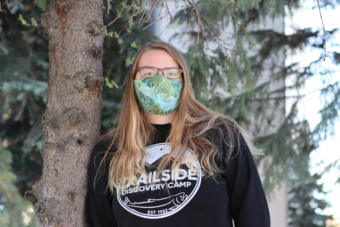
Vicki Long-Leather is the director at the Trailside Discovery Camp, a popular outdoor summer program with sites in Anchorage and Palmer. The kids’ camps are adapting to the new social-distancing reality. (Tegan Hanlon/Alaska Public Media)

Trailside Discovery Camp director Vicki Long-Leather always has a lengthy list of supplies to order for her summer programs in Anchorage and Palmer. But, this year, there’s even more to buy, including more hand sanitizer, thermometers, disinfectant wipes, face masks and art supplies.

“Every camper is going to have to have their own individual Ziploc full of glue sticks and scissors and markers, crayons, paints,” Long-Leather said.

That’s because, at summer day camp during the coronavirus, there won’t be any sharing or high-fives or trading snacks or even sitting close together.

“We’re basically taking a few weeks to completely change something that we’ve been planning for the whole year,” Long-Leather said.

Right now, Long-Leather is among camp directors across Alaska who are redoing their summer programs to prepare to welcome campers during the pandemic. As businesses reopen and more people are called back to their workplaces, some parents are anxiously waiting to find out their camps’ plans.

“I do not have care if summer camps or schools don’t go,” said Erica Jensen, an Anchorage mom who depends on summer camp for her 9-year-old son Orion.

This winter, she registered Orion for Trailside programs for the entire summer. Then, came the coronavirus and classroom closures. Her child-care concerns began.

“It’s been on my mind since March when all this happened,” she said. “And I’ve been trying to take it one month at a time like, ‘Okay, I know I’m set through the end of May. Alright, what am I doing in June?’”

This week, Jensen got confirmation that Orion can attend Trailside starting in late May, just a few days after the end of the school year. It’s a huge relief, she said.

But that won’t be the case for everyone. Overall, there will be fewer camp spots for Alaska’s children this summer, in a state already strapped for child care.

Programs are wrestling with new state requirements and the money needed to implement them, said Thomas Azzarella, director of the Alaska Afterschool Network.

The state is requiring day camps to limit groups to no more than 10 campers. Staff must use cloth face coverings, and older children are encouraged to wear them too. Everyone also needs to go through daily health screenings. Field trips involving other groups are not allowed. There’s a list of other rules.

Since early April, Camp Fire Alaska has offered emergency child-care programs to healthcare workers and first responders. Supplies are sorted into individual bags for each child to limit the spread germs. It plans to follow similar procedures at its summer camps. (Photo courtesy Camp Fire Alaska)

The state also continues to discuss when and how overnight camps can open, according to a spokesman with the Alaska Department of Health and Social Services.

But already, some programs have called off their camps, like the Sitka Fine Arts Camp. Camps at the Anchorage School District where students learn Chinese or Spanish were canceled. Others programs will reduce the number of children served. And some are moving from in-person camps to virtual ones, like the Girl Scouts of Alaska and the Anchorage Museum.

“This was a way that we could provide something consistent for the entire summer,” said Hollis Mickey, the museum’s chief learning and access officer.

Others, like Trailside, are adapting their in-person programs. Azzarella said his organization is helping camps navigate the new social-distancing reality.

“We recognize summer camps are a critical part of getting our state economy open,” he said. “So it’s something that we are really, again, assessing and determining what are those best practices to ensure programs can open and do so safely and effectively.”

Long-Leather said since Trailside is based outdoors, it’s easier to keep campers farther apart. The popular program usually serves about 250 children each day. This summer, Long-Leather hopes to maintain the capacity, but spread campers across more locations.

Also, to help develop new guidelines, Long-Leather formed a parent advisory group and hired a consultant. They created a 54-page coronavirus handbook that includes a six-step response plan if a camper or employee tests positive for the disease.

“This isn’t just camp opening up and trying to make it work,” Long-Leather said. “This is camp opening with consultant backing.”

Camp Fire Alaska, the state’s largest child care provider, plans to hold its day camps in Anchorage and Eagle River this summer, said chief program officer Melanie Hooper.

But it has called off its overnight camps for June and July, and will “continue to explore options for later in the summer,” Hooper said.

It has also canceled its in-person camps in rural Alaska, and won’t fly staff to remote communities because of concerns about spreading the virus. Instead, it will provide activity kits for children, families and elders, with an emphasis on delivering certain items including food, Hooper said.

Camp Fire isn’t new to caring for children during the coronavirus. Since early April, it has offered emergency child care to kids of health-care workers and first responders.

Hooper said camps opening this summer should prepare for everything to take more time, from pre-packaging snacks to keeping up with health guidelines.

“They can’t underestimate the amount of time and man hours it’s going to take to just stay on top of that health guidance and know that you’re going to be changing that sometimes weekly or daily,” she said.

Hooper said it’s important for parents to assess and manage the risk for their own family when deciding whether to send their children to camp this year, and know: “It’s not if there’s a COVID exposure at some point in the future for any camp or school or program, it’s when.” And camps are focused on mitigating that risk, she said.

At their child-care sites currently operating, Camp Fire has put tape on the floor so children know how far apart they should stay. They’ve removed stuffed animals, puppets, bean bag chairs and other items that are harder to clean. To play tag, children are using pool noodles instead of their hands, Hooper said.

“When I’m putting together our summer supply lists, we’re like, ‘Okay, well, certain board games don’t work well for physical distancing, and not sharing supplies,’ but the ones that have become very wildly popular are Battleship from afar, and Guess Who,” Hooper said.

As programs cancel and more Alaskans return to work, Dan Dillehay, who runs a smaller outdoors camp with his wife in Anchorage called Into the Woods, said he’s receiving more and more calls.

“Our phones have been ringing nonstop with parents asking about camps,” Dillehay said. “Parents are kind of scrambling to find care.”

Dillehay said they’re brainstorming socially-distant activities for the summer. They already do a lot of hiking, he said, so he plans to use a rope with knots tied at least six feet apart for campers to hold onto, to keep them spread out.

“We’ll encourage games like rather than tag where you touch another kid, you play some shadow tag, and tag their shadow,” he said.

But before there’s any playing, all children will have their temperatures checked.

Azzarella, from the Alaska Afterschool Network, encouraged families considering camp to send their children to the same program over several weeks instead of hopping between different sites to limit the spread of germs.

Site notifications
Update notification options
Subscribe to notifications